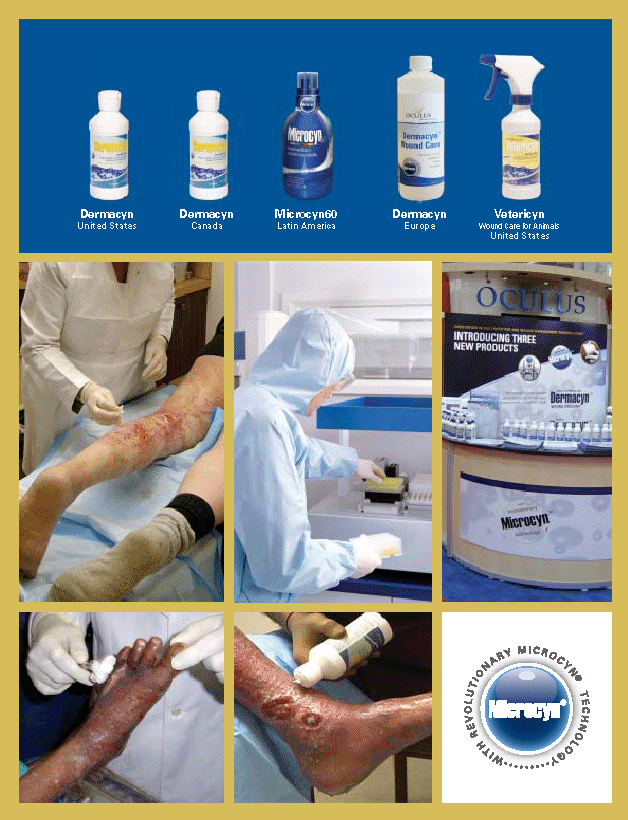
As filed with the Securities and Exchange Commission on
December 20, 2006
Registration
No. 333-135584
UNITED STATES SECURITIES AND
EXCHANGE COMMISSION
Washington, D.C.
20549
AMENDMENT NO. 5
TO
Form S-1
REGISTRATION
STATEMENT
UNDER
THE SECURITIES ACT OF
1933
OCULUS INNOVATIVE SCIENCES,
INC.
(Exact
name of registrant as specified in its charter)
| |
|
|
|
|
Delaware
(State
or other jurisdiction of
incorporation or organization)
|
|
3841
(Primary
Standard Industrial
Classification Code Number)
|
|
68-0423298
(I.R.S.
Employer
Identification No.)
|
1129 N. McDowell
Blvd.
Petaluma, CA 94954
(707) 782-0792
(Address,
including zip code, and telephone number, including area code,
of registrant’s principal executive offices)
Hojabr Alimi
Chief Executive Officer and
President
1129 N. McDowell
Blvd.
Petaluma, CA 94954
(707) 782-0792
(Name,
address, including zip code, and telephone number, including
area code, of agent for service)
Copies to:
| |
|
|
Sylvia K. Burks, Esq.
Gabriella A. Lombardi, Esq.
Pillsbury Winthrop Shaw Pittman LLP
2475 Hanover Street
Palo Alto, CA
94304-1114
(650) 233-4500
(650) 233-4545
facsimile
|
|
Robert C. Funsten, Esq.
Marc G. Alcser, Esq.
Stradling Yocca Carlson & Rauth
660 Newport Center Drive, Suite 1600
Newport Beach, CA
92660-6422
(949) 725-4000
(949)
725-4100
facsimile
|
Approximate date of commencement of proposed sale to the
public: As soon as practicable after the
effective date of this Registration Statement.
If any of the securities being registered on this Form are to be
offered on a delayed or continuous basis pursuant to
Rule 415 under the Securities Act of 1933, check the
following box. o
If this Form is filed to register additional securities for an
offering pursuant to Rule 462(b) under the Securities Act,
please check the following box and list the Securities Act
registration statement number of the earlier effective
registration statement for the same
offering. o
If this Form is a post-effective amendment filed pursuant to
Rule 462(c) under the Securities Act, check the following
box and list the Securities Act registration statement number of
the earlier effective registration statement for the same
offering. o
If this Form is a post-effective amendment filed pursuant to
Rule 462(d) under the Securities Act, check the following
box and list the Securities Act registration statement number of
the earlier effective registration statement for the same
offering. o
The Registrant hereby amends this Registration Statement on
such date or dates as may be necessary to delay its effective
date until the Registrant shall file a further amendment which
specifically states that this Registration Statement shall
thereafter become effective in accordance with Section 8(a)
of the Securities Act of 1933 or until the Registration
Statement shall become effective on such date as the Commission,
acting pursuant to said Section 8(a), may determine.
The
information in this prospectus is not complete and may be
changed. We may not sell these securities until the registration
statement filed with the Securities and Exchange Commission is
effective. This prospectus is not an offer to sell these
securities and we are not soliciting any offer to buy these
securities in any jurisdiction where the offer or sale is not
permitted.
|
SUBJECT TO COMPLETION, DATED DECEMBER 20, 2006
PRELIMINARY
PROSPECTUS
3,076,923 Shares
Oculus
Innovative Sciences, Inc.
Common
Stock
We are offering 3,076,923 shares of our common stock. This
is our initial public offering, and no public market currently
exists for our shares. We anticipate that the initial public
offering price will be between $12.00 and $14.00 per share.
Our common stock has been approved for quotation on the Nasdaq
Global Market under the symbol “OCLS.”
Investing in our common stock involves a high degree of risk.
Before buying any shares, you should carefully consider the risk
factors described in “Risk Factors” beginning on
page 9 of this prospectus.
| |
|
|
|
|
|
|
|
|
|
|
|
Per Share
|
|
|
Total
|
|
|
|
|
Public offering price
|
|
$
|
|
|
|
$
|
|
|
|
Underwriting discount
|
|
$
|
|
|
|
$
|
|
|
|
Proceeds, before expenses, to
Oculus Innovative Sciences, Inc.
|
|
$
|
|
|
|
$
|
|
|
The underwriters may also purchase up to an additional
461,538 shares from us at the public offering price, less
the underwriting discount, within 30 days after the date of
this prospectus to cover over-allotments. The underwriters will
have the right to purchase from us, at a nominal price, warrants
to purchase up to 7% of the total number of shares sold in this
offering.
Neither the Securities and Exchange Commission nor any state
securities commission has approved or disapproved these
securities or determined if this prospectus is truthful or
complete. Any representation to the contrary is a criminal
offense.
The underwriters expect to deliver the shares on or
about ,
2006.
ROTH
CAPITAL PARTNERS
|
|
| MAXIM
GROUP LLC |
BROOKSTREET
SECURITIES CORPORATION |
The date of this
prospectus
is ,
2006
TABLE OF
CONTENTS
You should rely only on the information contained in this
prospectus. We have not, and the underwriters have not,
authorized anyone to provide you with different information. We
are not making an offer to sell these securities in any
jurisdiction where the offer is not permitted. You should not
assume that the information contained in this prospectus is
accurate as of any date other than the respective dates as of
which the information is given.
PROSPECTUS
SUMMARY
Before you decide whether to invest in our common stock, you
should carefully read this entire prospectus, including
“Risk Factors” and the consolidated financial
statements and related notes. In this prospectus,
“we,” “us,” “our” and
“Oculus” refer to Oculus Innovative Sciences, Inc. and
its consolidated subsidiaries unless the context requires
otherwise.
Oculus
Innovative Sciences, Inc.
We have developed, and manufacture and market, a family of
products intended to help prevent and treat infections in
chronic and acute wounds. Infection is a serious potential
complication in both chronic and acute wounds, and controlling
infection is a critical step in wound healing. Our platform
technology, called Microcyn, is an electrically charged, or
super-oxidized, water-based solution that is designed to treat a
wide range of organisms that cause disease, or pathogens,
including viruses, fungi, spores and antibiotic resistant
strains of bacteria, such as Methicillin-resistant
Staphylococcus aureus, or MRSA, and Vancomycin-resistant
Enterococcus, or VRE, in wounds.
Microcyn has received CE Mark, or European Union certification,
for wound cleaning and reduction of microbial load, three
U.S. Food and Drug Administration, or FDA, 510(k)
clearances as a medical device in wound cleaning, or
debridement, lubricating, moistening and dressing. Microcyn has
also been granted approvals for use as an antiseptic,
disinfectant and sterilant in Mexico, approval for use in
cleaning and debriding in wound management in India and approval
for moistening, irrigating, cleansing and debriding skin lesions
in Canada. In addition, our 510(k) product label states that our
510(k) product is non-irritating and non-sensitizing to skin and
eyes and no special handling precautions are required. We do not
have the necessary regulatory approvals to market Microcyn in
the United States as a drug, nor do we have the necessary
regulatory clearance or approval to market Microcyn in the U.S.
as a medical device for a wound healing indication.
We believe Microcyn provides significant advantages over current
methods of care in the treatment of a wide range of chronic and
acute wounds throughout all stages of treatment. We believe that
Microcyn is the first topical product that is effective against
a broad range of bacteria and other infectious microbes,
including antibiotic resistant strains, such as MRSA and VRE,
without causing irritation of healthy tissue. Unlike most
antibiotics, we believe Microcyn does not target specific
strains of bacteria, a practice which has been shown to promote
the development of resistant bacteria. In addition, our products
are shelf stable, require no special preparation, and are easy
to use.
Clinical testing we conducted in connection with our 510(k)
submissions to the FDA, as well as physician clinical studies,
suggest that our 510(k) product may help reduce a wide range of
pathogens in acute and chronic wounds. These physician clinical
studies suggest that our 510(k) product is easy to use and
complementary to most existing treatment methods in wound care.
Physician clinical studies in the United States also suggest
that our 510(k) Microcyn product may shorten hospital stays,
lower aggregate patient care costs and, in certain cases, reduce
the need for system-wide, or systemic, antibiotics. Physicians
in several countries have also conducted studies in which
Microcyn was used to treat infection in a variety of wounds,
including
hard-to-treat
wounds such as diabetic ulcers and burns, and, in some cases,
reduced the need for systemic antibiotics. The clinical testing
and the physician studies described above were not intended to
be rigorously designed or controlled clinical trials and, as
such, did not have all of the controls required for clinical
trials used to support a new drug application to the FDA.
In July 2006, we completed a controlled clinical trial for
pre-operative skin preparation. After completion of this trial,
the FDA advised us that it is considering adopting new
heightened performance requirements for evaluating efficacy of
products designed to be used in pre-operative skin preparation
such as ours. In discussions with the FDA, the FDA has not
provided us with the definitive timing for, or parameters of,
any such new requirements, and has informally stated that it is
uncertain during what time frame it will be able to do so. We
plan to continue our discussions with the FDA regarding the
possible timing and parameters of any new guidelines for
evaluating efficacy for pre-operative skin preparations.
Depending on the ultimate position of the FDA regarding
performance criteria for pre-operative skin preparations, we may
reassess our priorities,
1
clinical timelines and schedules for pursuing a pre-operative
skin preparation indication or may decide not to pursue this
indication.
We intend to conduct a pilot study in early 2007 to evaluate the
effectiveness of Microcyn in patients with infections in open
wounds. Following completion of the pilot study, we intend to
establish a protocol for a Phase IIb clinical trial in a
similar patient population, which we intend to begin in mid to
late 2007. We anticipate this trial to last approximately
12 months.
We are also conducting laboratory and animal testing to assess
potential applications for Microcyn in several other markets,
including respiratory, dermatology, dental and veterinary
markets. FDA or other governmental approval may be required for
any potential new products or new indications.
We own one issued U.S. patent, 12 pending U.S. patent
applications and 18 foreign pending patent applications relating
to super-oxidized water, methods of using super-oxidized
water-based solution, and aspects of the method and apparatus
for manufacturing super-oxidized water.
We began selling our Microcyn-based product in July 2004 in
Mexico, where we sell through a dedicated contract sales force,
and in October 2004 in Europe, where we have a direct sales
force and exclusive distribution agreements with distributors
which we believe are experienced in supplying the wound care
market. We began selling our products in the United States in
June 2005 and have established a network of one national and
five regional distributors, who are supported by our commercial
team and clinical support staff. We began selling our product in
India in July 2006 through a national distributor, and in
Canada, we have entered into a distribution agreement under
which distribution is expected to commence by late 2007.
The following is a list of the regulatory approvals and
clearances that Microcyn-based products have received for our
most significant or potentially significant markets:
| |
|
|
|
|
|
|
|
Region
|
|
Approval or Clearance
Type
|
|
Year of Approval or
Clearance
|
|
Summary Indication
|
|
|
|
United States
|
|
510(k)
|
|
2005
|
|
Moistening and lubricating
absorbent wound dressings for traumatic wounds.
|
|
|
|
510(k)
|
|
2005
|
|
Moistening and debriding acute and
chronic dermal lesions.
|
|
|
|
510(k)
|
|
2006
|
|
Moistening absorbent wound
dressings and cleaning minor cuts.
|
|
European Union
|
|
CE Mark
|
|
2004
|
|
Debriding, irrigating and
moistening acute and chronic wounds in comprehensive wound
treatment by reducing microbial load and creating moist
environment.
|
|
Mexico
|
|
Product Registration
|
|
2003
|
|
Antiseptic disinfection solution
for high level disinfection of medical instruments, and/or
equipment and clean-rooms, areas of medical instruments,
equipment and clean room areas.
|
|
|
|
Product Registration
|
|
2004
|
|
Antiseptic treatment of wounds and
infected areas.
|
2
| |
|
|
|
|
|
|
|
Region
|
|
Approval or Clearance
Type
|
|
Year of Approval or
Clearance
|
|
Summary Indication
|
|
|
|
Canada
|
|
Class II Medical Device
|
|
2004
|
|
Moistening, irrigating, cleansing
and debriding acute and chronic dermal lesions, diabetic ulcers
and post-surgical wounds.
|
|
India(1)
|
|
Drug License
|
|
2006
|
|
Cleaning and debriding in wound
management.
|
(1) Drug license held by Indian distributor as required by
Indian law.
If we successfully complete additional clinical studies and
receive the necessary FDA regulatory approvals, we plan to
market Microcyn in the United States as a drug.
Market
Opportunity
According to Medtech Insight, a Division of Windhover
Information, there were over 90 million incidents of wounds
in the United States during 2004. Of these, over 6 million
were chronic wounds, including arterial, diabetic, pressure and
venous ulcers. The remaining 84 million incidents were
acute wounds, which follow the normal process of healing and
commonly include burns, traumatic wounds and approximately
67 million surgical incisions. Key trends in wound care
include a large and increasing at-risk population, primarily of
elderly, diabetic and obese people, increased emphasis on
controlling the cost of patient care, technological product and
treatment innovation, increased focus on improving the patient
experience and advancements in combination treatment methods.
When infection is present in a wound, standard treatments
include cleansing, debridement and systemic antibiotics.
Although there are a number of topical antiseptics and
antibiotics currently used to treat acute and chronic wounds,
their overall effectiveness is limited. For example:
|
|
|
| |
•
|
many antiseptics, including Betadine, hydrogen peroxide and
Dakin’s solution, are toxic, can destroy human cells and
tissue, may cause allergic reactions and can impede the wound
healing process;
|
| |
| |
•
|
silver-based products are expensive and require precise dosage
and close monitoring by trained medical staff to minimize the
potential for allergic reactions and bacterial
resistance; and
|
| |
| |
•
|
the increase in antibiotic resistant bacterial strains, such as
MRSA and VRE, have compromised the efficacy of some widely used
topical antibiotics, including Neosporin and Bacitracin.
|
Our
Solution
We believe our products have the following key features:
|
|
|
| |
•
|
Wound Care Solution. Our 510(k) product
is cleared for sale in the United States as a medical device in
wound cleaning, or debridement, lubricating, moistening and
dressing. Although we do not have the necessary regulatory
approvals to market Microcyn in the United States as a drug,
laboratory testing and physician clinical studies further
suggest that our 510(k) product may help reduce a wide range of
bacteria that cause infection in a variety of acute and chronic
wounds. In addition, because of its mechanism of action, we
believe that Microcyn does not target specific strains of
bacteria, the practice of which has been shown to promote the
development of resistant bacteria. In physician clinical studies
involving our 510(k) Microcyn product, Microcyn was used both
independent of and in conjunction with other wound care
therapeutic products, data supported that patients generally
experienced less pain, improved mobility and physical activity
levels and better quality of life.
|
|
|
|
| |
•
|
Non-irritating. Our 510(k) product
label states that our 510(k) product is non-irritating and
non-sensitizing to the skin and eyes. Throughout all our
clinical trials and physician clinical studies to date and
|
3
|
|
|
| |
|
since our initial commercialization of Microcyn in Mexico in
2004, we have received no reports of serious adverse events
related to the use of Microcyn products.
|
|
|
|
| |
•
|
Ease of Use. Our 510(k) product label
states that our 510(k) product requires no special handling
precautions. Our products require no preparation before use or
at time of disposal, and caregivers can use our products without
significant training. In addition, Microcyn can be stored at
room temperature. Unlike other super-oxidized water solutions,
which are typically stable for not more than 48 hours, our
laboratory tests show that Microcyn has a shelf life ranging
from one to two years, depending on the size and type of
packaging. Our products are also designed to be complementary to
most advanced technologies used to treat serious wounds, such as
negative pressure wound therapy, jet lavage and
tissue-engineered skin substitutes.
|
|
|
|
| |
•
|
Cost Effectiveness. The treatment of
many wounds requires extended hospitalization and care,
including the use of expensive systemic antibiotics. Infection
prolongs the healing time and necessitates increased use of
systemic antibiotics. We believe Microcyn has the potential to
help treat infection, accelerate wound healing time and, in
certain cases, may help reduce the need for systemic
antibiotics, thereby lowering overall patient cost.
|
Our
Strategy
Our goal is to become a worldwide leader in wound care by
establishing Microcyn as the standard of care for helping to
prevent and treat chronic and acute wounds. We also intend to
leverage our expertise in wound care into additional market
opportunities. The key elements of our strategy include the
following:
|
|
|
| |
•
|
drive adoption of Microcyn as the standard of care in the wound
care market to help prevent and treat infection;
|
| |
| |
•
|
obtain additional regulatory approvals in the United States;
|
| |
| |
•
|
expand our direct sales force and distribution networks;
|
| |
| |
•
|
pursue opportunities to combine Microcyn with other treatments;
|
| |
| |
•
|
develop strategic collaborations in the wound care
market; and
|
| |
| |
•
|
conduct additional tests to assess whether Microcyn can meet
additional regulatory requirements and be used in other markets.
|
Principal
Risks
There are significant risks and challenges relating to our
business and industry that may materially and adversely affect
our ability to execute our strategy and achieve our objectives,
including the following risks:
|
|
|
| |
•
|
we have a history of losses, expect to continue to incur losses
and may never achieve profitability;
|
| |
| |
•
|
all of our current products are based on our Microcyn platform
technology;
|
| |
| |
•
|
we do not have regulatory approval to market Microcyn as a drug
in the United States;
|
| |
| |
•
|
we are required to conduct lengthy and expensive clinical
trials, which may not be successful or lead to regulatory
approvals;
|
| |
| |
•
|
even if our products receive regulatory approval, our products
may not gain market acceptance;
|
| |
| |
•
|
one of our Microcyn based products was recently found to be
ineffective as a high level disinfectant in killing certain
strains of pathogens under current U.S. Environmental
Protection Agency testing protocols;
|
| |
| |
•
|
we may be unable to protect our intellectual property and we may
be subject to infringement claims from third parties; and
|
| |
| |
•
|
in connection with their dismissal in April 2006, our
former independent registered public accounting firm has
notified us of a number of reportable events it deemed to
constitute material weaknesses over
|
4
|
|
|
| |
|
financial reporting that could impact our ability to develop
reliable financial statements in a timely manner.
|
Recent
Developments
On September 14, 2006, we sold 84,539 units, consisting of
84,539 shares of our Series C convertible preferred
stock and warrants to purchase 16,907 shares of our common
stock at an exercise price of $18.00 per share, at a per
unit price of $18.00 for aggregate gross proceeds of $1,521,702.
On October 20, 2006, we sold 108,486 units, consisting of
108,486 shares of our Series C convertible preferred
stock and warrants to purchase 21,697 shares of our common
stock at an exercise price of $18.00 per share, at a per
unit price of $18.00 for aggregate gross proceeds of $1,952,748.
In connection with the first closing, we paid to Brookstreet
Securities Corporation, or Brookstreet, as placement agent, an
aggregate of $152,170 in commissions and issued to Brookstreet
fully vested warrants to purchase an aggregate of
10,567 shares of our common stock at an exercise price of
$18.00 per share. In connection with the second closing, we paid
to Brookstreet, an aggregate of $195,274 in commissions and
issued to Brookstreet fully vested warrants to purchase an
aggregate of 13,560 shares of our common stock at an
exercise price of $18.00 per share. We refer to these
transactions collectively as the Series C Financing elsewhere in
this prospectus.
On November 7, 2006, we signed a loan agreement with Robert
Burlingame under which Mr. Burlingame advanced to us
$4.0 million, which accrues interest at an annual rate of
7%. The principal and all accrued interest under the loan
agreement, which was funded on November 10, 2006, and is
available to us as working capital, will become due and payable
in full on the earlier of November 10, 2007 or five days
after the completion of an initial public offering of our common
stock resulting in gross proceeds to us of at least
$30.0 million. The loan is secured by all of our assets,
other than our intellectual property, but is subordinate to the
security interest held by our secured lender. At the time the
principal was advanced to us, Brookstreet was paid a fee in the
amount of $50,000 and granted a warrant to purchase
25,000 shares of our common stock at an exercise price of
$18.00 per share. We refer to this transaction as the Bridge
Loan elsewhere in this prospectus. Mr. Burlingame was
elected to our board of directors on November 7, 2006.
Corporate
Information
We were incorporated in California in 1999 as Micromed
Laboratories, Inc. In August 2001, we changed our name to Oculus
Innovative Sciences, Inc. In December 2006, we reincorporated in
Delaware. Our principal executive offices are located at
1129 N. McDowell Blvd., Petaluma, California, 94954,
and our telephone number is
(707) 782-0792.
We have two principal subsidiaries: Oculus Technologies of
Mexico, S.A. de C.V., organized in Mexico, and Oculus Innovative
Sciences Netherlands, B.V., organized in The Netherlands. Our
website is www.oculusis.com. Information that is included
on our website is not a part of this prospectus.
We use several trademarks in our business, including Microcyn,
Dermacyn and Vetericyn. We own trademark registrations for these
and other marks in the United States and in other countries, and
we are currently seeking to register our Cidalcyn, Dentricyn and
other marks in the United States and in other countries. All
other trademarks, trade names or services marks appearing in
this prospectus are the property of their respective owners.
Our human wound treatment product is marketed under the name
Dermacyn in the United States, the European Union and Canada,
under the name Microcyn60 in Mexico and under the name Oxum in
India. We have agreed to cease marketing our product in Mexico
under the name Microcyn60 by September 2007 as a result of the
settlement of a trademark confusion claim in Mexico. All
references in this prospectus to Microcyn as a product are to
the products marketed under their respective names. Other
references to Microcyn are to our platform technology used in
producing our products for wound care and for other markets.
A glossary of technical, medical and industry terms appears on
page 81.
5
The
Offering
|
|
|
|
Common stock to be offered by us |
|
3,076,923 shares |
| |
|
Common stock to be outstanding after the offering |
|
11,476,132 shares |
| |
|
Assumed initial public offering price per share |
|
$13.00 |
| |
|
Use of proceeds |
|
We intend to use the net proceeds from this offering to expand
our sales and marketing capabilities, to fund clinical trials
and related research, to repay the principal and interest of our
Bridge Loan and for general corporate purposes, including
working capital. See “Use of Proceeds.” |
| |
|
Proposed Nasdaq Global Market symbol |
|
OCLS |
The number of shares of common stock that will be outstanding
immediately after this offering:
|
|
|
| |
•
|
includes 4,222,731 shares of common stock outstanding as of
September 30, 2006;
|
| |
| |
•
|
includes the automatic conversion of all outstanding shares of
our convertible preferred stock into 4,176,478 shares of
our common stock;
|
| |
| |
•
|
excludes 2,260,263 shares of our common stock issuable upon
the exercise of outstanding stock options, options to be granted
in connection with this offering and options to be granted to a
new board member, at a weighted-average exercise price of
$5.04 per share;
|
| |
| |
•
|
excludes 1,098,301 shares of our common stock issuable upon
the exercise of outstanding warrants, at a weighted average
exercise price of $10.18 per share;
|
| |
| |
•
|
excludes 215,385 shares of our common stock issuable upon the
exercise of warrants to be issued to the underwriters in
connection with this offering at an exercise price equal to 165%
of the offering price; and
|
| |
| |
•
|
excludes up to 1,250,000 additional shares of our common stock
reserved for future grants under our 2006 Stock Incentive Plan.
|
Unless we indicate otherwise, all information in this prospectus:
|
|
|
| |
•
|
gives effect to the automatic conversion of all outstanding
shares of our preferred stock into shares of our common stock
upon the completion of this offering;
|
| |
| |
•
|
does not reflect the exercise of outstanding warrants or options
to purchase shares of our common stock;
|
| |
| |
•
|
assumes that the underwriters do not exercise their
over-allotment option to purchase up to 461,538 additional
shares in this offering and related warrants to purchase up to
32,307 additional shares of our common stock are not issued;
|
| |
| |
•
|
reflects our reincorporation in Delaware from California;
|
| |
| |
•
|
reflects the amendment of our certificate of incorporation in
connection with this offering to, among other things, change the
number of shares authorized for issuance; and
|
| |
| |
•
|
reflects the amendment to our bylaws in connection with this
offering.
|
6
Summary
Consolidated Financial Data
The following tables present our summary consolidated financial
data. Our historical results are not necessarily indicative of
the results that may be expected in the future. You should read
this information together with our audited consolidated
financial statements and related notes and the information under
“Selected Consolidated Financial Data” and
“Management’s Discussion and Analysis of Financial
Condition and Results of Operations” included elsewhere in
this prospectus.
The following tables present our summary consolidated financial
data:
|
|
|
| |
•
|
on an actual basis;
|
| |
| |
•
|
on a pro forma, as adjusted, basis to give effect to:
|
|
|
|
| |
•
|
the conversion of all outstanding shares of our convertible
preferred stock into 4,176,478 shares of our common stock
upon closing of this offering;
|
| |
| |
•
|
the sale of 3,076,923 shares of common stock in this
offering at an assumed initial public offering price of
$13.00 per share, which is the midpoint of our expected
offering range on the cover page of this prospectus, after
deducting the estimated underwriting discounts and commissions
and estimated offering expenses payable by us; and
|
| |
| |
•
|
the Bridge Loan, net of fees, resulting in proceeds to us of
$3,950,000 and repayment of the Bridge Loan out of the net
proceeds of this offering.
|
| |
|
|
|
|
|
|
|
|
|
|
|
|
|
|
|
|
|
|
|
|
|
|
|
Year Ended March 31,
|
|
|
Six Months Ended September 30,
|
|
|
|
|
2004
|
|
|
2005
|
|
|
2006
|
|
|
2005
|
|
|
2006
|
|
|
|
|
|
|
|
|
|
|
|
|
|
(unaudited)
|
|
|
|
|
(In thousands, except per share data)
|
|
|
|
|
Consolidated Statements of
Operations Data:
|
|
|
|
|
|
|
|
|
|
|
|
|
|
|
|
|
|
|
|
|
|
Revenues
|
|
|
|
|
|
|
|
|
|
|
|
|
|
|
|
|
|
|
|
|
|
Product
|
|
$
|
95
|
|
|
$
|
473
|
|
|
$
|
1,966
|
|
|
$
|
807
|
|
|
$
|
1,942
|
|
|
Service
|
|
|
807
|
|
|
|
883
|
|
|
|
618
|
|
|
|
275
|
|
|
|
388
|
|
|
|
|
|
|
|
|
|
|
|
|
|
|
|
|
|
|
|
|
|
|
|
|
Total revenues
|
|
|
902
|
|
|
|
1,356
|
|
|
|
2,584
|
|
|
|
1,082
|
|
|
|
2,330
|
|
|
|
|
|
|
|
|
|
|
|
|
|
|
|
|
|
|
|
|
|
|
|
|
Cost of revenues
|
|
|
|
|
|
|
|
|
|
|
|
|
|
|
|
|
|
|
|
|
|
Product(1)
|
|
|
1,403
|
|
|
|
2,211
|
|
|
|
3,899
|
|
|
|
1,350
|
|
|
|
1,043
|
|
|
Service(1)
|
|
|
1,265
|
|
|
|
1,311
|
|
|
|
1,003
|
|
|
|
497
|
|
|
|
422
|
|
|
|
|
|
|
|
|
|
|
|
|
|
|
|
|
|
|
|
|
|
|
|
|
Total cost of revenues
|
|
|
2,668
|
|
|
|
3,522
|
|
|
|
4,902
|
|
|
|
1,847
|
|
|
|
1,465
|
|
|
|
|
|
|
|
|
|
|
|
|
|
|
|
|
|
|
|
|
|
|
|
|
Gross profit (loss)
|
|
|
(1,766
|
)
|
|
|
(2,166
|
)
|
|
|
(2,318
|
)
|
|
|
(765
|
)
|
|
|
865
|
|
|
Operating expenses
|
|
|
|
|
|
|
|
|
|
|
|
|
|
|
|
|
|
|
|
|
|
Research and
development(1)
|
|
|
1,413
|
|
|
|
1,654
|
|
|
|
2,600
|
|
|
|
965
|
|
|
|
1,595
|
|
|
Selling, general and
administrative(1)
|
|
|
3,918
|
|
|
|
12,492
|
|
|
|
15,933
|
|
|
|
7,704
|
|
|
|
7,867
|
|
|
|
|
|
|
|
|
|
|
|
|
|
|
|
|
|
|
|
|
|
|
|
|
Total operating expenses
|
|
|
5,331
|
|
|
|
14,146
|
|
|
|
18,533
|
|
|
|
8,669
|
|
|
|
9,462
|
|
|
|
|
|
|
|
|
|
|
|
|
|
|
|
|
|
|
|
|
|
|
|
|
Loss from operations
|
|
|
(7,097
|
)
|
|
|
(16,312
|
)
|
|
|
(20,851
|
)
|
|
|
(9,434
|
)
|
|
|
(8,597
|
)
|
|
Interest expense
|
|
|
(178
|
)
|
|
|
(372
|
)
|
|
|
(172
|
)
|
|
|
(103
|
)
|
|
|
(261
|
)
|
|
Interest income
|
|
|
3
|
|
|
|
8
|
|
|
|
282
|
|
|
|
68
|
|
|
|
100
|
|
|
Other income (expense), net
|
|
|
(26
|
)
|
|
|
146
|
|
|
|
(377
|
)
|
|
|
(101
|
)
|
|
|
92
|
|
|
|
|
|
|
|
|
|
|
|
|
|
|
|
|
|
|
|
|
|
|
|
|
Net loss from continuing operations
|
|
|
(7,298
|
)
|
|
|
(16,530
|
)
|
|
|
(21,118
|
)
|
|
|
(9,570
|
)
|
|
|
(8,666
|
)
|
|
Loss on discontinued operations
|
|
|
—
|
|
|
|
—
|
|
|
|
(1,981
|
)
|
|
|
(174
|
)
|
|
|
—
|
|
|
|
|
|
|
|
|
|
|
|
|
|
|
|
|
|
|
|
|
|
|
|
|
Net loss
|
|
|
(7,298
|
)
|
|
|
(16,530
|
)
|
|
|
(23,099
|
)
|
|
|
(9,744
|
)
|
|
|
(8,666
|
)
|
|
Preferred stock dividends
|
|
|
—
|
|
|
|
—
|
|
|
|
(121
|
)
|
|
|
—
|
|
|
|
(242
|
)
|
|
|
|
|
|
|
|
|
|
|
|
|
|
|
|
|
|
|
|
|
|
|
|
Net loss available to common
stockholders
|
|
$
|
(7,298
|
)
|
|
$
|
(16,530
|
)
|
|
$
|
(23,220
|
)
|
|
$
|
(9,744
|
)
|
|
$
|
(8,908
|
)
|
|
|
|
|
|
|
|
|
|
|
|
|
|
|
|
|
|
|
|
|
|
|
|
Net loss per common share: basic
and diluted
|
|
$
|
(1.87
|
)
|
|
$
|
(4.22
|
)
|
|
$
|
(5.60
|
)
|
|
$
|
(2.38
|
)
|
|
$
|
(2.11
|
)
|
|
|
|
|
|
|
|
|
|
|
|
|
|
|
|
|
|
|
|
|
|
|
|
Weighted-average number of shares
used in per common share calculations: basic and diluted
|
|
|
3,911
|
|
|
|
3,914
|
|
|
|
4,150
|
|
|
|
4,086
|
|
|
|
4,221
|
|
|
|
|
|
|
|
|
|
|
|
|
|
|
|
|
|
|
|
|
|
|
|
|
Pro forma net loss per common
share: basic and diluted
|
|
|
|
|
|
|
|
|
|
$
|
(2.16
|
)
|
|
|
|
|
|
$
|
(0.79
|
)
|
|
|
|
|
|
|
|
|
|
|
|
|
|
|
|
|
|
|
|
|
|
|
|
Pro forma weighted-average number
of shares used in per common share calculations: basic and
diluted
|
|
|
|
|
|
|
|
|
|
|
10,759
|
|
|
|
|
|
|
|
11,283
|
|
|
|
|
|
|
|
|
|
|
|
|
|
|
|
|
|
|
|
|
|
|
|
7
|
|
|
|
(1) |
|
Includes the following stock-based compensation charges: |
| |
|
|
|
|
|
|
|
|
|
|
|
|
|
|
|
|
|
|
|
|
|
|
|
|
|
|
Six Months Ended
|
|
|
|
|
Year Ended March 31,
|
|
|
September 30,
|
|
|
|
|
2004
|
|
|
2005
|
|
|
2006
|
|
|
2005
|
|
|
2006
|
|
|
|
|
|
|
|
|
|
|
|
|
|
(unaudited)
|
|
|
|
|
(In thousands)
|
|
|
|
|
|
|
|
|
|
|
|
|
|
|
|
|
|
|
|
|
|
|
|
|
Cost of revenues
|
|
|
|
|
|
|
|
|
|
|
|
|
|
|
|
|
|
|
|
|
|
Product
|
|
$
|
—
|
|
|
$
|
2
|
|
|
$
|
2
|
|
|
$
|
1
|
|
|
$
|
—
|
|
|
Service
|
|
|
10
|
|
|
|
3
|
|
|
|
1
|
|
|
|
—
|
|
|
|
1
|
|
|
Operating expenses
|
|
|
|
|
|
|
|
|
|
|
|
|
|
|
|
|
|
|
|
|
|
Research and development
|
|
|
56
|
|
|
|
5
|
|
|
|
52
|
|
|
|
12
|
|
|
|
40
|
|
|
Selling, general and administrative
|
|
|
358
|
|
|
|
2,339
|
|
|
|
542
|
|
|
|
253
|
|
|
|
229
|
|
| |
|
|
|
|
|
|
|
|
|
|
|
As of September 30, 2006
|
|
|
|
|
|
|
|
Pro Forma
|
|
|
|
|
Actual
|
|
|
As Adjusted
|
|
|
|
|
|
|
|
(unaudited)
|
|
|
|
|
(In thousands, except per share data)
|
|
|
|
|
Consolidated Balance Sheet
Data:
|
|
|
|
|
|
|
|
|
|
Cash and cash
equivalents(1)
|
|
$
|
2,269
|
|
|
$
|
38,907
|
|
|
Working capital
(deficiency)(1)
|
|
|
(797
|
)
|
|
|
36,169
|
|
|
Total
assets(1)
|
|
|
10,056
|
|
|
|
45,289
|
|
|
Total liabilities
|
|
|
9,082
|
|
|
|
8,754
|
|
|
Total stockholders’
equity(1)
|
|
|
974
|
|
|
|
36,535
|
|
|
|
|
|
(1) |
|
A $1.00 increase or decrease in the assumed initial public
offering price of $13.00 per share (the midpoint of our
expected offering range on the cover of this prospectus) would
increase or decrease, as applicable, this amount on a pro forma
as adjusted basis by approximately $2,831 assuming the number of
shares offered by us, as set forth on the cover page of this
prospectus, remains the same and after deducting the estimated
underwriting discounts and commissions and our estimated
offering expenses. |
8
RISK
FACTORS
Investing in our common stock involves a high degree of risk.
You should carefully consider the risks described below with all
of the other information included in this prospectus before
making an investment decision. If any of the following risks
actually occur, our business, results of operations or financial
condition would likely suffer. In that case, the market price of
our common stock could decline and you could lose all or part of
your investment in our common stock. Additional risks and
uncertainties not presently known to us or that we currently
deem immaterial may also impair our business operations.
Risks
Related to Our Business
We have a
history of losses, we expect to continue to incur losses and we
may never achieve profitability.
We have incurred significant net losses in each fiscal year
since our inception, including losses of $7.3 million,
$16.5 million, $23.1 million and $8.7 million for
the years ended March 31, 2004, 2005 and 2006 and the six
months ended September 30, 2006, respectively. Our
accumulated deficit as of September 30, 2006 was
$59.3 million. We have yet to demonstrate that we can
generate sufficient sales of our products to become profitable.
The extent of our future operating losses and the timing of
profitability are highly uncertain, and we may never achieve
profitability. Even if we do generate significant revenues from
our product sales, we expect that increased operating expenses
will result in significant operating losses in the near term as
we, among other things:
|
|
|
| |
•
|
expand our sales and marketing capabilities in the United States
and internationally;
|
| |
| |
•
|
conduct preclinical studies and clinical trials on our products
and product candidates;
|
| |
| |
•
|
seek FDA clearance to market Microcyn as a drug in the United
States;
|
| |
| |
•
|
increase our research and development efforts to enhance our
existing products, commercialize new products and develop new
product candidates; and
|
| |
| |
•
|
establish additional and expand existing manufacturing
facilities.
|
As a result of these activities, we will need to generate
significant revenue in order to achieve profitability and may
never become profitable. We must also maintain specified cash
reserves in connection with our loan and security agreement
which may limit our investment opportunities. Failure to
maintain these reserves could result in our lender foreclosing
against our assets or imposing significant restrictions on our
operations. Even if we do achieve profitability, we may not be
able to sustain or increase profitability on an ongoing basis.
We believe that the net proceeds from this offering, the
Series C Financing and the Bridge Loan, together with our
future revenues, cash and cash equivalent balances and interest
we earn on these balances will be sufficient to meet our
anticipated cash requirements through at least the next
12 months. Without completion of this offering, or the
raise of capital through an alternate funding source, we would
curtail certain operational activities in order to reduce costs.
These activities may include clinical and regulatory trials,
sales and marketing activities, and international operations. In
the event that we are required to raise additional capital, we
cannot provide any assurance that we will secure any commitments
for new financing on acceptable terms, if at all.
Because
all of our products are based on our Microcyn platform
technology, we will need to generate sufficient revenues from
the sale of Microcyn to execute our business plan.
All of our products are based on our Microcyn platform
technology, and we do not have any non-Microcyn product
candidates that will generate revenues in the foreseeable
future. Accordingly, we expect to derive substantially all of
our future revenues from sales of our current Microcyn products.
We have only been selling our products since July 2004, and
substantially all of our historical product revenues have been
from sales of Microcyn in Mexico. Although we began selling in
Europe in October 2004, in the United States in June 2005, and
in India in July 2006, our product revenues outside of Mexico
were not significant prior to our
9
last fiscal quarter. For example, product revenues from
countries outside of Mexico were just 9.1% of our product
revenues for the year ended March 31, 2006, but 45.5% of
our product revenues for the six months ended September 30,
2006 were from countries outside Mexico. Microcyn has not been
adopted as a standard of care for wound treatment in any country
and may not gain acceptance among physicians, nurses, patients,
third-party payors and the medical community. Existing protocols
for wound care are well established within the medical community
and tend to vary geographically, and healthcare providers may be
reluctant to alter their protocols to include the use of
Microcyn. If Microcyn does not achieve an adequate level of
acceptance, we will not generate sufficient revenues to become
profitable.
One of
our non-commercialized products, when recently tested by the
U.S. Environmental Protection Agency, or EPA, did not meet
certain efficacy standards based on an EPA test protocol that
used parameters that differed from those parameters previously
used by us when we originally registered this product as an EPA
registered disinfectant product. As a result, we have
discontinued sampling, promotion and all distribution of this
non-commercialized product.
In October 2004, after EPA review of our registration filing,
including the results of disinfectant efficacy testing conducted
by an independent laboratory retained by us, we obtained EPA
authorization, or registration, for the distribution and sale of
our Microcyn-based product, which we call Cidalcyn, as a
hospital grade disinfectant. Although we have not commercialized
Cidalcyn, we previously provided samples to potential marketing
partners and other entities for product evaluation.
Subsequently, in July 2006, we were informed by the EPA
that in more recent tests conducted by the EPA, Cidalcyn did not
meet efficacy standards when tested against three specified
pathogens (Pseudomonas aeruginosa, Staphylococcus
aureus and Mycobacterium tuberculosis) when used
according to label directions. These new results prevent us from
marketing Cidalcyn as a hospital grade disinfectant. We believe
the EPA test protocol utilizes a bacterial culture to challenge
a disinfectant in a test method which does not replicate a human
wound environment and which is not used to evaluate the safety
or efficacy of wound care products by the FDA or CE Mark. We
believe the EPA test made use of a bacterial culture which
contained a significantly higher concentration of pathogens than
the culture used in the independent test, the results of which
we submitted to the EPA for registration purposes. This
increased concentration of bacteria might have overwhelmed our
Cidalcyn product. Subsequent testing we have conducted appears
to have confirmed the EPA’s results against two of the
three pathogens. Based on the EPA’s own testing, the EPA
strongly recommended that we immediately recall all Cidalcyn
distributed on and after September 28, 2005. Accordingly,
we promptly and voluntarily ceased all distribution of Cidalcyn
to end users, and we are not providing the product to
distributors or retailers for re-distribution to third parties
or end users; we have ceased promoting Cidalcyn; and we have
contacted the entities and small number of individuals in the
United States who are not our employees, to whom the Cidalcyn
product had been provided for evaluation purposes during the
one-year period (the product’s shelf-life) prior to our
receipt of the EPA’s recent notification to ensure they
have been informed not to use any remaining quantities they
might have in their possession. In August 2006, we received a
“show cause” letter from the EPA stating that it was
prepared to file a civil administrative complaint against us for
violation of federal pesticide legislation in connection with
the sale or distribution of a pesticide that did not meet the
label’s efficacy claims, and it gave us the opportunity to
advise the EPA of any factors we believe the EPA should consider
before issuing a civil complaint. We have engaged in discussions
with the EPA since that time and are working cooperatively with
the EPA to resolve this matter. We believe that any civil
penalties that might be assessed against us in connection with
such a civil complaint would not be in a material amount. Unless
and until we provide new information to support the original
label claims of Cidalcyn to the EPA, there will not be any sales
or other distributions of the product in the United States as a
hospital grade disinfectant.
We do not
have the necessary regulatory approvals to market Microcyn as a
drug in the United States.
We have obtained three 510(k) clearances in the United States
that permit us to sell Microcyn as a medical device to clean,
moisten and debride wounds. However, we do not have the
necessary regulatory approvals to market Microcyn in the United
States as a drug, which we will need to obtain in order to
execute our business plan. Before we are permitted to sell
Microcyn as a drug in the United States, we must, among other
things, successfully complete additional preclinical studies and
well-controlled clinical trials, submit a
10
New Drug Application, or NDA, to the FDA and obtain FDA
approval. In July 2006, we completed a controlled clinical trial
for pre-operative skin preparation. After completion of this
trial, the FDA advised us that it is considering adopting new
heightened performance requirements for evaluating efficacy of
products designed to be used in pre-operative skin preparation
such as ours. In discussions with the FDA, the FDA has not
provided us with the definitive timing for, or parameters of,
any such requirements, and has informally stated that it is
uncertain during what time frame it will be able to do so. We
plan to continue our discussions with the FDA regarding the
possible timing and parameters of any new guidelines for
evaluating efficacy for pre-operative skin preparations.
Depending on the ultimate position of the FDA regarding
performance criteria for pre-operative skin preparations, we may
reassess our priorities, clinical timelines and schedules for
pursuing a pre-operative skin preparation indication or may
decide not to pursue this indication. We also intend to seek FDA
approval for the use of Microcyn to treat infections in wounds.
We have sponsored the majority of physicians performing
physician clinical studies of Microcyn and in some cases, the
physicians who performed these studies also hold equity in our
company. The physician clinical studies were performed in the
United States, Mexico and Italy, and used various endpoints,
methods and controls. These studies were not intended to be
rigorously designed or controlled clinical trials and, as such,
did not have all of the controls required for clinical trials
used to support an NDA submission to the FDA in that they did
not include blinding, randomization, predefined clinical
endpoints, use of placebo and active control groups or
U.S. good clinical practice requirements. Consequently, the
results of these physician clinical studies may not be used by
us to support an NDA submission for Microcyn to the FDA. In
addition, any results obtained from clinical trials designed to
support an NDA submission for Microcyn to the FDA may not be as
favorable as results from such physician clinical studies and
otherwise may not be sufficient to support an NDA submission or
FDA approval of any Microcyn NDA.
The FDA approval process is expensive and uncertain, requires
detailed and comprehensive scientific and other data and
generally takes several years. Despite the time and expense
exerted, approval is never guaranteed. We do not know whether we
will obtain favorable results in our preclinical and clinical
studies or whether we will obtain the necessary regulatory
approvals to market Microcyn as a drug in the United States. We
anticipate that obtaining approval for the use of Microcyn to
treat infections in wounds in the United States will take
several years. Even if we obtain FDA approval to sell Microcyn
as a drug, we may not be able to successfully commercialize
Microcyn as a drug in the United States and may never recover
the substantial costs we have invested in the development of our
Microcyn products.
Our
inability to raise additional capital on acceptable terms in the
future may cause us to curtail certain operational activities,
including regulatory trials, sales and marketing, and
international operations, in order to reduce costs and sustain
the business, and would have a material adverse effect on our
business, and financial condition.
We expect capital outlays and operating expenditures to increase
over the next several years as we work to commercialize our
products and expand our infrastructure and research and
development activities. We have entered into debt financing
arrangements which are secured by all of our assets. We may need
to raise additional capital to, among other things:
|
|
|
| |
•
|
sustain commercialization of our current products or new
products;
|
| |
| |
•
|
increase our sales and marketing efforts to drive market
adoption and address competitive developments;
|
| |
| |
•
|
fund our clinical trials and preclinical studies;
|
| |
| |
•
|
expand our research and development activities;
|
| |
| |
•
|
expand our manufacturing capabilities;
|
| |
| |
•
|
acquire or license technologies; and
|
| |
| |
•
|
finance capital expenditures and our general and administrative
expenses.
|
11
Our present and future funding requirements will depend on many
factors, including:
|
|
|
| |
•
|
the progress and timing of our clinical trials;
|
| |
| |
•
|
the level of research and development investment required to
maintain and improve our technology position;
|
| |
| |
•
|
cost of filing, prosecuting, defending and enforcing patent
claims and other intellectual property rights;
|
| |
| |
•
|
our efforts to acquire or license complementary technologies or
acquire complementary businesses;
|
| |
| |
•
|
changes in product development plans needed to address any
difficulties in commercialization;
|
| |
| |
•
|
competing technological and market developments; and
|
| |
| |
•
|
changes in regulatory policies or laws that affect our
operations.
|
If we raise additional funds by issuing equity securities,
dilution to our stockholders could result. Any equity securities
issued also may provide for rights, preferences or privileges
senior to those of holders of our common stock. If we raise
additional funds by issuing debt securities, these debt
securities would have rights, preferences and privileges senior
to those of holders of our common stock, and the terms of the
debt securities issued could impose significant restrictions on
our operations. If we raise additional funds through
collaborations and licensing arrangements, we might be required
to relinquish significant rights to our technologies or
products, or grant licenses on terms that are not favorable to
us. A failure to obtain adequate funds may cause us to curtail
certain operational activities, including regulatory trials,
sales and marketing, and international operations, in order to
reduce costs and sustain the business, and would have a material
adverse effect on our business and financial condition.
Delays or
adverse results in clinical trials could result in increased
costs to us and delay our ability to generate revenue.
Clinical trials can be long and expensive, and the outcome of
clinical trials is uncertain and subject to delays. It may take
several years to complete clinical trials, if at all, and a
product candidate may fail at any stage of the clinical trial
process. The length of time required varies substantially
according to the type, complexity, novelty and intended use of
the product candidate. Interim results of a preclinical study or
clinical trial do not necessarily predict final results, and
acceptable results in preclinical studies or early clinical
trials may not be repeatable in later subsequent clinical
trials. The commencement or completion of any of our clinical
trials may be delayed or halted for a variety of reasons,
including the following:
|
|
|
| |
•
|
FDA requirements for approval, including requirements for
testing efficacy or safety, may change;
|
| |
| |
•
|
the FDA or other regulatory authorities do not approve a
clinical trial protocol;
|
| |
| |
•
|
patients do not enroll in clinical trials at the rate we expect;
|
| |
| |
•
|
delays in reaching agreement on acceptable clinical trial
agreement terms with prospective sites;
|
| |
| |
•
|
delays in obtaining institutional review board approval to
conduct a study at a prospective site;
|
| |
| |
•
|
third party clinical investigators do not perform our clinical
trials on our anticipated schedule or consistent with the
clinical trial protocol and good clinical practices, or the
third party organizations do not perform data collection and
analysis in a timely or accurate manner;
|
| |
| |
•
|
governmental regulations or administrative actions are
changed; and
|
| |
| |
•
|
insufficient funds to continue our clinical trials.
|
We do not know whether our existing or any future clinical
trials will demonstrate safety and efficacy sufficiently to
result in additional FDA approvals. While a number of physicians
have conducted clinical studies assessing the safety and
efficacy of Microcyn for various indications, the data from
these studies is not sufficient to support approval of Microcyn
as a drug in the United States. We will be required to conduct
additional clinical trials prior to seeking approval of Microcyn
for additional indications. Our failure to
12
adequately demonstrate the safety and efficacy of our product
candidates to the satisfaction of the FDA will prevent our
receipt of FDA approval for additional indications and,
ultimately, impact commercialization of our products in the
United States. If we experience significant delays or adverse
results in clinical trials, our financial results and the
commercial prospects for products based on Microcyn will be
harmed, our costs would increase and our ability to generate
revenue would be delayed.
If we
fail to obtain, or experience significant delays in obtaining
additional regulatory clearances or approvals to market our
current or future products, we may be unable to commercialize
these products.
Developing, testing, manufacturing, marketing and selling of
medical technology products are subject to extensive regulation
by numerous governmental authorities in the United States and
other countries. The process of obtaining regulatory clearance
and approval of medical technology products is costly and time
consuming. Even though the underlying product formulation may be
the same or similar, our products are subject to different
regulations and approval processes depending upon their intended
use. In the United States, use of Microcyn to cleanse and
debride a wound comes within the medical device regulation
framework, while use of Microcyn to treat infections in wounds
will require us to seek FDA approval of Microcyn as a drug in
the United States.
To obtain regulatory approval of our products as drugs in the
United States, we must first show that our products are safe and
effective for target indications through preclinical studies
(laboratory and animal testing) and clinical trials (human
testing). The FDA generally clears marketing of a medical device
through the 510(k) pre-market clearance process if it is
demonstrated that the new product has the same intended use and
the same or similar technological characteristics as another
legally marketed Class II device, such as a device already
cleared by the FDA through the 510(k) premarket notification
process, and otherwise meets the FDA’s requirements.
Product modifications, including labeling the product for a new
intended use, may require the submission of a new 510(k)
clearance and FDA approval before the modified product can be
marketed.
We do not know whether our products based on Microcyn will
receive approval from the FDA as a drug. The data from clinical
studies of Microcyn conducted by physicians to date will not
satisfy the FDA’s regulatory criteria for approval of an
NDA. In order for us to seek approval for the use of Microcyn as
a drug in the treatment of infections in wounds, we will be
required to conduct additional preclinical and clinical trials
and submit applications for approval to the FDA. For example, we
are currently planning to conduct a pilot study of Microcyn for
the treatment of wound infections, and we will need to conduct
additional non-clinical and well-controlled clinical trials in
order to generate data to support FDA approval of Microcyn for
this indication.
The outcomes of clinical trials are inherently uncertain. In
addition, we do not know whether the necessary approvals or
clearances will be granted or delayed for future products. The
FDA could request additional information or clinical testing
that could adversely affect the time to market and sale of
products as drugs. If we do not obtain the requisite regulatory
clearances and approvals, we will be unable to commercialize our
products as drugs or devices and may never recover any of the
substantial costs we have invested in the development of
Microcyn.
Distribution of our products outside the United States is
subject to extensive government regulation. These regulations,
including the requirements for approvals or clearance to market,
the time required for regulatory review and the sanctions
imposed for violations, vary from country to country. We do not
know whether we will obtain regulatory approvals in such
countries or that we will not be required to incur significant
costs in obtaining or maintaining these regulatory approvals. In
addition, the export by us of certain of our products that have
not yet been cleared for domestic commercial distribution may be
subject to FDA export restrictions. Failure to obtain necessary
regulatory approvals, the restriction, suspension or revocation
of existing approvals or any other failure to comply with
regulatory requirements would have a material adverse effect on
our future business, financial condition, and results of
operations.
13
If our products do not gain market acceptance, our business
will suffer because we might not be able to fund future
operations.
A number of factors may affect the market acceptance of our
products or any other products we develop or acquire, including,
among others:
|
|
|
| |
•
|
the price of our products relative to other treatments for the
same or similar treatments;
|
| |
| |
•
|
the perception by patients, physicians and other members of the
health care community of the effectiveness and safety of our
products for their indicated applications and treatments;
|
| |
| |
•
|
our ability to fund our sales and marketing efforts; and
|
| |
| |
•
|
the effectiveness of our sales and marketing efforts.
|
If our products do not gain market acceptance, we may not be
able to fund future operations, including developing, testing
and obtaining regulatory approval for new product candidates and
expanding our sales and marketing efforts for our approved
products, which would cause our business to suffer.
We may incur significant liabilities in connection with our
relationship with a former distributor in Mexico, and our
results of operations may be negatively affected by the
termination of this relationship.
On June 16, 2005, we entered into a series of agreements
with Quimica Pasteur, or QP, a Mexico-based distributor of
pharmaceutical products to hospitals and health care entities
owned or operated by the Mexican Ministry of Health, or MOH.
These agreements provided, among other things, for QP to act as
our exclusive distributor of Microcyn to the MOH for a period of
three years. We were granted an option to acquire all except a
minority share of the equity of QP directly from its principals.
In addition, two of our employees were appointed as officers of
QP, which resulted in the establishment of financial control of
QP by our company under applicable accounting literature.
As a result of our agreements, we were required to consolidate
QP’s operations with our financial results. In connection
with our audit of QP’s financial statements in late 2005,
we were made aware of a number of facts that suggested that QP
or its principals may have engaged in some form of tax avoidance
practice prior to the execution of the agreements between our
company and QP. We did not discover these facts prior to our
execution of these agreements or for several months thereafter.
Our prior independent auditors informed us that we did not have
effective anti-fraud programs designed to detect the type of
activities in which QP’s principals engaged or the
personnel to effectively evaluate and determine the appropriate
accounting for non-routine or complex accounting transactions.
Our audit committee engaged an outside law firm to conduct an
investigation whose findings implicated QP’s principals in
a systemic tax avoidance practice prior to June 16, 2005.
We estimate that QP’s liability for taxes, interest and
penalties related to these practices could amount to
$7 million or more. Based on the results of this
investigation, we terminated our agreements with QP effective
March 26, 2006.
Although we do not believe that we are responsible for any tax
avoidance practices of QP’s principals prior to
June 16, 2005, the Mexican taxing authority could make a
claim against us or our Mexican subsidiary. We have been
informed by counsel in Mexico that the statute of limitations,
including for actions for fraud, is five years from the date of
our last tax return, which was March 31, 2006. QP had a
well-established relationship with the MOH. We lost the benefit
of this relationship when we terminated our agreements with QP.
Although we currently market Microcyn in Mexico through a
dedicated contract sales force and continue to market Microcyn
to the MOH, which has recently increased its purchases of
Microcyn, we do not know whether our future sales in Mexico will
decline as a result of the termination of our relationship with
QP.
14
Our former independent registered public accounting firm has
notified us of a number of reportable events constituting a
material weakness over financial reporting which, if not
successfully remedied, may among other things, impact our
ability to develop reliable financial statements and comply with
our reporting obligations as a public company.
In August 2006, our former independent registered public
accounting firm, PricewaterhouseCoopers LLP, or PWC, notified us
of a number of deficiencies it believes comprise reportable
events that may, among other things, impact our ability to
develop reliable financial statements. In its letter, PWC stated
that it had advised our audit committee of the following:
|
|
|
| |
•
|
the absence of financial accounting personnel with sufficient
skills and experience to effectively evaluate and determine the
appropriate accounting for non-routine
and/or
complex accounting transactions consistent with accounting
principles generally accepted in the United States, which
resulted in a number of material audit adjustments to the
financial statements during the course of audit procedures;
|
| |
| |
•
|
the failure to maintain effective controls to ensure the
identification of accounting issues related to and the proper
accounting for stock options with the right of rescission that
were granted under certain stock option plans that required
registration or qualification under federal and state securities
laws primarily due to insufficient oversight and lack of
personnel in the accounting and finance organization with the
appropriate level of accounting knowledge, experience and
training;
|
| |
| |
•
|
the failure to maintain an effective anti-fraud program designed
to detect and prevent fraudulent activities in QP;
|
| |
| |
•
|
the need to expand significantly the scope of the audit of QP to
assess the impact of identified fraudulent activities on our
financial statements, in which regard PWC advised our audit
committee that the results of the fraud investigation may cause
PWC to be unwilling to be associated with our financial
statements;
|
| |
| |
•
|
the “tone at the top” set by our senior management
does not appear to encourage an attitude within our company that
controls are important or that established controls cannot be
circumvented;
|
| |
| |
•
|
we did not have the appropriate financial management and
reporting infrastructure in place to meet the demands that will
be placed upon us as a public company, including the
requirements of the Sarbanes-Oxley Act of 2002, and that we will
be unable to report our financial results accurately or in a
timely manner; and
|
| |
| |
•
|
significant control deficiencies, when considered in the
aggregate, constituted a material weakness over financial
reporting.
|
We have filed a copy of the letter from PWC as an exhibit to the
registration statement of which this prospectus forms a part.
For additional information, please see “Change in
Independent Registered Public Accounting Firm.”
We have
agreed to change the brand name of our product in Mexico, which
may result in the loss of any brand recognition that we have
established with users of our products.
In accordance with the settlement of a trademark infringement
lawsuit filed against us in Mexico, we have agreed to stop using
the name Microcyn60 in Mexico by September 2007. In addition, in
May 2006, a complaint was filed against us for trademark
confusion in connection with the same tradename, and we are in
settlement negotiations concerning such claim. We have marketed
our products in Mexico under the brand name of Microcyn60 since
2004. In the six months ended September 30, 2006, 54.5% of
our product revenues were derived from Mexico. As a result of
our agreement to change our product name, we may lose the
benefit of the brand name recognition we have generated in the
region and our product sales in Mexico could decline. In
locations where we have distributed our products, we believe
that the brand names of those products have developed name
recognition among consumers who purchase them. Any change to the
brand name of our other products may cause us to lose such name
recognition, which may lead to confusion in the marketplace and
a decline in sales of our products.
15
If our
competitors develop products similar to Microcyn, we may need to
modify or alter our business strategy, which may delay the
achievement of our goals.
Competitors may develop products with similar characteristics as
Microcyn. Such similar products marketed by larger competitors
can hinder our efforts to penetrate the market. As a result, we
may be forced to modify or alter our business and regulatory
strategy and sales and marketing plans, as a response to changes
in the market, competition and technology limitations, among
others. Such modifications may pose additional delays in
achieving our goals.
If we are
unable to expand our direct domestic sales force, we may not be
able to successfully sell our products in the United
States.
We currently sell Microcyn in the United States through a
network of one national and five regional distributors and our
medical and clinical employees. We plan to sell directly into
the United States markets and we plan to expand our
domestic sales force. Developing a sales force is expensive and
time consuming, and the lack of qualified sales personnel could
delay or limit the success of our product launch. Our domestic
sales force, if established, will be competing with the sales
operations of our competitors, which are better funded and more
experienced. We may not be able to develop domestic sales
capacity on a timely basis or at all.
Our
dependence on distributors for sales could limit or prevent us
from selling our products and from realizing long-term revenue
growth.
We currently depend on distributors to sell Microcyn in the
United States, Europe and other countries and intend to continue
to sell our products primarily through distributors in Europe
and the United States for the foreseeable future. In addition,
if we are unable to expand our direct sales force, we will
continue to rely on distributors to sell Microcyn. Our existing
distribution agreements are generally short-term in duration,
and we may need to pursue alternate distributors if the other
parties to these agreements terminate or elect not to renew
their agreements. If we are unable to retain our current
distributors for any reason, we must replace them with alternate
distributors experienced in supplying the wound care market,
which could be time-consuming and divert management’s
attention from other operational matters. In addition, we will
need to attract additional distributors to expand the geographic
areas in which we sell Microcyn. Distributors may not commit the
necessary resources to market and sell our products to the level
of our expectations, which could harm our ability to generate
revenues. In addition, some of our distributors may also sell
products that compete with ours. In some countries, regulatory
licenses must be held by residents of the country. For example,
the regulatory approval for one product in India is owned and
held by our Indian distributor. If the licenses are not in our
name or under our control, we might not have the power to ensure
their ongoing effectiveness and use by us. If current or future
distributors do not perform adequately, or we are unable to
locate distributors in particular geographic areas, we may not
realize long-term revenue growth.
We depend
on a contract sales force to sell our products in
Mexico.
We currently depend on a contract sales force to sell Microcyn
in Mexico. Our existing agreement is short-term in duration and
can be terminated by either party upon 30 days written
notice. If we are unable to retain our current agreement for any
reason, we may need to build our own internal sales force or
find an alternate source for contract sales people. We may be
unable to find an alternate source, or the alternate
source’s sales force may not generate sufficient revenue.
If our current or future contract sales force does not perform
adequately, we may not realize long-term revenue growth in
Mexico.
We intend to license or collaborate with third parties in
various potential markets, and events involving these strategic
partners or any future collaborations could delay or prevent us
from developing or commercializing products.
Our business strategy and our short- and long-term operating
results will depend in part on our ability to execute on
existing strategic collaborations and to license or partner with
new strategic partners. We believe collaborations allow us to
leverage our resources and technologies and to access markets
that are compatible with our own core areas of expertise while
avoiding the cost of establishing a direct sales force in each
market.
16
To penetrate our target markets, we may need to enter into
additional collaborative agreements to assist in the development
and commercialization of future products. For example, depending
upon our analysis of the time and expense involved in obtaining
FDA approval to sell a product to treat open wounds, we may
chose to license our technology to a third party as opposed to
pursuing commercialization ourselves. Establishing strategic
collaborations is difficult and time-consuming. Potential
collaborators may reject collaborations based upon their
assessment of our financial, regulatory or intellectual property
position and our internal capabilities. Our discussions with
potential collaborators may not lead to the establishment of new
collaborations on favorable terms. We have limited control over
the amount and timing of resources that our current
collaborators or any future collaborators devote to our
collaborations or potential products. These collaborators may
breach or terminate their agreements with us or otherwise fail
to conduct their collaborative activities successfully and in a
timely manner. Further, our collaborators may not develop or
commercialize products that arise out of our collaborative
arrangements or devote sufficient resources to the development,
manufacture, marketing or sale of these products. By entering
into a collaboration, we may preclude opportunities to
collaborate with other third parties who do not wish to
associate with our existing third party strategic partners.
Moreover, in the event of termination of a collaboration
agreement, termination negotiations may result in less favorable
terms.
If we
fail to comply with ongoing regulatory requirements, or if we
experience unanticipated problems with our products, these
products could be subject to restrictions or withdrawal from the
market.
Regulatory approvals or clearances that we currently have and
that we may receive in the future are subject to limitations on
the indicated uses for which the products may be marketed, and
any future approvals could contain requirements for potentially
costly post-marketing
follow-up
studies. If the FDA determines that our promotional materials or
activities constitute promotion of an unapproved use or we
otherwise fail to comply with FDA regulations, we may be subject
to regulatory enforcement actions, including a warning letter,
injunction, seizure, civil fine or criminal penalties. In
addition, the manufacturing, labeling, packaging, adverse event
reporting, storage, advertising, promotion, distribution and
record-keeping for approved products are subject to extensive
regulation. Our manufacturing facilities, processes and
specifications are subject to periodic inspection by the FDA,
European and other regulatory authorities and from time to time,
we may receive notices of deficiencies from these agencies as a
result of such inspections. Our failure to continue to meet
regulatory standards or to remedy any deficiencies could result
in restrictions being imposed on products or manufacturing
processes, fines, suspension or loss of regulatory approvals or
clearances, product recalls, termination of distribution or
product seizures or the need to invest substantial resources to
comply with various existing and new requirements. In the more
egregious cases, criminal sanctions, civil penalties,
disgorgement of profits or closure of our manufacturing
facilities are possible. The subsequent discovery of previously
unknown problems with Microcyn, including adverse events of
unanticipated severity or frequency, may result in restrictions
on the marketing of our products, and could include voluntary or
mandatory recall or withdrawal of products from the market.
New government regulations may be enacted and changes in FDA
policies and regulations, their interpretation and enforcement,
could prevent or delay regulatory approval of our products. We
cannot predict the likelihood, nature or extent of adverse
government regulation that may arise from future legislation or
administrative action, either in the United States or abroad.
Therefore, we do not know whether we will be able to continue to
comply with any regulations or that the costs of such compliance
will not have a material adverse effect on our future business,
financial condition, and results of operations. If we are not
able to maintain regulatory compliance, we will not be permitted
to market our products and our business would suffer.
We may
experience difficulties in manufacturing Microcyn, which could
prevent us from commercializing one or more of our
products.
The machines used to manufacture our Microcyn-based products are
complex, use complicated software and must be monitored by
highly trained engineers. Slight deviations anywhere in our
manufacturing process, including quality control, labeling and
packaging, could lead to a failure to meet the specifications
required by the FDA, the EPA, European notified bodies, Mexican
regulatory agencies and other foreign regulatory bodies, which
may result in lot failures or product recalls. In August 2006,
we received a “show cause” letter form the
17
EPA, which stated that, in tests conducted by the EPA, Cidalcyn
was found to be ineffective in killing specified pathogens when
used according to label directions. We have begun gathering
records for review to determine if there might have been any
problems in production of the lot tested by the EPA. We have
also quarantined all remaining quantities of the production lot
in question. If we are unable to obtain quality internal and
external components, mechanical and electrical parts, if our
software contains defects or is corrupted, or if we are unable
to attract and retain qualified technicians to manufacture our
products, our manufacturing output of Microcyn, or any other
product candidate based on our platform that we may develop,
could fail to meet required standards, our regulatory approvals
could be delayed, denied or revoked, and commercialization of
one or more of our Microcyn-based products may be delayed or
foregone. Manufacturing processes that are used to produce the
smaller quantities of Microcyn needed for our clinical test and
current commercial sales may not be successfully scaled up to
allow production of significant commercial quantities. Any
failure to manufacture our products to required standards on a
commercial scale could result in reduced revenues, delays in
generating revenue and increased costs.
Our
competitive position depends on our ability to protect our
intellectual property and our proprietary
technologies.
Our ability to compete and to achieve and maintain profitability
depends on our ability to protect our intellectual property and
proprietary technologies. We currently rely on a combination of
patents, patent applications, trademarks, trade secret laws,
confidentiality agreements, license agreements and invention
assignment agreements to protect our intellectual property
rights. We also rely upon unpatented know-how and continuing
technological innovation to develop and maintain our competitive
position. These measures may not be adequate to safeguard our
Microcyn technology. In addition, we granted a security interest
in our assets under a loan and security agreement. The security
interest extends to our intellectual property in the event we
fail to maintain specified cash reserves under the loan. If we
do not protect our rights adequately, third parties could use
our technology, and our ability to compete in the market would
be reduced.
Although we have filed U.S. and foreign patent applications
related to our Microcyn based products, the manufacturing
technology for making the products, and their uses, only one
patent has been issued from these applications to date.
Our pending patent applications and any patent applications we
may file in the future may not result in issued patents, and we
do not know whether any of our in-licensed patents or any
additional patents that might ultimately be issued by the
U.S. Patent and Trademark Office or foreign regulatory body
will protect our Microcyn technology. Any claims that issue may
not be sufficiently broad to prevent third parties from
producing competing substitutes and may be infringed, designed
around, or invalidated by third parties. Even issued patents may
later be found to be invalid, or may be modified or revoked in
proceedings instituted by third parties before various patent
offices or in courts.
The degree of future protection for our proprietary rights is
more uncertain in part because legal means afford only limited
protection and may not adequately protect our rights, and we
will not be able to ensure that:
|
|
|
| |
•
|
we were the first to invent the inventions described in patent
applications;
|
| |
| |
•
|
we were the first to file patent applications for inventions;
|
| |
| |
•
|
others will not independently develop similar or alternative
technologies or duplicate our products without infringing our
intellectual property rights;
|
| |
| |
•
|
any patents licensed or issued to us will provide us with any
competitive advantages;
|
| |
| |
•
|
we will develop proprietary technologies that are
patentable; or
|
| |
| |
•
|
the patents of others will not have an adverse effect on our
ability to do business.
|
The policies we use to protect our trade secrets may not be
effective in preventing misappropriation of our trade secrets by
others. In addition, confidentiality and invention assignment
agreements executed by our employees, consultants and advisors
may not be enforceable or may not provide meaningful protection
for our
18
trade secrets or other proprietary information in the event of
unauthorized use or disclosures. We cannot be certain that the
steps we have taken will prevent the misappropriation and use of
our intellectual property, particularly in foreign countries
where the laws may not protect our proprietary rights as fully
as in the United States. For example, one of our former contract
partners, Nofil Corporation, whom we relied upon to manufacture
our proprietary machines had access to our proprietary
information and we believe undertook the development and
manufacture of the machines to be sold to third parties in
violation of our agreement with such company. We have brought a
claim against Nofil Corporation in the U.S. District Court
for the Northern District of California. We believe that a
former officer of our Mexico subsidiary collaborated in these
acts, misappropriated our trade secrets, and is currently
selling products in Mexico that are competitive with our
products. In addition, we believe that, through the licensor of
the patents that we in-license and who has also assigned patents
to us, a company in Japan obtained one of our patent
applications, translated it into Hangul and filed it under such
company’s and the licensor’s name in South Korea.
These and any other leak of confidential data into the public
domain or to third parties could allow our competitors to learn
our trade secrets.
We are in
a dispute with the Japanese entity that licenses to us certain
rights under Japanese patents, which could result in our losing
such rights and may have a material adverse impact on our
business opportunities in Japan.
In March 2003, we obtained an exclusive license to six issued
Japanese patents and five Japanese published pending patent
applications owned by Coherent Technologies. The issued Japanese
patents and pending Japanese patent applications relate to an
earlier generation of super-oxidized water product with an
acidic pH and not the current commercialized Microcyn. The
patents that cover the method and apparatus for the production
of the earlier generation of super-oxidized water will expire
between 2011 and 2014. In June 2006, we received written notice
from Coherent Technologies advising us that the patent license
was terminated, citing various reasons with which we disagree.
Since that time we have engaged Coherent Technologies in
discussions concerning the license agreement and our continued
business relationship. Although we do not believe Coherent
Technologies has grounds to terminate the license, we may have
to take legal action to preserve our rights under the license
and to enjoin Coherent Technologies from breaching its terms. We
do not know whether we would prevail in any such action, which
would be costly and time consuming, and we could lose our rights
under the license, which could have a material adverse impact on
our business opportunities in Japan. In addition, we could have
to defend ourselves against infringement claims from Coherent
Technologies in Japan based on their position on termination of
the license.
We may
face intellectual property infringement claims that could be
time-consuming, costly to defend and could result in our loss of
significant rights and, in the case of patent infringement
claims, the assessment of treble damages.
From time to time, we may receive notices of claims of
infringement, misappropriation or misuse of other parties’
proprietary rights. We may have disputes regarding intellectual
property rights with the parties that have licensed those rights
to us. Some claims received from third parties may lead to
litigation. We cannot assure you that we will prevail in these
actions, or that other actions alleging misappropriation or
misuse by us of third-party trade secrets, infringement by us of
third-party patents and trademarks or the validity of our
patents, will not be asserted or prosecuted against us. We may
also initiate claims to defend our intellectual property.
Intellectual property litigation, regardless of outcome, is
expensive and time-consuming, could divert management’s
attention from our business and have a material negative effect
on our business, operating results or financial condition. If
there is a successful claim of infringement against us, we may
be required to pay substantial damages (including treble damages
if we were to be found to have willfully infringed a third
party’s patent) to the party claiming infringement, develop
non-infringing technology, stop selling our products or using
technology that contains the allegedly infringing intellectual
property or enter into royalty or license agreements that may
not be available on acceptable or commercially practical terms,
if at all. Our failure to develop non-infringing technologies or
license the proprietary rights on a timely basis could harm our
business. In addition, modifying our products to include the
non-infringing technologies could require us to seek re-approval
or clearance from various regulatory bodies for our products,
which would be costly and time
19
consuming. Also, we may be unaware of pending patent
applications that relate to our technology. Parties making
infringement claims on future issued patents may be able to
obtain an injunction that would prevent us from selling our
products or using technology that contains the allegedly
infringing intellectual property, which could harm our business.
In September 2005, a complaint was filed against us in Mexico
claiming trademark infringement with respect to our Microcyn60
mark. To settle this claim we have agreed to cease marketing our
product in Mexico under the name Microcyn60 by September 2007. A
second unrelated claim was filed against us in Mexico in May
2006, claiming trademark infringement with respect to our
Microcyn60 mark in Mexico. We are in discussions with the
claimant to settle the matter.
In addition to the infringement claims in Mexico, we are
currently involved in several pending trademark opposition
proceedings in connection with our applications to register the
marks Microcyn, Oculus Microcyn and
Dermacyn in the European Union, Argentina, Guatemala,
Honduras, Nicaragua and Paraguay. If we are unable to settle
these disputes or prevail in these opposition proceedings, we
will not be able to obtain registrations for the
Microcyn, Oculus Microcyn and Dermacyn
marks in those countries, and that may impair our ability to
enforce our trademark rights against infringers in those
countries. Although no such legal proceedings have been brought
or threats of such legal proceedings have been made, we cannot
rule out the possibility that any of these opposing parties will
also file a trademark infringement lawsuit seeking to prevent
our use and seek monetary damages based on our use of the
Microcyn, Oculus Microcyn and Dermacyn
marks in the European Union, Argentina, Guatemala, Honduras,
Nicaragua and Paraguay.
We have also entered into agreements with third parties to
settle trademark opposition proceedings in which we have agreed
to certain restrictions on our use and registration of certain
marks. In March 2006, we entered into an agreement with an
opposing party that places restrictions on the manner in which
we can use and register our Microcyn and Microcyn60
marks in countries where the opposing party has superior
rights, including in Europe and Singapore. These restrictions
include always using Microcyn along with the word
“technology” and another distinctive trademark such as
Cidalcyn, Dermacyn and Vetericyn. In
addition, we have entered into an agreement with an opposing
party in which we agreed to limit our use and registration of
the Microcyn mark in Uruguay to disinfectant, antiseptic
and sterilizing agents. Moreover, we have entered into an
agreement with an opposing party in Europe in which we agreed to
specifically exclude ophthalmologic products for our Oculus
Microcyn application in the European Union.
Our
ability to generate revenue will be diminished if we are unable
to obtain acceptable prices or an adequate level of
reimbursement from third-party payors of healthcare
costs.
The continuing efforts of governmental and other third-party
payors, including managed care organizations such as health
maintenance organizations, or HMOs, to contain or reduce costs
of health care may affect our future revenue and profitability,
and the future revenue and profitability of our potential
customers, suppliers and collaborative or license partners and
the availability of capital. For example, in certain foreign
markets, pricing or profitability of prescription
pharmaceuticals is subject to government control. In the United
States, governmental and private payors have limited the growth
of health care costs through price regulation or controls,
competitive pricing programs and drug rebate programs. Our
ability to commercialize our products successfully will depend
in part on the extent to which appropriate coverage and
reimbursement levels for the cost of our Microcyn products and
related treatment are obtained from governmental authorities,
private health insurers and other organizations, such as HMOs.
There is significant uncertainty concerning third-party coverage
and reimbursement of newly approved medical products and drugs.
Third-party payors are increasingly challenging the prices
charged for medical products and services. Also, the trend
toward managed healthcare in the United States and the
concurrent growth of organizations such as HMOs, as well as
legislative proposals to reform healthcare or reduce government
insurance programs, may result in lower prices for or rejection
of our products. The cost containment measures that health care
payors and providers are instituting and the effect of any
health care reform could materially and adversely affect our
ability to generate revenues.
20
In addition, given ongoing federal and state government
initiatives directed at lowering the total cost of health care,
the United States Congress and state legislatures will
likely continue to focus on health care reform, the cost of
prescription pharmaceuticals and the reform of the Medicare and
Medicaid payment systems. While we cannot predict whether any
proposed cost-containment measures will be adopted, the
announcement or adoption of these proposals could reduce the
price that we receive for our Microcyn products in the future.
We could
be required to indemnify third parties for alleged infringement,
which could cause us to incur significant costs.
Some of our distribution agreements contain commitments to
indemnify our distributors against liability arising from
infringement of third party intellectual property such as
patents. We may be required to indemnify our customers for
claims made against them or license fees they are required to
pay. If we are forced to indemnify for claims or to pay license
fees, our business and financial condition could be
substantially harmed.
A
significant part of our business is conducted outside of the
United States, exposing us to additional risks that may not
exist in the United States, which in turn could cause our
business and operating results to suffer.
We have international operations in Mexico and Europe. For the
fiscal years ended March 31, 2004, 2005 and 2006 and the
six months ended September 30, 2006, approximately 10%,
35%, 75% and 81%, respectively, of our total revenue was
generated from sales outside of the United States. Our business
is highly regulated for the use, marketing and manufacturing of
our Microcyn products both domestically and internationally. Our
international operations are subject to risks, including:
|
|
|
| |
•
|
local political or economic instability;
|
| |
| |
•
|
changes in governmental regulation;
|
| |
| |
•
|
changes in import/export duties;
|
| |
| |
•
|
trade restrictions;
|
| |
| |
•
|
lack of experience in foreign markets;
|
| |
| |
•
|
difficulties and costs of staffing and managing operations in
certain foreign countries;
|
| |
| |
•
|
work stoppages or other changes in labor conditions;
|
| |
| |
•
|
difficulties in collecting accounts receivables on a timely
basis or at all; and
|
| |
| |
•
|
adverse tax consequences or overlapping tax structures.
|
We plan to continue to expand internationally to respond to
customer requirements and market opportunities. We currently
have international manufacturing facilities in Mexico and The
Netherlands. Establishing operations in any foreign country or
region presents risks such as those described above as well as
risks specific to the particular country or region. In addition,
until a payment history is established over time with customers
in a new geography or region, the likelihood of collecting
receivables generated by such operations could be less than our
expectations. As a result, there is a greater risk that reserves
set with respect to the collection of such receivables may be
inadequate. If our international expansion efforts in any
foreign country are unsuccessful, we could incur significant
losses and we may not achieve profitability.
In addition, changes in policies or laws of the United States or
foreign governments resulting in, among other things, changes in
regulations and the approval process, higher taxation, currency
conversion limitations, restrictions on fund transfers or the
expropriation of private enterprises, could reduce the
anticipated benefits of our international expansion. If we fail
to realize the anticipated revenue growth of our future
international operations, our business and operating results
could suffer.
21
Our sales
in international markets subject us to foreign currency exchange
and other risks and costs which could harm our
business.
A substantial portion of our revenues are derived from outside
the United States, primarily from Mexico. We anticipate that
revenues from international customers will continue to represent
a substantial portion of our revenues for the foreseeable
future. Because we generate revenues in foreign currencies, we
are subject to the effects of exchange rate fluctuations. We
incurred foreign currency exchange losses of $4,000, $283,000
and $119,000 for the fiscal years ended March 31, 2004 and
2006 and the six months ended September 30, 2006,
respectively, and a gain of $134,000 for the fiscal year ended
March 31, 2005. The functional currency of our Mexican
subsidiary is the Mexican Peso, and the functional currency of
our subsidiary in The Netherlands is the Euro. For the
preparation of our consolidated financial statements, the
financial results of our foreign subsidiaries are translated
into U.S. dollars on average exchange rates during the
applicable period. If the U.S. dollar appreciates against
the Mexican Peso or the Euro, as applicable, the revenues we
recognize from sales by our subsidiaries will be adversely
impacted. Foreign exchange gains or losses as a result of
exchange rate fluctuations in any given period could harm our
operating results and negatively impact our revenues.
Additionally, if the effective price of our products were to
increase as a result of fluctuations in foreign currency
exchange rates, demand for our products could decline and
adversely affect our results of operations and financial
condition.
The loss
of key members of our senior management team, one of our
directors or our inability to retain highly skilled scientists,
technicians and salespeople could adversely affect our
business.
Our success depends largely on the skills, experience and
performance of key members of our executive management team,
including Hojabr Alimi, our Chief Executive Officer, and Akihisa
Akao, a member of our Board of Directors and one of our
consultants. The efforts of these people will be critical to us
as we continue to develop our products and attempt to
commercialize products in the chronic and acute wound care
market. If we were to lose one or more of these individuals, we
may experience difficulties in competing effectively, developing
our technologies and implementing our business strategies.
Our research and development programs depend on our ability to
attract and retain highly skilled scientists and technicians. We
may not be able to attract or retain qualified scientists and
technicians in the future due to the intense competition for
qualified personnel among medical technology businesses,
particularly in the San Francisco Bay Area. We also face
competition from universities and public and private research
institutions in recruiting and retaining highly qualified
personnel. In addition, our success depends on our ability to
attract and retain salespeople with extensive experience in
wound care and close relationships with the medical community,
including physicians and other medical staff. We may have
difficulties locating, recruiting or retaining qualified
salespeople, which could cause a delay or decline in the rate of
adoption of our products. If we are not able to attract and
retain the necessary personnel to accomplish our business
objectives, we may experience constraints that will adversely
affect our ability to support our research, development and
sales programs.
We maintain key-person life insurance only on Mr. Alimi. We
may discontinue this insurance in the future, it may not
continue to be available on commercially reasonable terms or, if
continued, it may prove inadequate to compensate us for the loss
of Mr. Alimi’s services.
We may be
unable to manage our future growth effectively, which would make
it difficult to execute our business strategy.
We may experience periods of rapid growth as we expand our
business, which will likely place a significant strain on our
limited personnel and other resources. Any failure by us to
manage our growth effectively could have an adverse effect on
our ability to achieve our commercialization goals.
Furthermore, we conduct business in a number of geographic
regions and are seeking to expand to other regions. We have not
established a physical presence in many of the international
regions in which we conduct or plan to conduct business, but
rather we manage our business from our headquarters in Northern
California. As a result, we conduct business at all times of the
day and night with limited personnel. If we fail to
22
appropriately target and increase our presence in these
geographic regions, we may not be able to effectively market and
sell our Microcyn products in these locations or we may not meet
our customers’ needs in a timely manner, which could
negatively affect our operating results.
Future growth will also impose significant added
responsibilities on management, including the need to identify,
recruit, train and integrate additional employees. In addition,
rapid and significant growth will place strain on our
administrative and operational infrastructure, including sales
and marketing and clinical and regulatory personnel. Our ability
to manage our operations and growth will require us to continue
to improve our operational, financial and management controls,
reporting systems and procedures. If we are unable to manage our
growth effectively, it may be difficult for us to execute our
business strategy.
The wound
care industry is highly competitive and subject to rapid
technological change. If our competitors are better able to
develop and market products that are less expensive or more
effective than any products that we may develop, our commercial
opportunity will be reduced or eliminated.
The wound care industry is highly competitive and subject to
rapid technological change. Our success depends, in part, upon
our ability to stay at the forefront of technological change and
maintain a competitive position.
We compete with large healthcare, pharmaceutical and
biotechnology companies, along with smaller or early-stage
companies that have collaborative arrangements with larger
pharmaceutical companies, academic institutions, government
agencies and other public and private research organizations.
Many of our competitors have significantly greater financial
resources and expertise in research and development,
manufacturing, pre-clinical testing, conducting clinical trials,
obtaining regulatory approvals and marketing approved products
than we do. Our competitors may:
|
|
|
| |
•
|
develop and patent processes or products earlier than we will;
|
| |
| |
•
|
develop and commercialize products that are less expensive or
more efficient than any products that we may develop;
|
| |
| |
•
|
obtain regulatory approvals for competing products more rapidly
than we will; and
|
| |
| |
•
|
improve upon existing technological approaches or develop new or
different approaches that render our technology or products
obsolete or non-competitive.
|
As a result, we may not be able to successfully commercialize
any future products.
The
success of our research and development efforts may depend on
our ability to find suitable collaborators to fully exploit our
capabilities. If we are unable to establish collaborations or if
these future collaborations are unsuccessful, our research and
development efforts may be unsuccessful, which could adversely
affect our results of operations and financial
condition.
An important element of our business strategy will be to enter
into collaborative or license arrangements under which we
license our Microcyn technology to other parties for development
and commercialization. We expect that while we may initially
seek to conduct initial clinical trials on our drug candidates,
we may need to seek collaborators for a number of our potential
products because of the expense, effort and expertise required
to continue additional clinical trials and further develop those
potential products candidates. Because collaboration
arrangements are complex to negotiate, we may not be successful
in our attempts to establish these arrangements. Also, we may
not have products that are desirable to other parties, or we may
be unwilling to license a potential product because the party
interested in it is a competitor. The terms of any arrangements
that we establish may not be favorable to us. Alternatively,
potential collaborators may decide against entering into an
agreement with us because of our financial, regulatory or
intellectual property position or for scientific, commercial or
other reasons. If we are not able to establish collaborative
agreements, we may not be able to develop and commercialize new
products, which would adversely affect our business and our
revenues.
In order for any of these collaboration or license arrangements
to be successful, we must first identify potential collaborators
or licensees whose capabilities complement and integrate well
with ours. We may rely
23
on these arrangements for, not only financial resources, but
also for expertise or economies of scale that we expect to need
in the future relating to clinical trials, manufacturing, sales
and marketing, and for licenses to technology rights. However,
it is likely that we will not be able to control the amount and
timing of resources that our collaborators or licensees devote
to our programs or potential products. If our collaborators or
licensees prove difficult to work with, are less skilled than we
originally expected, or do not devote adequate resources to the
program, the relationship will not be successful. If a business
combination, involving a collaborator or licensee and a third
party were to occur, the effect could be to diminish, terminate
or cause delays in development of a potential product.
We may
acquire other businesses or form joint ventures that could harm
our operating results, dilute your ownership of us, increase our
debt or cause us to incur significant expense.
As part of our business strategy, we may pursue acquisitions of
complementary businesses and assets, as well as technology
licensing arrangements. We also intend to pursue strategic
alliances that leverage our core technology and industry
experience to expand our product offerings or distribution. We
have no experience with respect to acquiring other companies and
limited experience with respect to the formation of
collaborations, strategic alliances and joint ventures. If we
make any acquisitions, we may not be able to integrate these
acquisitions successfully into our existing business, and we
could assume unknown or contingent liabilities. Any future
acquisitions by us also could result in significant write-offs
or the incurrence of debt and contingent liabilities, any of
which could harm our operating results. Integration of an
acquired company also may require management resources that
otherwise would be available for ongoing development of our
existing business. We may not identify or complete these
transactions in a timely manner, on a cost-effective basis, or
at all, and we may not realize the anticipated benefits of any
acquisition, technology license, strategic alliance or joint
venture.
To finance any acquisitions, we may choose to issue shares of
our common stock as consideration, which would dilute your
ownership interest in us. If the price of our common stock is
low or volatile, we may not be able to acquire other companies
for stock. Alternatively, it may be necessary for us to raise
additional funds for acquisitions through public or private
financings. Additional funds may not be available on terms that
are favorable to us, or at all.
If we are
unable to comply with broad and complex federal and state fraud
and abuse laws, including state and federal anti-kickback laws,
we could face substantial penalties and our products could be
excluded from government healthcare programs.
We are subject to various federal and state laws pertaining to
healthcare fraud and abuse, which include, among other things,
“anti-kickback” laws that prohibit payments to induce
the referral of products and services, and “false
claims” statutes that prohibit the fraudulent billing of
federal healthcare programs. Our operations are subject to the
federal anti-kickback statute, a criminal statute that, subject
to certain statutory exceptions, prohibits any person from
knowingly and willfully offering, paying, soliciting or
receiving remuneration, directly or indirectly, to induce or
reward a person either (i) for referring an individual for
the furnishing of items or services for which payment may be
made in whole or in part by a government healthcare program such
as Medicare or Medicaid, or (ii) for purchasing, leasing,
or ordering or arranging for or recommending the purchasing,
leasing or ordering of an item or service for which payment may
be made under a government healthcare program. Because of the
breadth of the federal anti-kickback statute, the Office of
Inspector General of the U.S. Department of Health and Human
Services, or the OIG, was authorized to adopt regulations
setting forth additional exceptions to the prohibitions of the
statute commonly known as “safe harbors.” If all of
the elements of an applicable safe harbor are fully satisfied,
an arrangement will not be subject to prosecution under the
federal anti-kickback statute.
We have agreements to pay compensation to our advisory board
members and physicians who conduct clinical trials or provide
other services for us. The agreements may be subject to
challenge to the extent they do not fall within relevant safe
harbors under federal and similar state anti-kickback laws. If
our past or present operations, including, but not limited to,
our consulting arrangements with our advisory board members or
physicians conducting clinical trials on our behalf, or our
promotional or discount programs, are found to be in violation
of these laws, we or our officers may be subject to civil or
criminal penalties,
24
including large monetary penalties, damages, fines, imprisonment
and exclusion from government healthcare program participation,
including Medicare and Medicaid.
In addition, if there is a change in law, regulation or
administrative or judicial interpretations of these laws, we may
have to change our business practices or our existing business
practices could be challenged as unlawful, which could have a
negative effect on our business, financial condition and results
of operations.
Healthcare fraud and abuse laws are complex and even minor,
inadvertent irregularities can potentially give rise to claims
that a statute or regulation has been violated.
The frequency of suits to enforce these laws have increased
significantly in recent years and have increased the risk that a
healthcare company will have to defend a false claim action, pay
fines or be excluded from the Medicare, Medicaid or other
federal and state healthcare programs as a result of an
investigation arising out of such action. We cannot assure you
that we will not become subject to such litigation. Any
violations of these laws, or any action against us for violation
of these laws, even if we successfully defend against it, could
harm our reputation, be costly to defend and divert
management’s attention from other aspects of our business.
Similarly, if the physicians or other providers or entities with
whom we do business are found to have violated abuse laws, they
may be subject to sanctions, which could also have a negative
impact on us.
Our
efforts to discover and develop potential products may not lead
to the discovery, development, commercialization or marketing of
actual drug products.
We are currently engaged in a number of different approaches to
discover and develop new product applications and product
candidates. At the present time, we have one Microcyn-based drug
candidate in clinical trials. We also have a non-Microcyn-based
compound in the research and development phase. We believe this
compound has potential applications in oncology. Discovery and
development of potential drug candidates are expensive and
time-consuming, and we do not know if our efforts will lead to
discovery of any drug candidates that can be successfully
developed and marketed. If our efforts do not lead to the
discovery of a suitable drug candidate, we may be unable to grow
our clinical pipeline or we may be unable to enter into
agreements with collaborators who are willing to develop our
drug candidates.
We must
implement additional and expensive finance and accounting
systems, procedures and controls as we grow our business and
organization and to satisfy new reporting requirements, which
will increase our costs and require additional management
resources.
As a public reporting company, we will be required to comply
with the Sarbanes-Oxley Act of 2002 and the related rules and
regulations of the Securities and Exchange Commission, or the
Commission, including expanded disclosures and accelerated
reporting requirements and more complex accounting rules.
Compliance with Section 404 of the Sarbanes-Oxley Act of
2002 and other requirements will increase our costs and require
additional management resources. In a letter following their
dismissal, our prior independent auditors informed us that we
did not have the appropriate financial management and reporting
structure in place to meet the demands of a public company and
that our accounting and financial personnel lacked the
appropriate level of accounting knowledge, experience and
training. We recently have been upgrading our finance and
accounting systems, procedures and controls and will need to
continue to implement additional finance and accounting systems,
procedures and controls as we grow our business and
organization, enter into complex business transactions and take
actions designed to satisfy new reporting requirements.
Specifically, our experience with QP indicated that we need to
better plan for complex transactions and the application of
complex accounting principles relating to those transactions. If
we are unable to complete the required Section 404
assessment as to the adequacy of our internal control over
financial reporting, if we fail to maintain or implement
adequate controls, or if our independent registered public
accounting firm is unable to provide us with an unqualified
report as to the effectiveness of our internal control over
financial reporting as of the date of our first Annual Report on
Form 10-K
for which compliance is required and thereafter, our ability to
obtain additional financing could be impaired. In addition,
investors could lose confidence in the reliability of our
internal control over financial reporting and in the accuracy of
our periodic reports filed under the Securities Exchange Act of
1934. A lack of investor confidence in the reliability and
accuracy of our public reporting could cause our stock price to
decline.
25
We may
not be able to maintain sufficient product liability insurance
to cover claims against us.
Product liability insurance for the healthcare industry is
generally expensive to the extent it is available at all. We may
not be able to maintain such insurance on acceptable terms or be
able to secure increased coverage if the commercialization of
our products progresses, nor can we be sure that existing or
future claims against us will be covered by our product
liability insurance. Moreover, the existing coverage of our
insurance policy or any rights of indemnification and
contribution that we may have may not be sufficient to offset
existing or future claims. A successful claim against us with
respect to uninsured liabilities or in excess of insurance
coverage and not subject to any indemnification or contribution
could have a material adverse effect on our future business,
financial condition, and results of operations.
Risks
Related to Our Common Stock
Purchasers
in this offering will experience immediate and substantial
dilution in the book value of their investment.
The initial public offering price of our common stock is
substantially higher than the net tangible book value per share
of our common stock immediately after this offering. Therefore,
if you purchase our common stock in this offering, you will
incur an immediate dilution of $9.90 in net tangible book value
per share from the price you paid, based on the assumed initial
public offering price of $13.00 per share. The exercise of
outstanding options will result in further dilution of your
investment. For additional information, please see
“Dilution.”
Our
operating results may fluctuate, which could cause our stock
price to decrease.
Fluctuations in our operating results may lead to fluctuations,
including declines, in our share price. Our operating results
and our share price may fluctuate from period to period due to a
variety of factors, including:
|
|
|
| |
•
|
demand by physicians, other medical staff and patients for our
Microcyn products;
|
| |
| |
•
|
reimbursement decisions by third-party payors and announcements
of those decisions;
|
| |
| |
•
|
clinical trial results and publication of results in
peer-reviewed journals or the presentation at medical
conferences;
|
| |
| |
•
|
the inclusion or exclusion of our Microcyn products in large
clinical trials conducted by others;
|
| |
| |
•
|
actual and anticipated fluctuations in our quarterly financial
and operating results;
|
| |
| |
•
|
developments or disputes concerning our intellectual property or
other proprietary rights;
|
| |
| |
•
|
issues in manufacturing our product candidates or products;
|
| |
| |
•
|
new or less expensive products and services or new technology
introduced or offered by our competitors or us;
|
| |
| |
•
|
the development and commercialization of product enhancements;
|
| |
| |
•
|
changes in the regulatory environment;
|
| |
| |
•
|
delays in establishing new strategic relationships;
|
| |
| |
•
|
introduction of technological innovations or new commercial
products by us or our competitors;
|
| |
| |
•
|
litigation or public concern about the safety of our product
candidates or products;
|
| |
| |
•
|
changes in recommendations of securities analysts or lack of
analyst coverage;
|
| |
| |
•
|
failure to meet analyst expectations regarding our operating
results;
|
| |
| |
•
|
additions or departures of key personnel; and
|
| |
| |
•
|
general market conditions.
|
26
Variations in the timing of our future revenues and expenses
could also cause significant fluctuations in our operating
results from period to period and may result in unanticipated
earning shortfalls or losses. In addition, the Nasdaq Global
Market, in general, and the market for life sciences companies,
in particular, have experienced significant price and volume
fluctuations that have often been unrelated or disproportionate
to the operating performance of those companies.
If an
active, liquid trading market for our common stock does not
develop, you may not be able to sell your shares quickly or at
or above the initial offering price.
Prior to this offering, there has not been a public market for
our common stock. Although we have applied to have our common
stock listed on the Nasdaq Global Market, an active and liquid
trading market for our common stock may not develop or be
sustained following this offering. You may not be able to sell
your shares quickly or at or above the initial offering price if
trading in our stock is not active. The initial public offering
price may not be indicative of prices that will prevail in the
trading market. See “Underwriting” for more
information regarding the factors that will be considered in
determining the initial public offering price.
Future
sales of shares by our stockholders could cause the market price
of our common stock to drop significantly, even if our business
is doing well.
After this offering, we will have 11,476,132 outstanding shares
of common stock based on the number of shares outstanding at
September 30, 2006. This includes the
3,076,923 shares we are selling in this offering, which
(other than shares purchased by our affiliates) may be resold in
the public market immediately. The remaining shares will become
available for resale in the public market as shown in the chart
below.
| |
|
|
Number of Restricted Shares and
% of
|
|
|
|
Total Outstanding Following Offering
|
|
Date Available for Sale Into Public Market
|
|
|
|
229,025 shares,
or 2%
|
|
Immediately
|
|
7,976,604 shares,
or 70%
|
|
Immediately upon expiration of the
180-day lock
up period
|
|
193,580 shares,
or 2%
|
|
At some point after the expiration
of the
180-day lock
up period
|
We do not
expect to pay dividends in the foreseeable future. As a result,
you must rely on stock appreciation, if any, for a return on
your investment.
We do not anticipate paying cash dividends on our common stock
in the foreseeable future. Any payment of cash dividends will
also depend on our financial condition, results of operations,
capital requirements and other factors and will be at the
discretion of our board of directors. Accordingly, you will have
to rely on appreciation in the price of our common stock, if
any, to earn a return on your investment in our common stock.
Furthermore, we may in the future become subject to contractual
restrictions on, or prohibitions against, the payment of
dividends.
We may
allocate net proceeds from this offering in ways with which you
may not agree.
Our management will have broad discretion in using the proceeds
from this offering and may use the proceeds in ways with which
you may disagree. Because we are not required to allocate the
net proceeds from this offering to any specific investment or
transaction, you cannot determine at this time the value or
propriety of our application of the proceeds. Moreover, you will
not have the opportunity to evaluate the economic, financial or
other information on which we base our decisions on how to use
our proceeds. We may use the proceeds for corporate purposes
that do not immediately enhance our prospects for the future or
increase the value of your investment. As a result, you and
other stockholders may not agree with our decisions.
27
Anti-takeover
provisions in our charter, by-laws and Delaware law may make it
more difficult for you to change our management and may also
make a takeover difficult.
Our corporate documents and Delaware law contain provisions that
limit the ability of stockholders to change our management and
may also enable our management to resist a takeover. These
provisions include:
|
|
|
| |
•
|
the ability of our board of directors to issue and designate the
rights of, without stockholder approval, up to
5,000,000 shares of preferred stock, which rights could be
senior to those of common stock;
|
| |
| |
•
|
limitations on persons authorized to call a special meeting of
stockholders; and
|
| |
| |
•
|
advance notice procedures required for stockholders to make
nominations of candidates for election as directors or to bring
matters before an annual meeting of stockholders.
|
These provisions might discourage, delay or prevent a change of
control or in our management. These provisions could also
discourage proxy contests and make it more difficult for you and
other stockholders to elect directors and cause us to take other
corporate actions. In addition, the existence of these
provisions, together with Delaware law, might hinder or delay an
attempted takeover other than through negotiations with our
board of directors.
Purchasers
in this offering may experience substantial dilution in the
value of their investment if we issue additional shares of our
capital stock.
Our charter documents allow us to issue up to
100,000,000 shares of our common stock and to issue and
designate the rights of, without stockholder approval, up to
5,000,000 shares of preferred stock. In the event we issue
additional shares of our capital stock, dilution to our
stockholders could result. In addition, if we issue and
designate a class of preferred stock, these securities may
provide for rights, preferences or privileges senior to those of
holders of our common stock.
28
INFORMATION
REGARDING FORWARD-LOOKING STATEMENTS
This prospectus contains forward-looking statements that involve
risks and uncertainties, such as statements about our plans,
objectives, expectations, assumptions, and future events. In
some cases, you can identify forward-looking statements by
terminology such as “anticipate,”
“estimate,” “plan,” “project,”
“continue,” “ongoing,”
“potential,” “expect,” “predict,”
“believe,” “intend,” “may,”
“will,” “should,” “could,”
“would,” and similar expressions. These statements
involve estimates, assumptions, known and unknown risks,
uncertainties and other factors that could cause actual results
to differ materially from any future results, performances, or
achievements expressed or implied by the forward-looking
statements. Consequently, you should not place undue reliance on
these forward-looking statements. We discuss many of these risks
in greater detail under the heading “Risk Factors”
above.
Forward-looking statements include, but are not limited to,
statements about:
|
|
|
| |
•
|
the progress and timing of our development programs and
regulatory approvals for our products;
|
| |
| |
•
|
the benefits and effectiveness of our products;
|
| |
| |
•
|
the development of protocols for clinical studies;
|
| |
| |
•
|
enrollment in clinical studies;
|
| |
| |
•
|
the progress and timing of clinical trials and physician studies;
|
| |
| |
•
|
our expectations related to the use of our proceeds from this
offering;
|
| |
| |
•
|
our ability to manufacture sufficient amounts of our product
candidates for clinical trials and products for
commercialization activities;
|
| |
| |
•
|
the outcome of discussions with the FDA and other regulatory
agencies;
|
| |
| |
•
|
the content and timing of submissions to, and decisions made by,
the FDA and other regulatory agencies, including demonstrating
to the satisfaction of the FDA the safety and efficacy of our
products;
|
| |
| |
•
|
the ability of our products to meet existing or future
regulatory standards;
|
| |
| |
•
|
the rate and causes of infection;
|
| |
| |
•
|
the accuracy of our estimates of the size and characteristics of
the markets which may be addressed by our products;
|
| |
| |
•
|
our expectations and capabilities relating to the sales and
marketing of our current products and our product candidates;
|
| |
| |
•
|
the execution of distribution agreements;
|
| |
| |
•
|
the expansion of our sales force and distribution network;
|
| |
| |
•
|
the establishment of strategic partnerships for the development
or sale of products;
|
| |
| |
•
|
the timing of commercializing our products;
|
| |
| |
•
|
our ability to protect our intellectual property and operate our
business without infringing on the intellectual property of
others;
|
| |
| |
•
|
our ability to continue to expand our intellectual property
portfolio;
|
| |
| |
•
|
our expectations about the outcome of litigation and
controversies with third parties;
|
| |
| |
•
|
our ability to attract and retain qualified directors, officers,
employees and advisory board members;
|
| |
| |
•
|
our relationship with Quimica Pasteur;
|
| |
| |
•
|
our ability to compete with other companies that are developing
or selling products that are competitive with our products;
|
| |
| |
•
|
the ability of our products to become the standard of care for
controlling infection in chronic and acute wounds;
|
| |
| |
•
|
our ability to expand to and commercialize products in markets
outside the wound care market;
|
| |
| |
•
|
our estimates regarding future operating performance, earnings
and capital requirements;
|
29
|
|
|
| |
•
|
our expectations with respect to our microbiology contract
testing laboratory;
|
| |
| |
•
|
our expectations relating to the concentration of our revenue
from international sales; and
|
| |
| |
•
|
the impact of the Sarbanes-Oxley Act of 2002 and any future
changes in accounting regulations or practices in general with
respect to public companies.
|
The forward-looking statements speak only as of the date on
which they are made, and, except as required by law, we
undertake no obligation to update any forward-looking statement
to reflect events or circumstances after the date on which the
statement is made or to reflect the occurrence of unanticipated
events. In addition, we cannot assess the impact of each factor
on our business or the extent to which any factor, or
combination of factors, may cause actual results to differ
materially from those contained in any forward-looking
statements.
This prospectus contains market data that we obtained from
industry sources. These sources do not guarantee the accuracy or
completeness of the information. Although we believe that the
industry sources are reliable, we have not independently
verified the information.
30
USE OF
PROCEEDS
We expect to receive net proceeds of approximately
$34.0 million from this offering, based on an assumed
initial public offering price of $13.00 per share, after
deducting the estimated underwriting discounts and commissions
and estimated offering expenses payable by us. If the
underwriters exercise their over-allotment option in full, our
estimated net proceeds will be approximately $39.6 million,
after deducting the estimated underwriting discounts and
commissions and estimated offering expenses payable by us. A
$1.00 increase or decrease in the assumed initial public
offering price of $13.00 per share (the midpoint of the
range on the cover page of this prospectus) would increase or
decrease, as applicable, the net proceeds to us by approximately
$2.8 million, assuming the number of shares offered by us,
as set forth on the cover page of this prospectus, remains the
same and after deducting the estimated underwriting discounts
and commissions and our estimated offering expenses.
We currently intend to use the proceeds of this offering as
follows:
|
|
|
| |
•
|
approximately $12.6 million to expand our sales and
marketing capabilities, including the expansion of our direct
sales force in Europe and the United States;
|
| |
| |
•
|
approximately $13.0 million to fund clinical trials and
related research;
|
|
|
|
| |
•
|
repayment of $4.0 million in principal and approximately
$35,000 of accrued interest on our $4.0 million Bridge Loan
from one of our directors, Robert Burlingame. The Bridge Loan,
which bears interest at an annual rate of 7%, is due on the
earlier of the date that is 5 business days after the
completion of an initial public offering resulting in gross
proceeds to us of at least $30.0 million or on
November 10, 2007; and
|
|
|
|
| |
•
|
the remaining proceeds for general corporate purposes, including
working capital.
|
While we have estimated the particular uses for the net proceeds
to be received upon the completion of this offering, the actual
amounts and timing of any expenditures will depend upon the rate
of growth, if any, of our business, the amount of cash generated
by our operations, status of our research and development
efforts, competitive and technological developments and the
amount of proceeds actually raised in this offering. A portion
of the net proceeds may also be used to acquire or invest in
complementary businesses, technologies, services or products,
although we have no agreements with respect to any such
transactions as of the date of this prospectus. Accordingly, our
management will have significant flexibility in applying the net
proceeds from this offering. Pending these uses described above,
we intend to invest the net proceeds in short-term, investment
grade securities.
We believe that the net proceeds from this offering, the
Series C Financing and the Bridge Loan, together with our
future revenues, cash and cash equivalent balances and interest
we earn on these balances will be sufficient to meet our
anticipated cash requirements through at least the next
12 months.
DIVIDEND
POLICY
We have never declared or paid any cash dividends on our common
stock. Upon the completion of this offering, we anticipate that
any earnings will be retained for development and expansion of
our business, and we do not anticipate paying any cash dividends
on our common stock in the foreseeable future. Our board of
directors has sole discretion to pay cash dividends based on our
financial condition, results of operations, capital
requirements, contractual obligations and other relevant
factors. In the future, we may also obtain loans or other credit
facilities that may restrict our ability to declare or pay
dividends.
31
CAPITALIZATION
The following table describes our capitalization as of
September 30, 2006:
|
|
|
| |
•
|
on an actual basis;
|
| |
| |
•
|
on a pro forma, as adjusted, basis to give effect to:
|
|
|
|
| |
•
|
the conversion of all outstanding shares of our convertible
preferred stock into 4,176,478 shares of our common stock
upon closing of this offering;
|
| |
| |
•
|
the sale of 3,076,923 shares of common stock in this
offering at an assumed initial public offering price of
$13.00 per share, which is the midpoint of our expected
offering range on the cover page of this prospectus, after
deducting the estimated underwriting discounts and commissions
and estimated offering expenses payable by us; and
|
| |
| |
•
|
the Bridge Loan, net of fees, resulting in proceeds to us of
$3,950,000 and repayment of the Bridge Loan out of the net
proceeds of this offering.
|
You should read this table together with “Management’s
Discussion and Analysis of Financial Condition and Results of
Operations” and our consolidated financial statements and
the related notes appearing elsewhere in this prospectus.
| |
|
|
|
|
|
|
|
|
|
|
|
As of September 30, 2006
|
|
|
|
|
|
|
|
Pro Forma
|
|
|
|
|
Actual
|
|
|
As Adjusted
|
|
|
|
|
|
|
|
(unaudited)
|
|
|
|
|
(In thousands, except share and per share data)
|
|
|
|
|
Short-term debt
|
|
$
|
1,776
|
|
|
$
|
1,776
|
|
|
Long-term debt, less current
portion
|
|
$
|
2,852
|
|
|
$
|
2,852
|
|
|
Stockholders’ equity
(deficit):
|
|
|
|
|
|
|
|
|
|
Convertible preferred stock,
$0.0001 par value; 30,000,000 shares authorized,
4,067,992 shares issued and outstanding, actual; no shares
authorized, issued or outstanding, pro forma, as adjusted
|
|
|
51,760
|
|
|
|
—
|
|
|
Common Stock, $0.0001 par value;
100,000,000 shares authorized, 4,222,731 shares issued
and outstanding, actual; no shares authorized, issued or
outstanding, pro forma, as adjusted
|
|
|
3,399
|
|
|
|
—
|
|
|
Preferred stock, $0.0001 par
value; no shares authorized, issued and outstanding, actual;
5,000,000 shares authorized, no shares issued and
outstanding, pro forma, as adjusted
|
|
|
—
|
|
|
|
—
|
|
|
Common stock, $0.0001 par value;
100,000,000 shares authorized, 11,476,132 shares
issued and outstanding, pro forma, as adjusted
|
|
|
—
|
|
|
|
1
|
|
|
Additional paid-in
capital(1)
|
|
|
5,163
|
|
|
|
95,932
|
|
|
Accumulated other comprehensive
gain (loss)
|
|
|
(140
|
)
|
|
|
(140
|
)
|
|
Accumulated deficit
|
|
|
(59,208
|
)
|
|
|
(59,258
|
)
|
|
|
|
|
|
|
|
|
|
|
|
Total stockholders’
equity(1)
|
|
|
974
|
|
|
|
36,535
|
|
|
|
|
|
|
|
|
|
|
|
|
Total
capitalization(1)
|
|
$
|
5,602
|
|
|
$
|
41,163
|
|
|
|
|
|
|
|
|
|
|
|
|
|
|
|
(1) |
|
A $1.00 increase or decrease in the assumed initial public
offering price of $13.00 per share (the midpoint of our
expected offering range on the cover page of this prospectus)
would increase or decrease, as applicable, this amount on a pro
forma, as adjusted, basis by approximately $2,831, assuming the
number of |
32
|
|
|
|
|
|
shares offered by us, as set forth on the cover page of this
prospectus, remains the same and after deducting the estimated
underwriting discounts and commissions and our estimated
offering expenses. |
The information set forth in the table excludes as of
September 30, 2006:
|
|
|
| |
•
|
2,260,263 shares of our common stock issuable upon the
exercise of outstanding stock options, options to be granted in
connection with this offering and options to be granted to a new
board member, at a weighted average exercise price of
$5.04 per share;
|
| |
| |
•
|
1,098,301 shares of our common stock issuable upon the
exercise of outstanding warrants, at a weighted average exercise
price of $10.18 per share;
|
| |
| |
•
|
215,385 shares of our common stock issuable upon the
exercise of warrants to be issued to the underwriters in
connection with this offering at an exercise price equal to 165%
of the offering price; and
|
| |
| |
•
|
up to 1,250,000 additional shares of our common stock
reserved for future grant under our 2006 Stock Incentive Plan.
|
33
DILUTION
Our historical net tangible book value as of September 30,
2006 was ($1,379,000) or ($0.33) per share of outstanding
common stock. Historical net tangible book value per share
represents the amount of our total tangible assets less total
liabilities, divided by the number of outstanding shares of
common stock on September 30, 2006. Our pro forma net
tangible book value as of September 30, 2006 was $328,000
or $0.04 per share of common stock. Pro forma net tangible
book value per share represents the amount of our total tangible
assets less total liabilities, including the close of the Bridge
Loan net of fees resulting in net proceeds of $3,950,000,
divided by the number of shares of common stock which includes
4,222,731 shares of common stock outstanding as of
September 30, 2006 and the conversion of all shares of our
convertible preferred stock into 4,176,478 shares of our
common stock upon the closing of this offering. Dilution of pro
forma net tangible book value per share represents the
difference between the amount per share paid by purchasers of
shares of common stock in this offering and the pro forma as
adjusted net tangible book value per share of common stock
immediately after completion of this offering. After giving
effect to the sale of 3,076,923 shares of common stock at
an assumed initial public offering price of $13.00 per
share, which is the midpoint of our expected offering range, and
after deducting the estimated underwriting discounts and
commissions and estimated offering expenses payable by us and
the repayment of our Bridge Loan out of the net proceeds of this
offering, our pro forma as adjusted net tangible book value as
of September 30, 2006 would have been $35,587,000 or
$3.10 per share of common stock. This represents an
immediate increase in net tangible book value of $3.06 per
share of common stock to existing common stockholders and an
immediate dilution in pro forma as adjusted net tangible book
value of $9.90 per share to new investors purchasing shares
of common stock in this offering. The following table
illustrates this per share dilution:
| |
|
|
|
|
|
|
|
|
|
Assumed initial public offering
price per share of common stock
|
|
|
|
|
|
$
|
13.00
|
|
|
Historical net tangible book value
per share at September 30, 2006
|
|
($
|
0.33
|
)
|
|
|
|
|
|
Increase in pro forma net tangible
book value per share attributable to pro forma adjustments
|
|
$
|
0.37
|
|
|
|
|
|
|
|
|
|
|
|
|
|
|
|
|
Pro forma net tangible book value
per share as of September 30, 2006
|
|
$
|
0.04
|
|
|
|
|
|
|
Increase in pro forma net tangible
book value per share attributable to new investors
|
|
$
|
3.06
|
|
|
|
|
|
|
Pro forma net tangible book value
per share after this offering
|
|
|
|
|
|
$
|
3.10
|
|
|
|
|
|
|
|
|
|
|
|
|
Dilution in pro forma net tangible
book value per share to new investors in this offering
|
|
|
|
|
|
$
|
9.90
|
|
|
|
|
|
|
|
|
|
|
|
A $1.00 increase or decrease in the assumed initial public
offering price of $13.00 per share (the midpoint of our
expected offering range on the cover of this prospectus) would
increase or decrease, as applicable, our pro forma as adjusted
net tangible book value by $2.8 million, pro forma as
adjusted net tangible book value per share by $0.25 per
share and the dilution to investors in this offering by
$0.75 per share, assuming the number of shares offered by
us, as set forth on the cover page of this prospectus, remains
the same and after deducting the estimated underwriting
discounts and commissions and estimated offering expenses
payable by us.
The following table summarizes, as of September 30, 2006,
on the pro forma basis described above, the number of shares of
common stock purchased from us, the total consideration paid and
the average price per share paid to us by existing and new
investors purchasing shares of common stock in this offering
assuming an initial public offering price of $13.00 per
share, which is the midpoint of our expected offering range,
before deducting the estimated underwriting discounts and
commissions and estimated offering expenses.
| |
|
|
|
|
|
|
|
|
|
|
|
|
|
|
|
|
|
|
|
|
|
|
|
Shares Purchased
|
|
|
Total Consideration
|
|
|
Average Price
|
|
|
|
|
Number
|
|
|
Percent
|
|
|
Amount
|
|
|
Percent
|
|
|
Per Share
|
|
|
|
|
Existing stockholders
|
|
|
8,399,209
|
|
|
|
73
|
%
|
|
$
|
62,384,772
|
|
|
|
61
|
%
|
|
$
|
7.43
|
|
|
New investors
|
|
|
3,076,923
|
|
|
|
27
|
%
|
|
|
40,000,000
|
|
|
|
39
|
%
|
|
$
|
13.00
|
|
|
|
|
|
|
|
|
|
|
|
|
|
|
|
|
|
|
|
|
|
|
|
|
Total
|
|
|
11,476,132
|
|
|
|
100.0
|
%
|
|
|
102,384,772
|
|
|
|
100.0
|
%
|
|
|
|
|
|
|
|
|
|
|
|
|
|
|
|
|
|
|
|
|
|
|
|
|
|
|
34
A $1.00 increase or decrease in the assumed initial public
offering price of $13.00 per share (the midpoint of our
expected offering range on the cover of this prospectus) would
increase or decrease, as applicable, total consideration paid by
new investors and total consideration paid by all stockholders
by $2.8 million, assuming the number of shares offered by
us, as set forth on the cover of this prospectus, remains the
same.
If the underwriters exercise their over-allotment option in
full, our existing stockholders would own 70% and our new
investors would own 30% of the total number of shares of our
common stock outstanding after this offering.
The number of shares of our common stock referred to above that
will be outstanding immediately after completion of this
offering is based on 4,222,731 shares of our common stock
outstanding as of September 30, 2006 and reflects the
automatic conversion of our preferred stock into
4,176,478 shares of common stock and excludes:
|
|
|
| |
•
|
2,260,263 shares of our common stock issuable upon the
exercise of outstanding stock options and options to be granted
in connection with this offering, and options to be granted to a
new board member, at a weighted-average exercise price of
$5.04 per share;
|
| |
| |
•
|
1,098,301 shares of our common stock issuable upon the
exercise of outstanding warrants, at a weighted average exercise
price of $10.18 per share;
|
| |
| |
•
|
215,385 shares of our common stock issuable upon the
exercise of warrants to be issued to the underwriters in
connection with this offering at an exercise price equal to 165%
of the offering price; and
|
| |
| |
•
|
up to 1,250,000 additional shares of our common stock
reserved for issuance under our 2006 Stock Incentive Plan.
|
If all of our outstanding options and warrants as of
September 30, 2006 were exercised, our pro forma, as
adjusted, net tangible book value per share after this offering
would be $4.09 per share, representing an increase
attributable to new investors of $2.14 per share, and there
would be an immediate dilution of $8.91 per share to new
investors.
In addition, we may choose to raise additional capital due to
market conditions or strategic considerations even if we believe
we have sufficient funds for our current or future operating
plans. To the extent that additional capital is raised through
the sale of equity or convertible debt securities, the issuance
of these securities could result in further dilution to our
stockholders.
35
SELECTED
CONSOLIDATED FINANCIAL DATA
You should read the following selected consolidated financial
data together with “Management’s Discussion and
Analysis of Financial Condition and Results of Operations”
and our consolidated financial statements and related notes
included elsewhere in this prospectus. The selected consolidated
statements of operations data for the six months ended
September 30, 2005 and 2006 and the selected consolidated
balance sheet data as of September 30, 2006 are derived
from our unaudited consolidated financial statements and related
notes included elsewhere in this prospectus. The selected
consolidated statements of operations data for each of the years
ended March 31, 2004, 2005 and 2006 and the selected
consolidated balance sheet data as of March 31, 2005 and
2006 have been derived from our audited consolidated financial
statements and related notes included elsewhere in this
prospectus. The selected consolidated statements of operations
data for the years ended March 31, 2002 and 2003 and the
selected consolidated balance sheet data as of March 31,
2002, 2003 and 2004 have been derived from our consolidated
financial statements and related notes not included in this
prospectus. The selected consolidated statement of operations
data for the year ended March 31, 2003 and the selected
consolidated balance sheet data as of March 31, 2003 have
not been audited. The unaudited financial statements include, in
the opinion of management, all adjustments that management
considers necessary for the fair presentation of the financial
information set forth in those statements. Our historical
results are not necessarily indicative of the results that may
be expected in the future.
| |
|
|
|
|
|
|
|
|
|
|
|
|
|
|
|
|
|
|
|
|
|
|
|
|
|
|
|
|
|
|
|
Year Ended March 31,
|
|
|
Six Months Ended September 30,
|
|
|
|
|
2002
|
|
|
2003
|
|
|
2004
|
|
|
2005
|
|
|
2006
|
|
|
2005
|
|
|
2006
|
|
|
|
|
|
|
|
(unaudited)
|
|
|
|
|
|
|
|
|
|
|
|
(unaudited)
|
|
|
|
|
(In thousands, except per share data)
|
|
|
|
|
Consolidated Statements of
Operations Data:
|
|
|
|
|
|
|
|
|
|
|
|
|
|
|
|
|
|
|
|
|
|
|
|
|
|
|
|
|
|
Revenues
|
|
|
|
|
|
|
|
|
|
|
|
|
|
|
|
|
|
|
|
|
|
|
|
|
|
|
|
|
|
Product
|
|
$
|
—
|
|
|
$
|
—
|
|
|
$
|
95
|
|
|
$
|
473
|
|
|
$
|
1,966
|
|
|
$
|
807
|
|
|
$
|
1,942
|
|
|
Service
|
|
|
2,000
|
|
|
|
2,470
|
|
|
|
807
|
|
|
|
883
|
|
|
|
618
|
|
|
|
275
|
|
|
|
388
|
|
|
|
|
|
|
|
|
|
|
|
|
|
|
|
|
|
|
|
|
|
|
|
|
|
|
|
|
|
|
|
|
Total revenues
|
|
|
2,000
|
|
|
|
2,470
|
|
|
|
902
|
|
|
|
1,356
|
|
|
|
2,584
|
|
|
|
1,082
|
|
|
|
2,330
|
|
|
|
|
|
|
|
|
|
|
|
|
|
|
|
|
|
|
|
|
|
|
|
|
|
|
|
|
|
|
|
|
Cost of revenues
|
|
|
|
|
|
|
|
|
|
|
|
|
|
|
|
|
|
|
|
|
|
|
|
|
|
|
|
|
|
Product(1)
|
|
|
—
|
|
|
|
—
|
|
|
|
1,403
|
|
|
|
2,211
|
|
|
|
3,899
|
|
|
|
1,350
|
|
|
|
1,043
|
|
|
Service(1)
|
|
|
815
|
|
|
|
1,768
|
|
|
|
1,265
|
|
|
|
1,311
|
|
|
|
1,003
|
|
|
|
497
|
|
|
|
422
|
|
|
|
|
|
|
|
|
|
|
|
|
|
|
|
|
|
|
|
|
|
|
|
|
|
|
|
|
|
|
|
|
Total cost of revenues
|
|
|
815
|
|
|
|
1,768
|
|
|
|
2,668
|
|
|
|
3,522
|
|
|
|
4,902
|
|
|
|
1,847
|
|
|
|
1,465
|
|
|
|
|
|
|
|
|
|
|
|
|
|
|
|
|
|
|
|
|
|
|
|
|
|
|
|
|
|
|
|
|
Gross profit (loss)
|
|
|
1,185
|
|
|
|
702
|
|
|
|
(1,766
|
)
|
|
|
(2,166
|
)
|
|
|
(2,318
|
)
|
|
|
(765
|
)
|
|
|
865
|
|
|
Operating expenses
|
|
|
|
|
|
|
|
|
|
|
|
|
|
|
|
|
|
|
|
|
|
|
|
|
|
|
|
|
|
Research and
development(1)
|
|
|
6
|
|
|
|
68
|
|
|
|
1,413
|
|
|
|
1,654
|
|
|
|
2,600
|
|
|
|
965
|
|
|
|
1,595
|
|
|
Selling, general and
administrative(1)
|
|
|
1,326
|
|
|
|
2,102
|
|
|
|
3,918
|
|
|
|
12,492
|
|
|
|
15,933
|
|
|
|
7,704
|
|
|
|
7,867
|
|
|
|
|
|
|
|
|
|
|
|
|
|
|
|
|
|
|
|
|
|
|
|
|
|
|
|
|
|
|
|
|
Total operating expenses
|
|
|
1,332
|
|
|
|
2,170
|
|
|
|
5,331
|
|
|
|
14,146
|
|
|
|
18,533
|
|
|
|
8,669
|
|
|
|
9,462
|
|
|
|
|
|
|
|
|
|
|
|
|
|
|
|
|
|
|
|
|
|
|
|
|
|
|
|
|
|
|
|
|
Loss from operations
|
|
|
(147
|
)
|
|
|
(1,468
|
)
|
|
|
(7,097
|
)
|
|
|
(16,312
|
)
|
|
|
(20,851
|
)
|
|
|
(9,434
|
)
|
|
|
(8,597
|
)
|
|
Interest expense
|
|
|
(24
|
)
|
|
|
(123
|
)
|
|
|
(178
|
)
|
|
|
(372
|
)
|
|
|
(172
|
)
|
|
|
(103
|
)
|
|
|
(261
|
)
|
|
Interest income
|
|
|
—
|
|
|
|
—
|
|
|
|
3
|
|
|
|
8
|
|
|
|
282
|
|
|
|
68
|
|
|
|
100
|
|
|
Other income (expense), net
|
|
|
4
|
|
|
|
(4
|
)
|
|
|
(26
|
)
|
|
|
146
|
|
|
|
(377
|
)
|
|
|
(101
|
)
|
|
|
92
|
|
|
|
|
|
|
|
|
|
|
|
|
|
|
|
|
|
|
|
|
|
|
|
|
|
|
|
|
|
|
|
|
Net loss from continuing operations
|
|
|
(167
|
)
|
|
|
(1,595
|
)
|
|
|
(7,298
|
)
|
|
|
(16,530
|
)
|
|
|
(21,118
|
)
|
|
|
(9,570
|
)
|
|
|
(8,666
|
)
|
|
Loss on discontinued operations
|
|
|
—
|
|
|
|
—
|
|
|
|
—
|
|
|
|
—
|
|
|
|
(1,981
|
)
|
|
|
(174
|
)
|
|
|
—
|
|
|
|
|
|
|
|
|
|
|
|
|
|
|
|
|
|
|
|
|
|
|
|
|
|
|
|
|
|
|
|
|
Net loss
|
|
|
(167
|
)
|
|
|
(1,595
|
)
|
|
|
(7,298
|
)
|
|
|
(16,530
|
)
|
|
|
(23,099
|
)
|
|
|
(9,744
|
)
|
|
|
(8,666
|
)
|
|
Preferred stock dividends
|
|
|
—
|
|
|
|
—
|
|
|
|
—
|
|
|
|
—
|
|
|
|
(121
|
)
|
|
|
—
|
|
|
|
(242
|
)
|
|
|
|
|
|
|
|
|
|
|
|
|
|
|
|
|
|
|
|
|
|
|
|
|
|
|
|
|
|
|
|
Net loss available to common
stockholders
|
|
$
|
(167
|
)
|
|
$
|
(1,595
|
)
|
|
$
|
(7,298
|
)
|
|
$
|
(16,530
|
)
|
|
$
|
(23,220
|
)
|
|
$
|
(9,744
|
)
|
|
$
|
(8,908
|
)
|
|
|
|
|
|
|
|
|
|
|
|
|
|
|
|
|
|
|
|
|
|
|
|
|
|
|
|
|
|
|
|
Net loss per common share: basic
and
diluted(2)
|
|
|
|
|
|
|
|
|
|
|
|
|
|
|
|
|
|
|
|
|
|
|
|
|
|
|
|
|
|
Continuing operations
|
|
|
(0.04
|
)
|
|
|
(0.42
|
)
|
|
|
(1.87
|
)
|
|
|
(4.22
|
)
|
|
|
(5.12
|
)
|
|
|
(2.34
|
)
|
|
|
(2.11
|
)
|
|
Discontinued operations
|
|
|
—
|
|
|
|
—
|
|
|
|
—
|
|
|
|
—
|
|
|
|
(0.48
|
)
|
|
|
(0.04
|
)
|
|
|
—
|
|
|
|
|
|
|
|
|
|
|
|
|
|
|
|
|
|
|
|
|
|
|
|
|
|
|
|
|
|
|
|
|
|
|
$
|
(0.04
|
)
|
|
$
|
(0.42
|
)
|
|
$
|
(1.87
|
)
|
|
$
|
(4.22
|
)
|
|
$
|
(5.60
|
)
|
|
$
|
(2.38
|
)
|
|
$
|
(2.11
|
)
|
|
|
|
|
|
|
|
|
|
|
|
|
|
|
|
|
|
|
|
|
|
|
|
|
|
|
|
|
|
|
|
Weighted average number of shares
used in per common share calculations: basic and diluted
|
|
|
3,795
|
|
|
|
3,827
|
|
|
|
3,911
|
|
|
|
3,914
|
|
|
|
4,150
|
|
|
|
4,086
|
|
|
|
4,221
|
|
|
|
|
|
|
|
|
|
|
|
|
|
|
|
|
|
|
|
|
|
|
|
|
|
|
|
|
|
|
|
|
Pro forma net loss per common
share: basic and diluted
|
|
|
|
|
|
|
|
|
|
|
|
|
|
|
|
|
|
$
|
(2.16
|
)
|
|
|
|
|
|
$
|
(0.79
|
)
|
|
|
|
|
|
|
|
|
|
|
|
|
|
|
|
|
|
|
|
|
|
|
|
|
|
|
|
|
|
|
|
Pro forma weighted average number
of shares used in per common share calculations: basic and
diluted
|
|
|
|
|
|
|
|
|
|
|
|
|
|
|
|
|
|
|
10,759
|
|
|
|
|
|
|
|
11,283
|
|
|
|
|
|
|
|
|
|
|
|
|
|
|
|
|
|
|
|
|
|
|
|
|
|
|
|
|
|
|
|
36
|
|
|
|
(1) |
|
Includes the following stock-based compensation charges: |
| |
|
|
|
|
|
|
|
|
|
|
|
|
|
|
|
|
|
|
|
|
|
|
|
|
|
|
|
|
|
|
|
|
|
|
Six Months Ended
|
|
|
|
|
Year Ended March 31,
|
|
|
September 30,
|
|
|
|
|
2002
|
|
|
2003
|
|
|
2004
|
|
|
2005
|
|
|
2006
|
|
|
2005
|
|
|
2006
|
|
|
|
|
|
|
|
(unaudited)
|
|
|
|
|
|
|
|
|
|
|
|
(unaudited)
|
|
|
|
|
(In thousands)
|
|
|
|
|
|
|
|
|
|
|
|
|
|
|
|
|
|
|
|
|
|
|
|
|
|
|
|
|
|
|
|
|
|
|
Cost of revenues
|
|
|
|
|
|
|
|
|
|
|
|
|
|
|
|
|
|
|
|
|
|
|
|
|
|
|
|
|
|
Product
|
|
$
|
—
|
|
|
$
|
—
|
|
|
$
|
—
|
|
|
$
|
2
|
|
|
$
|
2
|
|
|
$
|
1
|
|
|
$
|
—
|
|
|
Service
|
|
|
—
|
|
|
|
55
|
|
|
|
10
|
|
|
|
3
|
|
|
|
1
|
|
|
|
—
|
|
|
|
1
|
|
|
Operating expenses
|
|
|
|
|
|
|
|
|
|
|
|
|
|
|
|
|
|
|
|
|
|
|
|
|
|
|
|
|
|
Research and development
|
|
|
—
|
|
|
|
—
|
|
|
|
56
|
|
|
|
5
|
|
|
|
52
|
|
|
|
12
|
|
|
|
40
|
|
|
Selling, general and administrative
|
|
|
—
|
|
|
|
186
|
|
|
|
358
|
|
|
|
2,339
|
|
|
|
542
|
|
|
|
253
|
|
|
|
229
|
|
|
|
|
|
(2) |
|
See Note 1 to our consolidated financial statements for a
description of the method used to compute basic and diluted net
loss per share and number of shares used in computing historical
basic and diluted net loss per share. |
| |
|
|
|
|
|
|
|
|
|
|
|
|
|
|
|
|
|
|
|
|
|
|
|
|
|
|
|
|
|
|
|
|
|
|
|
|
|
|
|
|
|
|
As of
|
|
|
|
|
As of March 31,
|
|
|
September 30,
|
|
|
|
|
2002
|
|
|
2003
|
|
|
2004
|
|
|
2005
|
|
|
2006
|
|
|
2006
|
|
|
|
|
|
|
|
(unaudited)
|
|
|
|
|
|
|
|
|
|
|
|
(unaudited)
|
|
|
|
|
(In thousands)
|
|
|
|
|
|
|
|
|
|
|
|
|
|
|
|
|
|
|
|
|
|
|
|
|
|
|
|
|
|
|
Consolidated Balance Sheet
Data:
|
|
|
|
|
|
|
|
|
|
|
|
|
|
|
|
|
|
|
|
|
|
|
|
|
|
Cash and cash equivalents
|
|
$
|
764
|
|
|
$
|
177
|
|
|
$
|
869
|
|
|
$
|
3,287
|
|
|
$
|
7,448
|
|
|
$
|
2,269
|
|
|
Working capital
|
|
|
889
|
|
|
|
(145
|
)
|
|
|
(1,186
|
)
|
|
|
663
|
|
|
|
5,127
|
|
|
|
(797
|
)
|
|
Total assets
|
|
|
1,687
|
|
|
|
961
|
|
|
|
2,992
|
|
|
|
6,940
|
|
|
|
12,689
|
|
|
|
10,056
|
|
|
Total liabilities
|
|
|
747
|
|
|
|
1,040
|
|
|
|
3,374
|
|
|
|
4,738
|
|
|
|
5,351
|
|
|
|
9,082
|
|
|
Total stockholders’ equity
(deficit)
|
|
|
940
|
|
|
|
(79
|
)
|
|
|
(382
|
)
|
|
|
2,202
|
|
|
|
7,338
|
|
|
|
974
|
|
37
MANAGEMENT’S
DISCUSSION AND ANALYSIS OF
FINANCIAL CONDITION AND RESULTS OF OPERATIONS
The following discussion of our financial condition and
results of operations should be read together with our
consolidated financial statements and related notes included
elsewhere in this prospectus. This discussion contains
forward-looking statements based upon current expectations that
involve risks, uncertainties and assumptions. Our actual results
may differ materially from those anticipated in these
forward-looking statements as a result of various factors,
including those set forth under “Risk Factors,”
“Information Regarding Forward-looking Statements” and
elsewhere in this prospectus.
Overview
We have developed and manufacture and market a family of
products intended to help prevent and treat infections in
chronic and acute wounds. Infection is a serious potential
complication in both chronic and acute wounds, and controlling
infection is a critical step in wound healing. Our platform
technology, called Microcyn, is an electrically charged, or
super-oxidized water-based solution, that is designed to treat a
wide range of pathogens, including viruses, fungi, spores and
antibiotic resistant strains of bacteria such as
Methicillin-resistant Staphylococcus aureus, or MRSA, and
Vancomycin-resistant Enterococcus, or VRE, in wounds.
Microcyn has received CE Mark approval for wound cleaning and
reduction of microbial loads, three U.S. FDA 510(k) clearances
as a medical device in wound debridement, lubricating,
moistening and dressing. Microcyn has also been granted
approvals for use as an antiseptic, disinfectant and sterilant
in Mexico, approval for use in cleaning and debriding in wound
management in India, and approval for moistening, irrigating,
cleansing and debriding skin lesions in Canada. In addition, our
510(k) product label states that our 510(k) product is
non-irritating and non-sensitizing to skin and eyes and no
special handling precautions are required. We do not have the
necessary regulatory approvals to market Microcyn in the United
States as a drug, nor do we have the necessary regulatory
clearance or approval to market Microcyn in the U.S. as a
medical device for a wound healing indication.
We believe that Microcyn may be the first topical product that
is effective against a broad range of bacteria and other
infectious microbes without causing toxic side effects on, or
irritation of, healthy tissue. Unlike most antibiotics,
including antibiotic resistant strains, such as MRSA and VRE, we
believe Microcyn does not target specific strains of bacteria, a
practice which has been shown to promote the development of
resistant bacteria. In addition, our products are shelf stable,
require no special preparation and are easy to use.
We currently sell Microcyn in the United States through a small
commercial team and through one national and five regional
distributors. In Europe, we have a small direct sales force and
exclusive distribution agreements with four distributors, all of
which are experienced suppliers to the wound care market, with
an aggregate combined sales force of over 25 full-time
equivalent salespeople. In Mexico, we sell through a dedicated
contract sales force, including salespeople, nurses and clinical
support staff, and a network of distributors to both the public
and private sector. The MOH, which approves product selection
and procurement for government hospitals and healthcare
institutions, has approved reimbursement for Microcyn. In India
we sell through a national distributor, and in Canada, we have
entered into a distribution agreement under which distribution
will commence upon required regulatory approvals. We plan to
expand our direct sales force in the United States, Europe and
Mexico to support our distribution network.
Clinical testing we conducted in connection with our 510(k)
submissions to the FDA, as well as physician clinical studies,
suggest that our 510(k) product may help reduce a wide range of
pathogens. These physician clinical studies suggest that our
510(k) product is easy to use and complementary to most existing
treatment methods in wound care. Physician clinical studies also
suggest that our 510(k) Microcyn product may shorten hospital
stays, lower aggregate patient care costs and, in certain cases,
reduce the need for system-wide or, systemic, antibiotics.
Physicians in several countries have also conducted studies in
which Microcyn was used to treat infection in a variety of
wounds, including
hard-to-treat
wounds such as diabetic ulcers and burns, and, in some cases,
reduced the need for systemic antibiotics. The clinical testing
and the physician studies described above were not intended to
be rigorously designed or controlled clinical trials and, as
such, did not have all of the controls required for clinical
trials used to support a new drug application to the FDA.
38
In July 2006, we completed a controlled clinical trial for
pre-operative skin preparation. After completion of this trial,
the FDA advised us that it is considering adopting new
heightened performance requirements for evaluating efficacy of
products designed to be used in pre-operative skin preparation
such as ours. In discussions with the FDA, the FDA has not
provided us with the definitive timing for, or parameters of,
any such new requirements, and has informally stated that it is
uncertain during what time frame it will be able to do so. We
plan to continue our discussions with the FDA regarding the
possible timing and parameters of any new guidelines for
evaluating efficacy for pre-operative skin preparations.
Depending on the ultimate position of the FDA regarding the
performance criteria for pre-operative skin preparations, we may
reassess our priorities, clinical timelines and schedules for
pursuing a pre-operative skin preparation indication or may
decide not to pursue this indication.
We intend to conduct a pilot study in early 2007 to evaluate the
effectiveness of Microcyn in patients with open wounds.
Following completion of the pilot study, we intend to establish
a protocol for a Phase IIb clinical trial in a similar
patient population, which we intend to begin in mid to late
2007. We anticipate this trial to last approximately
12 months. The Phase IIb clinical trial is expected to cost
approximately $4.0 million and will be funded through
proceeds from this offering. We anticipate this clinical trial
to be completed in late 2008.
We are also conducting laboratory and animal testing to assess
potential applications for Microcyn in several other markets,
including respiratory, dermatology, dental and veterinary
markets. FDA or other governmental approvals may be required for
any potential new products or new indicators.
In the event we choose to pursue a partnering arrangement to
commercialize products, we would expect a larger portion of our
revenues would be derived from licensing as opposed to direct
sales.
We also have a non-Microcyn based compound in the research and
development phase. This compound has potential applications in
oncology. We anticipate spending approximately $500,000 on
further clinical studies on this compound, funded by proceeds
from this offering. We expect these studies to be completed in
2008.
We have incurred significant net losses since our inception and
had an accumulated deficit of $59.3 million as of
September 30, 2006. We expect to incur significant expenses
in the foreseeable future as we seek to commercialize our
products, and we cannot be sure that we will achieve
profitability.
We also operate a microbiology contract testing laboratory
division that provides consulting and laboratory services to
companies that design and manufacture biomedical devices, as
well as testing on our products and potential products. Our
testing laboratory complies with U.S. good manufacturing
practices and quality systems regulation. We are in the process
of transitioning our business away from providing laboratory
services to others, as we continue to focus our efforts on
commercializing Microcyn.
39
Financial
Operations Overview
Revenues
We derive our revenues from product sales and service
arrangements. Product revenues are generated from the sale of
Microcyn to hospitals, medical centers, doctors, pharmacies,
distributors and strategic partners, and are generally recorded
upon shipment following receipt of a purchase order or upon
obtaining proof of sell-through by a distributor. Product sales
are made either through direct sales personnel or distributors.
Historically, a significant amount of our product sales have
been in Mexico, and more recently in India as well. The
following table shows our revenues generated from product sales
by country:
| |
|
|
|
|
|
|
|
|
|
|
|
|
|
|
|
|
|
|
|
|
|
|
|
|
|
|
Six months Ended
|
|
|
|
|
Year Ended March 31,
|
|
|
September 30,
|
|
|
|
|
2004
|
|
|
2005
|
|
|
2006
|
|
|
2005
|
|
|
2006
|
|
|
|
|
(In thousands)
|
|
|
(In thousands)
|
|
|
U.S
|
|
$
|
—
|
|
|
$
|
4
|
|
|
$
|
109
|
|
|
$
|
88
|
|
|
$
|
56
|
|
|
Mexico
|
|
|
95
|
|
|
|
434
|
|
|
|
1,788
|
|
|
|
655
|
|
|
|
1,058
|
|
|
India
|
|
|
—
|
|
|
|
—
|
|
|
|
—
|
|
|
|
—
|
|
|
|
580
|
|
|
Europe
|
|
|
—
|
|
|
|
35
|
|
|
|
69
|
|
|
|
64
|
|
|
|
248
|
|
|
|
|
|
|
|
|
|
|
|
|
|
|
|
|
|
|
|
|
|
|
|
|
Total
|
|
$
|
95
|
|
|
$
|
473
|
|
|
$
|
1,966
|
|
|
$
|
807
|
|
|
$
|
1,942
|
|
Service revenues are derived from consulting and testing
contracts. Service revenues are generally recorded upon
performance under the service contract. Revenues generated from
testing contracts are recorded upon completion of the test and
when the final report is sent to the customer. We have refocused
our business efforts away from consulting and testing services
toward the commercialization of Microcyn. As a result, we expect
service revenues to continue to significantly decline in future
periods.
Cost of
Revenues
Cost of product revenues represents the costs associated with
the manufacturing of our products, including expenses for our
various facilities which are fixed, and related personnel cost
and the cost of materials used to produce our products. Cost of
service revenues consists primarily of personnel related
expenses and supplies.
Research
and Development Expense
Research and development expense consists of costs related to
the research and development of Microcyn and our manufacturing
process, the development of new products and new delivery
systems for our products and to carry out preclinical studies
and clinical trials to obtain various regulatory approvals.
Research and development expense is charged as incurred.
Selling,
General and Administrative Expense
Selling, general and administrative expense consists of
personnel related costs, including salaries and sales
commissions, and education and promotional expenses associated
with Microcyn and costs related to administrative personnel and
senior management. These expenses also include the costs of
educating physicians and other healthcare professionals
regarding our products and participating in industry conferences
and seminars. Selling, general and administrative expense also
includes travel costs, outside consulting services, legal and
accounting fees and other professional and administrative costs.
Stock-Based
Compensation Expense
Prior to April 1, 2006, we accounted for stock-based
employee compensation arrangements in accordance with the
provisions of Accounting Principles Board Opinion No. 25,
or APB No. 25, “Accounting for Stock Issued to
Employees,” and its interpretations and applied the
disclosure requirements of SFAS No. 148, “Accounting
for Stock-Based Compensation-Transition and Disclosure, an
amendment of FASB Statement No. 123.” We used the
minimum value method to measure the fair value of awards issued
prior to April 1, 2006 with respect to its application
requirements under SFAS No. 123.
40
Effective April 1, 2006, we adopted
SFAS No. 123(R) “Share Based Payment,” or
SFAS 123(R). This statement is a revision of
SFAS Statement No. 123, “Accounting for
Stock-Based Compensation” and supersedes APB Opinion
No. 25, and its related implementation guidance.
SFAS 123(R) addresses all forms of share-based payment, or
SBP, awards including shares issued under employee stock
purchase plans, stock options, restricted stock and stock
appreciation rights. Under SFAS 123(R), SBP awards result
in a cost that will be measured at fair value on the
awards’ grant date, based on the estimated number of awards
that are expected to vest and will result in a charge to
operations.
Under SFAS 123(R), nonpublic entities, including those that
become public entities after June 15, 2005, that used the
minimum value method of measuring equity share options and
similar instruments for either recognition or pro forma
disclosure purposes under Statement 123 are required to apply
SFAS 123(R) prospectively to new awards and to awards
modified, repurchased or cancelled after the date of adoption.
In addition, SFAS 123(R) requires such entities to continue
accounting for any portion of awards outstanding at the date of
initial application using the accounting principles originally
applied to those awards. Accordingly, we record stock-based
compensation expense relating to awards granted prior to
April 1, 2006 that are expected to vest in periods ending
after April 1, 2006 in accordance with the provisions of
APB No. 25 and related interpretive guidance.
We have adopted the prospective method with respect to
accounting for our transition to SFAS 123(R). Accordingly,
we recognized in salaries and related expense $104,000 of
stock-based compensation expense in the six months ended
September 30, 2006, which represents the intrinsic value of
options granted prior to April 1, 2006 that we continue to
account for using the recognition and measurement principles
prescribed under APB No. 25.
Long-lived
Assets in Geographic Regions
Our long-lived assets are located in three countries: the United
States, the Netherlands, and Mexico. The following table shows
our long-lived asset balances by country:
| |
|
|
|
|
|
|
|
|
|
|
|
|
|
|
|
|
|
|
|
|
|
|
|
|
|
|
Six Months Ended
|
|
|
|
|
Year Ended March 31,
|
|
|
September 30,
|
|
|
|
|
2004
|
|
|
2005
|
|
|
2006
|
|
|
2005
|
|
|
2006
|
|
|
|
|
(In thousands)
|
|
|
(In thousands)
|
|
|
|
|
U.S.
|
|
$
|
1,057
|
|
|
$
|
1,291
|
|
|
$
|
930
|
|
|
$
|
1,181
|
|
|
$
|
965
|
|
|
Mexico
|
|
|
112
|
|
|
|
165
|
|
|
|
371
|
|
|
|
148
|
|
|
|
388
|
|
|
Europe
|
|
|
144
|
|
|
|
503
|
|
|
|
639
|
|
|
|
487
|
|
|
|
871
|
|
|
|
|
|
|
|
|
|
|
|
|
|
|
|
|
|
|
|
|
|
|
|
|
Total
|
|
$
|
1,313
|
|
|
$
|
1,959
|
|
|
$
|
1,940
|
|
|
$
|
1,816
|
|
|
$
|
2,224
|
|
Our international operations are subject to risks, including
difficulties and costs of staffing and managing operations in
certain foreign countries and in collecting accounts receivables
on a timely basis or at all. We plan to continue to expand
internationally to respond to customer requirements and market
opportunities. However, until a payment history is established
over time with customers in a new geography or region, the
likelihood of collecting receivables generated by such
operations could be less than our expectations. As a result,
there is a greater risk that reserves set with respect to the
collection of such receivables may be inadequate.
Because of our international operations, we generate revenues in
foreign currencies and are subject to the effects of exchange
rate fluctuations. Foreign exchange gains or losses as a result
of exchange rate fluctuations in any given period could harm our
operating results and negatively impact our revenues. Further,
if the effective price of our products were to increase as a
result of fluctuations in foreign currency exchange rates,
demand for our products could decline and adversely affect our
results of operations and financial condition.
In addition, changes in policies or laws of the United States or
foreign governments resulting in, among other things, changes in
regulations and the approval process, higher taxation, currency
conversion limitations,
41
restrictions on fund transfers or the expropriation of private
enterprises, could reduce the anticipated benefits of our
international expansion.
Discontinued
Operations
On June 16, 2005, we entered into a series of agreements
with Quimica Pasteur, or QP, a Mexico-based distributor of
pharmaceutical products to hospitals and health care entities
owned and/or
operated by the Mexican Ministry of Health, or MOH. These
agreements provided, among other things, for QP to act as our
exclusive distributor of Microcyn to the MOH for a period of
three years.
In connection with these agreements, we were granted an option
to acquire all except a minority share of the equity of QP
directly from its principals in exchange for 150,000 shares
of common stock, contingent upon QP’s attainment of certain
financial milestones. Two of our employees were appointed as
officers of QP, which resulted in the establishment of financial
control of QP by our company under applicable accounting
literature. In addition, due to its liquidity circumstances, QP
was unable to sustain operations without our financial and
management support. Accordingly, QP was deemed to be a variable
interest entity in accordance with FIN 46R and the results
of QP were therefore consolidated with our financial statements
for the period from June 16, 2005 through March 26,
2006, the effective termination date of the distribution and
related agreements.
In connection with an audit of QP’s financial statements in
late 2005, we were made aware of a number of facts that
suggested that QP or its principals may have engaged in some
form of fraudulent tax avoidance practice prior to the execution
of the agreements between our company and QP. We did not
discover these facts prior to our execution of these agreements
or for several months thereafter. Our prior independent auditors
informed us that we did not have effective anti-fraud programs
designed to detect the activities in which QP’s principals
engaged or the personnel to effectively evaluate and determine
the accounting for non-routine or complex accounting
transactions. Our audit committee engaged an outside law firm to
conduct an investigation whose findings implicated QP’s
principals in a systemic tax avoidance practice prior to
June 16, 2005. Based on the results of this investigation,
we terminated our agreements with QP on March 26, 2006. We
estimate that QP’s liability for taxes, interest and
penalties related to these practices could amount to
$7 million or more. QP had a well-established relationship
with the MOH. Although we lost the benefit of this relationship
when we terminated our agreements with QP, we continue to sell
to the MOH through our dedicated direct sales force and through
other distributors. As of September 30, 2006, our sales to
the MOH were not negatively affected by the termination of our
relationship with QP and we do not expect that it will have a
significant effect on sales to the MOH in the future.
In accordance with SFAS 144, we have reported QP’s
results for the period of June 16, 2005 through
March 26, 2006 as discontinued operations because the
operations and cash flows of QP have been eliminated from our
ongoing operations as a result of the termination of these
agreements. We no longer have any continuing involvement with QP
as of the date on which the agreements were terminated. Amounts
associated with the loss upon the termination of the agreements
with QP, which consisted of funds we advanced to QP to provide
it with working capital, are presented separately from QP’s
operating results.
Critical
Accounting Policies
The preparation of our consolidated financial statements in
conformity with accounting principles generally accepted in the
United States requires management to exercise its judgment. We
exercise considerable judgment with respect to establishing
sound accounting polices and in making estimates and assumptions
that affect the reported amounts of our assets and liabilities,
our recognition of revenues and expenses, and disclosure of
commitments and contingencies at the date of the financial
statements.
On an ongoing basis, we evaluate our estimates and judgments.
Areas in which we exercise significant judgment include, but are
not necessarily limited to, our valuation of accounts
receivable, inventory, depreciation, amortization,
recoverability of long-lived assets, income taxes, equity
transactions (compensatory and financing) and contingencies. We
have also adopted certain polices with respect to our
recognition of revenue that we believe are consistent with the
guidance provided under Securities and Exchange Commission Staff
Accounting Bulletin No. 104.
42
We base our estimates and judgments on a variety of factors
including our historical experience, knowledge of our business
and industry, current and expected economic conditions, the
attributes of our products, regulatory environment, and in
certain cases, the results of outside appraisals. We
periodically re-evaluate our estimates and assumptions with
respect to these judgments and modify our approach when
circumstances indicate that modifications are necessary.
While we believe that the factors we evaluate provide us with a
meaningful basis for establishing and applying sound accounting
policies, we cannot guarantee that the results will always be
accurate. Since the determination of these estimates requires
the exercise of judgment, actual results could differ from such
estimates.
A description of significant accounting polices that require us
to make estimates and assumptions in the preparation of our
consolidated financial statements is as follows:
Revenue
Recognition and Accounts Receivable
We generate product revenues from sales of our products to
hospitals, medical centers, doctors, pharmacies, distributors
and strategic partners. We sell our products directly to third
parties and to distributors through various cancelable
distribution agreements. We have also entered into an agreement
to license our products.
We apply the revenue recognition principles set forth in
Securities and Exchange Commission Staff Accounting Bulletin, or
SAB, 104 “Revenue Recognition,” with respect to all of
our revenues. Accordingly, we record revenues when persuasive
evidence of an arrangement exists, delivery has occurred, the
fee is fixed or determinable, and collectability of the sale is
reasonable assured.
We require all of our product sales to be supported by evidence
of a sale transaction that clearly indicates the selling price
to the customer, shipping terms and payment terms. Evidence of
an arrangement generally consists of a contract or purchase
order approved by the customer. We have ongoing relationships
with certain customers from which we customarily accept orders
by telephone in lieu of a purchase order.
We recognize revenues at the time in which we receive a
confirmation that the goods were either tendered at their
destination when shipped “FOB destination,” or
transferred to a shipping agent when shipped “FOB shipping
point.” Delivery to the customer is deemed to have occurred
when the customer takes title to the product. Generally, title
passes to the customer upon shipment, but could occur when the
customer receives the product based on the terms of the
agreement with the customer.
While we have a policy of investigating the creditworthiness of
our customers, we have, under certain circumstances, shipped
goods in the past and deferred the recognition of revenues when
available information indicates that collection is in doubt. We
establish allowances for doubtful accounts when available
information causes us to believe that a credit loss is probable.
We market a substantial portion of our goods through
distributors. In Europe, we defer recognition of
distributor-generated revenues until the time we confirm that
distributors have sold these goods. Although our terms provide
for no right of return, our products have a finite shelf life
and we may, at our discretion, accommodate distributors by
accepting returns to avoid the distribution of expired goods.
Service revenues are recorded upon performance of the service
contracts. Revenues generated from testing contracts are
recorded when the test is completed and the final report is sent
to the customer.
Inventory
and Cost of Revenues
We state our inventory at the lower of cost, determined using
the
first-in,
first-out method, or market, based on standard costs.
Establishing standard manufacturing costs requires us to make
estimates and assumptions as to the quantities and costs of
materials, labor and overhead that are required to produce a
finished good. Cost of service revenues is expensed when
incurred.
43
Income
Taxes
We are required to determine the aggregate amount of income tax
expense or loss based upon tax statutes in jurisdictions in
which we conduct business. In making these estimates, we adjust
our results determined in accordance with generally accepted
accounting principles for items that are treated differently by
the applicable taxing authorities. Deferred tax assets and
liabilities, as a result of these differences, are reflected on
our balance sheet for temporary differences in loss and credit
carryforwards that will reverse in subsequent years. We also
establish a valuation allowance against deferred tax assets when
it is more likely than not that some or all of the deferred tax
assets will not be realized. Valuation allowances are based, in
part, on predictions that management must make as to our results
in future periods. The outcome of events could differ over time
which would require that we make changes in our valuation
allowance.
Equity
Transactions
Under generally accepted accounting principles, we have the
ability to choose between two alternative methods of accounting
for employee stock based compensation: the intrinsic value
method or the fair value method. Although we have adopted the
intrinsic value method, the results we could derive under the
fair value method could differ significantly. In addition, since
our stock is not publicly traded, we must estimate its fair
value. We have used outside valuation specialists that have
relied upon information provided by management to determine
value of our stock and have also made valuation estimates based
on concurrent sales of equity securities for cash and other
business related information.
Deferred
Stock-Based Compensation Expense
Stock-based compensation expense, which is a non-cash charge,
results from stock option grants at exercise prices that, for
financial reporting purposes, are deemed to be below the fair
value of the underlying common stock. We recognize stock-based
compensation expense on a straight-line basis over the vesting
period of the underlying option, which is generally five years.
The amount of stock-based compensation expense expected to be
amortized in future periods may decrease if unvested options for
which deferred stock-based compensation expense has been
recorded are subsequently cancelled or may increase if future
option grants are made with exercise prices below the deemed
fair value of the common stock on the date of measurement.
During the period from April 1, 2005 to March 31,
2006, we granted options to purchase a total of
787,000 shares of common stock with exercise prices ranging
from $4.40 to $12.00 per share and at a weighted average
exercise price of $9.20 per share. We obtained a
contemporaneous valuation from an independent valuation
specialist in July 2005. This valuation was used by our board of
directors to establish the fair market value of our common stock
with respect to the majority of options granted in the year
ended March 31, 2006. Our other options were granted at
fair market value as determined by our board of directors. Given
the absence of an active market for our common stock and
resulting lack of liquidity in the year ended March 31,
2006, our board of directors determined the estimated fair value
of our common stock on the date of grant based on several
factors, including the offering prices and liquidation
preferences of our preferred stock, progress and milestones
achieved in our business, our financial condition, equity market
conditions, trading ranges of comparable public companies and
the likelihood of achieving a liquidity event such as an initial
public offering or a sale of the company given prevailing market
conditions.
After receipt of the independent valuation in July 2005, our
board of directors reassessed the value of our common stock. In
reassessing the value of our common stock, we used a
straight-line approach because we determined no single event
supported incremental movement in the underlying stock. Further,
we believe this approach is consistent with valuation
methodologies applied by similar companies pursuing an initial
public offering. Based upon this process, we determined that the
reassessed fair value of options granted from August 7,
2003 through April 1, 2005 ranged from $3.28 to
$9.12 per share. Accordingly, we recorded deferred
stock-based compensation of $233,000, $2.8 million and
$401,000 during the years ended March 31, 2004, 2005 and
2006, respectively, in accordance with Accounting Principles
Board, or APB, Opinion 25. The deferred stock-based
compensation is being amortized on a straight-line basis over
the vesting period of the
44
related awards, which is generally five years. For the years
ended March 31, 2004, 2005 and 2006, we recorded employee
stock-based compensation of $30,000, $2.3 million and
$279,000, respectively. Stock-based compensation expense
recorded during the year ended March 31, 2005 includes
$1.7 million for the intrinsic value of options to purchase
300,000 shares of common stock granted to our Chief
Executive Officer.
The information regarding net loss as required by SFAS No.
123 presented in Note 13 to our consolidated financial
statements, has been determined as if we had accounted for our
employee stock options under the fair value method. The
resulting effect on net loss pursuant to SFAS No. 123 is
not likely to be representative of the effect on net loss
pursuant to SFAS No. 123 in future years, since future
years are likely to include additional grants and the impact of
future years’ vesting.
Comparison
of Six Months Ended September 30, 2006 and
September 30, 2005
Revenues
Revenues increased $1.2 million, or 116%, to
$2.3 million for the six months ended
September 30, 2006, from $1.1 million for the
six months ended September 30, 2005. Product revenues
increased $1.1 million, or 140%, to $1.9 million for
the six months ended September 30, 2006, from $807,000
for the six months ended September 30, 2005. This
increase was primarily due to $580,000 in sales to a new
customer, Alkem Laboratories Limited, in India, during the
six months ended September 30, 2006. Sales to India,
which amounted to $580,000, were reported as part of our Europe
business which totaled $828,000 in product revenues for the six
months ended September 30, 2006. Other product revenues
from Europe were $248,000. Microcyn product revenues generated
in European countries increased by $184,000 from the six months
ended September 30, 2005, to the six months ended
September 30, 2006, due to continued penetration into the
hospital markets by our direct sales force in Europe.
Additionally, Microcyn product revenues in Mexico increased by
$403,000 from the six months ended September 30, 2005, to
the six months ended September 30, 2006, due to continued
penetration into the hospital markets by our direct sales force
in Mexico.
Service revenues increased $113,000, or 41%, to $388,000 for the
six months ended September 30, 2006, from $275,000 for
the six months ended September 30, 2005.
We expect that product revenues will continue to increase as we
expand our sales and marketing efforts worldwide. As of
September 30, 2006, sales of our product to the MOH were
not negatively affected by the termination of our relationship
with QP. We expect that our service revenues will significantly
decline in future periods, as we continue to implement our
strategy of focusing primarily on our Microcyn business.
Cost of
Revenues
Cost of revenues decreased $381,000, or 21%, to
$1.5 million for the six months ended September 30,
2006, from $1.8 million for the six months ended
September 30, 2005. Cost of revenues from product sales
principally include fixed costs associated with plant and labor
and to a lesser extent variable costs associated with packaging
and other raw materials. During the six months ended
September 30, 2006, revenues from product sales exceeded
cost of revenues from product sales as our sales volumes were
sufficient to cover our fixed and variable cost components.
Cost of revenues from product sales decreased $307,000, or 23%,
to $1.0 million for the six months ended September 30,
2006, from $1.4 million for the six months ended
September 30, 2005. Cost of revenues from product sales in
the U.S. decreased $612,000 for the six months ended
September 30, 2006, as compared to the six months ended
September 30, 2005. Beginning in April 2006, we shifted the
focus of our United States facility from manufacturing to
activities related to the research and development of new
Microcyn products. As a result, we began classifying the expense
associated with our United States facility as a research and
development expense, and therefore our fixed cost of product
revenues decreased accordingly. Cost of revenues from product
sales in Europe increased $448,000 for the six months ended
September 30, 2006 as compared to the six months ended
September 30, 2005, as our European manufacturing center
expanded production capacity and the associated fixed costs grew
accordingly. Also during that time, cost of sales from
45
product revenues in Mexico decreased by $110,000 as we closed a
manufacturing facility in Morelia, Mexico in September 2005, and
opened a new, lower fixed cost facility in Guadalajara, Mexico
the following quarter.
Cost of revenues from services decreased $75,000, or 15%, to
$422,000 for the six months ended September 30, 2006, from
$497,000 for the six months ended September 30, 2005.
Gross margins increased $1.6 million to a gross profit of
$865,000 for the six months ended September 30, 2006, from
a gross loss of $765,000 for the six months ended
September 30, 2005. Primarily this increase was due to the
$1.1 million growth in product revenues, while the cost of
product revenues decreased by $306,000.
We experienced positive gross margins during the six months
ended September 30, 2006, and expect to experience positive
gross margins in future periods as well. If we fail to increase
our sales volume to sufficient levels in the future, we may have
to examine strategies to reduce our recurring fixed costs of
manufacturing. We expect that cost of revenues will continue to
increase in absolute dollars as product sales increase in future
periods.
Research
and Development Expense
Research and development expense increased $631,000, or 65%, to
$1.6 million for the six months ended September 30,
2006, from $965,000 for the six months ended September 30,
2005. This increase was primarily attributable to the U.S.
manufacturing department shifting focus from product
manufacturing to research and development in April 2006. As a
result, we began classifying the expense associated with our
U.S. facility as a research and development expense, and
therefore our research and development expense increased
accordingly. Additionally, $205,000 of this increase was
attributable to higher salary and related expenses in the
clinical and regulatory department. The expansion of our
clinical and regulatory team was due to our increased focus on
medical education, clinical trials and the management of
regulatory trials designed to obtain FDA drug approvals for our
Microcyn products.
We expect that research and development expense will continue to
increase substantially in future years as we seek additional
regulatory approvals of our Microcyn products. We expect to
expand the scope of our new product development, which may also
result in substantial increases in research and development
expense.
Selling,
General and Administrative Expense
Selling, general and administrative expense increased $159,000,
or 2%, to $7.9 million during the six months ended
September 30, 2006, from $7.7 million during the six
months ended September 30, 2005. This increase was
partially due to a $345,000 increase in U.S. selling,
general, and administrative expense, which was primarily the
result of an increase of $167,000 in personnel expense during
the six months ended September 30, 2006. Additionally,
outside service fees for sales and marketing in the United
States increased by $162,000. Selling, general, and
administrative expense in Europe increased $456,000, primarily
due to higher personnel expense as we hired additional sales
representatives and other general support staff during the six
months ended September 30, 2006. The increase in selling,
general, and administrative expense was offset by a $642,000
decrease in selling, general, and administrative expense in
Mexico in the six months ended September 30, 2006 as
compared to the six months ended September 30, 2005. This
decrease was primarily the result of lower personnel expense of
$314,000 as we reduced our internal sales force and general and
administrative personnel in Mexico during the six months ended
September 30, 2005. In addition, outside professional fees
associated with sales and marketing decreased by $180,000, and
rent expense decreased by $112,000 as we moved to lower cost
office space in September 2005.
We expect that selling, general and administrative expense will
increase in the future as we increase sales and marketing
personnel and expand our infrastructure to support the
requirements of being a public company.
Interest
Expense and Interest Income
Interest expense increased $157,000, or 152%, to $261,000 for
the six months ended September 30, 2006 from $103,000 for
the six months ended September 30, 2005. This increase was
primarily the result of higher
46
borrowings during the six months ended September 30, 2006.
Interest income increased $31,000 or 45%, to $100,000 for the
six months ended September 30, 2006, from $68,000 for the
six months ended September 30, 2005. This increase was
primarily the result of higher balances of interest-bearing
instruments during the six months ended September 30, 2006.
Other
Income (Expense), Net
Other income (expense), net was $92,000 net income for the six
months ended September 30, 2006, compared with
$101,000 net expense for the six months ended
September 30, 2005. This change was primarily attributable
to a $119,000 gain on foreign exchange translation for the six
months ended September 30, 2006, as compared to loss of
$102,000 for the six months ended September 30, 2005.
Discontinued
Operations
Loss from operations of discontinued business was $174,000 for
the six months ended September 30, 2005. This charge
represents the net loss associated with the entity QP which were
consolidated with our financial statements as required by
FIN 46(R), and later deemed to be a discontinued operation.
As no relationship existed with this entity following the year
ended March 31, 2006, no charges were recognized during the
six months ended September 30, 2006.
Comparison
of Years Ended March 31, 2006 and March 31,
2005
Revenues
Revenues increased $1.2 million, or 91%, to
$2.6 million for the year ended March 31, 2006, from
$1.4 million for the year ended March 31, 2005.
Product revenues increased $1.5 million, or 316%, to
$2.0 million for the year ended March 31, 2006, from
$473,000 for the year ended March 31, 2005. This increase
was primarily due to a $1.4 million increase in sales of
Microcyn60 in Mexico following the expansion of our sales force
in that country and the receipt of product reimbursement by the
MOH.
The increase in product revenues was partially offset by a
$265,000 decrease in service revenues during the year ended
March 31, 2006, as compared to the prior year. The decrease
in service revenues was a result of a shift in our focus from
services to the development of our Microcyn products in fiscal
2006.
Cost of
Revenues
Cost of revenues increased $1.4 million, or 39%, to
$4.9 million for the year ended March 31, 2006, from
$3.5 million for the year ended March 31, 2005. Cost
of revenues from product sales principally include fixed costs
associated with plant and labor and to a lesser extent variable
costs associated with packaging and other raw materials. Cost of
revenues from product sales increased $1.7 million, or 76%,
to $3.9 million in the year ended March 31, 2006, from
$2.2 million in the year ended March 31, 2005. This
increase was due primarily to European product manufacturing
beginning in the middle of the year ended March 31, 2005 as
compared to a full year of costs in the year ended
March 31, 2006. As such, total cost of product revenues in
Europe increased $637,000 to $1.0 million for the year
ended March 31, 2006 from $381,000 for the year ended
March 31, 2005. Additionally, we incurred charges we
believe to be
non-recurring.
We wrote off $1.0 million of inventory due to product
labeling issues and expiring shelf life of products as a result
of a one-time build-up of excess product inventory. We also
relocated our manufacturing facility in Mexico and incurred
approximately $200,000 of labor and severance charges related to
the move. These increases were partially offset by a $308,000,
or 23%, decrease in costs related to service revenues to
$1.0 million in the year ended March 31, 2006, from
$1.3 million in the year ended March 31, 2005. The
lower cost of service revenues was related to our shift in focus
to product development and the sale of our Microcyn products
during fiscal 2006.
We experienced a gross loss of $2.3 million during the year
ended March 31, 2006. This gross loss was primarily due to
relatively high fixed costs associated with manufacturing our
products and a sales volume that was not sufficient to cover
these costs. Additionally, there were several charges that we
believe to be non-recurring that were incurred during the year
ended March 31, 2006 that increased our gross loss for the
period.
47
The most significant of these charges was the write off of
inventory and the costs associated with the relocation of our
Mexican manufacturing facility as described above.
Research
and Development Expense
Research and development expense increased $946,000, or 57%, to
$2.6 million in the year ended March 31, 2006, from
$1.7 million in the year ended March 31, 2005. This
increase was primarily attributable to the expansion of our
regulatory team, which focused on EPA, FDA and KEMA approvals
for Microcyn products during the period. Additionally, in
September 2005, we commenced our pre-operative skin preparation
pilot studies to support our application for an FDA drug
clearance indicating microbial load reduction. Total spending on
regulatory trials, other clinical studies, and related expenses
increased $1.2 million, or 164%, to $1.9 million for
the year ended March 31, 2006, from $735,000 during the
year ended March 31, 2005. This increase was partially
offset by a $418,000 decrease in spending on new product
development to $497,000 in the year ended March 31, 2006,
from $915,000 in the year ended March 31, 2005.
Selling,
General and Administrative Expense
Selling, general and administrative expense increased
$3.4 million, or 28%, to $15.9 million during the year
ended March 31, 2006, from $12.5 million during the
year ended March 31, 2005. This increase was partially due
to a $1.5 million increase in United States selling,
general and administrative expense primarily as a result of
higher outside consulting and service fees during the year ended
March 31, 2006. Specifically, outside accounting fees
increased by $653,000 due to the preparation and completion of
an audit of our last four fiscal years, legal fees increased by
$507,000 due to expanded intellectual property and general legal
support, and outside consulting and service fees increased by
$294,000 due to consulting expenses related to the marketing of
our products in Asia.
In addition, sales and marketing expense in Europe increased
$429,000 due to the hiring of additional sales and marketing
personnel during the year ended March 31, 2006.
Selling, general and administrative expense in Mexico increased
$3.3 million in the year ended March 31, 2006 compared
to the prior year primarily due to expanded sales and marketing
efforts in Mexico, as well as non-recurring charges associated
with the relocation of our Mexican subsidiary’s facility.
During the year ended March 31, 2006, we began utilizing
75 full-time, direct sales personnel in the major districts
of Mexico, dedicated to the sale of Microcyn60 in the hospital
and pharmacy markets in Mexico. As a result, sales and marketing
expense in Mexico increased $2.7 million during the year
ended March 31, 2006, compared to the prior year.
The increase in selling, general and administrative expense was
offset by a $1.8 million decrease in non-cash stock
compensation expense in the year ended March 31, 2006
compared to the prior year. Approximately $1.7 million of
non-cash stock-based compensation expense incurred in the year
ended March 31, 2005 was related to the grant of an option
to purchase 300,000 shares of common stock to our Chief
Executive Officer.
Interest
Expense and Interest Income
Interest expense decreased $200,000, or 54%, to $172,000 in the
year ended March 31, 2006, from $372,000 in the year ended
March 31, 2005. This decrease was primarily the result of
lower borrowings during the year. Interest income increased
$274,000, to $282,000 in the year ended March 31, 2006,
from $8,000 in the year ended March 31, 2005. This increase
was primarily the result of higher balances of interest-bearing
instruments during the year ended March 31, 2006.
Other
Income (Expense), Net
Other income (expense), net was $377,000 net expense in the
year ended March 31, 2006, compared with $146,000 net
income in the year ended March 31, 2005. This change was
primarily attributable to a $283,000 loss on foreign exchange
translation in the year ended March 31, 2006, as compared
to a gain of $134,000 in the year ended March 31, 2005.
48
Discontinued
Operations
Loss on discontinued operations was $2.0 million in the
year ended March 31, 2006. This loss consisted of $818,000
classified as a loss from operations of discontinued business
and $1.2 million of loss on the disposal of discontinued
business. The loss from operations of discontinued business
represents the net operating loss of QP, which was consolidated
with our financial results as required by FIN 46(R). The
relationship was terminated in the fourth quarter of the fiscal
year ended March 31, 2006 and the loss was classified as a
discontinued operation on our statements of operations. In
addition, $1.2 million of net assets associated with this
entity were written off and classified as a loss on disposal of
discontinued business. As no relationship existed with this
entity prior to the year ended March 31, 2006, no charges
were recognized in prior years.
Comparison
of Years Ended March 31, 2005 and March 31,
2004
Revenues
Revenues increased $454,000, or 50%, to $1.4 million for
the year ended March 31, 2005, from $902,000 for the year
ended March 31, 2004. Product revenues increased $378,000
to $473,000 for the year ended March 31, 2005, as compared
to $95,000 in the prior year. This increase was primarily
attributable to the hiring of new sales and marketing personnel
in Mexico and an increased demand for Microcyn60 in the Mexican
private hospital market.
Service revenues increased $76,000, or 9%, to $883,000 for the
year ended March 31, 2005, as compared to $807,000 for the
prior year. This increase was primarily the result of increased
demand for our laboratory testing services.
Cost of
Revenues
Cost of revenues increased $854,000, or 32%, to
$3.5 million for the year ended March 31, 2005, from
$2.7 million for the year ended March 31, 2004. Cost
of product revenues increased $808,000 primarily due to the
expansion of our manufacturing capacity in the United States and
Europe and related costs, including operating expenses for new
facilities and an increase in personnel.
Cost of service revenues was $1.3 million for both the
years ended March 31, 2005 and 2004.
We experienced gross losses during the years ended
March 31, 2005 and March 31, 2004 of $2.2 million
and $1.8 million, respectively. These gross losses were
primarily due to the relatively high fixed costs associated with
manufacturing our products and a sales volume that was not
sufficient to cover these costs. During these years we developed
our manufacturing sites in the United States, Europe and Mexico,
prior to significant sales in those countries.
Research
and Development Expense
Research and development expense increased $241,000, or 17%, to
$1.7 million for the year ended March 31, 2005, from
$1.4 million for the year ended March 31, 2004. This
increase was primarily related to a $194,000 increase in salary
expense related to the expansion of our research and development
and regulatory teams and a $102,000 increase in consulting
services in the year ended March 31, 2005, as compared to
the prior year.
Selling,
General and Administrative Expense
Selling, general and administrative expense increased
$8.6 million, or 219%, to $12.5 million for the year
ended March 31, 2005, from $3.9 million for the year
ended March 31, 2004. This increase was due in part to a
$4.1 million increase in general and administrative
expense, primarily personnel costs associated with hiring
additional senior management, sales and marketing, operations
and administrative personnel. Additionally, selling, general and
administrative expense was higher due to a $2.0 million
increase in non-cash stock compensation expense in the year
ended March 31, 2005 compared to the prior year.
49
Interest
Expense
Interest expense increased $194,000, or 109%, to $372,000 in the
year ended March 31, 2005, from $178,000 in the year ended
March 31, 2004. This increase was primarily due to an
increase in non-cash interest expense charged on warrants issued
in connection with debt financing transactions in the year ended
March 31, 2005.
Other
Income (Expense), net
Other income (expense), net was net income of $146,000 in the
year ended March 31, 2005, compared to net expense of
$26,000 in the year ended March 31, 2004. The change was
primarily attributable to a gain of $134,000 on foreign exchange
transactions in the year ended March 31, 2005, compared to
a loss of $4,000 in the prior year.
Liquidity
and Capital Resources
Since our inception, we have incurred significant losses and, as
of September 30, 2006, we had an accumulated deficit of
approximately $59.3 million. We have not yet achieved
profitability. We expect that our research and development and
selling, general and administrative expenses will continue to
increase and, as a result, we will need to generate significant
product revenues to achieve profitability. We may never achieve
profitability.
Sources
of Liquidity
Since our inception, substantially all of our operations have
been financed through the sale of our common and preferred
stock. Through September 30, 2006, we had received net
proceeds of $3.5 million from the sale of common stock,
$6.6 million from the sale of Series A convertible
preferred stock, $43.7 million from the sale of
Series B convertible preferred stock and $304,000 from the
issuance of common stock to employees, consultants and directors
in connection with the exercise of stock options. We have
received additional funding through loans and capital equipment
leases, as described below. We have also used our revenues to
date as a source of additional liquidity. As of
September 30, 2006, we had cash and cash equivalents of
$2.3 million and debt under our notes payable and equipment
loans of $4.5 million.
In June 2006, we entered into a loan and security agreement with
a financial institution to borrow a maximum of
$5.0 million. The facility allows us to borrow a maximum of
$2.7 million in working capital, $1.3 million in
accounts receivable financing and $1.0 million in equipment
financing, subject to certain conditions. In conjunction with
this agreement, we issued warrants to purchase up to
75,000 shares of our Series B preferred stock at an
exercise price of $18.00 per share. Warrants to purchase
53,750 shares were earned and exercisable at execution of
the agreement, and warrants to purchase 21,250 shares will
be earned on a pro rata basis upon our use of this facility. As
of October 31, 2006, we had borrowed $4.2 million
against this facility at an interest rate of 8.5%. Draws under
this facility bear interest at prime plus one-half percent.
On September 14, 2006, we sold 84,539 units,
consisting of 84,539 shares of our Series C
convertible preferred stock and warrants to purchase
16,907 shares of our common stock at an exercise price of
$18.00 per share, at a per unit price of $18.00 for
aggregate gross proceeds of $1,521,702. In connection with this
sale, we paid to Brookstreet, as placement agent, an aggregate
of $152,170 in commissions and issued to Brookstreet fully
vested warrants to purchase an aggregate of 10,567 shares
of our common stock at an exercise price of $18.00 per
share.
On October 20, 2006, we sold 108,486 units, consisting
of 108,486 shares of our Series C convertible
preferred stock and warrants to purchase 21,697 shares of
our common stock at an exercise price of $18.00 per share,
at a per unit price of $18.00 for aggregate gross proceeds of
$1,952,748. In connection with this sale, we paid to
Brookstreet, as placement agent, an aggregate of $195,274 in
commissions and issued to Brookstreet fully vested warrants to
purchase an aggregate of 13,560 shares of our common stock
at an exercise price of $18.00 per share.
On November 7, 2006, we signed a loan agreement with Robert
Burlingame, under which Mr. Burlingame advanced to us
$4.0 million, which was funded on November 10, 2006,
which accrues interest at an annual
50
rate of 7%. The principal and all accrued interest under the
loan agreement, and is available to us as working capital, will
become due and payable in full on the earlier of
November 10, 2007 or five days after the completion of an
initial public offering of our common stock resulting in gross
proceeds to us of at least $30.0 million. The loan is
secured by all of our assets, other than our intellectual
property, but is subordinate to the security interest held by
our secured lender. Brookstreet was paid a fee in the amount of
$50,000 and granted a warrant to purchase 25,000 shares of
our common stock at an exercise price of $18.00 per share in
connection with this loan.
Cash
Flows
As of September 30, 2006, we had cash and cash equivalents
of $2.3 million, compared to $7.4 million at
March 31, 2006 and $3.3 million at March 31, 2005.
Net cash used in operating activities was $5.6 million,
$13.5 million and $19.7 million in the years ended
March 31, 2004, 2005 and 2006, respectively, and
$8.7 million for the six months ended September 30,
2006. Net cash used in each of these periods primarily reflects
net loss for these periods, offset in part by non-cash charges
in operating assets and liabilities, non-cash stock-based
compensation and depreciation.
Net cash used in investing activities was $1.0 million,
$1.1 million and $419,000 for the years ended
March 31, 2004, 2005 and 2006, respectively, and $587,000
for the six months ended September 30, 2006. Cash was used
primarily to invest in fixed assets and other capital
expenditures to support increased personnel and manufacturing
facility expansion in Europe and Mexico during the years ended
March 31, 2004 and 2005. We expect to continue to make
significant investments in the purchase of property and
equipment to support our expanding operations.
Net cash provided by financing activities for the years ended
March 31, 2004, 2005 and 2006 was $7.3 million,
$17.2 million and $26.1 million, respectively, and
$4.3 million for the six months ended September 30,
2006. The net cash provided by financing activities for the year
end periods was primarily attributable to the sale of
convertible preferred stock, which generated $6.6 million,
$16.7 million and $27.0 million for the years ended
March 31, 2004, 2005 and 2006, respectively. In addition,
net proceeds from debt financing added $574,000,
$1.2 million and $257,000 for the years ended
March 31, 2004, 2005 and 2006, respectively, and
$4.4 million for the six months ended September 30,
2006. Debt financing consisted primarily of notes payable to
individuals and secured notes issued to finance the purchase of
capital equipment, corporate insurance premiums and general
operations.
Contractual
Obligations
As of March 31, 2006, we had contractual obligations as follows
(long-term debt and capital lease amounts include principal
payments only):
| |
|
|
|
|
|
|
|
|
|
|
|
|
|
|
|
|
|
|
|
|
|
|
|
Payments Due by Period
|
|
|
|
|
|
|
|
Less than
|
|
|
|
|
|
|
|
|
After
|
|
|
|
|
Total
|
|
|
1 year
|
|
|
1-3 years
|
|
|
4-5 years
|
|
|
5 years
|
|
|
|
|
(in thousands)
|
|
|
|
|
Long-term debt
|
|
$
|
714
|
|
|
$
|
504
|
|
|
$
|
93
|
|
|
$
|
117
|
|
|
$
|
—
|
|
|
Capital leases
|
|
|
56
|
|
|
|
15
|
|
|
|
41
|
|
|
|
—
|
|
|
|
—
|
|
|
Operating leases
|
|
|
878
|
|
|
|
341
|
|
|
|
340
|
|
|
|
197
|
|
|
|
—
|
|
|
|
|
|
|
|
|
|
|
|
|
|
|
|
|
|
|
|
|
|
|
|
|
Total
|
|
$
|
1,648
|
|
|
$
|
860
|
|
|
$
|
474
|
|
|
$
|
314
|
|
|
$
|
—
|
|
|
|
|
|
|
|
|
|
|
|
|
|
|
|
|
|
|
|
|
|
|
|
We have leases covering approximately 40,000 square feet of
office and manufacturing space in Petaluma, California, expiring
in 2007, and our monthly rent is $23,493. We also have leases
covering approximately 19,000 square feet of office and
manufacturing space in Sittard, The Netherlands expiring in
2009, and approximately 12,000 square feet of office and
manufacturing space and 5,000 square feet of warehouse
space in Zapopan, Mexico, expiring in 2011 and 2007,
respectively.
51
In June 2006, we entered into a loan and security agreement with
a financial institution to borrow a maximum of
$5.0 million. The facility allows us to borrow a maximum of
$2.7 million in working capital, $1.3 million in
accounts receivable financing and $1.0 million in equipment
financing, subject to certain conditions. As a result of our
borrowings of $4.2 million under such agreement, as of
September 30, 2006, our total debt has increased to
$4.6 million as of September 30, 2006.
We do not have any off-balance sheet arrangements as such term
is defined in rules promulgated by the SEC.
Operating
Capital and Capital Expenditure Requirements
We expect to continue to incur substantial operating losses in
the future and to make capital expenditures to support the
expansion of our research and development programs and to expand
our commercial operations. We anticipate using a portion of the
proceeds from this offering to finance these activities. It may
take several years to obtain the necessary regulatory approvals
to commercialize Microcyn as a drug in the United States.
We expect to use the net proceeds from this offering to fund
approximately $12.6 million in expenses related to the
expansion of our sales and marketing capabilities, including the
expansion of our direct sales forces in the United States and
Europe, approximately $13.0 million in clinical trials and
related research, the repayment of the principal and interest on
our Bridge Loan and the remaining proceeds for general corporate
purposes, including working capital. A portion of the net
proceeds may also be used to acquire or invest in complementary
businesses, technologies, services or products. The amount and
timing of actual expenditures may vary significantly depending
upon the rate of growth, if any, of our business, the amount of
cash generated by our operations, status of our research and
development efforts, competitive and technological developments
and the amount of proceeds actually raised in this offering.
We currently anticipate that the net proceeds from this
offering, the Series C Financing and the Bridge Loan,
together with our future revenues, cash and cash equivalent
balances and interest we earn on these balances will be
sufficient to meet our anticipated cash requirements through at
least the next 12 months.
Our future funding requirements will depend on many factors,
including:
|
|
|
| |
•
|
the scope, rate of progress and cost of our clinical trials and
other research and development activities;
|
| |
| |
•
|
future clinical trial results;
|
| |
| |
•
|
the terms and timing of any collaborative, licensing and other
arrangements that we may establish;
|
| |
| |
•
|
the cost and timing of regulatory approvals;
|
| |
| |
•
|
the cost and delays in product development as a result of any
changes in regulatory oversight applicable to our products;
|
| |
| |
•
|
the cost and timing of establishing sales, marketing and
distribution capabilities;
|
| |
| |
•
|
the effect of competing technological and market developments;
|
| |
| |
•
|
the cost of filing, prosecuting, defending and enforcing any
patent claims and other intellectual property rights; and
|
| |
| |
•
|
the extent to which we acquire or invest in businesses, products
and technologies.
|
If we are unable to generate a sufficient amount of revenue to
finance our operations, research and development and regulatory
plans, we may seek to raise additional funds through public or
private equity offerings, debt financings, capital lease
transactions, corporate collaborations or other means. We may
seek to raise additional capital due to favorable market
conditions or strategic considerations even if we have
sufficient funds for planned operations. The sale of additional
equity or convertible debt securities could result in dilution
to our stockholders. To the extent that we raise additional
funds through collaborative arrangements, it may be necessary to
relinquish some rights to our technologies or grant licenses on
terms that are not favorable to us. We do not know whether
additional funding will be available on acceptable terms, or at
all. A failure to secure additional funding when needed may
require us to curtail certain operational activities,
52
including regulatory trials, sales and marketing, and
international operations and would have a material adverse
effect on our future business and financial condition.
Recent
Accounting Pronouncements
In Emerging Issues Task Force, or EITF, Issue
No. 04-8,
“The Effect of Contingently Convertible Instruments on
Diluted Earnings per Share,” the EITF reached a consensus
that contingently convertible instruments, such as contingently
convertible debt, contingently convertible preferred stock and
other such securities should be included in diluted earnings per
share (if dilutive) regardless of whether the market price
trigger has been met. The consensus became effective for
reporting periods ending after December 15, 2004. The
adoption of this pronouncement did not have material effect on
our financial statements.
In May 2005, the Financial Accounting Standards Board, or FASB,
issued Statement of Financial Accounting Standards No. 154,
“Accounting Changes and Error Corrections — a
replacement of APB Opinion No. 20 and FASB Statement
No. 3”, or SFAS 154. This Statement replaces APB
Opinion No. 20, “Accounting Changes”, and FASB
Statement No. 3, “Reporting Accounting Changes in
Interim Financial Statements”, and changes the requirements
for the accounting for and reporting of a change in accounting
principle. This Statement applies to all voluntary changes in
accounting principle. It also applies to changes required by an
accounting pronouncement in the unusual instance that the
pronouncement does not include specific transition provisions.
When a pronouncement includes specific transition provisions,
those provisions should be followed.
APB Opinion No. 20 previously required that most voluntary
changes in accounting principle be recognized by including in
net income of the period of the change the cumulative effect of
changing to the new accounting principle. This Statement
requires retrospective application to prior periods’
financial statements of changes in accounting principle, unless
it is impracticable to determine either the period-specific
effects or the cumulative effect of the change. When it is
impracticable to determine the period-specific effects of an
accounting change on one or more individual prior periods
presented, this Statement requires that the new accounting
principle be applied to the balances of assets and liabilities
as of the beginning of the earliest period for which
retrospective application is practicable and that a
corresponding adjustment be made to the opening balance of
retained earnings (or other appropriate components of equity or
net assets in the statement of financial position) for that
period rather than being reported in an income statement. When
it is impracticable to determine the cumulative effect of
applying a change in accounting principle to all prior periods,
this Statement requires that the new accounting principle be
applied as if it were adopted prospectively from the earliest
date practicable. This Statement is effective for accounting
changes and corrections of errors made in fiscal years beginning
after December 15, 2005. We do not believe that the
adoption of SFAS 154 will have a significant effect on our
financial statements.
On June 29, 2005, the EITF ratified Issue
No. 05-2,
“The Meaning of ‘Conventional Convertible Debt
Instrument’ in EITF Issue
No. 00-19,
‘Accounting for Derivative Financial Instruments Indexed
to, and Potentially Settled in, a Company’s Own
Stock.” EITF
Issue 05-2
provides guidance on determining whether a convertible debt
instrument is “conventional” for the purpose of
determining when an issuer is required to bifurcate a conversion
option that is embedded in convertible debt in accordance with
SFAS 133. Issue
No. 05-2
is effective for new instruments entered into and instruments
modified in reporting periods beginning after June 29,
2005. We do not believe that the adoption of this pronouncement
will have a significant effect on our financial statements.
In September 2005, the EITF ratified Issue
No. 05-4,
“The Effect of a Liquidated Damages Clause on a
Freestanding Financial Instrument Subject to EITF Issue
No. 00-19,
‘Accounting for Derivative Financial Instruments Indexed
to, and Potentially Settled in, a Company’s Own
Stock’.”
EITF 05-4
provides guidance to issuers as to how to account for
registration rights agreements that require an issuer to use its
“best efforts” to file a registration statement for
the resale of equity instruments and have it declared effective
by the end of a specified grace period and, if applicable,
maintain the effectiveness of the registration statement for a
period of time or pay a liquidated damage penalty to the
investor. We are currently in the process of evaluating the
effect that the adoption of this pronouncement may have on our
financial statements.
53
In September 2005, the FASB ratified the EITF Issue
No. 05-7,
“Accounting for Modifications to Conversion Options
Embedded in Debt Instruments and Related Issues,” which
addresses whether a modification to a conversion option that
changes its fair value affects the recognition of interest
expense for the associated debt instrument after the
modification and whether a borrower should recognize a
beneficial conversion feature, not a debt extinguishment if a
debt modification increases the intrinsic value of the debt (for
example, the modification reduces the conversion price of the
debt). This issue is effective for future modifications of debt
instruments beginning in the first interim or annual reporting
period beginning after December 15, 2005. We do not believe
that the adoption of this pronouncement will have a significant
effect on our financial statements.
In September 2005, the FASB also ratified the EITF’s Issue
No. 05-8,
“Income Tax Consequences of Issuing Convertible Debt with a
Beneficial Conversion Feature,” which discusses whether the
issuance of convertible debt with a beneficial conversion
feature results in a basis difference arising from the intrinsic
value of the beneficial conversion feature on the commitment
date, which is treated and recorded in the shareholder’s
equity for book purposes, but as a liability for income tax
purposes, and, if so, whether that basis difference is a
temporary difference under FASB Statement No. 109,
“Accounting for Income Taxes.” This Issue should be
applied by retrospective application pursuant to
Statement 154 to all instruments with a beneficial
conversion feature accounted for under
Issue 00-27
included in financial statements for reporting periods beginning
after December 15, 2005. We do not believe that the
adoption of this pronouncement will have a significant effect on
our financial statements.
In February 2006, the FASB issued SFAS No. 155
“Accounting for Certain Hybrid Financial Instruments-an
amendment of FASB Statements No. 133 and 140”, or
FAS 155. FAS 155 addresses the following:
a) permits fair value re-measurement for any hybrid
financial instrument that contains an embedded derivative that
otherwise would require bifurcation; b) clarifies which
interest-only strips and principal-only strips are not subject
to the requirements of Statement 133; c) establishes a
requirement to evaluate interests in securitized financial
assets to identify interests that are freestanding derivatives
or that are hybrid financial instruments that contain an
embedded derivative requiring bifurcation; d) clarifies
that concentrations of credit risk in the form of subordination
are not embedded derivatives; and e) amends
Statement 140 to eliminate the prohibition on a qualifying
special-purpose entity from holding a derivative financial
instrument that pertains to a beneficial interest other than
another derivative financial instrument. FAS 155 is
effective for all financial instruments acquired or issued after
the beginning of an entity’s first fiscal year that begins
after September 15, 2006. We are currently evaluating the
requirements of FAS 155, but do not expect that the
adoption of this pronouncement will have a material effect on
our financial statements.
In March 2006, the FASB issued SFAS 156 “Accounting
for Servicing of Financial Assets, an amendment of FASB
Statement No. 140,” or SFAS 156. SFAS 156 is
effective for the first fiscal year beginning after
September 15, 2006. SFAS 156 changes the way entities
account for servicing assets and obligations associated with
financial assets acquired or disposed of. We have not yet
completed our evaluation of the impact of adopting SFAS 156
on our results of operations or financial position, but do not
expect that the adoption of SFAS 156 will have a material
impact.
In September 2006, the FASB issued SFAS No. 157,
“Accounting for Fair Value Measurements”, or
SFAS 157. SFAS 157 defines fair value, and establishes
a framework for measuring fair value in generally accepted
accounting principles and expands disclosure about fair value
measurements. SFAS 157 is effective for financial
statements issued subsequent to November 15, 2007. We do
not expect the new standard to have any material impact on our
financial position, results of operations or cash flows.
Other accounting standards that have been issued or proposed by
the FASB or other standards-setting bodies that do not require
adoption until a future date are not expected to have a material
impact on our consolidated financial statements upon adoption.
Income
Taxes
Since inception, we have incurred operating losses and,
accordingly, have not recorded a provision for income taxes for
any of the periods presented. As of March 31, 2006, we had
net operating loss carryforwards
54
for federal, state and foreign income tax purposes of
approximately $28.8 million, $25.9 million and
$17.4 million, respectively. The carryforwards expire
beginning 2020, 2010 and 2014, respectively. We also had, as of
March 31, 2006, federal and state research credit
carryforwards of approximately $104,000 and $108,000,
respectively. The federal credits expire beginning 2026, and the
state credits have no expiration.
We have experienced substantial ownership changes in connection
with financing transactions completed through the year ended
March 31, 2006. Accordingly, our utilization of net
operating loss and tax credit carryforwards against taxable
income in future periods, if any, is subject to substantial
limitations under the Change in Ownership rules of
Section 382 of the Internal Revenue Code. After considering
all available evidence, we have fully reserved for these and
other deferred tax assets since it is more likely than not such
benefits will not be realized in future periods. We will
continue to evaluate our deferred tax assets to determine
whether any changes in circumstances could affect the
realization of their future benefit. If it is determined in
future periods that portions of our deferred income tax assets
satisfy the realization standard of SFAS No. 109, the
valuation allowance will be reduced accordingly.
Quantitative
and Qualitative Disclosures About Market Risk
Market risk represents the risk of changes in the value of
market risk sensitive instruments caused by fluctuations in
interest rates, foreign exchange rates and commodity prices.
Changes in these factors could cause fluctuations in our results
of operations and cash flows.
Our exposure to interest rate risk is confined to our excess
cash in highly liquid money market funds. The primary objective
of our investment activities is to preserve our capital to fund
operations. We also seek to maximize income from our investments
without assuming significant risk. We do not use derivative
financial instruments in our investment portfolio. Our cash and
investments policy emphasizes liquidity and preservation of
principal over other portfolio considerations.
We have operated primarily in the United States; however we do
have two significant subsidiaries, one each in Europe and
Mexico. In order to mitigate our exposure to foreign currency
rate fluctuations, we maintain minimal cash balances in the
foreign subsidiaries. However, if we are successful in our
efforts to grow internationally, our exposure to foreign
currency rate fluctuations, primarily the Euro and Mexican Peso,
may increase. We are exposed to foreign currency risk related to
the Euro denominated and Mexican Peso denominated intercompany
receivables. Because our intercompany receivables are accounted
for in Euros and Mexican Pesos, any appreciation or devaluation
of the Euro or Mexican Peso will result in a gain or loss to the
consolidated statements of operations.
55
BUSINESS
Overview
We have developed and manufacture and market, a family of
products intended to help prevent and treat infections in
chronic and acute wounds. Infection is a serious potential
complication in both chronic and acute wounds, and controlling
infection is a critical step in wound healing. Our platform
technology, called Microcyn, is an electronically charged, or
super-oxidized, water-based solution that is designed to treat a
wide range of organisms that cause disease, or pathogens,
including viruses, fungi, spores and antibiotic resistant
strains of bacteria such as Methicillin-resistant
Staphylococcus aureus, or MRSA, and Vancomycin-resistant
Enterococcus, or VRE, in wounds. We do not have the
necessary regulatory approvals to market Microcyn in the United
States as a drug, nor do we have the necessary regulatory
clearance or approval to market Microcyn in the U.S. as a
medical device for a wound healing indication. Our 510(k)
product is cleared for sale in the United States as a medical
device in wound cleaning, or debridement, lubricating,
moistening and dressing. Clinical testing we conducted in
connection with our submissions to the FDA, as well as physician
clinical studies suggest that our 510(k) product may help reduce
a wide range of pathogens in acute and chronic wounds. These
physician clinical studies suggest that our 510(k) product is
easy to use and complementary to most existing treatment methods
in wound care. Physician clinical studies in the United States
suggest that our 510(k) product may shorten hospital stays,
lower aggregate patient care costs and, in certain cases, reduce
the need for system-wide or, systemic, antibiotics.
In 2005, chronic and acute wound care represented an aggregate
of $9.6 billion in global product sales, of which
$3.3 billion was spent for the treatment of skin ulcers,
$1.6 billion to treat burns and $4.7 billion for the
treatment of surgical and trauma wounds, according to Kalorama
Information, a life sciences market research firm. We believe
our addressable market for the treatment of skin ulcers is
approximately $1.3 billion, $300 million for the
treatment of burns and $700 million for the treatment of
surgical and trauma wounds. Common methods of controlling
infection, including topical antiseptics and antibiotics, have
proven to be only moderately effective in combating infection in
the wound bed. However, topical antiseptics tend to inhibit the
healing process due to their toxicity and may require
specialized preparation or handling. Antibiotics can lead to the
emergence of resistant bacteria, such as MRSA and VRE. Systemic
antibiotics may not be effective in controlling infection in
patients with disorders affecting circulation, such as diabetes,
which are commonly associated with chronic wounds. As a result,
no single treatment is used across all types of wounds and
stages of healing.
We believe Microcyn provides significant advantages over current
methods of care in the treatment of a wide range of chronic and
acute wounds throughout all stages of treatment. These stages
include cleaning, or debridement, prevention and treatment of
infections and wound moistening. We believe that Microcyn may be
the first topical product that is effective against a broad
range of bacteria and other infectious microbes including
antibiotic resistant strains such as MRSA and VRE, without
causing irritation of healthy tissue. Unlike most antibiotics,
we believe Microcyn does not target specific strains of
bacteria, a practice which has been shown to promote the
development of resistant bacteria. In addition, our products are
shelf stable, require no special preparation, and are easy to
use.
Our goal is to become a worldwide leader in wound care by
establishing Microcyn as the standard of care for helping to
prevent and treat infections in chronic and acute wounds. We
currently have, and intend to seek additional regulatory
clearances and approvals to market Microcyn worldwide. In July
2004, we began selling Microcyn in Mexico after receiving
approval from the Mexican Ministry of Health, or MOH, for the
use of Microcyn as an antiseptic, disinfectant and sterilant.
Since then, physicians in the United States, Europe and Mexico
have conducted twelve physician clinical studies assessing
Microcyn’s use in the treatment of infections in a variety
of wounds, including
hard-to-treat
wounds such as diabetic ulcers and burns. These studies were not
intended to be rigorously designed or controlled clinical trials
and, as such, did not have all of the controls required for
clinical trials used to support an NDA submission to the FDA in
that they did not include blinding, randomization, predefined
clinical end points, use of placebo and active control groups or
U.S. good clinical practices requirements. We used the data
generated from some of these studies to support our application
for the CE Mark, or European Union certification, for wound
cleaning and reduction of infection. We received the
CE Mark in November 2004 and additional international
approvals in Canada,
56
Mexico and India. Microcyn has also received three
FDA 510(k) clearances for use as a medical device in wound
cleaning, or debridement, lubricating, moistening and dressing,
including traumatic wounds and acute and chronic dermal lesions.
In July 2006, we completed a controlled clinical trial for
pre-operative skin preparation. After completion of this trial,
the FDA advised us that it is considering adopting new
heightened performance requirements for evaluating efficacy of
products designed to be used in pre-operative skin preparation
such as ours. In discussions with the FDA, the FDA has not
provided us with the definitive timing for, or parameters of,
any such new requirements, and has informally stated that it is
uncertain during what time frame it will be able to do so. We
plan to continue our discussions with the FDA regarding the
possible timing and parameters of any new guidelines for
evaluating efficacy for pre-operative skin preparations.
Depending on the ultimate position of the FDA regarding
performance criteria for pre-operative skin preparations, we may
reassess our priorities, clinical timelines and schedules for
pursuing a pre-operative skin preparation indication or may
decide not to pursue this indication.
We intend to conduct a pilot study in early 2007 to evaluate the
effectiveness of Microcyn in patients with infections in open
wounds. Following completion of the pilot study, we intend to
establish a protocol for a Phase IIb clinical trial in a
similar patient population, which we hope to begin in mid to
late 2007. We anticipate this trial to last approximately
12 months.
We also are conducting laboratory and animal testing to assess
potential applications for Microcyn in several other markets,
including respiratory, dermatology, dental and veterinary
markets, and FDA or other governmental approvals may be required
for any potential new products or new indications.
We currently sell Microcyn in the United States through one
national and five regional distributors who are supported by our
commercial team and clinical support staff. In October 2006, we
initiated a focused U.S.-based sales effort to increase the
awareness of Microcyn at selected wound treatment centers in a
major metropolitan area, and, if this strategy is successful, we
intend to target other metropolitan areas in 2007 and 2008. In
Europe, we sell Microcyn through exclusive distribution
agreements with distributors, all of which, we believe, are
experienced suppliers to the wound care market, supported by our
direct sales force. In Mexico, we sell Microcyn through a
network of distributors and through a contract sales force,
including salespeople, nurses and clinical support staff. We
plan to continue to expand our sales and marketing force to
support our distribution network. In India we sell through a
national distributor and in Canada, we have entered into a
distribution agreement under which distribution will commence
upon required regulatory approvals.
Our goal is to achieve the following milestones through 2009:
2007
|
|
|
| |
•
|
Initiate and complete pilot study for Microcyn in the treatment
of infections in open wounds
|
| |
| |
•
|
Initiate enrollment for Phase IIb clinical trial for Microcyn in
the treatment of infections in open wounds
|
| |
| |
•
|
Initiate several physician-sponsored studies in the United
States, Europe and India
|
| |
| |
•
|
Initiate 510(k) clearance process for next generation Microcyn
product formulation
|
| |
| |
•
|
Execute distribution agreements for Microcyn in select European,
Asian and South American countries
|
| |
| |
•
|
Expand U.S. sales force to cover additional major U.S.
metropolitan areas
|
2008
|
|
|
| |
•
|
Receive 510(k) marketing clearance for next generation Microcyn
product formulation
|
2009
|
|
|
| |
•
|
Data expected from Phase IIb clinical trial for Microcyn in the
treatment of infections in open wounds
|
| |
| |
•
|
Initiate strategic partner discussions for Microcyn in the
treatment of infections in open wounds
|
57
We cannot guarantee that we will obtain on timely basis, if at
all, the necessary FDA approval to market Microcyn in the United
States for the treatment of infection in open wounds. A number
of factors can delay or prevent completion of human clinical
trials, particularly patient recruitment. Moreover, many drug
candidates fail to successfully complete clinical trials. After
an NDA is filed with the FDA, the FDA commences an in-depth
review of the NDA that takes ten months to a year to complete
but may take longer. In addition, we cannot guarantee that we
will obtain on a timely basis, or at all, the necessary 510(k)
clearances for the next generation Microcyn product formulation.
The milestones described above assume that we complete our
clinical trials for the treatment of infection in open wounds
and that the results from these clinical trials support an NDA
filing and that our products will be commercially viable. We
cannot guarantee that we will find appropriate distribution or
strategic partners, generate revenue sufficient to fund our cash
flow needs or that we will meet any of the milestones described
above in a timely manner or at all.
We also operate a microbiology contract testing laboratory
division that provides consulting and laboratory services to
companies that design and manufacture biomedical devices, as
well as testing on our products and potential products. Our
testing laboratory complies with U.S. good manufacturing
practices and quality systems regulation. We are in the process
of transitioning our business away from providing laboratory
services to others, as we continue to focus our efforts on
commercializing Microcyn.
Industry
Background
Wound Care Industry Overview
According to Medtech Insight, a Division of Windhover
Information, there were over 90 million incidents of wounds
in the United States during 2004. Of these, over six million
were chronic wounds, including arterial, diabetic, pressure and
venous ulcers. The remaining 84 million were acute wounds,
which follow the normal process of healing and commonly include
burns, traumatic wounds, and approximately 67 million
surgical incisions.
Key trends in wound care include:
|
|
|
| |
•
|
large and increasing elderly, diabetic and obese populations,
each of which is vulnerable to developing a variety of
difficult-to-heal
ulcers;
|
| |
| |
•
|
increased emphasis on controlling the cost of patient care in
hospitals, wound care centers and in private practice;
|
| |
| |
•
|
technological innovation, which has expanded treatment options
from traditional ointments and gauze to include advanced
treatments, such as vacuum devices, silver dressings, ultrasound
and skin grafts;
|
| |
| |
•
|
increased focus on improving the patient experience, including
reduction of pain and accelerated healing time; and
|
| |
| |
•
|
adjunctive nature of the market where multiple treatment methods
are employed, either simultaneously or sequentially, depending
on the type and stage of the wound.
|
Wound care is complex, and controlling infection is a critical
step in wound healing.
Difficult-to-heal
wounds can result from traumatic injury, diabetes, peripheral
vascular disease, complications following surgery, rheumatoid
arthritis, congestive heart failure, arterial or venous ulcers
and many other conditions which compromise circulation. Without
proper medical intervention and control of infection, these
types of wounds typically remain open and chronically infected.
Chronic Wounds
Chronic wounds are wounds that do not heal within a normally
expected time frame under standard care. The most frequently
occurring chronic wounds are venous, arterial, pressure and
diabetic foot ulcers. According to Medtech Insight, in 2004, the
incidence of chronic wounds in the United States was
approximately 6.1 million, comprised of 2.0 million
pressure ulcers, 1.7 million arterial ulcers,
1.6 million venous ulcers and 800,000 diabetic foot ulcers.
In addition to being expensive to treat, chronic wounds are
debilitating, painful and can result in amputations and other
serious consequences. Clinical studies suggest
58
that, depending on the severity of the wound, up to 43% of
patients with diabetic foot ulcers undergo an amputation.
Furthermore, the five year survival rate for patients undergoing
amputations as a result of diabetic foot ulcers is 27%.
The increasing prevalence of chronic wounds is driven by the
large and growing elderly, diabetic and obese populations.
Aging. People aged 65 and over are more
susceptible to wounds that become chronic than the overall
population. In 2006, there were more than 37 million people
in the United States over 65, representing more than 12% of the
population. By 2030, this group is expected to comprise more
than 19% of the total population of the United States, according
to U.S. Census Bureau projections. Additionally, according
to Medtech Insight, 70% of pressure ulcers occur in people age
70 years or older and 25% of patients in nursing homes
suffer from pressure ulcers.
Diabetes. Diabetics are particularly
vulnerable to chronic wounds as a result of the debilitating
effect of diabetes on the circulatory system. According to the
Centers for Disease Control and Prevention, CDC, one out of
three children born in 2000 in the United States will develop
diabetes. There are currently approximately 14.7 million
diabetic Americans, representing 5% of the total population, up
from 2.7% in 1990. Furthermore, according to the CDC the
incidence of diabetes is significantly higher in people over 65:
in 2004, 16% of people over 65 were diabetic compared to 7.5% of
the total population.
Obesity. Obesity is a leading cause of
Type II, or “adult onset,” diabetes, making the
obese population more likely to eventually sustain chronic
wounds. Obesity in the United States is a growing problem.
According to the National Institute of Diabetes and Digestive
and Kidney Diseases in 2000, more than 30% of the United States
adult population was obese, up from 13% in 1960.
Acute Wounds
Acute wounds are typically caused by traumatic injury or
surgical incision and are broadly categorized as those that can
be expected to heal within a definable timeframe. However, the
healing process may be affected by complicating factors such as
infection, leading to chronic wounds.
All acute wounds have the potential for infection and may
require prophylactic treatment to prevent infection. According
to Medtech Insight, in 2004, about 16.2 million traumatic
wounds were treated, including 8.7 million open wounds.
Also according to Medtech Insight, in 2004, approximately
67 million surgical wounds were reported in the United
States, including 36 million completed under anesthesia.
Despite modern infection control procedures, and technologies at
hospitals and surgery centers, every time the skin is opened
there is a risk of infection. We believe that there is a higher
likelihood of infection in surgeries involving anesthesia
because of the length of time the wound is open. In a clinical
study on surgical infections, it was shown that infection rates
vary with the time required to complete the surgery. For
example, infection rates varied from about 3.6% for surgeries
taking less than 30 minutes to about 16.4% for those longer than
5 hours.
Critical Steps for Wound Treatment
Infection Control
According to the Committee to Reduce Infection Deaths, or RID,
one out of every 20 patients contracts an infection while
in the hospital. Certain infections are increasingly dangerous
because they cannot be effectively controlled by commonly used
antibiotics. In addition, the RID estimates that each year in
the United States, approximately two million patients contract
infections while in hospitals and, of those, an estimated
100,000 die as a result. According to a recent study, patients
with surgical site infections incur almost triple the average
hospital costs of other patients. Surgical site infections
account for approximately 500,000 hospital acquired infections
in the United States each year, according to the CDC.
Staphylococcus aureus, or Staph, is one of the
most common hospital acquired infections. One of the deadliest
forms of Staph infection is MRSA. According to data from
the CDC, in 2003, 57% of the Staph infections reported
were MRSA, up from 22% in 1995 and 2% in 1974. Patients who do
survive MRSA often spend months in the hospital and endure
repeated surgeries to remove infected tissue.
59
When infection is present in a wound, standard treatments can
include cleansing, debridement and systemic antibiotics. Many
cleansing agents can harm tissue, causing irritation and
sensitization and impeding the wound healing process. Some forms
of debridement may increase scar tissue and complicate skin
grafting. Systemic antibiotics may be ineffective if the
patient’s metabolic state is compromised. Additionally, the
effectiveness of oral or systemic antibiotics in diabetic foot
ulcer patients may be diminished due to the patient’s poor
circulation, limiting delivery of the antibiotics to the wound
site.
Because there is a risk of infection with many surgical
procedures, clinicians perform several procedures before and
after surgery designed to prevent infection. Pre-operative
procedures generally involve preparing the surgical site with an
anti-bacterial agent, such as Betadine. Post-operative
procedures can include an anti-infective irrigation, a
therapeutic body cavity cleansing and the use of systemic
antibiotics.
Wound
Healing and Closure
Wound healing is a cascade process comprised of inflammation,
proliferation and maturation. The first stage of the wound
healing process is the inflammatory phase, which is associated
with swelling, redness and heat, and involves the migration of
healthy cells to the wound bed. Removing dead tissue or debris
from the wound prepares the wound bed for regeneration of new
tissue. The second phase is the proliferative phase, which
involves collagen and blood vessel formation and tissue growth.
The final phase, maturation, occurs as the wound begins to take
on its permanent form as collagen is reconstituted, forming new
skin. None of these phases, however, will progress normally in
the presence of infection.
Advanced
Technologies
Techniques and devices have been developed to treat complex and
hard-to-treat
wounds, ranging from specialized devices to antimicrobial
dressings. Negative pressure wound therapy, high pressure oxygen
chambers and localized devices, sophisticated water-based tissue
removal devices, oxygenated mist devices and tissue engineered
skin substitutes are some of the most advanced devices available
to the wound care specialist. Although relatively effective,
many of these treatments have limitations or drawbacks in that
they cannot be used on certain types of wounds or are expensive
and complex to use. Despite these advanced technologies,
treatment of challenging wounds continues to be multi-pronged,
with a number of associated therapies employed in an attempt to
achieve wound closure.
Market
Opportunity — Key Limitations of Existing
Treatments
Commonly used topical antiseptics and antibiotics have
limitations and side effects that may constrain their usage. For
example:
|
|
|
| |
•
|
many antiseptics, including Betadine, hydrogen peroxide and
Dakin’s solution, are toxic, can destroy human cells and
tissue, may cause allergic reactions and can impede the wound
healing process;
|
| |
| |
•
|
silver-based products are expensive and require precise dosage
and close monitoring by trained medical staff to minimize the
potential for tissue toxicity allergic reactions and bacterial
resistance; and
|
| |
| |
•
|
the increase in antibiotic resistant bacterial strains, such as
MRSA and VRE, have compromised the effectiveness of some widely
used topical antibiotics including Neosporin and Bacitracin.
|
Our
Solution
We believe Microcyn has potential advantages over current
methods of care in the treatment of chronic and acute wounds,
including the following:
|
|
|
| |
•
|
Wound Care Solution. Our 510(k) product
is cleared as a medical device for sale in the United States in
wound cleaning, or debridement, lubricating, moistening and
dressing. Although we do not have the necessary regulatory
approvals to market Microcyn in the United States as a drug,
laboratory testing and physician clinical studies further
suggest that our 510(k) Microcyn product may be effective
against a wide range of bacteria that cause infection in a
variety of acute and chronic wounds. In addition, because of its
mechanism of action, we believe Microcyn does not target
specific strains of bacteria, the practice
|
60
|
|
|
| |
|
of which has been shown to promote the development of resistant
bacteria. In physician clinical studies involving our 510(k)
Microcyn product was used both independent of and in conjunction
with other wound care therapeutic products, data supported that
patients generally experienced less pain, improved mobility and
physical activity levels and better quality of life.
|
|
|
|
| |
•
|
Non-irritating. Our 510(k) product
label states that our 510(k) product is non-irritating and
non-sensitizing to the skin and eyes. Throughout all our
clinical trials and physician clinical studies to date and since
our first commercial sale of Microcyn in Mexico in 2004, we have
received no reports of serious adverse events related to the use
of Microcyn products.
|
|
|
|
| |
•
|
Ease of Use. Our 510(k) product label
states that our 510(k) product requires no special handling
precautions. Our products require no preparation before use or
at time of disposal, and caregivers can use our products without
significant training. In addition, Microcyn can be stored at
room temperature. Unlike other super-oxidized water solutions,
which are typically stable for not more than 48 hours, our
laboratory tests show that Microcyn has a shelf life ranging
from one to two years depending on the size and type of
packaging. Our products are also designed to be complementary to
most advanced technologies to treat serious wounds, such as
negative pressure wound therapy, jet lavage and
tissue-engineered skin substitutes.
|
|
|
|
| |
•
|
Cost-Effectiveness. The treatment of
many wounds requires extended hospitalization and care,
including the use of expensive systemic antibiotics. Infection
prolongs the healing time and necessitates increased use of
systemic antibiotics. We believe that Microcyn has the potential
to help treat infection, accelerate healing time and, in certain
cases, may help reduce the need for systemic antibiotics,
thereby lowering overall patient cost.
|
Our
Strategy
Our goal is to become a worldwide leader in wound care by
establishing Microcyn as the standard of care for helping to
prevent and treat infections in chronic and acute wounds. We
also intend to leverage our expertise in wound care into
additional market opportunities. The key elements of our
strategy include the following:
|
|
|
| |
•
|
Drive adoption of Microcyn as the standard of care in the
wound care market to help prevent and treat infection
|
We believe our products are well positioned to become the
standard of care in helping to prevent and treat infection. We
seek to drive adoption of Microcyn as the standard of care in
the wound care market through data from physician clinical
studies, our own clinical trials and key opinion leader
programs. We intend to continue to maintain a marketing presence
in key medical communities throughout the world through targeted
direct marketing and sponsorships of physician presentations at
medical conferences and seminars.
|
|
|
| |
•
|
Obtain additional regulatory approvals in the United
States
|
We intend to seek additional regulatory clearances and
approvals, which we believe will allow us to accelerate adoption
of our products by wound care specialists worldwide. Our current
focus is on developing a well-defined, well-controlled clinical
protocol for a Phase IIb trial. To increase our probability
of success in the trial, we intend to conduct a pilot study in
early 2007 to evaluate the effectiveness of Microcyn in subjects
with infections in open wounds. Following completion of the
pilot study, we intend to establish a Phase IIb clinical
trial in a similar patient population.
|
|
|
| |
•
|
Expand our direct sales force and distribution
networks
|
We intend to expand our direct sales force and distribution
networks in the United States, Europe and the rest of the world.
In the United States, Europe and Mexico, we sell our products
through distribution networks supported by our direct sales
force. We also have distribution agreements for our products in
India, Southeast Asia and the Middle East. We select
distributors based on their demonstrated expertise in selling to
wound care professionals and facilities. In the United States we
are initiating a series of
61
focused, intense product roll-outs in large metropolitan areas
to increase the awareness of Dermacyn among healthcare
providers. We will continue to expand the number of metropolitan
areas included in this roll-out as we expand our
U.S.-based
sales force.
|
|
|
| |
•
|
Pursue opportunities to combine Microcyn with other
treatments
|
We believe our products are compatible with and may potentially
enhance the efficacy of a variety of existing wound care
treatment methods including negative pressure wound therapy,
pulse and jet lavage and tissue engineered skin substitutes.
Combining Microcyn with these therapies has been and continues
to be evaluated in physician clinical studies. We believe
combination therapies to treat open wounds are gaining
acceptance by wound care professionals and may prove to be
clinically and commercially attractive.
|
|
|
| |
•
|
Develop strategic collaborations in the wound care
market
|
We intend to pursue strategic relationships with respect to both
product development and distribution. To accelerate adoption of
our products, we may enter into strategic relationships with
healthcare companies that have product lines or distribution
channels that are complementary to ours. We believe
collaborations allow us to leverage our resources and
technology. These relationships may take the form of
co-development, co-promotion or distribution agreements. In
addition, we may expand our offerings of new products or
technologies through acquisitions or licensing agreements.
|
|
|
| |
•
|
Conduct additional tests to assess whether our Microcyn
platform can meet additional regulatory requirements and be used
in other markets
|
We believe our products have potential applications in several
other large markets, including the respiratory, dermatology,
dental and veterinary markets. We intend to pursue access to
these markets through strategic partnerships.
Microcyn
Platform Technology
Mechanism
of Action
We believe Microcyn’s ability to treat and help prevent
infection and its sterilant properties are based on its uniquely
engineered chemistry. As a result of our proprietary
manufacturing process, Microcyn contains a wide array of
reactive chemicals that, among other things, interact and
inactivate surface proteins on microorganisms and viruses. The
function of these proteins are varied and play significant roles
in cell communication, nutrient and waste transport and other
required functions for cell viability. Once Microcyn surrounds
single cell microorganisms, it damages these proteins, causing
cell membrane rupture, leading to cell death. This destruction
of the cell appears to occur through a fundamentally different
process than that which occurs as a result of contact with a
bleach-based solution because experiments have demonstrated that
Microcyn kills bleach-resistant bacteria. However, the solution
remains non-irritating and human tissues because human cells are
interlocked and prevent Microcyn from targeting and surrounding
single cells topically on the body.
In laboratory tests, Microcyn has been shown to eliminate
certain biofilms. A biofilm is a complex cluster of
microorganisms or bacteria marked by the formation of a
protective shell, allowing the bacteria to collect and
proliferate. It is estimated that over 65% of microbial
infections in the body involve bacteria growing as a biofilm.
Bacteria living in a biofilm typically have significantly
different properties from free-floating bacteria of the same
species. One result of this film environment is increased
resistance to antibiotics and to the body’s immune system.
In chronic wounds, biofilms interfere with the normal healing
process and halt or slow wound closure. In our laboratory
studies, Microcyn was shown to destroy two common biofilms after
five minutes of exposure.
It is widely accepted that reducing inflammation surrounding an
injury or wound is beneficial to wound healing. Our independent
laboratory research suggests that Microcyn may inhibit certain
inflammatory responses from allergy-producing, or mast, cells.
These reactions are critical components of the body’s
natural inflammatory response to injury or wounds. Our
laboratory research suggests that Microcyn’s interference
with these cells is selective to only the inflammation response
and does not interfere with other functions of these
62
cells. Additionally, physician clinical studies suggest that
Microcyn only inhibits this response in tissue that is directly
exposed to the solution.
Microcyn has demonstrated antimicrobial activity against
numerous bacterial, viral and fungal pathogens, including
antibiotic-resistant strains, as evidenced by passing results in
numerous standardized laboratory microbiology tests conducted on
our 510(k) product by a variety of certified independent testing
laboratories. Some of the pathogens against which Microcyn has
demonstrated antimicrobial activity are listed below:
Pathogen
Antibiotic-Resistant Bacteria
Vancomycin Resistant Enterococcus faecalis (VRE)
Methicillin resistant Staphylococcus aureus (MRSA)
Other Bacteria
Acinetobacter baumanii
Aspergillus niger
Clostridium difficile
Escherichia coli
Escherichia coli O157:H7
Mycobacterium bovis
Pseudomonas aeruginosa
Salmonella typhi
Viruses
Human Coronavirus
Human Immunodeficiency Virus Type 1 — HIV
Influenza A
Rhinovirus Type 37
Fungi
Candida albicans
Trichophyton mentagrophytes
In addition to the above mentioned independent laboratory
microbiology tests, a study was completed and published in the
Journal of Hospital Infection in 2005, which was co-authored by
our Director of Medical Affairs, Andres
Gutiérrez, M.D., Ph.D., that showed that Microcyn
exerts a wide range of antimicrobial activity (Landa-Solis,
González-Espinosa D, Guzman B, Snyder M, Reyes-Terán
G, Torres K and Gutiérrez AA. Microcyn: a novel
super-oxidized water with neutral pH and disinfectant activity.
J Hosp Infect
(UK) 61: 291-299).
Current
Regulatory Approvals and Clearances
All our current products are based on our Microcyn platform
technology. We are able to modify the chemistry of Microcyn by
changing the oxidation-reduction potential, pH-level and
concentrations of specific ions or chemicals, which allows us to
manufacture a variety of solutions, each specifically designed
for maximum efficacy and safety by indication. The indications
for our products vary from country to country due to different
regulatory requirements and standards from jurisdiction to
jurisdiction. The indications below are summaries of the
indications approved by the regulatory authority or authorities
in the listed jurisdiction. The similarly named products have
similar formulations; however, they may not have identical
specifications due to varying requirements in different
jurisdictions’ regulatory agencies. The following is a list
of the regulatory
63
approvals and clearances that Microcyn-based products have
received for its most significant or potentially significant
markets:
| |
|
|
|
|
|
|
|
Region
|
|
Approval or Clearance Type
|
|
Year of Approval or Clearance
|
|
Summary Indication
|
|
|
|
United States
|
|
510(k)
|
|
2005
|
|
Moistening and lubricating
absorbent wound dressings for traumatic wounds.
|
|
|
|
510(k)
|
|
2005
|
|
Moistening and debriding acute and
chronic dermal lesions.
|
|
|
|
510(k)
|
|
2006
|
|
Moistening absorbent wound
dressings and cleaning minor cuts.
|
|
European Union
|
|
CE Mark
|
|
2004
|
|
Debriding, irrigating and
moistening acute and chronic wounds in comprehensive wound
treatment by reducing microbial load and creating moist
environment.
|
|
Mexico
|
|
Product Registration
|
|
2004
|
|
Antiseptic treatment of wounds and
infected areas.
|
|
|
|
Product Registration
|
|
2003
|
|
Antiseptic disinfection solution
for high level disinfection of medical instruments, and/or
equipment and clean-rooms, areas of medical instruments,
equipment and clean room areas.
|
|
Canada
|
|
Class II Medical Device
|
|
2004
|
|
Moistening, irrigating, cleansing
and debriding acute and chronic dermal lesions, diabetic ulcers
and post-surgical wounds.
|
|
India(1)
|
|
Drug License
|
|
2006
|
|
Cleaning and debriding in wound
management.
|
(1) Drug license held by Indian distributor as required by
Indian law.
Clinical
Trials
In July 2006, we completed a controlled clinical trial for the
use of Microcyn as a pre-operative skin preparation. In this
study, the application of Microcyn, a commonly used skin
disinfectant called Hibiclens, or sterile saline was randomized
so that each subject had two of the three alternatives on a
possible four sites per person. The amount of bacteria per
square centimeter was measured initially to determine the
baseline level. Subsequently, the amount of bacteria on the
groin and abdominal sites were measured after 30 seconds, 10
minutes and six hours. The trial was conducted by a third
party laboratory that has completed numerous similar studies
with other pre-operative skin preparation products. The trial
was completed in July 2006. The results from this trial showed
that Microcyn produces an average reduction in bacterial count
that was statistically comparable to Hibiclens.
After completion of this trial, the FDA advised us that it is
considering adopting new heightened performance requirements for
evaluating efficacy of products designed to be used in
pre-operative skin preparation such as ours. In discussions with
the FDA, the FDA has not provided us with the definitive timing
for, or parameters of, any such new requirements, and has
informally stated that it is uncertain during what time frame it
will be able to do so. We plan to continue our discussions with
the FDA regarding the possible timing and parameters of any new
guidelines for evaluating efficacy for pre-operative skin
preparations. Depending on the ultimate position of the FDA
regarding the performance criteria for pre-operative skin
preparations, we may reassess our priorities, clinical timelines
and schedules for pursuing a pre-operative skin preparation
indication or may decide not to pursue this indication.
We intend to develop Microcyn as a topical antimicrobial to
treat infected wounds and to obtain the necessary clearances
and/or approvals to commercialize this product. We intend to
conduct a pilot study in early 2007 to evaluate the
effectiveness of Microcyn in patients with infections in open
wounds. Following completion of the pilot study, we intend to
establish a protocol for a Phase IIb clinical trial in a similar
patient population, which we intend to begin in mid to late
2007. We expect to have data available from the trial in
64
2009. Assuming the results of the Phase IIb trial supports
further development of our product for treatment of open wounds,
the results of this Phase IIb trial will be used to determine
the design and sample sizes for subsequent Phase III trials.
These Phase IIb and Phase III clinical trials are intended to
provide the clinical basis for submission to the FDA of an NDA
for the treatment of open wounds.
Physician
Clinical Studies
In addition to our clinical trials, several physicians have
conducted twelve clinical studies of Microcyn generating data
suggesting that our 510(k) Microcyn product is non-irritating to
healthy tissue, reduces microbial load, shortens treatment time
and may have the potential to reduce costs to healthcare
providers and patients. We have sponsored the majority of
physicians performing these studies by supplying Microcyn,
unrestricted research grants and paying expenses and honoraria.
In some cases, the physicians who performed these studies also
hold equity in our company. The studies were performed in the
United States, Mexico and Italy, and used various endpoints,
methods and controls (for example, saline, antiseptics and
antibiotics). These studies were not intended to be rigorously
designed or controlled clinical trials and, as such, did not
have all of the controls required for clinical trials used to
support an NDA submission to the FDA in that they did not
include blinding, randomization, predefined clinical endpoints,
use of placebo and active control groups or U.S. good
clinical practice requirements.
In many cases the physicians who led these studies have
published articles on their studies and results. The following
table lists a selection of articles and publications from
physicians who have completed studies on the use of Microcyn for
wound care and wound irrigation.
| |
|
|
|
|
|
|
|
Physician
|
|
Country
|
|
Number of Patients
|
|
Publication
|
|
|
|
David E. Allie, M.D.(1)
|
|
U.S.
|
|
40
|
|
Allie D. Super-Oxidized Dermacyn
in Lower-Extremity Wounds. Wounds, 2006, Jan (Suppl), 3-6
|
|
Tom Wolvos, M.D.(2)
|
|
U.S.
|
|
26
|
|
Wolvos TA. Advanced Wound Care
with Stable, Super-Oxidized Water. A look at how combination
therapy can optimize wound healing. Wounds, 2006, Jan
(Suppl), 11-13
|
|
Cheryl Bongiovanni, Ph.D.(3)
|
|
U.S.
|
|
8
|
|
Bongiovanni CM. Superoxidized
Water Improves Wound Care Outcomes in Diabetic Patients.
Diabetic Microvascular Complications Today, 2006,
May-Jun:
11-14
|
|
Luca Dalla Paola, M.D.(4)
|
|
Italy
|
|
218
|
|
Dalla Paola L, Brocco E, Senesi,
A, Merico M, De Vido D, Assaloni R, DaRos R. Super-Oxidized
Solution (SOS) Therapy for Infected Diabetic Foot Ulcers.
Wounds, 2006, vol. 18: 262-270
|
|
|
|
|
|
|
|
Dalla Paola, L. Treating diabetic
foot ulcers with super-oxidized water. Wounds, 2006, Jan
(Suppl), 14-16
|
|
Ariel Miranda, M.D.(5)
|
|
Mexico
|
|
64
|
|
Miranda-Altamirano A. Reducing
Bacterial Infectious Complications from Burn Wounds. A look at
the use of Oculus Microcyn60 to treat wounds in Mexico.
Wounds, 2006, Jan (Suppl), 17-19
|
Notes
|
|
|
|
(1) |
|
indicates that the physician is a member of our Medical and
Business Advisory Board, a paid consultant, an investor and
received research grants, expense payments, honorarium and
Microcyn to complete the study |
65
|
|
|
|
(2) |
|
indicates that the physician is a paid consultant and a warrant
holder |
| |
|
(3) |
|
indicates that the doctor received Microcyn to complete the study |
| |
|
(4) |
|
indicates that the physician is a member of our Medical and
Business Advisory Board and received expense payments and
Microcyn to complete the study |
| |
|
(5) |
|
indicates that the physician received payments, expense payments
and Microcyn to complete the study |
In addition to the above articles and publications, several
additional journal articles have been submitted for peer review
and publication. There are also several ongoing and planned
physician clinical studies in the United States, Europe and
India to assess Microcyn’s effectiveness in helping to
prevent and treat infections in wounds. For example, we are
supporting a study by Dr. David Armstrong of the Scholl
College of Podiatric Medicine in Chicago, Illinois and
Dr. Andrew Boulton, Head of the Manchester Diabetes Center
at the Manchester Royal Infirmary in the United Kingdom. This is
a study of diabetic foot ulcers using the VersaJet, and
aggressive debridement system, in two groups of 20 patients
each, one utilizing Microcyn and the other utilizing saline. The
endpoints are microbial load reduction and time to complete
wound healing.
Dr. Dalla Paola is conducting a second study, in addition
to the above publication, involving 100 patients comparing
Microcyn to another antimicrobial agent in the treatment of
diabetic foot necrobiosis, with time to wound healing the
primary endpoint. We have given Dr. Tom Wolvos, a board
certified surgeon who is the Medical Director at the Scottsdale
Healthcare Wound Management Center in Arizona, an unrestricted
research grant to conduct a 40-patient study comparing Microcyn
to saline solution with the VAC, a negative pressure wound
therapy system, in the treatment of a variety of wounds. Lastly,
Cheryl Bongiovanni, Ph.D., Director of the Lake Wound
Clinics in Lakeview, Oregon, is conducting two patient studies,
one focusing on the potential cost savings from the use of
Microcyn in treating a variety of wounds, and one 20-patient
study comparing Microcyn with saline solution in the treatment
of leg ulcers. We provided each of these doctors with Microcyn
and may pay their expenses, including travel, hotels and meals,
to attend medical conferences to present their findings. We have
also paid consulting fees and expenses to Dr. Wolvos in
connection with corporate development and licensing evaluations.
Sales and
Marketing
We are developing distribution and sales networks to market our
products domestically and in a number of countries outside the
United States. We expect to expand our existing sales force in
the United States, Europe and Mexico as we obtain additional
regulatory claims. Our products are purchased by hospitals,
physicians, nurses and other healthcare practitioners who are
the primary caregivers to patients being treated for acute or
chronic wounds, as well as those patients undergoing surgical
procedures.
Our strategy is to enter into agreements with established
regional distributors, provide ongoing sales support and utilize
clinical studies and key opinion leader programs to accelerate
product adoption. Implementation of our strategy includes the
development of relationships with wound care specialists through
targeted direct marketing and communications programs and
through sponsorship of physician presentations at medical
conferences and seminars.
In the United States, we currently distribute our products
through one national and five regional distributors who are
supported by our commercial team and clinical support staff. In
addition to our distributors, we employ medical and clinical
professionals, with marketing contacts in leading wound care
clinics, hospitals and health care agencies that provide wound
care services. Our U.S. commercial team is initiating a focused
sales strategy that will allow us to increase the awareness of
Microcyn to healthcare providers. This strategy involves
sampling and customer education efforts in a major metropolitan
area. Based on the success of this initial roll-out, we intend
to target other metropolitan areas in 2007 and 2008. We intend
to hire additional salespeople in the United States in the event
we receive FDA approval of our product for additional
indications.
In Europe, we have arrangements with distributors in Germany,
Italy, Sweden and the Czech Republic who are supported by our
sales team. We are actively pursuing additional distribution
arrangements in other
66
European countries. We currently have a small direct sales force
in our European regional sales office in The Netherlands, and
intend to hire additional direct sales people to support our
distributors.
In Mexico, we market our products through our established
distribution network and direct sales organization. We have a
dedicated contract sales force, including salespeople, nurses
and clinical support staff responsible for selling Microcyn to
private and public hospitals and to retail independent
pharmacies.
We have established distribution channels for our disinfectant
and wound care products in India, Bangladesh, Pakistan,
Singapore, United Arab Emirates and Saudi Arabia. In December
2005, we entered into an agreement with Alkem Laboratories, a
large pharmaceutical company in India, which employs more than
800 salespeople servicing the Indian healthcare market. We
commenced sales to Alkem Laboratories in April 2006. Under
the terms of this agreement, Alkem has exclusive rights to
market, distribute and sell our Microcyn-based products in the
Republic of India and the Kingdom of Nepal. During the term of
this agreement, Alkem is entitled to use our patents, trade
secrets, trademarks and other intellectual property rights as to
our Microcyn-based products. However, we will remain the owner
of and reserve such patents, trade secrets, trademarks and other
intellectual property rights. In the event we fail to timely
deliver the ordered quantities, we will be subject to certain
penalties. In addition, if either party fails to fulfill their
respective obligations under the agreement for a period of
180 days, which is not remediated within 30 days of
receiving notice, the other party may terminate the agreement.
The agreement has a five year term and may be renewed after its
initial term for such additional term as the parties agree to in
writing.
Other
Market Opportunities
We are also conducting laboratory and animal testing to assess
potential applications in several other markets and if these
tests yield promising results, we will determine whether to seek
regulatory clearance. We may pursue access to these markets
through strategic partnerships. Some of these market
opportunities include:
Respiratory
Our nasal product candidate is an anti-microbial solution
designed to be self-administered into a patient’s nasal
cavity for the treatment of chronic rhinosinusitis, or
inflammation of the nasal sinuses. In animal studies, Microcyn
has been shown to kill the bacteria that causes rhinosinusitis.
We are currently conducting pre-clinical animal studies seeking
to support the efficacy and safety of this product candidate.
Rhinosinusitis affects an estimated 35 million people in
the United States. There is no FDA-approved therapy for
chronic rhinosinusitis. Most treatment methods have focused on
the symptoms of the disease and include the use of antibiotics,
antihistamines, corticosteroids and sinus surgery.
Dermatology
We believe that our Microcyn technology can be used to develop
products to treat various fungal and bacterial skin infections.
Laboratory and clinical test data support that our technology
may be effective in treating these bacterial and fungal
infections.
Dental
and Oral Care
We believe that our Microcyn technology may be used both as a
mouthwash and a dental rinse, and that early data from physician
studies support its safe use in oral surgery.
Veterinary
Medicine
Our animal wound care product based on Microcyn technology,
Vetericyn, was launched in late 2004 and is currently available
for purchase by veterinarians through MWI Veterinary Supply,
Inc., a distributor of animal health products. However, we have
not generated meaningful revenue from this agreement. Vetericyn
has uses in a variety of applications, including the treatment
of hard-to-heal wounds in horses and other companion animals.
67
Research
and Product Development
The main goals of our research and product development program
are to design, develop and produce products to treat acute and
chronic wounds, and to identify new applications for our
technology. Our research and product development efforts with
our Microcyn-based products are divided into three areas:
science, new product development and engineering.
Our scientists work to continually improve our product
performance by evaluating variations of the formulations and
chemical structures of our products. For example, we are
evaluating alterations to Microcyn to increase the speed at
which it kills certain bacteria and viruses.
The focus of our current development efforts is new
formulations, applications and delivery systems for Microcyn,
including the following:
|
|
|
| |
•
|
an intravenous bag and spikeable bottle for use with compatible
wound care systems;
|
| |
| |
•
|
various formulations and delivery systems that extend the
stability of the product;
|
| |
| |
•
|
a surgical irrigant to control infections during and after
surgery; and
|
| |
| |
•
|
a fine mist to treat chronic rhinosinusitis.
|
Our engineers seek to optimize our manufacturing process by
reducing costs and increasing yield. For example, we have
significantly decreased the waste product resulting from our
manufacturing process, and we continue to experiment to find
ways of decreasing it further.
Our technology may have application in other non-medical
markets. We intend to pursue opportunities in these markets with
third parties. Our director of research and development
coordinates all research and product development activities. We
plan to increase our research and product development staff in
the future to address market demands identified in our market
research and commercial practice.
Manufacturing
We manufacture Microcyn through a proprietary electrolysis
process within a multi-chamber system. We are able to control
the passage of ions through proprietary membranes, yielding
electrolyzed water with only trace amounts of chlorine. This
process is fundamentally different from the processes for
manufacturing hydrogen peroxide and bleach and is the basis for
our technology’s effectiveness and safety. Our
manufacturing process produces very little waste, which is
disposed of as water after a simple non-toxic chemical treatment.
We manufacture our products in Petaluma, California, Sittard,
The Netherlands and Zapopan, Mexico. We have developed an
automated manufacturing process and conduct quality assurance
testing on each production batch in accordance with current
U.S. Good Manufacturing Practices, or cGMP. Our facilities
are required to meet and maintain regulatory standards
applicable to the manufacture pharmaceutical and medical device
products. Our United States and Netherlands facilities are
certified and comply with cGMP medical device Quality Systems
Regulation or QSR, and International Organization for
Standardization, or ISO, guidelines. Our Mexico facility has
been approved by the MOH.
Our machines are subjected to a series of tests, which is part
of a validation protocol mandated by cGMP, QSR and ISO
requirements. This validation is designed to ensure that the
final product is consistently manufactured in accordance with
product specifications at all manufacturing sites. Certain
materials and components used in manufacturing our machines are
proprietary to us.
We believe we have a sufficient number of machines to produce an
adequate amount of Microcyn to meet anticipated future
requirements for at least the next two years. As we expand into
new geographic markets, we may establish additional
manufacturing facilities to better serve those new markets.
Intellectual
Property
Our success depends in part on our ability to obtain and
maintain proprietary protection for our product technology and
know-how, to operate without infringing proprietary rights of
others, and to prevent others
68
from infringing our proprietary rights. We seek to protect our
proprietary position by, among other methods, filing, when
possible, U.S. and foreign patent applications relating to our
technology, inventions and improvements that are important to
our business. We also rely on trade secrets, know-how,
continuing technological innovation, and in-licensing
opportunities to develop and maintain our proprietary position.
As of October 30, 2006, we own one issued U.S. patent, 12
pending U.S. patent applications and 18 foreign pending patent
applications generally relating to super-oxidized water. These
applications include three U.S. provisional applications
for which the one-year period to file a non-provisional
application has not yet expired as well as three international
PCT applications that have not yet reached the deadline to file
counterpart phase applications. We filed the provisional U.S.
patent applications as a way of deferring the payment of U.S.
and foreign patent office fees while we decide whether the
invention merits a full examination based on the development of
the market for the product. In addition, a provisional patent
application gives us the opportunity to continue to develop the
inventive concepts further before filing further U.S. and
foreign patent applications that are subject to examination. Our
portfolio of pending applications can be divided into two
groups. The first group includes one U.S. issued patent and
three pending U.S. patent applications and seven foreign patent
applications that relate to early generation super-oxidized
water product, methods of using super-oxidized water, and
aspects of the method and apparatus for manufacturing
super-oxidized water. The second group includes nine pending
U.S. patent applications, including three provisional
applications, and 11 foreign patent applications that
relate to Microcyn, the method and apparatus for manufacturing
Microcyn, and its uses.
In March 2003, we obtained an exclusive license to six
issued Japanese patents and five Japanese published pending
patent applications owned by Coherent Technologies, or Coherent.
The issued Japanese patents and pending Japanese patent
applications relate to an early generation of unstable,
super-oxidized water product and aspects of the method and
apparatus for producing super-oxidized water and will expire
between 2011 and 2014. In June 2006, we received written
notice via email from Coherent advising us that the patent
license was terminated, citing various reasons with which we
disagree. Although we do not believe Coherent has grounds to
terminate the license, we may have to take legal action to
preserve our rights under the license and to enjoin Coherent
from breaching its terms. We do not know whether we would
prevail in any such action, which would be costly and time
consuming, and we could lose our rights under the license, which
could have a material adverse impact on our business
opportunities in Japan. In addition, we may have to defend
ourselves against infringement claims from Coherent in Japan
based on their position on termination of the license. We do not
believe the Japanese patents disclose or cover certain
innovations in our products, which we developed independently
and are the subject of our own patent applications. Neither
party has sought legal remedy to this issue. In fact, we
maintain an ongoing dialogue with Coherent. To date, we have not
commercialized any products or generated any revenue in Japan.
Although we work to protect our technology, we cannot assure you
that any patent will issue from currently pending patent
applications or from future patent applications. We also cannot
assure you that the scope of any patent protection will exclude
competitors or provide competitive advantages to us, that any of
our patents will be held valid if subsequently challenged, or
that others will not claim rights in or ownership of our patents
and proprietary rights. Furthermore, we cannot assure you that
others have not developed or will develop similar products,
duplicate any of our products or design around our patents.
We have also filed for trademark protection for marks used with
our Microcyn products in each of the United States, Europe,
certain countries in Central and South America, including Mexico
and Brazil, Latin America, certain countries in Asia, including
Japan, China and the Republic of Korea, and Australia.
In addition to patents and trademarks, we rely on trade secret
and other intellectual property laws, nondisclosure agreements
and other measures to protect our intellectual property rights.
We believe that in order to have a competitive advantage, we
must develop and maintain the proprietary aspects of our
technologies. We require our employees, consultants and advisors
to execute confidentiality agreements in connection with their
employment, consulting or advisory relationship with us. We also
require our employees, consultants and advisors who we expect to
work on our products to agree to disclose and assign to us all
inventions made in the course of our working relationship with
them, while using our property or which relate
69
to our business. Despite any measures taken to protect our
intellectual property, unauthorized parties may attempt to copy
aspects of our products or to wrongfully obtain or use
information that we regard as proprietary. For more information,
please see “Risk Factors,” “Our competitive
position depends on our ability to protect our intellectual
property and our proprietary technologies.”
Competition
We believe the principal competitive factors in our target
market include improved patient outcomes, such as time in the
hospital, healing time, adverse events, safety of products, ease
of use, stability, spore killing and cost effectiveness. The
medical device industry, and in particular the wound care
market, is highly competitive. We compete with a number of large
well-established and well-funded companies that sell a broad
range of wound care products, including topical anti-infectives
and antibiotics, as well as some advanced wound technologies,
such as skin substitutes, growth factors and sophisticated
delayed release silver-based dressings.
Our products compete with a variety of products used for wound
cleaning, debriding and moistening, including sterile saline,
and chlorhexadine-based products, and they also compete with a
large number of prescription and
over-the-counter
products for the prevention and treatment of infections,
including topical anti-infectives, such as Betadine, silver
sulfadiazine, hydrogen peroxide, Dakin’s solution and
hypochlorous acid, and topical antibiotics, such as Neosporine
and Bacitracin. Currently, no single anti-infective product
dominates the chronic or acute wound markets because many of the
products have serious limitations or tend to inhibit the wound
healing process.
Our products can also replace the use of sterile saline for
debriding and moistening a dressing as well as for use as a
complementary product with many advanced wound care
technologies, such as the VAC from Kinetic Concepts Inc., skin
substitute products from Smith & Nephew, Integra Life
Sciences, Life Cell, Organogenesis and Ortec International, and
ultrasound from Celleration. We believe that Microcyn can
enhance the effectiveness of many of these advanced wound care
technologies. Because Microcyn is competitive with some of the
large wound care companies’ products and complementary to
others, we may compete with such companies in some product lines
and complement other product lines.
While many companies are able to produce oxidized water, their
products, unlike ours, typically become unstable after
48 hours, and we believe they have a much higher chlorine
content that may not be suitable for treatment of infections in
wounds. One such company, PuriCore, sells electrolysis machines
used to manufacture brine-based oxidized water primarily as a
sterilant.
Some of our competitors enjoy several competitive advantages,
including:
|
|
|
| |
•
|
significantly greater name recognition;
|
| |
| |
•
|
established relationships with healthcare professionals,
patients and third party payors;
|
| |
| |
•
|
established distribution networks;
|
| |
| |
•
|
additional product lines and the ability to offer rebates or
bundle products to offer discounts or incentives;
|
| |
| |
•
|
greater experience in conducting research and development,
manufacturing, obtaining regulatory approval for products and
marketing; and
|
| |
| |
•
|
greater financial and human resources for product development,
sales and marketing and patient support.
|
Government
Regulation
Government authorities in the United States at the federal,
state and local levels and foreign countries extensively
regulate, among other things, the research, development,
testing, manufacture, labeling, promotion, advertising,
distribution, sampling, marketing, and import and export of
pharmaceutical products, biologics and medical devices. All of
our products in development will require regulatory approval by
government agencies prior to commercialization. In particular,
human therapeutic products are subject to rigorous pre-
70
clinical and clinical trials and other approval procedures of
the FDA and similar regulatory authorities in foreign countries.
Various federal, state, local and foreign statutes and
regulations also govern testing, manufacturing, safety,
labeling, storage, distribution and record-keeping related to
such products and their marketing. The process of obtaining
these approvals and the subsequent process of maintaining
substantial compliance with appropriate federal, state, local,
and foreign statutes and regulations require the expenditure of
substantial time and financial resources. In addition, statutes,
rules, regulations and policies may change and new legislation
or regulations may be issued that could delay such approvals.
Medical
Device Regulation
In 2005, Microcyn received 510(k) clearance as a medical device
for wound cleaning, or debridement, lubricating, moistening and
dressing. Any future product candidates or new applications
using Microcyn that are classified as medical devices will need
approval or clearance by the FDA.
New medical devices, such as Microcyn, are subject to FDA
approval and extensive regulation under the Federal Food Drug
and Cosmetic Act, or FDCA. Under the FDCA, medical devices are
classified into one of three classes: Class I,
Class II or Class III. The classification of a device
into one of these three classes generally depends on the degree
of risk associated with the medical device and the extent of
control needed to ensure safety and effectiveness.
Class I devices are those for which safety and
effectiveness can be assured by adherence to a set of general
controls. These general controls include compliance with the
applicable portions of the FDA’s Quality System Regulation,
which sets forth good manufacturing practice requirements;
facility registration, device listing and product reporting of
adverse medical events; truthful and non-misleading labeling;
and promotion of the device only for its cleared or approved
intended uses. Class II devices are also subject to these
general controls, and any other special controls as deemed
necessary by the FDA to ensure the safety and effectiveness of
the device. Review and clearance by the FDA for these devices is
typically accomplished through the so-called 510(k) pre-market
notification procedure. When 510(k) clearance is sought, a
sponsor must submit a pre-market notification demonstrating that
the proposed device is substantially equivalent to a legally
marketed Class II device (for example, a device previously
cleared through the 510(k) premarket notification process). If
the FDA agrees that the proposed device is substantially
equivalent to the predicate device, then 510(k) clearance to
market will be granted. After a device receives 510(k)
clearance, any modification that could significantly affect its
safety or effectiveness, or that would constitute a major change
in its intended use, requires a new 510(k) clearance or could
require pre-market approval, or PMA.
Clinical trials are almost always required to support a PMA
application and are sometimes required for a 510(k) pre-market
notification. These trials generally require submission of an
application for an investigational device exemption, or IDE. An
IDE must be supported by pre-clinical data, such as animal and
laboratory testing results, which show that the device is safe
to test in humans and that the study protocols are
scientifically sound. The IDE must be approved in advance by the
FDA for a specified number of patients, unless the product is
deemed a non-significant risk device and is eligible for more
abbreviated investigational device exemption requirements.
Both before and after a medical device is commercially
distributed, manufacturers and marketers of the device have
ongoing responsibilities under FDA regulations. The FDA reviews
design and manufacturing practices, labeling and record keeping,
and manufacturers’ required reports of adverse experiences
and other information to identify potential problems with
marketed medical devices. Device manufacturers are subject to
periodic and unannounced inspection by the FDA for compliance
with the Quality System Regulation, which sets forth the current
good manufacturing practice requirements that govern the methods
used in, and the facilities and controls used for, the design,
manufacture, packaging, servicing, labeling, storage,
installation and distribution of all finished medical devices
intended for human use.
FDA regulations prohibit the advertising and promotion of a
medical device for any use outside the scope of a 510(k)
clearance or PMA approval or for unsupported safety or
effectiveness claims. Although the FDA does not regulate
physicians’ practice of medicine, the FDA does regulate
manufacturer communications with respect to off-label use.
71
If the FDA finds that a manufacturer has failed to comply with
FDA laws and regulations or that a medical device is ineffective
or poses an unreasonable health risk, it can institute or seek a
wide variety of enforcement actions and remedies, ranging from a
public warning letter to more severe actions such as:
|
|
|
| |
•
|
fines, injunctions and civil penalties;
|
| |
| |
•
|
recall or seizure of products;
|
| |
| |
•
|
operating restrictions, partial suspension or total shutdown of
production;
|
| |
| |
•
|
refusing requests for 510(k) clearance or PMA approval of new
products;
|
| |
| |
•
|
withdrawing 510(k) clearance or PMA approvals already
granted; and
|
| |
| |
•
|
criminal prosecution.
|
The FDA also has the authority to require repair, replacement or
refund of the cost of any medical device.
The FDA also administers certain controls over the export of
medical devices from the United States, as international sales
of medical devices that have not received FDA approval are
subject to FDA export requirements. Additionally, each foreign
country subjects such medical devices to its own regulatory
requirements. In the European Union, a single regulatory
approval process has been created, and approval is represented
by the CE Mark.
Pharmaceutical
Product Regulation
We have two pharmaceutical product candidates that are regulated
by the FDA and will require approval before we can market or
sell them as drugs. Any future product candidates or new
applications using Microcyn that are classified as drugs will
need approval by the FDA.
In the United States, the FDA regulates drugs under the FDCA and
implementing regulations that are adopted under the FDCA. In the
case of biologics, the FDA regulates such products under the
Public Health Service Act. If we fail to comply with the
applicable requirements under these laws and regulations at any
time during the product development process, approval process,
or after approval, we may become subject to administrative or
judicial sanctions. These sanctions could include the FDA’s
refusal to approve pending applications, withdrawals of
approvals, clinical holds, warning letters, product recalls,
product seizures, total or partial suspension of our operations,
injunctions, fines, civil penalties or criminal prosecution. Any
agency enforcement action could have a material adverse effect
on us. The FDA also administers certain controls over the export
of drugs and biologics from the United States.
Under the United States regulatory scheme, the development
process for new pharmaceutical products can be divided into
three distinct phases:
|
|
|
| |
•
|
Pre-Clinical Phase. The pre-clinical phase
involves the discovery, characterization, product formulation
and animal testing necessary to prepare an Investigational New
Drug application, or IND, for submission to the FDA. The IND
must be accepted by the FDA before the drug can be tested in
humans.
|
| |
| |
•
|
Clinical Phase. The clinical phase of
development follows a successful IND submission and involves the
activities necessary to demonstrate the safety, tolerability,
efficacy, and dosage of the substance in humans, as well as the
ability to produce the substance in accordance with cGMP
requirements. Data from these activities are compiled in a New
Drug Application, or NDA, or for biologic products a Biologics
License Application, or BLA, for submission to the FDA
requesting approval to market the drug.
|
| |
| |
•
|
Post-Approval Phase. The post-approval phase
follows FDA approval of the NDA or BLA, and involves the
production and continued analytical and clinical monitoring of
the product. The post- approval phase may also involve the
development and regulatory approval of product modifications and
line extensions, including improved dosage forms, of the
approved product, as well as for generic
|
72
|
|
|
| |
|
versions of the approved drug, as the product approaches
expiration of patent or other exclusivity protection.
|
Each of these three phases is discussed further below.
Pre-Clinical Phase. The development of a new
pharmaceutical agent begins with the discovery or synthesis of a
new molecule. These agents are screened for pharmacological
activity using various animal and tissue models, with the goal
of selecting a lead agent for further development. Additional
studies are conducted to confirm pharmacological activity, to
generate safety data, and to evaluate prototype dosage forms for
appropriate release and activity characteristics. Once the
pharmaceutically active molecule is fully characterized, an
initial purity profile of the agent is established. During this
and subsequent stages of development, the agent is analyzed to
confirm the integrity and quality of material produced. In
addition, development and optimization of the initial dosage
forms to be used in clinical trials are completed, together with
analytical models to determine product stability and
degradation. A bulk supply of the active ingredient to support
the necessary dosing in initial clinical trials must be secured.
Upon successful completion of pre-clinical safety and efficacy
studies in animals, an IND submission is prepared and provided
to the FDA for review prior to commencement of human clinical
trials. The IND consists of the initial chemistry, analytical,
formulation, and animal testing data generated during the
pre-clinical phase. The review period for an IND submission is
30 days, after which, if no comments are made by the FDA,
the product candidate can be studied in Phase I clinical
trials.
Clinical Phase. Following successful
submission of an IND, the sponsor is permitted to conduct
clinical trials involving the administration of the
investigational product candidate to human subjects under the
supervision of qualified investigators in accordance with good
clinical practice. Clinical trials are conducted under protocols
detailing, among other things, the objectives of the study and
the parameters to be used in assessing the safety and the
efficacy of the drug. Each protocol must be submitted to the FDA
as part of the IND prior to beginning the trial. Each trial must
be reviewed, approved and conducted under the auspices of an
independent Institutional Review Board, and each trial, with
limited exceptions, must include the patient’s informed
consent. Typically, clinical evaluation involves the following
time-consuming and costly three-phase sequential process:
|
|
|
| |
•
|
Phase I. Phase I human clinical
trials are conducted in a limited number of healthy individuals
to determine the drug’s safety and tolerability and include
biological analyses to determine the availability and
metabolization of the active ingredient following
administration. The total number of subjects and patients
included in Phase I clinical trials varies, but is
generally in the range of 20 to 80 people.
|
| |
| |
•
|
Phase II. Phase II clinical trials
involve administering the drug to individuals who suffer from
the target disease or condition to determine the drug’s
potential efficacy and ideal dose. These clinical trials are
typically well controlled, closely monitored, and conducted in a
relatively small number of patients, usually involving no more
than several hundred subjects. These trials require scale up for
manufacture of increasingly larger batches of bulk chemical.
These batches require validation analysis to confirm the
consistent composition of the product.
|
| |
| |
•
|
Phase III. Phase III clinical trials
are performed after preliminary evidence suggesting
effectiveness of a drug has been obtained and safety (toxicity),
tolerability, and an ideal dosing regimen have been established.
Phase III clinical trials are intended to gather additional
information about the effectiveness and safety that is needed to
evaluate the overall benefit-risk relationship of the drug and
to complete the information needed to provide adequate
instructions for the use of the drug. Phase III trials
usually include from several hundred to several thousand
subjects.
|
Throughout the clinical phase, samples of the product made in
different batches are tested for stability to establish shelf
life constraints. In addition, large-scale production protocols
and written standard operating procedures for each aspect of
commercial manufacture and testing must be developed.
Phase I, II, and III testing may not be completed
successfully within any specified time period, if at all. The
FDA closely monitors the progress of each of the three phases of
clinical trials that are conducted under an IND and may, at its
discretion, reevaluate, alter, suspend, or terminate the testing
based upon the data
73
accumulated to that point and the FDA’s assessment of the
risk/benefit ratio to the patient. Clinical investigators, or
IRBs, and companies may be subject to pre-approval, routine, or
“for cause” inspections by the FDA for compliance with
Good Clinical Practices, or GCPs, and FDA regulations governing
clinical investigations. The FDA may suspend or terminate
clinical trials, or a clinical investigator’s participation
in a clinical trial, at any time for various reasons, including
a finding that the subjects or patients are being exposed to an
unacceptable health risk. The FDA can also request additional
clinical trials be conducted as a condition to product approval.
Additionally, new government requirements may be established
that could delay or prevent regulatory approval of our products
under development. Furthermore, institutional review boards,
which are independent entities constituted to protect human
subjects in the institutions in which clinical trials are being
conducted, have the authority to suspend clinical trials in
their respective institutions at any time for a variety of
reasons, including safety issues.
Post-Approval Phase. After approval, we are
still subject to continuing regulation by the FDA, including,
but not limited to, record keeping requirements, submitting
periodic reports to the FDA, reporting of any adverse
experiences with the product, and complying with drug sampling
and distribution requirements. In addition, we are required to
maintain and provide updated safety and efficacy information to
the FDA. We are also required to comply with requirements
concerning advertising and promotional labeling. In that regard,
our advertising and promotional materials must be truthful and
not misleading. We are also prohibited from promoting any
non-FDA approved or “off-label” indications of
products. Failure to comply with those requirements could result
in significant enforcement action by the FDA, including warning
letters, orders to pull the promotional materials, and
substantial fines. Also, quality control and manufacturing
procedures must continue to conform to cGMP after approval.
Drug and biologics manufacturers and their subcontractors are
required to register their facilities and products manufactured
annually with the FDA and certain state agencies and are subject
to periodic routine and unannounced inspections by the FDA to
assess compliance with cGMP regulations. Facilities may also be
subject to inspections by other federal, foreign, state, or
local agencies. In addition, approved biological drug products
may be subject to
lot-by-lot
release testing by the FDA before these products can be
commercially distributed. Accordingly, manufacturers must
continue to expend time, money, and effort in the area of
production and quality control to maintain compliance with cGMP
and other aspects of regulatory compliance. Future FDA
inspections may identify compliance issues at our facilities or
at the facilities that may disrupt production or distribution,
or require substantial resources to correct.
In addition, following FDA approval of a product, discovery of
problems with a product or the failure to comply with
requirements may result in restrictions on a product,
manufacturer, or holder of an approved marketing application,
including withdrawal or recall of the product from the market or
other voluntary or FDA-initiated action that could delay further
marketing. Newly discovered or developed safety or effectiveness
data may require changes to a product’s approved labeling,
including the addition of new warnings and contraindications.
Also, the FDA may require post-market testing and surveillance
to monitor the product’s safety or efficacy, including
additional clinical studies, known as Phase IV trials, to
evaluate long-term effects.
Regulation
of Disinfectants
In October 2004, we obtained EPA authorization, or registration
for the distribution and sale of our Microcyn based product as a
hospital grade disinfectant. In August 2006, we received a
“show cause” letter from the EPA stating that it was
prepared to file a civil administrative complaint against us for
violation of federal pesticide legislation in connection with
the sale or distribution of a pesticide that did not meet the
label’s efficacy claims unless and until we provide new
information to support the original label claims as a hospital
grade disinfectant to the EPA, there will not be any sales or
other distributions of the product in the United States as a
hospital grade disinfectant.
In the United States, the EPA regulates disinfectants as
antimicrobial pesticides under the Federal Insecticide,
Fungicide and Rodenticide Act, or FIFRA, and the implementing
regulations that the EPA has adopted under FIFRA. Before
marketing a disinfectant in the United States, we must satisfy
the EPA’s pesticide registration requirements. That
registration process requires us to demonstrate the
disinfectant’s
74
efficacy and to determine the potential human and ecological
risks associated with use of the disinfectant. The testing and
registration process could be lengthy and could be expensive.
There is no assurance, however, that we will be able to satisfy
all of the pesticide registration requirements for a particular
proposed new disinfectant product. Once we satisfy the FIFRA
registration requirements for an individual disinfectant,
additional FIFRA regulations will apply to our various business
activities, including marketing, related to that EPA-registered
product.
Failure to comply with FIFRA’s requirements could expose us
to various enforcement actions. FIFRA empowers the EPA to seek
administrative or judicial sanctions against those who violate
FIFRA. Among the potential FIFRA penalties are civil
administrative penalties, stop sale orders, cancellation of our
registration, seizures, injunctions and criminal sanctions. If
EPA were to initiate a FIFRA enforcement action against us, it
could have a material adverse effect on us.
Other
Regulation in the United States
Health
Care Coverage and Reimbursement by Third-Party Payors
Commercial success in marketing and selling our products
depends, in part, on the availability of adequate coverage and
reimbursement from third-party health care payors, such as
government and private health insurers and managed care
organizations. Third-party payers are increasingly challenging
the pricing of medical products and services. Government and
private sector initiatives to limit the growth of health care
costs, including price regulation, competitive pricing, and
managed-care arrangements, are continuing in many countries
where we do business, including the United States. These
changes are causing the marketplace to be more cost-conscious
and focused on the delivery of more cost-effective medical
products. Government programs, including Medicare and Medicaid,
private health care insurance companies, and managed-care plans
control costs by limiting coverage and the amount of
reimbursement for particular procedures or treatments. This has
created an increasing level of price sensitivity among customers
for our products. Some third-party payors also require that a
favorable coverage determination be made for new or innovative
medical devices or therapies before they will provide
reimbursement of those medical devices or therapies. Even though
a new medical product may have been cleared or approved for
commercial distribution, we may find limited demand for the
product until adequate coverage and reimbursement have been
obtained from governmental and other third-party payors.
Fraud and
Abuse Laws
In the United States, we are subject to various federal and
state laws pertaining to healthcare fraud and abuse, which,
among other things, prohibit the offer or acceptance of
remuneration intended to induce or in exchange for the purchase
of products or services reimbursed under a federal healthcare
program and the submission of false or fraudulent claims with
the government. These laws include the federal Anti-Kickback
Statute, the False Claim Act and comparable state laws. These
laws regulate the activities of entities involved in the
healthcare industry, such as us, by limiting the kinds of
financial arrangements such entities may have with healthcare
providers who use or recommend the use of medical products
(including for example, sales and marketing programs, advisory
boards and research and educational grants). In addition, in
order to ensure that healthcare entities comply with healthcare
laws, the Office of Inspector General, or OIG, of the
U.S. Department of Health and Human Services recommends
that healthcare entities institute effective compliance
programs. To assist in the development of effective compliance
programs, the OIG has issued model Compliance Program Guidance,
or CPG, materials for a variety of healthcare entities which,
among other things, identify practices to avoid that may
implicate the federal Anti-Kickback Statute and other relevant
laws and describes elements of an effective compliance program.
While compliance with the CPG materials is voluntary, a recent
California law requires pharmaceutical and devices manufacturers
to initiate compliance programs that incorporate the CPG and the
July 2002 Pharmaceuticals Research and Manufacturers of
America Code on Interactions with Healthcare Professionals.
Due to the scope and breadth of the provisions of some of these
laws, it is possible that some of our practices might be
challenged by the government under one or more of these laws in
the future. Violations of
75
these laws, which are discussed more fully below, can lead to
civil and criminal penalties, damages, imprisonment, fines,
exclusion from participation in Medicare, Medicaid and other
federal health care programs, and the curtailment or
restructuring of our operations. Any such violations could have
a material adverse effect on our business, financial condition,
results of operations or cash flows.
Anti-Kickback Laws. Our operations are subject
to federal and state anti-kickback laws. The federal
Anti-Kickback Statute prohibits persons from knowingly and
willfully soliciting, receiving, offering or providing
remuneration directly or indirectly to induce either the
referral of an individual for a good or service reimbursed under
a federal healthcare program, or the furnishing, recommending,
or arranging of a good or service, for which payment may be made
under a federal healthcare program, such as Medicare or
Medicaid. The definition of “remuneration” has been
broadly interpreted to include anything of value, including such
items as gifts, discounts, the furnishing of supplies or
equipment, waiver of co-payments, and providing anything at less
than its fair market value. Because the Anti-Kickback Statute
makes illegal a wide variety of common (even beneficial)
business arrangements, the OIG was tasked with issuing
regulations, commonly known as “safe harbors,” that
describe arrangements where the risk of illegal remuneration is
minimal. As long as all of the requirements of a particular safe
harbor are strictly met, the entity engaging in that activity
will not be prosecuted under the federal Anti-Kickback Statute.
The failure of a transaction or arrangement to fit precisely
within one or more safe harbors does not necessarily mean that
it is illegal or that prosecution will be pursued. However,
business arrangements that do not fully satisfy an applicable
safe harbor may result in increased scrutiny by government
enforcement authorities, such as the OIG. Our agreements to pay
compensation to our advisory board members and physicians who
conduct clinical trials or provide other services for us may be
subject to challenge to the extent they do not fall within
relevant safe harbors under state and federal anti-kickback
laws. In addition, many states have adopted laws similar to the
federal Anti-Kickback Statute which apply to the referral of
patients for healthcare services reimbursed by Medicaid, and
some have adopted such laws with respect to private insurance.
Violations of the Anti-Kickback Statute are subject to
significant fines and penalties and may lead to a company being
excluded from participating in federal health care programs.
False Claims Laws. The federal False Claims
Act prohibits knowingly filing a false claim, knowingly causing
the filing of a false claim, or knowingly using false statements
to obtain payment from the federal government. Under the False
Claims Act, such suits are known as “qui tam”
actions, and those who bring such suits. Individuals may file
suit on behalf of the government share in any amounts received
by the government pursuant to a settlement. In addition, certain
states have enacted laws modeled after the federal False Claims
Act under the Deficit Reduction Act of 2005, the federal
government created financial incentives for states to enact
false claims laws consistent with the federal False Claims Act.
As more states enact such laws, we expect the number of qui tam
lawsuits to increase. Qui tam actions have increased
significantly in recent years, causing greater numbers of
healthcare companies to have to defend a false claims action,
pay fines or be excluded from Medicare, Medicaid or other
federal or state government healthcare programs as a result of
investigations arising out of such actions.
HIPAA. Two federal crimes were created under
the Health Insurance Portability and Accountability Act of 1996,
or HIPAA: healthcare fraud and false statements relating to
healthcare matters. The healthcare fraud statute prohibits
knowingly and willfully executing a scheme to defraud any
healthcare benefit program, including private payors. The false
statements statute prohibits knowingly and willfully falsifying,
concealing or covering up a material fact or making any
materially false, fictitious or fraudulent statement in
connection with the delivery of or payment for healthcare
benefits, items or services.
Health
Information Privacy and Security
Individually identifiable health information is subject to an
array of federal and state regulation. Federal rules promulgated
pursuant to HIPAA regulate the use and disclosure of health
information by “covered entities.” Covered entities
include individual and institutional health care providers from
which we may receive individually identifiable health
information. These regulations govern, among other things, the
use and disclosure of health information for research purposes,
and require the covered entity to obtain the written
authorization of the individual before using or disclosing
health information for research. Failure of the
76
covered entity to obtain such authorization could subject the
covered entity to civil and criminal penalties. We may
experience delays and complex negotiations as we deal with each
entity’s differing interpretation of the regulations and
what is required for compliance. Also, where our customers or
contractors are covered entities, including hospitals,
universities, physicians or clinics, we may be required by the
HIPAA regulations to enter into “business associate”
agreements that subject us to certain privacy and security
requirements. In addition, many states have laws that apply to
the use and disclosure of health information, and these laws
could also affect the manner in which we conduct our research
and other aspects of our business. Such state laws are not
preempted by the federal privacy law where they afford greater
privacy protection to the individual. While activities to assure
compliance with health information privacy laws are a routine
business practice, we are unable to predict the extent to which
our resources may be diverted in the event of an investigation
or enforcement action with respect to such laws.
Foreign
Regulation
Whether or not we obtain FDA approval for a product, we must
obtain approval of a product by the applicable regulatory
authorities of foreign countries before we can commence clinical
trials or marketing of the product in those countries. The
approval process varies from country to country, and the time
may be longer or shorter than that required for FDA approval.
The requirements governing the conduct of clinical trials,
product licensing, pricing, and reimbursement also vary greatly
from country to country. Although governed by the applicable
country, clinical trials conducted outside of the United States
typically are administered under a three-phase sequential
process similar to that discussed above for pharmaceutical
products.
European
Union Regulation
Medical Device Regulation. Our Microcyn
products are classified as medical devices in the European
Union. In order to sell our medical device products within the
European Union, we are required to comply with the requirements
of the Medical Devices Directive, or MDD, and its national
implementations, including affixing CE Marks on our products. In
order to comply with the MDD, we must meet certain requirements
relating to the safety and performance of our products and,
prior to marketing our products, we must successfully undergo
verification of our product’s regulatory compliance, or
conformity assessment.
Medical devices are divided into three regulatory classes:
Class I, Class IIb and Class III. The nature of
the conformity assessment procedures depends on the regulatory
class of the product. We executed the conformity assessment for
production quality assurance for Class IIb products for
Dermacyn Wound Care. Compliance with production quality
assurance is audited every year by a private entity certified by
government regulators. In order to comply with the examination,
we completed, among other things, a risk analysis and presented
clinical data, which demonstrated that our products met the
performance specifications claimed by us, provided sufficient
evidence of adequate assessment of unwanted side effects and
demonstrated that the benefits to the patient outweigh the risks
associated with the device. We will be subject to continued
supervision and will be required to report any serious adverse
incidents to the appropriate authorities. We will also be
required to comply with additional national requirements that
are beyond the scope of the MDD.
We received our CE certificate for Dermacyn Wound Care as a
Class IIb medical device in February 2005. There can be no
assurance that we will be able to maintain the requirements
established for CE Marks for any or all of our products or that
we will be able to produce these products in a timely and
profitable manner while complying with the requirements of the
MDD and other regulatory requirements.
Marketing Authorizations for Drugs. In order
to obtain marketing approval of any of our drug products in
Europe, we must submit for review an application similar to a
U.S. NDA to the relevant authority. In contrast to the
United States, where the FDA is the only authority that
administers and approves NDAs, in Europe there are multiple
authorities that administer and approve these applications.
Marketing authorizations in Europe expire after five years but
may be renewed.
We believe that our Microcyn based drugs will be reviewed by the
Committee for Medicinal Products for Human Use, or CHMP, on
behalf of the European Medicines Agency, or EMEA. Based upon the
review of the
77
CHMP, the EMEA provides an opinion to the European Commission on
the safety, quality and efficacy of the drug. The decision to
grant or refuse an authorization is made by the European
Commission.
Approval of applications can take several months to several
years, or may be denied. This approval process can be affected
by many of the same factors relating to safety, quality and
efficacy as in the approval process for NDAs in the United
States. As in the United States, European drug regulatory
authorities can require us to perform additional non-clinical
studies and clinical trials. The need for such studies or
trials, if imposed, may delay marketing approval and involve
unanticipated costs. Inspection of clinical investigation sites
by a competent authority may also be required as part of the
regulatory approval procedure. In addition, as a condition of
marketing approval, regulatory agencies in Europe may require
post-marketing surveillance to monitor for adverse effects, or
other additional studies as deemed appropriate. The terms of any
approval, including labeling content, may be more restrictive
than expected and could affect the marketability of a product.
In addition, after approval for the initial indication, further
clinical studies are usually necessary to gain approval for any
additional indications.
European GMP. In the European Union, the
manufacture of pharmaceutical products and clinical trial
supplies is subject to good manufacturing practice, or GMP, as
set forth in the relevant laws and guidelines. Compliance with
GMP is generally assessed by the competent regulatory
authorities. They may conduct inspections of relevant
facilities, and review manufacturing procedures, operating
systems and personnel qualifications. In addition to obtaining
approval for each product, in many cases each drug manufacturing
facility must be approved. Further inspections may occur over
the life of the product.
Mexico
The MOH is the authority in charge of sanitary controls in
Mexico. Sanitary controls are a group of practices related to
the orientation, education, testing, verification and
application of security measures and sanctions exercised by the
MOH. The MOH acts by virtue of the Federal Commission for the
Protection against Sanitary Risks, or COFEPRIS, a decentralized
entity of the MOH whose mission is to protect the population
against sanitary risks, by means of centralized sanitary
regulations, controls and by raising public awareness.
The MOH is responsible for the issuance of Official Mexican
Standards and specifications for drugs subject to the provisions
of the General Health Law, which govern the process and
specifications of drugs, including the obtaining, preparation,
manufacturing, maintenance, mixture, conditioning, packaging,
handling, transport, distribution, storage and supply of
products to the public at large. In addition, a medical device
is defined as a device that may contain antiseptics or
germicides used in surgical practice or in the treatment of
continuity solutions, skin injuries or its attachments.
Regulations applicable to medical devices and drugs are divided
into two sections: the business that manufacture the medical
device or drug and the product itself.
Manufacturing a Medical Device or Drug. Under
the General Health Law, a business that manufactures drugs is
either required to obtain a Sanitary Authorization or to file an
Operating Notice. Our Mexico subsidiary is considered a business
that manufactures medical devices and therefore is not subject
to a Sanitary Authorization, but rather only an Operating Notice.
In addition to its Operating Notice, our Mexico subsidiary has
obtained a “Good Processing Practices Certificate”
issued by COFEPRIS, which demonstrates that the manufacturing of
Microcyn at the facility located in Zapopan, Mexico, operates in
accordance with the applicable official standards.
Commercialization of Drugs and Medical
Devices. Drugs and medical devices should be
commercialized in appropriate packaging containing labels
printed in accordance with specific official standards. For
medical devices, there are no specific standards or regulations
related to the labeling of the product, but rather only a
general standard related to the labeling for all types of
products to be commercialized in Mexico. Advertising of medical
devices is regulated in the General Health Law and in the
specific regulations of the General Health Law related to
advertising. Generally, the advertising of medical devices is
subject to a permit only in the case that such advertising is
directed to the general public.
78
Medical Devices and Drugs as a Product. To
produce, sell or distribute medical devices, a Sanitary Registry
is required in accordance with the General Health Law and the
Regulation for Drugs. Such registry is granted for a term of
five years, and this term may be extended. The Sanitary Registry
may be revoked if the interested party does not request the
extension in the term or the product or the manufacturer or the
raw material is changed without the permission of the MOH.
The MOH classifies the medical devices in three classes:
|
|
|
| |
•
|
Class I. Devices for which safety and effectiveness have
been duly proved and are generally not used inside the body;
|
| |
| |
•
|
Class II. Devices that may vary with respect to the
material used for its fabrication or in its concentration and
generally used in the inside of the body for a period no greater
than 30 days; and
|
| |
| |
•
|
Class III. New devices or recently approved devices in the
medical practice or those used inside the body and which shall
remain inside the body for a period greater than 30 days.
|
Violation of these regulations may result in the revocation of
the registrations or approvals, and, in addition, economic
fines. In some cases, such violations may constitute criminal
actions.
In addition, regulatory approval of prices is required in most
countries other than the United States, which could result in
lengthy negotiations delaying our ability to commercialize our
products. We face the risk that the prices which result from the
regulatory approval process would be insufficient to generate an
acceptable return.
Employees
As of September 30, 2006, we had 76 full-time employees,
including 19 in manufacturing, eight in research and
development, five in regulatory and clinical, 17 in sales and
marketing and 13 in executive or administrative functions in the
U.S., four in administrative functions in Europe, eight in
administrative functions in Mexico, and two in information
technology function. In early 2007, we plan to add additional
sales and marketing personnel to support our various markets and
opportunities. We also plan to hire additional clinical support
personnel to work with key opinion leaders, and to provide
educational services and technical support our distribution
channels. None of our employees is covered by collective
bargaining arrangements, and we consider our relationship with
our employees to be good.
Properties
We currently lease approximately 12,000 square feet of
office, research and manufacturing space in Petaluma,
California, which serves as our principal executive offices. We
also lease approximately 28,000 square feet of office space
in an adjacent building for manufacturing and research and
development. Both leases expire in September 2007.
We lease approximately 4,000 square feet of office space
and approximately 14,000 square feet of manufacturing and
warehouse space in Zapopan, Mexico, under a lease that expires
in April 2011. We lease approximately 5,000 square feet of
office space and approximately 14,000 square feet of
manufacturing and warehouse space in Sittard, The Netherlands,
under leases that expire in January 2009. As we expand, we
may need to establish manufacturing facilities in other
countries.
We believe our properties are adequate to meet our needs through
September 2007.
Legal
Proceedings
In March 2006, we filed suit in the U.S. District Court for
the Northern District of California against Nofil Corporation
and Naoshi Kono, its Chief Executive Officer, for breach of
contract, misappropriation of trade secrets and trademark
infringement. We believe that Nofil Corporation violated key
terms of both an exclusive purchase agreement and non-disclosure
agreement by contacting and working with a potential
79
competitor in Mexico. In the complaint, we seek damages of
$3.5 million and immediate injunctive relief. No trial date
has been set.
In September 2005, a complaint was filed against us in Mexico
claiming trademark infringement with respect to our Microcyn60
mark. To settle this claim we have agreed to cease marketing our
product in Mexico under the name Microcyn60 in Mexico by
September 2007. A second unrelated claim was filed against us in
Mexico in May 2006, claiming trademark infringement with
respect to our Microcyn60 mark in Mexico. We are in discussions
with the claimant to settle the matter.
In September 2006, a consulting firm in Mexico City contacted us
threatening legal action in Mexico, alleging breach of contract
and claiming damages of $225,000. We entered into a settlement
agreement with the consulting firm in December 2006 which
provides for the payment of $115,000 for the dismissal of their
claim and waiver of any previous claims against us.
In April 2005, a former director and Chief Operating
Officer of our company filed an action in the Superior Court of
the State of California, Sonoma County, alleging breach of
employment contract. In the complaint, the plaintiff claims
$300,000 and the right to purchase approximately
150,000 shares of our common stock at $3.00 per share.
We entered into a settlement agreement with the plaintiff in
November 2006 which provides for the payment of $250,000 and the
issuance of a warrant to purchase 50,000 shares of our common
stock exercisable at $3.00 per share. The issuance of warrants
is subject to our obtaining appropriate waivers from our
preferred stockholders, which were received on December 14,
2006, and the cash payment is subject to the closing of an
equity financing resulting in gross proceeds to us of
$10 million or more on the completion of our initial public
offering. The estimated expense of $550,000 will be recorded as
a general and administrative expense in the period the warrants
are issued. Under the terms of the agreement, the plaintiff has
agreed to dismiss his claim and waived any other previous claims
against us. If the claims are litigated, we may incur
considerable litigation costs. We expect our insurance carrier
to cover a portion of the claim.
Except for the foregoing, we are not a party to any material
legal proceedings, and, except as set forth above, management is
not aware of any threatened legal proceedings that it believes
could cause a material adverse impact on our business, financial
condition or results of operations. From time to time, we may be
party to lawsuits in the ordinary course of business.
80
GLOSSARY
OF TECHNICAL, MEDICAL AND INDUSTRY TERMS
The following technical, medical, and industry-specific terms
used in this prospectus have the following meanings:
|
|
|
|
Anti-infective |
|
Capable of killing infectious agents or of preventing them from
spreading and causing infection. |
| |
|
Antimicrobial |
|
Capable of destroying or inhibiting the growth of
micro-organisms. |
| |
|
Antiseptic |
|
A germicide used on skin or living tissue for the purpose of
inhibiting or destroying microorganisms (for example, alcohol,
chlorhexidine, chlorine, hexachlorophene, iodine, chloroxylenol
PCMX, quaternary ammonium compounds, and triclosan). |
| |
|
Disinfection |
|
Destruction of pathogenic and other kinds of microorganisms by
physical or chemical means. Disinfection is less lethal than
sterilization, because it destroys the majority of recognized
pathogenic microorganisms, but not necessarily all microbial
forms (for example, bacterial spores). Disinfection does not
ensure the degree of safety associated with sterilization
processes. |
| |
|
Germicide |
|
An agent that destroys microorganisms, especially pathogenic
organisms. Terms with the same suffix (e.g., virucide,
fungicide, bactericide, tuberculocide, and sporicide) indicate
agents that destroy the specific microorganism identified by the
prefix. Germicides can be used to inactivate microorganisms in
or on living tissue (antiseptics), or on environmental surfaces
(disinfectants). |
| |
|
Microbial load |
|
Number of viable organisms in or on an object or surface or
organic material on a surface or object before decontamination
or sterilization. |
| |
|
Pathogen |
|
A specific causative agent of disease, such as a bacteria, virus
or fungus. |
| |
|
Spore |
|
A small, usually single-celled reproductive body that is highly
resistant to desiccation and heat and is capable of growing into
a new organism, produced especially by certain bacteria, fungi,
algae, and nonflowering plants. A dormant nonreproductive body
formed by certain bacteria in response to adverse environmental
conditions. |
| |
|
Wound debridement |
|
Surgical removal of dead, devitalized or contaminated tissue and
removal of foreign matter from a wound. |
81
MANAGEMENT
Executive
Officers, Key Employees and Directors
The following table shows information about our executive
officers, key employees and directors as of October 31,
2006:
| |
|
|
|
|
|
|
|
Name
|
|
Age
|
|
Position(s)
|
|
|
|
Hojabr Alimi
|
|
|
46
|
|
|
Chief Executive Officer, President
and Chairman of the Board
|
|
Michael Wokasch
|
|
|
55
|
|
|
Chief Operating Officer
|
|
Robert Miller
|
|
|
64
|
|
|
Chief Financial Officer
|
|
James Schutz
|
|
|
43
|
|
|
Vice President of Corporate
Development, General Counsel, Corporate Secretary and Director
|
|
Theresa
Mitchell(1)
|
|
|
56
|
|
|
Vice President of Regulatory,
Clinical Affairs, Quality Assurance and Research and Development
|
|
Bruce Thornton
|
|
|
42
|
|
|
Vice President of International
Operations and Sales
|
|
Robert Northey, Ph.D.
|
|
|
49
|
|
|
Director of Research and
Development
|
|
Andres
Gutiérrez, M.D., Ph.D.
|
|
|
45
|
|
|
Director of Medical Affairs
|
|
Gerard de Nies
|
|
|
42
|
|
|
Director of Marketing and
Sales-Europe, Middle East and Africa of Oculus Innovative
Sciences Netherlands
|
|
Sergio Caleti
|
|
|
41
|
|
|
Commercial Director of Oculus
Technologies of Mexico
|
|
Akihisa Akao
|
|
|
52
|
|
|
Director
|
|
Edward
Brown(4)
|
|
|
42
|
|
|
Director
|
|
Robert Burlingame
|
|
|
72
|
|
|
Director
|
|
Richard
Conley(2)(3)(4)
|
|
|
56
|
|
|
Director
|
|
Gregory
French(2)(3)(4)
|
|
|
45
|
|
|
Director
|
|
|
|
|
(1) |
|
Resignation tendered effective January 2, 2007, at which
time we anticipate that Ms. Mitchell will transition to a
consulting role with us, the terms of which are yet to be
determined. |
| |
|
(2) |
|
Member of the audit committee |
| |
|
(3) |
|
Member of the compensation committee |
| |
|
(4) |
|
Member of the nominating and corporate governance committee |
Hojabr Alimi, one of our founders, has served as our
Chief Executive Officer, President and director since 1999 and
was appointed as Chairman of the board of directors in
June 2006. Prior to co-founding our company with his spouse
in 1999, Mr. Alimi was a Corporate Microbiologist for
Arterial Vascular Engineering. Mr. Alimi received a B.A. in
biology from Sonoma State University.
Michael Wokasch has served as our Chief Operating Officer
since June 2006. From July 2004 to May 2006, Mr. Wokasch
served as Senior Vice President Global Commercial Operations for
the Biopharmaceuticals division of Chiron Corporation, a
biotechnology company. He served as Chief Operating Officer of
Impax Laboratories, a pharmaceutical company, from January 2003
to June 2004. Prior to Impax, Mr. Wokasch served as
President of PanVera Corporation and then Aurora Biosciences
Corporation, both drug discovery subsidiary companies of Vertex
Pharmaceuticals, from July 2001 to December 2002, and as Chief
Executive Officer of Gala Design, a biotechnology company, from
June 2000 to July 2001. Prior to this, Mr. Wokasch also
served as a President and Corporate Senior Vice President at
Covance from 1997 to 1999, a contract research organization. In
this capacity, Mr. Wokasch managed the global Early
Development operations at Covance responsible for providing drug
development services including preclinical toxicology,
bioanalytical chemistry, regulatory, and Phase I clinical
services to pharmaceutical and biotechnology companies. Prior to
82
this, he held sales and marketing positions at Abbott
Laboratories, Merck & Co., and Miles Inc.
Mr. Wokasch received a B.S. from the University of
Minnesota, College of Pharmacy.
Robert Miller has served as our Chief Financial Officer
since June 2004 and was a consultant to us from March 2003 to
May 2004. Mr. Miller has served as a director of Scanis,
Inc. since 1998 and served as acting Chief Financial Officer
from 1998 to June 2006. He was a Chief Financial Officer
consultant to Evit Labs from June 2003 to December 2004,
Wildlife International Network from October 2002 to December
2005, Endoscopic Technologies from November 2002 to March 2004,
Biolog from January 2000 to December 2002 and Webware from
August 2000 to August 2002. Prior to this, Mr. Miller was
the Chief Financial Officer for GAF Corporation, Penwest Ltd.
and Bugle Boy and Treasurer of Mead Corporation. He received a
B.A. in economics from Stanford University and an M.B.A. in
finance from Columbia University.
James Schutz has served as our Vice President of
Corporate Development and General Counsel since August 2003, as
a director since May 2004 and Corporate Secretary since June
2006. From August 2001 to August 2003, Mr. Schutz served as
General Counsel at Jomed (formerly EndoSonic Corp.), an
international medical device company. From 1999 to July 2001,
Mr. Schutz served as in-house counsel at Urban Media
Communications Corporation, an Internet/telecom company based in
Palo Alto, California. Mr. Schutz received a B.A. in
economics from the University of California, San Diego and
a J.D. from the University of San Francisco School of Law.
Theresa Mitchell has served as our Vice President of
Regulatory, Clinical Affairs, Quality Assurance and Research and
Development since March 2005. Ms. Mitchell has tendered her
resignation effective January 2, 2007, at which time we
anticipate that she will transition to a consulting role with us
on terms that are not yet determined. Prior to joining us,
Ms. Mitchell took a sabbatical following her service as
Vice President, Regulatory and Clinical Affairs and Quality
Assurance at Oratec Interventions, Inc., a medical device
company, from December 1998 to December 2003. She has held
senior regulatory and clinical positions at Target Therapeutics,
Fidus Medical, General Surgical Innovations and Advanced
Cardiovascular Systems. Ms. Mitchell received a B.A. in
experimental psychology/biostatistics and an M.A. in liberal
arts from California State University, San Francisco.
Bruce Thornton has served as our Vice President of
International Operations and Sales since June 2005.
Mr. Thornton served as our General Manager for
U.S. Operations from March 2004 to July 2005. He served as
Vice President of Operations for Jomed (formerly EndoSonic
Corp.) from January 1999 to September 2003, and as Vice
President of Manufacturing for Volcano Therapeutics, an
international medical device company, following its acquisition
of Jomed, until March 2004. Mr. Thornton received a B.S. in
aeronautical science from Embry-Riddle Aeronautical University
and an M.B.A. from National University.
Robert Northey, Ph.D. has served as our Director of
Research and Development since July 2005. Dr. Northey
served as a consultant to us from May 2001 to June 2005. From
August 1998 until June 2005, he was an Assistant Professor in
the Paper Science and Engineering Department at the University
of Washington. Dr. Northey received a B.S. in wood and
fiber science and a Ph.D. in wood chemistry, each from the
University of Washington.
Andres Gutiérrez, M.D., Ph.D. has served as our
Director of Medical Affairs since August 2005.
Dr. Gutiérrez served as a consultant to us from April
2003 to July 2005. He served as the Head of the Cell Therapy
Unit at the National Institute of Rehabilitation in Mexico City
from September 2000 to July 2005 and as a consulting physician
with the Department of Medicine at Hospital Angeles del
Pederegal in Mexico City from 1996 to July 2005. He received an
M.D. with a specialty in internal medicine, and a Ph.D. in
biomedical sciences, each from the National University of Mexico
in Mexico City.
Gerard de Nies has served as Director of
Marketing and Sales - Europe, Middle East and Africa of our
Netherlands subsidiary, since August 2005. Mr. de Nies held
a similar position in Kimberly-Clark for the
Scientific & Industrial division, where he was
responsible for sales and marketing in Europe from July 1999
through August 2005. He was the Sales Manager in the Ethicon
Endo-Surgery division of Johnson & Johnson from June
1993 to July 1999. Mr. de Nies received a Bachelor of
nursing and of healthcare management, each from the University
of Amsterdam, The Netherlands.
83
Sergio Caleti has served as Commercial Director for our
Mexican subsidiary since February 2005. Mr. Caleti served
as the Mexico National Sales Manager of Darier Laboratories, a
dermatological laboratory, from July 2003 to January 2005. He
served as the Regional Sales Manager, Hospital Products Division
for the central region for Abbott Laboratories from 1999 until
June 2003. Mr. Caleti received an engineering degree from
the Engineering School of Universidad Iberoamericana, Mexico.
Akihisa Akao has served as a director since 1999 and as a
consultant since October 2005. Mr. Akao has
served as President for White Moon Medical, Inc., a consulting
company that provides advice to early-stage companies seeking to
enter the Japanese medical products market. He served as the
general manager in Japan at PowerMedical Interventions Inc., a
medical device company, from January 2001 to September 2005. He
also served as President of
E-Med Japan,
an application service provider for medical professionals and
consumers, from 1999 to July 2000. Mr. Akao received a B.A.
in electronic engineering from Doshisha University, Kyoto, Japan.
Edward Brown has served as a director since September
2005. Mr. Brown is co-founder of Healthcare Investment
Partners, or HIP, a private equity buyout fund focused
exclusively on healthcare, and has served as a Managing Director
of HIP since June 2004. Before joining HIP, Mr. Brown was a
Managing Director in the Healthcare Group of Credit Suisse First
Boston, where he led the firm’s West Coast healthcare
effort and was one of the senior partners responsible for the
firm’s global life sciences practice, from August 2000 to
June 2004. Mr. Brown serves on the board of directors of
Angiotech Pharmaceuticals, Inc. Mr. Brown received an A.B.
in English from Middlebury College.
Robert Burlingame has served as a director since November
2006. Mr. Burlingame is the Chief Executive Officer and
Chairman of the Board of Burlingame Industries, Inc., a
manufacturer of automated equipment specializing in the concrete
rooftile industry, which he founded in 1969. He has held various
senior management positions at several rooftile companies,
including California Tile and Lifetile Corporation.
Mr. Burlingame received a B.S. in business from Michigan
State University and was a pilot in the U.S. Navy.
Richard Conley has served as a director since 1999, and
served as our Secretary from July 2002 to June 2006. Since April
2001, Mr. Conley has served as Executive Vice President and
Chief Operating Officer at Don Sebastiani & Sons
International Wine Negociants, a branded wine marketing company.
From 1994 to March 2001, he served as Senior Vice President and
Chief Operating Officer at Sebastiani Vineyards, a California
wine producer, where he was originally hired as Chief Financial
Officer in 1994. Mr. Conley received a B.S. in finance and
accounting from Western Carolina University and an M.B.A. from
St. Mary’s University.
Gregory French has served as a director since 2000.
Mr. French is owner and Chairman of the Board of G&C
Enterprises LLC, a real estate and investment company, which he
founded in 1999. He held various engineering and senior
management positions at several medical device companies,
including Advanced Cardiovascular Systems, Peripheral Systems
Group and Arterial Vascular Engineering. Mr. French
received a B.S.I.E. from the California State Polytechnic
University, San Luis Obispo.
Board of
Directors
Our board of directors currently consists of seven members. We
are actively seeking two additional independent board members,
in order to achieve a majority of independent directors on our
board of directors. All directors are elected to hold office
until their successors have been elected and qualified or until
the earlier of death, resignation or removal. The authorized
number of directors may be changed by resolution duly adopted by
the board of directors. Vacancies on the board can be filled by
resolution of the board of directors. Each of
Messrs. Brown, Conley and French are independent directors
as defined by Rule 4200(a)(15) of the National Association
of Securities Dealers listing standards.
Board
Committees
Our board of directors currently has an audit committee,
compensation committee and nominating and corporate governance
committee, which have the composition and responsibilities
described below. As of the
84
completion of this offering, we expect that all of the members
of our committees will be independent directors under the rules
of the SEC and the Nasdaq Stock Market.
Audit Committee. The audit committee provides
assistance to the board of directors in fulfilling its legal and
fiduciary obligations in matters involving our accounting,
auditing, financial reporting, internal control and legal
compliance functions by:
|
|
|
| |
•
|
appointing, retaining, determining compensation and overseeing
our independent accountants;
|
| |
| |
•
|
ensuring that our accountants are independent from management;
|
| |
| |
•
|
approving the services performed by our independent accountants;
|
| |
| |
•
|
reviewing our independent accountants’ reports regarding
our accounting policies and systems of internal controls;
|
| |
| |
•
|
reviewing compliance with legal and regulatory
requirements; and
|
| |
| |
•
|
ensuring the integrity of our financial statements.
|
Our audit committee presently consists of Messrs. Conley
and French. Following this offering, we expect that our audit
committee will consist of Messrs. Conley and French and one
additional independent director, with Mr. Conley serving as
Chairman of the Committee. Each member of the audit committee is
able to read and understand fundamental financial statements,
including our balance sheet, income statement and cash flow
statements. Our board of directors has determined that
Mr. Conley is an audit committee financial expert as
currently defined under the rules of the SEC. We believe that
the composition of our audit committee meets the criteria for
independence under, and the functioning of our audit committee
complies with the requirements of, the Sarbanes Oxley Act of
2002, the rules of the Nasdaq Stock Market and SEC rules and
regulations. Our board of directors has approved and adopted a
written charter for the audit committee.
Compensation Committee. The compensation
committee performs the following functions, among others, as set
forth in its committee charter:
|
|
|
| |
•
|
determining our general compensation policies and the
compensation of our directors and officers;
|
| |
| |
•
|
reviewing and approving bonuses for our officers and other
employees;
|
| |
| |
•
|
reviewing and determining equity based compensation for our
directors, officers, employees and consultants;
|
| |
| |
•
|
administering our stock option plans and employee stock purchase
plans;
|
| |
| |
•
|
reviewing corporate goals and objectives relative to executive
compensation; and
|
| |
| |
•
|
evaluating our chief executive officer’s performance and
setting our chief executive officer’s compensation.
|
The compensation committee historically has established our
chief executive officer compensation. Our compensation committee
presently consists of Messrs. Conley and French. Following
this offering, we expect that our compensation committee will be
comprised of Messrs. Conley and French and one additional
independent director, with Mr. French serving as Chairman
of the Committee. Each member is and will be an outside director
as currently defined in Section 162(m) of the Internal
Revenue Code of 1986 and a non-employee director within the
current meaning of
Rule 16b-3
as promulgated under the Securities Exchange Act of 1934. We
believe that the composition of our compensation committee meets
the criteria for independence under, and the functioning of our
compensation committee complies with the applicable requirements
of, the Nasdaq Stock Market.
Nominating and Corporate Governance
Committee. The nominating and corporate
governance committee performs the following functions, among
others, as set forth in its committee charter:
|
|
|
| |
•
|
evaluating and recommending to the full board of directors
candidates for directorship and the size and composition of the
board;
|
85
|
|
|
| |
•
|
recommending members of the board of directors to serve on the
various committees of the board of directors;
|
| |
| |
•
|
overseeing our corporate governance guidelines;
|
| |
| |
•
|
developing plans for chief executive officer succession; and
|
| |
| |
•
|
reporting and making recommendations to the board concerning
corporate governance matters and recommending a code of conduct
for our directors, officers and employees.
|
Our nominating and corporate governance committee consists of
Messrs. Brown, Conley and French, with Mr. Brown
serving as Chairman of the Committee. We believe that the
composition of our nominating and corporate governance committee
meets the criteria for independence under the rules of the
Nasdaq Stock Market and SEC rules and regulations.
Compensation
Committee Interlocks and Insider Participation
None of the members of our compensation committee is presently
nor at any time has been one of our executive officers or
employees. Mr. Conley served as our Secretary from July
2002 until June 2006 but he was not compensated for such
service, other than as a member of our board of directors. No
interlocking relationship exists, or has existed in the past,
between our board or compensation committee and the board or
compensation committee of any company other than with a wholly
owned subsidiary.
Director
Compensation
We have agreements with each of our directors, including our
employee directors, which provide for the grant of stock options
as compensation for service on our board of directors. Pursuant
to our agreements with each of Messrs. Alimi, Akao, Conley
and French, we granted to each of these directors an option to
purchase 19,570 shares of our common stock, which
represented 0.5% of the then outstanding shares of our common
stock, and granted Mr. Schutz an option to purchase
6,250 shares of our common stock, each with an exercise
price of $3.00 per share. We granted an option to purchase
50,000 shares of our common stock to Mr. Brown
pursuant to his agreement with an exercise price of
$10.16 per share. All unvested shares underlying the
options mentioned above will vest in full upon completion of
this offering. We also granted Messrs. Alimi and Schutz
options to purchase 12,500 shares and 6,250 shares,
respectively, of our common stock with an exercise price of
$10.16 per share. The director options granted to Messrs. Alimi
and Schutz vest as to 20% of the shares on each of the first
five anniversaries of the grant date. In addition, we reimburse
our non-employee directors for reasonable
out-of-pocket
expenses incurred on our behalf. Mr. Brown’s option vests
as to 20% of the shares on the first anniversary of the grant
date and as to
1/60
each month thereafter until fully vested. We also granted an
option to purchase 75,000 shares of our common stock to
Mr. Burlingame, with an exercise price of $13.00 per
share, which was fully vested upon grant.
86
Executive
Compensation
The following table summarizes all compensation paid to our
chief executive officer and to our four other most highly
compensated executive officers whose total annual salary and
bonus exceeded $100,000 for all services rendered in all
capacities to us during the fiscal year ended March 31,
2006. We refer to these individuals as our named executive
officers. The compensation described in this table does not
include medical, group life insurance or other benefits which
are generally available to all of our salaried employees.
Summary
Compensation Table
| |
|
|
|
|
|
|
|
|
|
|
|
|
|
|
|
|
|
|
|
|
|
Long-Term
|
|
|
|
|
|
|
|
|
|
Compensation
|
|
|
|
|
|
Annual Compensation
|
|
Shares Underlying
|
|
All Other
|
|
Name and Position(s)
|
|
Salary ($)
|
|
Bonus ($)
|
|
Options (#)
|
|
Compensation ($)
|
|
|
|
Hojabr Alimi
|
|
$
|
262,885
|
|
|
$
|
26,250
|
|
|
|
12,500
|
|
|
$
|
4,517
|
(1)
|
|
President and Chief Executive
Officer
|
|
|
|
|
|
|
|
|
|
|
|
|
|
|
|
|
|
Robert Miller
|
|
|
183,038
|
|
|
|
1,250
|
|
|
|
6,250
|
|
|
|
—
|
|
|
Chief Financial Officer
|
|
|
|
|
|
|
|
|
|
|
|
|
|
|
|
|
|
James Schutz
|
|
|
185,961
|
|
|
|
1,250
|
|
|
|
6,250
|
|
|
|
6,246
|
(2)
|
|
Vice President of Corporate
Development, General Counsel and Corporate Secretary
|
|
|
|
|
|
|
|
|
|
|
|
|
|
|
|
|
|
Theresa Mitchell
|
|
|
170,077
|
|
|
|
6,250
|
|
|
|
100,624
|
|
|
|
—
|
|
|
Vice President of Regulatory,
Clinical Affairs, Quality Assurance and Research and Development
|
|
|
|
|
|
|
|
|
|
|
|
|
|
|
|
|
|
Bruce Thornton
|
|
|
171,851
|
|
|
|
1,250
|
|
|
|
90,624
|
|
|
|
5,042
|
(3)
|
|
Vice President of International
Operations and Sales
|
|
|
|
|
|
|
|
|
|
|
|
|
|
|
|
|
|
|
|
|
(1) |
|
Consists of $350 for IRA contributions and $4,167 for life
insurance premiums. |
| |
|
(2) |
|
Consists of $5,486 for IRA contributions and $760 for life
insurance premiums. |
| |
|
(3) |
|
Consists of IRA contributions. |
| |
|
(4) |
|
Resignation tendered effective January 2, 2007, at which
time it is anticipated that Ms. Mitchell will transition to
a consulting role with us on terms which are not yet determined. |
87
Options/SAR
Grants Table
The following table set forth certain information for the year
ended March 31, 2006 with respect to stock options granted
to our named executive officers. The percentage of total options
granted is based on an aggregate of 629,498 options granted to
employees in the year ended March 31, 2006.
| |
|
|
|
|
|
|
|
|
|
|
|
|
|
|
|
|
|
|
|
|
|
|
|
|
|
|
|
|
|
|
|
Potential
|
|
|
|
|
|
|
|
Realizable Value
|
|
|
|
Individual Grants
|
|
|
|
at Assumed
|
|
|
|
Number of
|
|
% of Total
|
|
|
|
|
|
Annual Rates of
|
|
|
|
Shares
|
|
Options
|
|
|
|
|
|
Stock Price
|
|
|
|
Underlying
|
|
Granted to
|
|
|
|
|
|
Appreciation for
|
|
|
|
Options
|
|
Employees in
|
|
Exercise Price
|
|
Expiration
|
|
Option Term(4)
|
|
Name
|
|
Granted(1)
|
|
2006
|
|
Per Share(2)
|
|
Date(3)
|
|
5% ($)
|
|
10% ($)
|
|
|
|
Hojabr Alimi
|
|
|
12,500
|
|
|
|
2.0
|
%
|
|
$
|
10.16
|
|
|
|
10/1/2015
|
|
|
$
|
131,437
|
|
|
$
|
275,236
|
|
|
Robert Miller
|
|
|
6,250
|
|
|
|
1.0
|
|
|
|
10.16
|
|
|
|
10/1/2015
|
|
|
|
65,719
|
|
|
|
137,618
|
|
|
James Schutz
|
|
|
6,250
|
|
|
|
1.0
|
|
|
|
10.16
|
|
|
|
10/1/2015
|
|
|
|
65,719
|
|
|
|
137,618
|
|
|
Theresa Mitchell
|
|
|
50,000
|
|
|
|
7.9
|
|
|
|
4.40
|
|
|
|
4/1/2015
|
|
|
|
788,768
|
|
|
|
1,313,867
|
|
|
|
|
|
50,624
|
|
|
|
8.0
|
|
|
|
10.16
|
|
|
|
10/1/2015
|
|
|
|
532,310
|
|
|
|
1,114,683
|
|
|
Bruce Thornton
|
|
|
20,000
|
|
|
|
3.2
|
|
|
|
4.40
|
|
|
|
5/6/2015
|
|
|
|
317,399
|
|
|
|
531,180
|
|
|
|
|
|
70,624
|
|
|
|
11.2
|
|
|
|
10.16
|
|
|
|
10/1/2015
|
|
|
|
742,609
|
|
|
|
1,555,061
|
|
|
|
|
|
(1) |
|
The options become exercisable as to 20% of the shares on each
of the first five anniversaries of the grant date. |
| |
|
(2) |
|
The exercise price is the fair market value of our common stock
on the date of grant, as determined by our board of directors. |
| |
|
(3) |
|
The options have a term of ten years, subject to earlier
termination upon the occurrence of certain events related to
termination of service or employment. Vesting of the options is
subject to acceleration under certain circumstances described
under “Director Compensation” and “Employment,
Severance and Change of Control Arrangements.” |
| |
|
(4) |
|
The 5% and 10% assumed rates of appreciation are required by the
rules of the SEC and do not represent our estimate or projection
of the future common stock price. There can be no assurance that
any of the values reflected in the table will be achieved. |
88
Aggregated
Option/SAR Exercises in Last Fiscal Year and Fiscal Year-End
Option/SAR Values
The following table shows information concerning the number and
value of unexercised options held by each of the named executive
officers at March 31, 2006. There was no public trading
market for our common stock as of March 31, 2006.
Accordingly, as permitted by the rules of the Commission, we
have calculated the value of unexercised
in-the-money
options at fiscal year-end assuming that the fair market value
of our common stock as of March 31, 2006 was equal to the
initial public offering price of $13.00, which is the midpoint
of the range set forth on the cover of the prospectus, less the
aggregate exercise price.
| |
|
|
|
|
|
|
|
|
|
|
|
|
|
|
|
|
|
|
|
|
|
|
|
|
|
|
|
|
|
|
|
|
|
Number of Securities
|
|
|
Value of Unexercised
|
|
|
|
|
|
|
|
|
|
|
Underlying Unexercised
|
|
|
In-the-Money
|
|
|
|
|
Shares
|
|
|
|
|
|
Options at
|
|
|
Options/SARs
|
|
|
|
|
Acquired
|
|
|
Value
|
|
|
Fiscal Year-End (#)
|
|
|
at Fiscal Year-End ($)
|
|
|
Name
|
|
on Exercise
|
|
|
Realized
|
|
|
Exercisable
|
|
|
Unexercisable
|
|
|
Exercisable
|
|
|
Unexercisable
|
|
|
|
|
Hojabr Alimi
|
|
|
—
|
|
|
|
—
|
|
|
|
414,828
|
|
|
|
27,242
|
|
|
$
|
5,287,230
|
|
|
$
|
182,920
|
|
|
Robert Miller
|
|
|
60,000
|
|
|
|
—
|
|
|
|
73,814
|
|
|
|
6,250
|
|
|
|
738,140
|
|
|
|
17,750
|
|
|
James Schutz
|
|
|
—
|
|
|
|
—
|
|
|
|
48,750
|
|
|
|
101,250
|
|
|
|
487,500
|
|
|
|
967,750
|
|
|
Theresa Mitchell
|
|
|
—
|
|
|
|
—
|
|
|
|
10,000
|
|
|
|
90,624
|
|
|
|
86,000
|
|
|
|
487,772
|
|
|
Bruce Thornton
|
|
|
—
|
|
|
|
—
|
|
|
|
4,000
|
|
|
|
96,624
|
|
|
|
40,000
|
|
|
|
432,572
|
|
Employment,
Severance and Change of Control Arrangements
We have entered into employment agreements with each of Hojabr
Alimi, Michael Wokasch, Robert Miller, James Schutz, Theresa
Mitchell and Bruce Thornton. In the event Mr. Alimi,
Mr. Wokasch, Mr. Miller or Mr. Schutz is
terminated without cause or resigns for good reason, upon
satisfaction of certain requirements, including executing a
general release of claims against us, the officer is entitled to
accrued but unpaid salary (including vacation pay),
reimbursement of any outstanding business expenses, a lump
severance payment equal to 12 times in the case of
Mr. Wokasch, 18 times in the case of Mr. Miller
and Mr. Schutz, or 24 times in the case of Mr. Alimi,
the average monthly base salary paid to the officer over the
preceding 12 months (or for the term of the officer’s
employment if less than 12 months), automatic vesting of
all unvested options and other equity awards, the extension of
exercisability of all options and other equity awards to at
least 12 months following the date the officer terminates
employment or, if earlier, until the option expires, up to one
year reimbursement for health care premiums and a full gross up
of any excise taxes payable by the officer under
Section 4999 of the Internal Revenue Code because of the
foregoing payments and acceleration (including the reimbursement
of any additional federal, state and local taxes payable as a
result of the gross up). If any officer terminates his or her
employment for any reason, he or she must give us at least
30 days’, or in the case of Mr. Alimi, at least
60 days’ prior written notice.
Hojabr Alimi. Our agreement with
Mr. Alimi, dated January 1, 2004, provides for an
annual salary of $225,000, which amount may be increased by our
board of directors. Separately, we granted Mr. Alimi an
option to purchase 19,570 shares of our common stock for
service as a director at an exercise price of $3.00 per
share, which vests at a rate of 20% per year from the date
of grant with accelerated vesting in full upon completion of
this offering.
Michael Wokasch. Our agreement with
Mr. Wokasch, dated June 10, 2006, provides for an
annual salary of $200,000. In connection with
Mr. Wokasch’s agreement, we granted him an option to
purchase 125,000 shares of our common stock on
July 27, 2006, at an exercise price of $12.00 per share,
which will vest over five years from the date of grant. We will
also grant Mr. Wokasch an annual bonus of $100,000 upon
meeting certain milestones. Separate from this agreement, we
paid Mr. Wokasch a one-time signing bonus of $25,000.
Robert Miller. Our agreement with
Mr. Miller, dated June 1, 2004, provides for an annual
salary of $165,000. In connection with this agreement, we
granted Mr. Miller an option to purchase 94,633 shares of
our common stock, which vested immediately based on
Mr. Miller’s prior consultant work for us, and an
option to purchase an additional 39,181 shares of our common
stock, which vests based on Mr. Miller’s hours
89
of service. Upon completion of this offering, we will grant
Mr. Miller an additional fully-vested option to purchase
60,000 shares of our common stock. All of these options have, or
will have, an exercise price of $3.00 per share.
James Schutz. Our agreement with
Mr. Schutz, dated January 1, 2004, provides for an
annual salary of $165,000, which amount may be increased by our
board of directors, and an option to purchase 37,500 shares
of our common stock at an exercise price of $3.00 per
share, which vests in five equal annual installments from the
date of grant. Separately, we granted Mr. Schutz an option
to purchase 6,250 shares of our common stock for service as
a director, at an exercise price of $3.00 per share, which
vests at a rate of 20% per year from the date of grant with
accelerated vesting in full upon completion of this offering.
Theresa Mitchell. Our agreement with
Ms. Mitchell, dated March 23, 2005, provides for a
salary of $165,000, which amount may be increased by our board
of directors. In connection with Ms. Mitchell’s
agreement, we also granted her an option to purchase
50,000 shares of our common stock, at an exercise price of
$4.40 per share, which vests in five equal annual
installments from the date of grant. We must provide her with
12 months’ notice if she is terminated without cause.
During this 12-month period, we may provide Ms. Mitchell
with continued salary payments as severance. In the event of a
change of control of Oculus, if Ms. Mitchell is terminated,
she is entitled to a lump sum severance payment equal to
12 months of her then base salary and all unvested options
and other equity awards will immediately vest in full and remain
exercisable for at least 12 months following her
termination or, if earlier, the date the option or other equity
award expires. Ms. Mitchell’s agreement also provides
her a full gross up of any excise taxes payable by
Ms. Mitchell under Section 4999 of the Internal
Revenue Code because of the foregoing payments and acceleration
(including the reimbursement of any additional federal, state
and local taxes payable as a result of the gross up). Ms.
Mitchell has tendered her resignation effective January 2,
2007, at which time we anticipate she will assume a consulting
role with us on terms not yet determined.
Bruce Thornton. Our agreement with Mr.
Thornton, entered in June 2005, provides an annual salary of
$160,000, which amount may be increased by our board of
directors. In connection with his agreement, we also granted him
an option to purchase 20,000 shares of our common stock, at
an exercise price of $4.40 per share, which vests ratably over
five years from the date of grant. We must provide him with
six months’ notice if he is terminated without cause.
During this six-month period, we may provide Mr. Thornton
with continued salary payments as severance. In the event of a
change of control of Oculus, if Mr. Thornton is terminated,
he is entitled to a lump sum severance payment equal to
12 months of his then base salary, and all unvested options
and other equity awards will immediately vest in full and remain
exercisable for at least 12 months following his
termination or, if earlier, the date the option or other equity
award expires. Mr. Thornton’s agreement also provides
him a full gross up of any excise taxes payable by
Mr. Thornton under Section 4999 of the Internal
Revenue Code because of the foregoing payments and acceleration
(including the reimbursement of any additional federal, state
and local taxes payable as a result of the gross up).
Equity
Compensation Plans
1999
Stock Plan
General. Our 1999 stock plan was adopted by
our board of directors and approved by our shareholders in
May 1999.
Administration. The compensation committee of
our board of directors administers the 1999 stock plan. The 1999
stock plan provides for the granting of incentive stock options
within the meaning of Section 422 of the Internal Revenue
Code of 1986, or Section 422, to employees, officers and
employee directors and the granting of nonstatutory stock
options and stock purchase rights to employees, officers,
directors (including non-employee directors) and consultants.
The administrator determines to whom to grant options or stock
purchase rights, the number of shares under the options or stock
purchase rights, the exercise or purchase price, the fair market
value of our common stock, the term of options, which is
prohibited from exceeding 10 years (five years in the case
of an incentive stock option granted to a shareholder holding
more than 10% of the voting shares of our company, or 10%
holders) and other terms and conditions. Under our 1999 stock
plan, incentive stock options must be granted with an exercise
price of at least 100% of the fair market value of our common
stock on the date of grant, and
90
nonstatutory options must be granted with an exercise price of
at least 85% of the fair market value of our common stock on the
date of grant. Incentive stock options and nonstatutory stock
options granted to 10% holders must have an exercise price of at
least 110% of the fair market value of our common stock on the
date of grant. To the extent an optionee would have the right in
any calendar year to exercise for the first time one or more
incentive stock options for shares having an aggregate fair
market value in excess of $100,000, any such excess options
would be treated as nonstatutory stock options.
Authorized Shares. Under our 1999 Plan, we
reserved 1,151,250 shares of our common stock for issuance.
As of September 30, 2006, 473,650 shares of common
stock remained available for future issuance under our 1999
stock plan. As of September 30, 2006, options to purchase a
total of 418,500 shares of common stock were outstanding
under the 1999 stock plan at a weighted average exercise price
of $0.44 per share. In June 2006, our board determined that
no additional grants would be made under our 1999 stock plan.
Plan Features. Options granted under the 1999
stock plan generally vest at the rate of 20% of the total number
of shares subject to the options on each anniversary of the
vesting commencement date. No option may be transferred by the
optionee other than by will or the laws of descent or
distribution. Each option may be exercised during the lifetime
of the optionee only by such optionee. Generally, options
granted under the 1999 stock plan remain exercisable for
12 months following the termination of service of an
optionee by reason of death or disability and remain exercisable
for 3 months upon a termination of service for any other
reason. The 1999 stock plan provides that in the event of a
recapitalization, stock split or similar capital transaction, we
will make appropriate adjustments in order to preserve the
benefits of options outstanding under the plan. If we are
involved in a merger or consolidation, options granted under the
1999 stock plan will fully vest immediately prior to the
effective date of such transaction, unless the surviving or
acquiring company assumes or substitutes an equivalent option or
right for them.
2000
Stock Plan
General. Our 2000 stock plan was adopted by
our board of directors in March 2000 and was subsequently
approved by our shareholders in June 2000.
Administration. The compensation committee of
our board of directors administers the 2000 stock plan. The 2000
stock plan provides for the granting of incentive stock options
within the meaning of Section 422 to employees, officers
and employee directors and the granting of nonstatutory stock
options and stock purchase rights to employees, officers,
directors (including non-employee directors) and consultants.
The administrator determines to whom to grant options or stock
purchase rights, the number of shares under the options or stock
purchase rights, the exercise or purchase price, the fair market
value of our common stock, the term of options, which is
prohibited from exceeding 10 years (five years in the case
of an incentive stock option granted to 10% holders) and other
terms and conditions. Under our 2000 stock plan, incentive stock
options must be granted with an exercise price of at least 100%
of the fair market value of our common stock on the date of
grant, and nonstatutory options must be granted with an exercise
price of at least 85% of the fair market value of our common
stock on the date of grant. Incentive stock options and
nonstatutory stock options granted to 10% holders must have an
exercise price of at least 110% of the fair market value of our
common stock on the date of grant. To the extent an optionee
would have the right in any calendar year to exercise for the
first time one or more incentive stock options for shares having
an aggregate fair market value in excess of $100,000, any such
excess options would be treated as nonstatutory stock options.
Authorized Shares. Under our 2000 stock plan,
we reserved 348,750 shares of our common stock for
issuance. As of September 30, 2006, 305,950 shares of
common stock remained available for future issuance under our
2000 stock plan. As of September 30, 2006, options to
purchase a total of 39,500 shares of common stock were
outstanding under the 2000 stock plan at a weighted average
exercise price of $2.50 per share. In June 2006, our board
determined that no additional grants would be made under our
2000 stock plan.
Plan Features. Options granted under the 2000
stock plan generally vest at the rate of 20% of the total number
of shares subject to the options on each anniversary of the
vesting commencement date. No option may be transferred by the
optionee other than by will or the laws of descent or
distribution. Each option may be exercised during the lifetime
of the optionee only by such optionee. Generally, options
granted under the
91
2000 stock plan remain exercisable for 12 months following
the termination of service of an optionee by reason of death or
disability and remain exercisable for 3 months upon a
termination of service for any other reason. The 2000 stock plan
provides that in the event of a recapitalization, stock split or
similar capital transaction, we will make appropriate
adjustments in order to preserve the benefits of options
outstanding under the plan. If we are involved in a merger or
consolidation, options granted under the 2000 stock plan will
fully vest immediately prior to the effective date of such
transaction, unless the surviving or acquiring company assumes
or substitutes an equivalent option or right for them.
2003
Stock Plan
General. Our 2003 stock plan was adopted by
our board of directors and approved by our shareholders in July
2003.
Administration. The compensation committee of
our board of directors administers the 2003 stock plan. The 2003
stock plan provides for the granting of incentive stock options
within the meaning of Section 422 to employees, officers
and employee directors and the granting of nonstatutory stock
options and stock purchase rights to employees, officers,
directors (including non-employee directors) and consultants.
The administrator determines to whom to grant options or stock
purchase rights, the number of shares under the options or stock
purchase rights, the exercise or purchase price, the fair market
value of our common stock, the term of options, which is
prohibited from exceeding 10 years (five years in the case
of an incentive stock option granted to 10% holders) and other
terms and conditions. Under our 2003 stock plan, incentive stock
options must be granted with an exercise price of at least 100%
of the fair market value of our common stock on the date of
grant, and nonstatutory options must be granted with an exercise
price of at least 85% of the fair market value of our common
stock on the date of grant. Incentive stock options and
nonstatutory stock options granted to 10% holders must have an
exercise price of at least 110% of the fair market value of our
common stock on the date of grant. To the extent an optionee
would have the right in any calendar year to exercise for the
first time one or more incentive stock options for shares having
an aggregate fair market value in excess of $100,000, any such
excess options would be treated as nonstatutory stock options.
Authorized Shares. Under our 2003 stock plan,
we have reserved 1,000,000 shares of our common stock for
issuance. As of September 30, 2006, 656,720 shares of
common stock remained available for future issuance under our
2003 stock plan. As of September 30, 2006, options to
purchase a total of 321,452 shares of common stock were
outstanding under the 2003 stock plan at a weighted average
exercise price of $3.00 per share. In June 2006, our board
determined that no additional grants would be made under our
2003 stock plan.
Plan Features. Options granted under the 2003
stock plan generally vest at the rate of 20% of the total number
of shares subject to the options on each anniversary of the
vesting commencement date. No option may be transferred by the
optionee other than by will or the laws of descent or
distribution. Each option may be exercised during the lifetime
of the optionee only by such optionee. Generally, options
granted under the 2003 stock plan remain exercisable for
12 months following the termination of service of an
optionee by reason of death or disability and remain exercisable
for 3 months upon a termination of service for any other
reason. The 2003 stock plan provides that in the event of a
recapitalization, stock split or similar capital transaction, we
will make appropriate adjustments in order to preserve the
benefits of options outstanding under the plan. If we are
involved in a merger or consolidation, options granted under the
2003 stock plan will fully vest immediately prior to the
effective date of such transaction, unless the surviving or
acquiring company assumes or substitutes an equivalent option or
right for them.
2004
Stock Plan
General. Our 2004 stock plan was adopted by
our board of directors and approved by our shareholders in
July 2004.
Administration. The compensation committee of
our board of directors administers the 2004 stock plan. The 2004
stock plan provides for the granting of incentive stock options
within the meaning of Section 422 to employees, officers
and employee directors and the granting of nonstatutory stock
options to employees, officers, directors (including
non-employee directors) and consultants. The administrator
determines to whom
92
to grant options, the number of shares under the options, the
fair market value of our common stock, the term of options,
which is prohibited from exceeding 10 years (five years in
the case of an incentive stock option granted to 10% holders)
and other terms and conditions. Under our 2004 stock plan,
incentive stock options must be granted with an exercise price
of at least 100% of the fair market value of our common stock on
the date of grant, and nonstatutory options must be granted with
an exercise price of at least 85% of the fair market value of
our common stock on the date of grant. Incentive stock options
and nonstatutory stock options granted to 10% holders must have
an exercise price of at least 110% of the fair market value of
our common stock on the date of grant. No incentive stock option
can be granted to an employee if as a result of the grant, the
employee would have the right in any calendar year to exercise
for the first time one or more incentive stock options for
shares having an aggregate fair market value in excess of
$100,000.
Authorized Shares. Under our 2004 stock plan,
we reserved 1,500,000 shares of our common stock for
issuance. As of September 30, 2006, 394,189 shares of
common stock remained available for future issuance under our
2004 stock plan. As of September 30, 2006, options to
purchase a total of 1,045,811 shares of common stock were
outstanding under the 2004 stock plan at a weighted average
exercise price of $8.54 per share. Our board determined
that no additional grants under the 2004 stock plan will be made
following the completion of this offering.
Plan Features. Options granted under the 2004
stock plan generally vest at the rate of 20% of the total number
of shares subject to the options on each anniversary of the
vesting commencement date. No option may be transferred by the
optionee other than by will or the laws of descent or
distribution. Each option may be exercised during the lifetime
of the optionee only by such optionee. Generally, options
granted under the 2004 stock plan remain exercisable for
6 months following the termination of service of an
optionee by reason of death or disability and remain exercisable
for between 30 days and 3 months upon a termination of
service for any other reason. The exercise period for
nonstatutory stock options may be extended for 6 months. An
optionee must execute a shareholders agreement with us prior to
the receipt of shares pursuant to the exercise of options
granted under our 2004 stock plan. The 2004 stock plan provides
that in the event of a recapitalization, stock split or similar
capital transaction, we will make appropriate adjustments in
order to preserve the benefits of options outstanding under the
plan. If we are involved in a merger or consolidation, options
granted under the 2004 stock plan will fully vest immediately
prior to the effective date of such transaction, unless the
surviving or acquiring company assumes or substitutes an
equivalent option for them.
2006
Stock Incentive Plan
General. Our 2006 stock incentive plan was
adopted by our board of directors in August 2006, and by our
stockholders in December 2006, and will become effective upon
the completion of this offering.
The 2006 stock plan provides for the granting of incentive stock
options within the meaning of Section 422 to employees and
the granting of nonstatutory stock options to employees,
non-employee directors, advisors, and consultants. The 2006
stock incentive plan also provides for grants of restricted
stock, stock appreciation rights and stock units awards to
employees, non-employee directors, advisors and consultants.
|
|
|
| |
•
|
Stock Options. The compensation committee, a
plan administrator, determines to whom to grant awards, the
number of shares under the awards, the fair market value of our
common stock, the term of options, which is prohibited from
exceeding 10 years (five years in the case of an incentive
stock option granted to 10% holders) and other terms and
conditions. Under our 2006 stock plan, incentive stock options
must be granted with an exercise price of at least 100% of the
fair market value of our common stock on the date of grant, and
nonstatutory options must be granted with an exercise price of
at least 85% of the fair market value of our common stock on the
date of grant. Incentive stock options and nonstatutory stock
options granted 10% holders must have an exercise price of at
least 110% of the fair market value of our common stock on the
date of grant. No incentive stock option can be granted to an
employee if as a result of the grant, the employee would have
the right in any calendar year to exercise for the first time
one or more incentive stock options for shares having an
aggregate fair market value in excess of $100,000. The exercise
price for the shares of common stock subject to option grants
made under our 2006 stock plan may be paid in cash or in shares
of our common stock held by the optionee. The option may be
exercised through a same-day sale program without any cash
outlay by the optionee. In addition, the administrator may
provide
|
93
|
|
|
| |
|
financial assistance to an optionee, provided such optionee is
not an executive officer or board member, in the exercise of the
optionee’s outstanding options by allowing such individual
to deliver a full-recourse, interest-bearing promissory note in
payment of the exercise price and any associated withholding
taxes incurred in connection with such exercise.
|
|
|
|
| |
•
|
Restricted Stock. Participants who are granted
restricted stock awards generally have all of the rights of a
stockholder with respect to such stock. Restricted stock may
generally be subject to a repurchase right by us in the event
the recipient ceases to be employed. Restricted stock may be
issued for consideration determined by the compensation
committee, including cash, promissory notes and past or future
services. Restricted stock may be subject to vesting over time
or upon achievement of milestones.
|
| |
| |
•
|
Stock Units. Stock units are denominated in
unit equivalent of shares of our common stock. They are
typically awarded to participants without payment of
consideration, but are subject to vesting conditions based upon
a vesting schedule or performance criteria established by the
plan administrator. Unlike restricted stock, the stock
underlying stock units will not be issued until the stock units
have vested, and recipients of stock units generally will have
no voting or dividend rights prior to the time the vesting
conditions are satisfied.
|
| |
| |
•
|
Stock Appreciation Rights. Stock appreciation
rights may be granted independently or in consideration of a
reduction in the recipient’s compensation. Stock
appreciation rights typically will provide for payments to the
holder based upon increases in the price of our common stock
over the exercise price of the related option. The exercise
price of a stock appreciation right will be determined by the
committee and may vary in accordance with a predetermined
formula while the stock appreciation right is outstanding. The
plan administrator may elect to pay stock appreciation rights in
cash or in common stock or in a combination of cash and common
stock.
|
Administration. The compensation committee of
our board of directors will administer the 2006 stock plan. Our
board of directors may appoint one or more separate committees
of our board of directors, each consisting of one or more
members of our board of directors, to administer our 2006 stock
plan with respect to participants other than employees who are
subject to Section 16 of the Exchange Act. Our board of
directors may also authorize one or more officers to designate
employees, other than employees who are subject to
Section 16 of the Exchange Act, to receive awards under our
2006 stock plan
and/or to
determine the number of such awards to be received by such
employees subject to limits specified by our board of directors.
Authorized Shares. Under our 2006 stock plan,
1,250,000 shares of our common stock have been authorized
for issuance. Shares subject to awards that expire unexercised
or are forfeited or terminated will again become available for
issuance under the 2006 stock plan. No participant in the 2006
stock plan can receive option grants, restricted shares, stock
appreciation rights or stock units for more than
750,000 shares in the aggregate in any calendar year.
Plan Features. Under the 2006 stock plan:
|
|
|
| |
•
|
Generally, if we merge with or into another corporation, we may
accelerate the vesting or exercisability of outstanding options
and terminate any unexercised options unless they are assumed or
substituted for by any surviving entity or a parent or
subsidiary of the surviving entity.
|
| |
| |
•
|
The administrator may permit or require a participant to have
cash otherwise payable to a participant on exercise of a stock
appreciation right or settlement of stock units credited to a
deferred compensation account, have shares that would otherwise
be deliverable to a participant on exercise of an option or
stock appreciation right converted into an equal number of stock
units or have shares otherwise deliverable upon exercise of an
option or stock appreciation right or settlement of stock units
converted into amounts credited to a deferred compensation
account.
|
| |
| |
•
|
Awards under our 2006 stock plan may provide that the number of
shares of our common stock or other benefits granted, issued,
retained or vested under the award are subject to the attainment
of performance criteria including cash flow, earnings per share,
earnings before interest, taxes and amortization, return on
equity, total stockholder return, share price performance,
return on capital, return on assets or net assets, revenue,
income or net income, operating income or net operating income,
operating profit or net operating profit, operating margin or
profit shares. The administrator
|
94
|
|
|
| |
|
may structure such awards to be qualified performance-based
compensation under Section 162(m) of the Code.
|
|
|
|
| |
•
|
The 2006 stock plan terminates ten years after its initial
adoption, unless terminated earlier by the board. The board of
directors may amend or terminate the plan at any time, subject
to stockholder approval where required by applicable law. Any
amendment or termination may not impair the rights of holders of
outstanding awards without their consent.
|
SIMPLE
IRA Plan
We sponsor a SIMPLE IRA plan under which employees may choose to
make salary reduction contributions, and we make matching
contributions up to 3% of the employee’s compensation for
the year. All contributions are made directly to an individual
retirement account established for each employee.
Indemnification
Agreements
We plan to enter into agreements to indemnify our directors and
executive officers. We believe that these agreements are
necessary to attract and retain qualified persons as directors
and executive officers. Our certificate of incorporation and our
bylaws contain provisions that limit the liability of our
directors and executive officers to the fullest extent permitted
by Delaware law. A description of these provisions is contained
under the heading “Description of Common Stock —
Limitation of Liability and Indemnification Matters.”
We have an insurance policy covering our directors and officers
with respect to specified liabilities, including liabilities
arising under the Securities Act, or otherwise. Insofar as
indemnification for liabilities arising under the Securities Act
may be permitted to cover directors, officers and persons
controlling us pursuant to the foregoing provisions, we have
been informed that in the opinion of the SEC, this
indemnification is against public policy as expressed in the
Securities Act and is therefore unenforceable.
Advisory
Boards
We have two advisory boards: Medical and Business Advisory Board
and Clinical Investigational Board. We rely extensively on our
physician advisors to advise on marketing and research and
development efforts and provide information and data on the
clinical use of our products. At least once per year we meet
with each advisory board and each member is available to us as
needed.
Our Medical and Business Advisory Board assists us in the
following:
|
|
|
| |
•
|
prioritizing medical markets in terms of where our product can
be the most effective, the speed with which they can be
introduced and the scope of the problem in the market;
|
| |
| |
•
|
prioritizing physician clinical studies;
|
| |
| |
•
|
identifying clinical studies to be pursued;
|
| |
| |
•
|
providing introductions to wound care specialists in the United
States and Europe;
|
| |
| |
•
|
advising regarding the success of our products in various market
segments;
|
| |
| |
•
|
reviewing and commenting on the specific protocols being
considered;
|
| |
| |
•
|
providing guidance on how best to educate and encourage the
medical community to adopt our product as the standard of care
in wound management;
|
| |
| |
•
|
providing input to potential collaborators on the application
and effectiveness of our products; and
|
| |
| |
•
|
participating in physician clinical studies and presenting the
results to other physicians.
|
95
Our Medical and Business Advisory Board is currently comprised
of the following individuals:
| |
|
|
|
|
|
Name
|
|
Specialty
|
|
Position
|
|
|
|
Don C. Wukasch, M.D.
|
|
Cardiovascular Surgery
|
|
Fellow, American College of
Surgeons and American College of Cardiology
|
|
Barnett L. Cline, M.D.
M.P.H., Ph.D.
|
|
Tropical Medicine
|
|
Tulane University Professor of
Tropical Medicine, Emeritus; member, Armed Forces
Epidemiological Board
|
|
Paul L. Schnur, M.D.
|
|
Plastic and Reconstructive Surgery
|
|
Consultant, Plastic Surgery
Division, Mayo Clinic Scottsdale; Associate Professor,
University of Arizona, College of Medicine
|
|
Bruce C. Wilson, M.D.,
F.A.C.C.
|
|
Cardiology
|
|
Fellow, American College of
Cardiology; Chairman, Heart Hospital of Milwaukee; Assistant
Professor of Medicine, Medical College of Wisconsin
|
|
Gerald L. Woolam, M.D.
|
|
General Surgery
|
|
Professor of Surgery, Texas Tech
University
|
|
Philip J. Kearney
|
|
Legal
|
|
Assistant United States Attorney
|
|
David E. Allie, M.D.
|
|
Cardiothoracic and Endovascular
Surgery
|
|
Chief of Cardiothoracic and
Endovascular Surgery, Cardiovascular Institute of the South
Lafayette; Director, Vascular Surgery and Noninvasive Vascular
Labs Houma
|
|
Luca Dalla Paola, M.D.
|
|
Endocrinologist and Surgery
|
|
Chief of the Diabetic Foot Unit of
Presidio Ospedaliero Abano Terme Hospital; Professor, Bologna
University School of Medicine
|
Our Clinical Investigational Board assists us by introducing us
to practicing physicians and key opinion leaders in our target
markets and reviewing physician clinical studies. The Clinical
Investigational Board is currently comprised of the following
individuals:
| |
|
|
|
|
|
Name
|
|
Specialty
|
|
Position
|
|
|
|
Gerald Keusch, M.D.
|
|
Infectious Disease
|
|
Associate Dean of Global Health,
Professor of Medicine, Boston University
|
|
Richard Marks, M.D.
|
|
Foot and Ankle Surgery
|
|
Associate Professor of Orthopedic
Surgery, Medical College of Wisconsin
|
|
Akito
Ohmura, M.D., Ph.D.
|
|
Anesthesiology
|
|
Head of Medical ISO Committee
Japan; Dean, Teikyo University School of Medicine
|
All of our physician advisors serve one or five-year terms. All
of our physician advisors are employed by employers other than
us and may have commitments or consulting arrangements with
other companies, including our competitors, that may limit their
availability to consult for us. Although these advisors may
contribute significantly to our affairs, we generally do not
expect them to devote more than a small portion of their time to
us.
96
Advisory
Board Compensation
In consideration of the services provided, we pay each of the
members on the Medical and Business Advisory Board a quarterly
stipend, except for Dr. Allie and Mr. Kearney.
Drs. Cline, Schnur, Woolam, Dalla Paola and Wilson each
receive $3,000 per quarter and Dr. Wukasch receives $6,000
per quarter. We also have a consulting agreement with
Dr. Wilson and pay him an additional $12,000 per quarter
pursuant to this agreement. Although Dr. Allie does not
receive a quarterly stipend, we paid Dr. Allie $10,000 and
issued him 12,500 shares of our common stock as payment for
our participation in the 2005 New Cardiovascular Horizons
Conference, of which Dr. Allie served as conference
co-chairman. In addition, we granted each of our physician
advisors, except for Dr. Dalla Paola, warrants to purchase
shares of our common stock with a conversion price of
$18.00 per share. Dr. Allie has a warrant to purchase
2,500 shares, Drs. Cline, Schnur, Wilson and Woolam
each have a warrant to purchase 3,750 shares, and
Dr. Wukasch has a warrant to purchase 6,250 shares. We
also compensate our Medical Advisory Board members for physician
clinical studies they conduct for us.
We do not provide cash compensation to members of our Clinical
Investigation Board. However, we granted Drs. Keusch and
Marks each a warrant to purchase 2,500 shares with a
conversion price of $18.00 per share. We also granted
Dr. Ohmura an option to purchase 2,500 shares of our
common stock with an exercise price of $3.00 per share. This
option will not vest fully until October 2008.
97
RELATED
PARTY TRANSACTIONS
We issued promissory notes to Akihisa Akao, one of our
directors, in May 1999, December 1999 and February 2003 in the
amount of $15,000 bearing interest at a rate of 8% per
annum, $200,000 bearing interest at a rate of 8% per annum,
and $40,000 bearing interest at a rate of 10% per annum,
respectively. These obligations were repaid in October 2004.
We entered into a consulting agreement with White Moon Medical,
a company formed under the laws of Japan, in October 2005, which
was renewed for an additional one-year term expiring in October
2007. Mr. Akihisa Akao is the sole stockholder of White
Moon Medical. Under the terms of the agreement, White Moon
Medical provides us with merger and acquisition strategy and
technology support in Asia, particularly in Japan. We have
agreed to pay White Moon Medical an annual consulting fee of
$146,000, and White Moon Medical is also eligible for additional
bonuses. This agreement may be terminated by either party upon
30 days’ written notice. Payments to White Moon
Medical through September 30, 2006 amounted to $146,000.
We entered into a consulting agreement with Mr. Robert
Burlingame, one of our directors, in November 2006. Under the
terms of the agreement, Mr. Burlingame provides us with
consulting services relating to global planning and
implementation of key performance indicators to track progress
of company-wide projects. In return for his services, we have
issued to Mr. Burlingame a warrant to purchase
75,000 shares of our common stock at an exercise price of
$13.00 per share.
We issued a promissory note to Richard Conley, one of our
directors, in February 2003 in the amount of $40,000 bearing
interest at a rate of 10% per annum. This note was
convertible at any time by Mr. Conley into
10,000 shares of either our common stock or Series A
preferred stock. On June 30, 2005, Mr. Conley
converted this note into an aggregate of 10,000 shares of
our Series A preferred stock at a conversion price of
$4.00 per share.
We issued a promissory note to Mr. Burlingame, one of our
directors, in November 2006 in the amount of $4.0 million,
bearing interest at a rate of 7% per annum. This obligation
matures on the earlier of November 10, 2007 or five days
after the consummation of our initial public offering resulting
in gross proceeds to us of at least $30.0 million. The loan
is secured by all of our assets, other than our intellectual
property, but is subordinate to the security interest held by
our secured lender.
In accordance with the terms of the underlying option
agreements, the vesting of options to purchase
75,062 shares of our common stock granted to our directors
will be accelerated upon completion of this offering. Please see
“Management — Director Compensation” for
information on options granted to our directors.
In connection with the termination of Robert Miller’s
prior consulting agreement, we have agreed to grant him a
fully-vested option to purchase 60,000 shares of our common
stock at $3.00 per share upon completion of this offering.
Assuming an initial public offering price of $13.00, we would
recognize approximately $600,000 of stock-based compensation
expense related to this option grant.
Brookstreet also acted as managing dealer in the sale of our
Series A convertible preferred stock and our Series B
convertible preferred stock. In connection with the
Series A convertible preferred stock offering, we paid
Brookstreet $1,123,746 in commissions and issued Brookstreet and
its affiliates warrants to purchase an aggregate of
433,774 shares of our common stock, at an exercise price of
$3.00 per share. In connection with the Series B
convertible preferred stock offering, we paid Brookstreet
$3,413,818 in commissions and issued Brookstreet and its
affiliates warrants to purchase an aggregate of
329,471 shares of our common stock at an exercise price of
$18.00 per share.
We entered into a managing dealer agreement, as amended, with
Brookstreet, a holder of more than 5% of our voting securities
in May 2006, pursuant to which Brookstreet acted as
managing dealer, on a best-efforts basis, for the sale of units
of our securities. Each unit consisted of one share of our
Series C convertible preferred stock, and a warrant to
purchase that number of shares of our common stock equal to
one-fifth of the number of Series C shares underlying the
unit, at an exercise price of $18.00 per share. In connection
with
98
the Series C Financing, we paid to Brookstreet $347,444 in
commissions and issued to Brookstreet fully vested warrants to
purchase an aggregate of 24,127 shares of our common stock,
at an exercise price of $18.00 per share. In addition, we
paid Brookstreet $10,000 upon the execution of a term sheet
regarding the terms of this offering, and an additional $10,000
on May 31, 2006, to defray the costs associated with the
solicitation of stockholder approval.
Brookstreet also acted as a finder in connection with the Bridge
Loan, which we entered into in November 2006. At the time the
principal was advanced to us in November 2006, Brookstreet was
paid a fee in the amount of $50,000 and was granted a warrant to
purchase 25,000 shares of our common stock at an exercise
price of $18.00 per share.
Please see “Management — Executive
Compensation” for additional information on compensation of
our executive officers and “Management —
Employment, Severance and Change of Control Arrangements”
for additional information regarding employment arrangements
with our executive officers.
Our certificate of incorporation provides that we will indemnify
our directors and officers to the fullest extent permitted by
Delaware law. In addition, we intend to enter into
indemnification agreements with our directors and executive
officers. Please see “Description of Common
Stock — Limitations of Liability and Indemnification
Matters” for further details.
99
PRINCIPAL
STOCKHOLDERS
The following table sets forth information as of
November 30, 2006 regarding the number of shares and the
percentage of common stock beneficially owned before and after
the completion of this offering by:
|
|
|
| |
•
|
each of our directors and named executive officers listed above
in the summary compensation table; and
|
| |
| |
•
|
all of our directors and executive officers as a group.
|
We are not aware of any owners of more than 5% of our common
stock other than Messrs. Alimi and Akao and Brookstreet
Securities Corporation. We have determined beneficial ownership
in accordance with the rules of the SEC. Except as indicated by
the footnotes below, we believe, based on the information
furnished to us, that the persons and entities named in the
table below have sole voting and investment power with respect
to all shares of common stock that they beneficially own,
subject to applicable community property laws.
For purposes of the table below, we have 8,399,209 shares
of common stock issued and outstanding prior to the completion
of this offering, assuming the conversion of all outstanding
shares of preferred stock into 4,176,478 shares of common stock,
and 11,476,132 shares of common stock issued and
outstanding upon completion of this offering. In computing the
number of shares of common stock beneficially owned by a person
and the percentage ownership of that person, we deemed
outstanding shares of common stock subject to all derivative
securities held by that person that are currently exercisable or
exercisable within 60 days of November 30, 2006 and
shares of common stock subject to options that vest upon
completion of this offering. We did not deem these shares
outstanding, however, for the purpose of computing the
percentage ownership of any other person.
| |
|
|
|
|
|
|
|
|
|
|
|
|
|
|
|
Number of Shares
|
|
|
Percentage of Shares Outstanding
|
|
|
Name of Beneficial
Owner(1)
|
|
Beneficially Owned
|
|
|
Before the Offering
|
|
|
After the Offering
|
|
|
|
|
5% Stockholders:
|
|
|
|
|
|
|
|
|
|
|
|
|
|
Brookstreet Securities Corporation
and related parties(2)
|
|
|
812,372
|
|
|
|
8.8
|
%
|
|
|
6.6
|
%
|
|
Executive Officers and
Directors:
|
|
|
|
|
|
|
|
|
|
|
|
|
|
Hojabr Alimi(3)
|
|
|
1,439,445
|
|
|
|
16.3
|
%
|
|
|
12.1
|
%
|
|
Robert Miller(4)
|
|
|
195,376
|
|
|
|
2.3
|
%
|
|
|
1.7
|
%
|
|
James Schutz(5)
|
|
|
82,812
|
|
|
|
1.0
|
%
|
|
|
*
|
|
|
Theresa Mitchell(6)
|
|
|
22,656
|
|
|
|
*
|
|
|
|
*
|
|
|
Bruce Thornton(7)
|
|
|
28,322
|
|
|
|
*
|
|
|
|
*
|
|
|
Akihisa Akao(8)
|
|
|
541,320
|
|
|
|
6.4
|
%
|
|
|
4.7
|
%
|
|
Robert Burlingame(9)
|
|
|
216,666
|
|
|
|
2.5
|
%
|
|
|
1.9
|
%
|
|
Edward Brown(10)
|
|
|
50,000
|
|
|
|
*
|
|
|
|
*
|
|
|
Richard Conley(11)
|
|
|
188,820
|
|
|
|
2.2
|
%
|
|
|
1.6
|
%
|
|
Gregory French(12)
|
|
|
75,382
|
|
|
|
*
|
|
|
|
*
|
|
|
All directors and executive
officers as a group (10 persons)(13)
|
|
|
2,840,799
|
|
|
|
29.9
|
%
|
|
|
22.6
|
%
|
|
|
|
|
* |
|
Represents beneficial ownership of less than 1%. |
| |
|
(1) |
|
Unless otherwise noted, the address of each beneficial owner
listed in the table is: c/o Oculus Innovative Sciences,
Inc., 1129 N. McDowell Boulevard, Petaluma, California
94954. |
| |
|
(2) |
|
Principal address is 2361 Campus Drive, Suite 210, Irvine,
California 92612. Consists of shares issuable under warrants
that are immediately exercisable. Stan Brooks, trustee of the
Brooks Family Trust, has voting or investment power for the
shares held by Brookstreet Securities Corporation. |
100
|
|
|
|
(3) |
|
Includes 422,867 shares issuable upon exercise of options
that are exercisable within 60 days of November 30,
2006 and 7,828 shares issuable upon exercise of options that
will become exercisable upon completion of this offering. |
| |
|
(4) |
|
Includes 75,376 shares issuable upon exercise of options
that are exercisable within 60 days of November 30,
2006, 60,000 shares issuable upon exercise of options to be
granted upon completion of this offering and 50,000 shares
held by The Miller 2005 Grandchildren’s Trust, for which
Mr. Miller is a trustee. |
| |
|
(5) |
|
Includes 79,062 shares issuable upon exercise of options
that are exercisable within 60 days of November 30,
2006 and 3,750 shares issuable upon exercise of options
that will become exercisable upon completion of this offering. |
| |
|
(6) |
|
Includes 22,656 shares issuable upon exercise of options
that are exercisable within 60 days of November 30,
2006. |
| |
|
(7) |
|
Includes 28,322 shares issuable upon exercise of options
that are exercisable within 60 days of November 30,
2006. |
| |
|
(8) |
|
Includes 11,078 shares issuable upon exercise of options
that are exercisable within 60 days of November 30,
2006 and 7,828 shares issuable upon exercise of options that
will become exercisable upon completion of this offering. |
| |
|
(9) |
|
Includes 75,000 shares issuable upon exercise of options
that are exercisable within 60 days of November 30,
2006 and 75,000 shares issuable upon exercise of warrants
that are exercisable within 60 days of November 30,
2006. |
| |
|
(10) |
|
Includes 10,000 shares issuable upon exercise of options
that are exercisable within 60 days of November 30,
2006, and 40,000 shares issued upon exercise of options
that will become exercisable upon completion of this offering. |
| |
|
(11) |
|
Includes 140,992 shares issuable upon exercise of options
that are exercisable within 60 days of November 30,
2006 and 7,828 shares issuable upon exercise of options
that will become exercisable upon completion of this offering. |
| |
|
(12) |
|
Includes 31,890 shares issuable upon exercise of options
that are exercisable within 60 days of November 30,
2006, 7,828 shares issuable upon exercise of options that
will become exercisable upon completion of this offering, and
18,750 shares held by the French Living Trust
UTA 4/10/96. |
| |
|
(13) |
|
Includes 972,243 shares issuable upon exercise of options
and warrants that are exercisable within 60 days of
November 30, 2006 and 135,062 shares issuable upon
exercise of options that will become exercisable upon completion
of this offering. |
101
DESCRIPTION
OF CAPITAL STOCK
General
The following describes our common stock and preferred stock and
certain provisions of our certificate of incorporation and our
bylaws as will be in effect upon the completion of this
offering. This description is only a summary. You should also
refer to the certificate of incorporation and bylaws, which have
been filed as exhibits to our registration statement, of which
this prospectus forms a part. Upon completion of this offering,
our authorized capital stock will consist of
100,000,000 shares of common stock, $0.0001 par value
per share, and 5,000,000 shares of preferred stock,
$0.0001 par value per share.
Common
Stock
As of November 30, 2006, there were 8,399,209 shares
of common stock outstanding held by approximately 623
stockholders of record, assuming the automatic conversion of
each outstanding share of preferred stock upon the closing of
this offering.
Each holder of common stock is entitled to one vote for each
share of common stock held on all matters submitted to a vote of
stockholders. We have not provided for cumulative voting for the
election of directors in our certificate of incorporation. This
means that the holders of a majority of the shares voted can
elect all of the directors then standing for election. Subject
to preferences that may apply to shares of preferred stock
outstanding at the time, the holders of outstanding shares of
our common stock are entitled to receive dividends out of assets
legally available at the times and in the amounts that our board
of directors may determine from time to time.
Holders of common stock have no preemptive subscription,
redemption or conversion rights or other subscription rights.
Upon our liquidation, dissolution or winding-up, the holders of
common stock are entitled to share in all assets remaining after
payment of all liabilities and the liquidation preferences of
any outstanding preferred stock. Each outstanding share of
common stock is, and all shares of common stock to be issued in
this offering, when they are paid for will be, fully paid and
nonassessable.
Preferred
Stock
At the closing of this offering, each share of our preferred
stock issued and outstanding will convert into one share of our
common stock, for an aggregate of 4,176,478 shares of
common stock. As a result, upon the closing of this offering,
there will be no shares of preferred stock outstanding.
At the closing of this offering, our certificate of
incorporation will be amended to delete all reference to the
prior series of preferred stock and our board of directors will
be authorized, subject to limitations imposed by Delaware law,
to issue up to a total of 5,000,000 shares of preferred
stock in one or more series, without stockholder approval. Our
board is authorized to establish from time to time the number of
shares to be included in each series, and to fix the rights,
preferences and privileges of the shares of each wholly unissued
series and any of its qualifications, limitations or
restrictions. Our board can also increase or decrease the number
of shares of any series, but not below the number of shares of
that series then outstanding, without any further vote or action
by the stockholders.
The board may authorize the issuance of preferred stock with
voting or conversion rights that could harm the voting power or
other rights of the holders of the common stock. The issuance of
preferred stock, while providing flexibility in connection with
possible acquisitions and other corporate purposes, could, among
other things, have the effect of delaying, deferring or
preventing a change in control of us and might harm the market
price of our common stock and the voting and other rights of the
holders of common stock. We have no current plans to issue any
shares of preferred stock.
Registration
Rights
In accordance with the terms of the Amended and Restated
Investors Rights Agreement, or the Investors Rights Agreement,
effective as of September 14, 2006, among us and certain
stockholders referred to in the
102
Investors Rights Agreement, upon completion of this offering,
the holders of 381,530 shares of common stock issued upon
conversion of the preferred stock will be entitled to
contractual rights to require us to register those shares under
the Securities Act. If we propose to register any of our
securities under the Securities Act for our own account or the
account of a security holder, other than on a
Form S-8,
holders of those shares are entitled to include their shares in
our registration, provided, among other conditions, that the
underwriters of any such offering have the right to limit the
number of shares included in the registration. Six months after
the effective date of the registration statement of which this
prospectus is a part, and subject to limitations and conditions
specified in the investor rights agreement with the holders,
holders of a majority of the shares of common stock issued upon
conversion of the preferred stock may require us to prepare and
file a registration statement under the Securities Act at our
expense covering those shares. We are not obligated to effect
more than one of these stockholder-initiated registrations.
In accordance with the terms of the Investors Rights Agreement
and certain outstanding warrants, upon completion of this
offering, the holders of 432,940 shares of common stock
issued upon the exercise of warrants will be entitled to
contractual rights to require us to register those shares under
the Securities Act. If we propose to register any of our
securities under the Securities Act for our own account, holders
of those shares are entitled to include their shares in our
registration, provided, among other conditions, that the
underwriters of any such offering have the right to limit the
number of shares included in the registration.
Anti-Takeover
Effects of Certain Provisions of Delaware Law and Our
Certificate of Incorporation and Bylaws
Certain provisions of Delaware law, our certificate of
incorporation and our bylaws described below may have the effect
of delaying, deferring or discouraging another party from
acquiring control of us.
Delaware
Law
We are subject to the provisions of Section 203 of the
Delaware General Corporation Law, or Delaware law, regulating
corporate takeovers. In general, these provisions prohibit a
Delaware corporation from engaging in any business combination
with any interested stockholder for a period of three years
following the date that the stockholder became an interested
stockholder, unless:
|
|
|
| |
•
|
either the business combination or the transaction that resulted
in the stockholder becoming an interested stockholder is
approved by our board of directors before the date the
interested stockholder attained that status;
|
| |
| |
•
|
upon consummation of the transaction that resulted in the
stockholder becoming an interested stockholder, the interested
stockholder owned at least 85% of the voting stock of the
corporation outstanding at the time the transaction commenced,
excluding for purposes of determining the voting stock
outstanding (but not the outstanding voting stock owned by the
interested stockholder) those shares owned (i) by persons
who are directors and also officers and (ii) employee stock
plans in which employee participants do not have the right to
determine confidentially whether shares held subject to the plan
will be tendered in a tender or exchange offer; or
|
| |
| |
•
|
on or after that date, the business combination is approved by
our board of directors and authorized at a meeting of
stockholders, and not by written consent, by at least two-thirds
of the outstanding voting stock that is not owned by the
interested stockholder.
|
Section 203 defines “business combination” to
include the following:
|
|
|
| |
•
|
any merger or consolidation involving the corporation and the
interested stockholder;
|
| |
| |
•
|
any sale, transfer, pledge or other disposition of 10% or more
of the assets of the corporation involving the interested
stockholder;
|
| |
| |
•
|
subject to certain exceptions, any transaction that results in
the issuance or transfer by the corporation of any stock of the
corporation to the interested stockholder:
|
103
|
|
|
| |
•
|
any transaction involving the corporation that has the effect of
increasing the proportionate share of the stock of any class or
series of the corporation beneficially owned by the interested
stockholder; or
|
| |
| |
•
|
the receipt by the interested stockholder of the benefit of any
loans, advances, guarantees, pledges or other financial benefits
provided by or through the corporation.
|
In general, Section 203 defines an interested stockholder
as any entity or person beneficially owning 15% or more of the
outstanding voting stock of the corporation and any entity or
person affiliated with or controlling or controlled by any of
these entities or persons.
A Delaware corporation may opt out of this provision either with
an express provision in its original certificate of
incorporation or in an amendment to its certificate of
incorporation or bylaws approved by its stockholders. However,
we have not opted out of this provision. The statute could
prohibit or delay mergers or other takeover or change in control
attempts and, accordingly, may discourage attempts to acquire us.
Certificate
of Incorporation and Bylaws
Following the completion of this offering, our certificate of
incorporation and bylaws will provide that:
|
|
|
| |
•
|
no action can be taken by stockholders except at an annual or
special meeting of the stockholders called in accordance with
our bylaws, and stockholders may not act by written consent;
|
| |
| |
•
|
our board of directors will be expressly authorized to make,
alter or repeal our bylaws;
|
| |
| |
•
|
except as otherwise required by law, special meetings of the
stockholders may only be called by the Chairman of the Board,
the Chief Executive Officer or by majority of the board of
directors;
|
| |
| |
•
|
except as otherwise provided for in the certificate of
incorporation with respect to any series of preferred stock,
vacancies on the board of directors may only be filled by a
majority of the board of directors then in office;
|
| |
| |
•
|
stockholders will need to comply with advanced notice procedures
to make nominations of candidates for election as directors or
to bring matters before an annual stockholder meeting;
|
| |
| |
•
|
our board of directors will be authorized to issue preferred
stock without stockholder approval; and
|
| |
| |
•
|
we will indemnify officers and directors against losses that
they may incur in investigations and legal proceedings resulting
from their services to us, which may include services in
connection with takeover defense measures.
|
Limitation
of Liability and Indemnification Matters
Our certificate of incorporation and bylaws limit the liability
of our directors for monetary damages for breach of their
fiduciary duty as directors, except for liability that cannot be
eliminated under Delaware law. Under Delaware law, our directors
have a fiduciary duty to us which will not be eliminated by this
provision in our certificate of incorporation. In addition, each
of our directors will continue to be subject to liability under
Delaware law for breach of the director’s duty of loyalty
to us for acts or omissions which are found by a court of
competent jurisdiction to be not in good faith or which involve
intentional misconduct or knowing violations of law for actions
leading to improper personal benefit to the director and for
payment of dividends or approval of stock repurchases or
redemptions that are prohibited by Delaware law. This provision
does not affect the directors’ responsibilities under any
other laws, such as the Federal securities laws.
Delaware law permits a corporation to not hold its directors
personally liable for monetary damages for breach of their
fiduciary duty as directors, except for liability for the
following:
|
|
|
| |
•
|
any breach of the director’s duty of loyalty to the
corporation or its stockholders;
|
| |
| |
•
|
acts or omissions not in good faith or which involve intentional
misconduct or a knowing violation of law;
|
104
|
|
|
| |
•
|
voting for or assenting to unlawful payment of dividends or
unlawful stock repurchases or redemptions; or
|
| |
| |
•
|
any transaction from which the director derived an improper
personal benefit.
|
This limitation of liability does not apply to liabilities
arising under the federal or state securities laws and does not
affect the availability of equitable remedies such as injunctive
relief or rescission. Any amendment or repeal of these
provisions requires the approval of the holders of shares
representing at least two-thirds of our shares entitled to vote
in the election of directors, voting as one class.
Delaware law provides that the indemnification permitted
thereunder shall not be deemed exclusive of any other rights to
which the directors and officers may be entitled under our
bylaws, any agreement, and a vote of stockholders or otherwise.
Our certificate of incorporation and bylaws eliminate the
personal liability of directors to the maximum extent permitted
by Delaware law. In addition, our certificate of incorporation
and bylaws provide that we may fully indemnify any person who
was or is a party or is threatened to be made a party to any
threatened, pending or completed action, suit or proceeding
(whether civil, criminal, administrative or investigative) by
reason of the fact that such person is or was one of our
directors, officers, employees or other agents, against expenses
(including attorneys’ fees), judgments, fines and amounts
paid in settlement actually and reasonably incurred by such
person in connection with such action, suit or proceeding.
We plan to enter into separate indemnification agreements with
our directors and executive officers that could require us,
among other things, to indemnify them against certain
liabilities that may arise by reason of their status or service
as directors and to advance their expenses incurred as a result
of any proceeding against them as to which they could be
indemnified. We believe that the limitation of liability
provision in our certificate of incorporation and the
indemnification agreements will facilitate our ability to
continue to attract and retain qualified individuals to serve as
directors and officers. Our bylaws also permit us to secure
insurance on behalf of any officer, director, employee or other
agent for any liability arising out of his or her actions,
regardless of whether Delaware law would permit indemnification.
We have purchased liability insurance for our officers and
directors.
At present, there is no pending litigation or proceeding
involving any director, officer, employee or agent as to which
indemnification will be required or permitted under our
certificate of incorporation. We are not aware of any threatened
litigation or proceeding that may result in a claim for such
indemnification.
Nasdaq
Symbol
Our common stock has been approved for quotation on the Nasdaq
Global Market under the symbol “OCLS.”
Transfer
Agent and Registrar
The transfer agent and registrar for our common stock is Mellon
Investor Services LLC.
105
SHARES ELIGIBLE
FOR FUTURE SALE
Prior to this offering, there has been no public market for our
common stock. We cannot predict the effect, if any, that market
sales of shares or the availability of shares for sale will have
on the market price prevailing from time to time. As described
below, only a limited number of shares will be available for
sale shortly after this offering due to contractual and legal
restrictions on resale. Nevertheless, sales of our common stock
in the public market after the restrictions lapse, or the
perception that those sales may occur, could cause the
prevailing market price to decrease or to be lower than it might
be in the absence of those sales of perceptions and could impair
our ability to obtain future capital.
Sale of
Restricted Shares
Upon completion of this offering, we will have outstanding
11,476,132 shares of common stock, assuming outstanding
options or warrants are not exercised prior to the completion of
this offering. Of these outstanding shares, all of the
3,076,923 shares of common stock being sold in this
offering will be freely tradable, other than by any of our
“affiliates” as defined in Rule 144(a) under the
Securities Act, without restriction or registration under the
Securities Act. All of the remaining shares were issued and sold
by us in private transactions and are eligible for public sale
only if registered under the Securities Act or sold in
accordance with Rule 144 or Rule 701 under the
Securities Act. These remaining shares are “restricted
shares” within the meaning of Rule 144 under the
Securities Act and will also be subject to the 180-day lock-up
period described below.
Lock-Up
Agreements
Our directors and executive officers and certain of our other
stockholders, option holders and warrant holders who
collectively hold at least 90% of our outstanding common stock,
in the aggregate and on a fully diluted basis, are subject to
restrictions on transfer or have, or will have, agreed that they
will not sell, offer, contract or grant any option to sell,
pledge, transfer, establish an open put equivalent position or
otherwise dispose of, any shares of our common stock, securities
convertible into or exercisable or exchangeable for shares of
our common stock or any interest therein, or any capital stock
of our subsidiaries for a period of at least 180 days after
the date of this prospectus. Roth Capital Partners may in its
sole discretion, and subject to certain limited exceptions, at
any time and without notice, release for sale in the public
market all or any portion of the shares subject to the
lock-up
agreements to which it is a party. To the extent shares are
released before the expiration of the
lock-up
period and these shares are sold into the market, the market
price of our common stock could decline. As a result of the
transfer restrictions and
lock-up
agreements described above and the provisions of Rules 144,
144(k) and 701, the restricted shares will be available for sale
in the public market as follows:
• 229,025 shares will be eligible for sale immediately
following the date of this prospectus;
• 7,976,604 shares will be eligible for sale upon the
expiration of the
lock-up
agreements, described above, beginning 180 days after the
date of this prospectus; and
• 193,580 shares will be eligible for sale upon the
exercise of vested options, beginning 180 days after the
date of this prospectus.
Rule 144
In general, under Rule 144 as currently in effect,
beginning 90 days after the date of this prospectus, a
person who beneficially owns shares for at least one year,
unless Rule 144(k) is available as described below, would be
entitled to sell within any three-month period a number of
shares that does not exceed the greater of:
|
|
|
| |
•
|
1% of the then outstanding shares of common stock, or
approximately 80,101 shares immediately after this
offering, assuming no exercise of the underwriters’
over-allotment option; and
|
106
|
|
|
| |
•
|
the average weekly trading volume of the common stock on the
Nasdaq Global Market during the four calendar weeks preceding
the date on which notice of the sale on Form 144 is filed
with the SEC.
|
Sales under Rule 144, however, are subject to specific
manner of sale provisions, notice requirements and the
availability of current public information about our company. We
cannot estimate the number of shares of common stock our
existing stockholders will sell under Rule 144 as this will
depend on the market price of our common stock, the personal
circumstances of the stockholders and other factors.
Rule 144(k)
Under Rule 144(k), in general, a stockholder who has
beneficially owned shares of our common stock for at least two
years and who is not deemed to have been an affiliate of our
company at any time during the immediately preceding
90 days may sell shares without complying with the manner
of sale provisions, notice requirements, public information
requirements or volume limitations of Rule 144.
Rule 701
Subject to various limitations on the aggregate offering price
of a transaction and other conditions, Rule 701 may be
relied upon with respect to the resale of securities originally
purchased from us by our employees, directors, officers,
consultants or advisers prior to the completion of this
offering, pursuant to written compensatory benefit plans or
written contracts relating to the compensation of such persons.
In addition, the SEC has indicated that Rule 701 will apply
to stock options granted by us before this offering, along with
the shares acquired upon exercise of those options. Securities
issued in reliance on Rule 701 are deemed to be restricted
shares and, beginning 90 days after the date of this
prospectus, unless subject to the contractual restrictions
described above, shares may be sold by such persons other than
affiliates, subject only to the manner of sale provisions of
Rule 144; however, no shares may be sold by affiliates
under Rule 144 without compliance with the one-year minimum
holding period requirements.
Stock
Options
We intend to file a registration statement on
Form S-8
under the Securities Act covering approximately
1,250,000 shares of common stock reserved for issuance
under our 2006 Stock Incentive Plan. Accordingly, the shares of
common stock registered under this registration statement will
be available for sale in the open market upon exercise by the
holders, unless those shares are subject to vesting restrictions
with us or the contractual restrictions described above.
Registration
Rights
In addition, in accordance with the terms of the Amended and
Restated Investors Rights Agreement, upon completion of this
offering, the holders of approximately 381,530 shares of
common stock and warrants to purchase 432,940 shares of our
common stock or preferred stock will be entitled to cause us to
register the sale of those shares under the Securities Act.
Registration of these shares under the Securities Act would
result in these shares, other than shares purchased by our
affiliates, becoming freely tradable without restriction under
the Securities Act immediately upon the effectiveness of the
registration. See “Description of Capital Stock —
Registration Rights.”
107
UNDERWRITING
Subject to the terms and conditions of the underwriting
agreement among us and the underwriters, each underwriter has
agreed to purchase from us the following respective number of
shares of common stock at the offering price less the
underwriting discount set forth on the cover page of this
prospectus.
| |
|
|
|
|
|
Underwriter
|
|
Shares
|
|
|
|
Roth Capital Partners
|
|
|
|
|
|
Brookstreet Securities Corporation
|
|
|
|
|
|
Maxim Group LLC
|
|
|
|
|
|
Total
|
|
|
|
|
The underwriting agreement provides that the obligations of the
underwriters are subject to certain conditions precedent and
that the underwriters will purchase all such shares of common
stock if any of these shares are purchased. The underwriters are
obligated to take and pay for all of the shares of common stock
offered hereby, other than those covered by the over-allotment
option described below, if any are taken.
The underwriters have advised us that they propose to offer the
shares of common stock to the public at the offering price set
forth on the cover page of this prospectus and to certain
dealers at such price less a concession not in excess of
$ per share. The underwriters
may allow, and such dealers may re-allow, a concession not in
excess of $ per share to
certain other dealers. If all of the shares are not sold at the
initial offering price, the underwriters may change the offering
price and other selling terms.
Pursuant to the underwriting agreement, we have granted to the
underwriters an option, exercisable for 30 days after the
date of this prospectus, to purchase up to an aggregate of
461,539 additional shares of common stock from us, at the
offering price, less the underwriting discount set forth on the
cover page of this prospectus, solely to cover over-allotments.
To the extent that the underwriters exercise such option, the
underwriters will become obligated, subject to certain
conditions, to purchase approximately the same percentage of
such additional shares as the number set forth next to the
underwriter’s name in the preceding table bears to the
total number of shares in the table, and we will be obligated,
pursuant to the option, to sell such shares to the underwriters.
The following table summarizes the discounts and commissions to
be paid to the underwriters by us in connection with this
offering. These amounts are shown assuming both no exercise and
full exercise of the underwriters’ option to purchase
additional shares of common stock.
| |
|
|
|
|
|
|
|
|
|
|
|
Total
|
|
|
|
|
No Exercise
|
|
|
Full Exercise
|
|
|
|
|
Per Share
|
|
$
|
|
|
|
$
|
|
|
|
Total
|
|
$
|
|
|
|
$
|
|
|
We expect to incur expenses, exclusive of the underwriting
discount and commission, of approximately $3.2 million in
connection with this offering. We have agreed to pay to Roth
Capital Partners and Brookstreet Securities Corporation a
non-accountable expense allowance equal to 1% of the gross
proceeds to us in the offering. An electronic prospectus is
available on the websites maintained by the underwriters and may
also be made available on websites maintained by selected
dealers and selling group members participating in this
offering. No form of prospectus other than print and electronic
forms, which will be printable, will be used in connection with
this offering.
In connection with the offering, we have agreed to sell to the
underwriters, for nominal consideration, underwriter warrants
entitling the underwriters, or their assigns, to purchase up to
an aggregate of 7% of the total number of shares sold in this
offering at a price equal to 165% of the public offering price
per share. The underwriter warrants will be exercisable for five
years from the closing date of the offering and will contain
cashless exercise provisions and customary anti-dilution
provisions. The underwriter warrants grant the
108
underwriters, or their assigns, “piggyback”
registration rights with respect to the common stock issuable
upon exercise of the underwriter warrants for the five-year
period during which the underwriter warrants are exercisable.
In addition, within 180 days prior to the effective date of
this offering, we have issued to Brookstreet Securities
Corporation warrants to purchase an aggregate of
24,127 shares of our common stock, at an exercise price of
$18.00 per share, for its services as the managing dealer
in connection with our Series C Financing and warrants to
purchase 25,000 shares of our common stock, at an exercise
price of $18.00 per share, for its services as a finder in
connection with our Bridge Loan.
The underwriter warrants and the warrants issued to Brookstreet
in connection with our Series C Financing and Bridge Loan
are deemed compensation by the National Association of
Securities Dealers, or NASD, and may not be sold, transferred,
pledged, hypothecated or assigned for a period of
180-days
following the effective date of the offering pursuant to
Rule 2710(g)(1) of the NASD Conduct Rules.
We, our directors and executive officers and certain of our
other stockholders, option holders and warrant holders are
subject to certain restrictions on transfer or have, or will
have, agreed that during the
180-day
period after the date of this prospectus, subject to limited
exceptions, we and they will not, without prior written consent
from Roth Capital Partners, directly or indirectly, issue, sell,
offer, agree to sell, grant any option or contract for the sale
of, pledge, make any short sale of, maintain any short position
with respect to, establish or maintain a “put equivalent
option” (within the meaning of
Rule 16a-1(h)
under the Exchange Act) with respect to, enter into any swap,
derivative transaction or other arrangement (whether any such
transaction is to be settled by delivery of common stock, other
securities, cash or other consideration) that transfers to
another, in whole or in part, any of the economic consequences
of ownership, or otherwise dispose of, any shares of our common
stock, or any securities convertible into, exercisable or
exchangeable for, our common stock or any interest therein or
any capital stock of our subsidiaries). These transfer
restrictions and
lock-up
agreements will cover approximately 90% of our outstanding
common stock in the aggregate and on a fully-diluted basis. Roth
Capital Partners may, in its sole discretion and subject to
certain limited exceptions, allow any party subject to the
lock-up agreements to which it is a party to dispose of common
stock or other securities prior to the expiration of the
180-day
period; no agreements between Roth Capital Partners and the
parties allow them to do so as of the date of this prospectus.
The 180-day
restricted period contained in the
lock-up
agreements described above is subject to extension such that, in
the event that either (1) during the last 17 days of
the 180-day period, we issue an earnings release or material
news or a material event relating to us occurs or (2) prior
to the expiration of the
180-day
restricted period, we announce that we will release earnings
results during the
16-day
period beginning on the last day of the
180-day
period, the “lock-up” restrictions described above
will, subject to limited exceptions, continue to apply until the
date that is 15 calendar days plus three business days
after the date of issuance of the earnings release or the
occurrence of the material news or material event.
Prior to the offering, there has been no public market for the
common stock. The initial public offering price for the shares
of common stock included in this offering will be determined by
negotiation among us and Roth Capital Partners. Among the
factors considered in determining the price were:
|
|
|
| |
•
|
the history of and prospects for our business and the industry
in which we operate;
|
| |
| |
•
|
an assessment of our management;
|
| |
| |
•
|
our past and present revenues and earnings;
|
| |
| |
•
|
the prospects for growth of our revenues and earnings; and
|
| |
| |
•
|
currently prevailing conditions in the securities markets,
including current market valuations of publicly traded companies
which are comparable to us.
|
Each of the underwriters has advised us that it does not intend
to confirm sales to any account over which it exercises
discretionary authority.
109
We have agreed to indemnify the underwriters against certain
liabilities, including liabilities under the Securities Act.
Until the distribution of the common stock is completed, rules
of the Commission may limit the ability of the underwriters and
certain selling group members to bid for and purchase the common
stock. As an exception to these rules, the underwriters are
permitted to engage in certain transactions that stabilize,
maintain or otherwise affect the price of the common stock.
In connection with this offering, the underwriters may engage in
stabilizing transactions, over-allotment transactions, syndicate
covering transactions and penalty bids in accordance with
Regulation M under the Exchange Act.
|
|
|
| |
•
|
Stabilizing transactions permit bids to purchase the underlying
security so long as the stabilizing bids do not exceed a
specified maximum.
|
| |
| |
•
|
Over-allotment transactions involve sales by the underwriters of
the shares of common stock in excess of the number of shares the
underwriters are obligated to purchase, which creates a
syndicate short position. The short position may be either a
covered short position or a naked short position. In a covered
short position, the number of shares over-allotted by the
underwriters is not greater than the number of shares they may
purchase in the over-allotment option. In a naked short
position, the number of shares involved is greater than the
number of shares in the over-allotment. The underwriters may
close out any short position by exercising their over-allotment
option
and/or
purchasing shares of common stock in the open market.
|
| |
| |
•
|
Syndicate covering transactions involve purchases of the shares
of common stock in the open market after the distribution has
been completed in order to cover syndicate short positions. In
determining the source of the shares of common stock to close
out the short position, the underwriters will consider, among
other things, the price of shares of common stock available for
purchase in the open market as compared to the price at which
they may purchase shares of common stock through the
over-allotment option. If the underwriters sell more shares of
common stock than could be covered by the over-allotment option,
a naked short position, the position can only be closed out by
buying shares of common stock in the open market. A naked short
position is more likely to be created if the underwriters are
concerned that there could be downward pressure on the price of
the shares of common stock in the open market after pricing that
could adversely affect investors who purchase in the offering.
|
| |
| |
•
|
Penalty bids permit representatives to reclaim a selling
concession from a syndicate member when the shares of common
stock originally sold by the syndicate member are purchased in a
stabilizing or syndicate covering transaction to cover syndicate
short positions.
|
Similar to other purchase transactions, the underwriters’
purchases to cover the syndicate short sales may have the effect
of raising or maintaining the market price of the shares of
common stock or preventing or retarding a decline in the market
price of the shares of common stock. As a result, the price of
the shares of common stock may be higher than the price that
might otherwise exist in the open market.
The underwriters will deliver a prospectus to all purchasers of
shares of common stock in the short sales. The purchases of
shares of common stock in short sales are entitled to the same
remedies under the federal securities laws as any other
purchaser of shares of common stock covered by this prospectus.
Passive market making may stabilize or maintain the market price
of our common stock at a level above that which might otherwise
prevail and, if commenced, may be discontinued at any time.
The underwriters are not obligated to engage in any of the
transactions described above. If they do engage in any of these
transactions, they may discontinue them at any time.
110
We have applied to list the common stock on the Nasdaq Global
Market under the symbol “OCLS.”
From time to time in the ordinary course of their respective
businesses, the underwriters and their affiliates may in the
future engage in commercial banking or investment banking
transactions with our affiliates and us.
Selling
Restrictions
The distribution of this document and the offering and sale of
shares in certain non-US jurisdictions may be restricted by law
and therefore persons into whose possession this document comes
should inform themselves about and observe any such
restrictions. Any failure to comply with these restrictions may
constitute a violation of securities law of any such
jurisdiction.
Purchasers of the shares offered by this prospectus may be
required to pay stamp taxes and other charges in accordance with
the laws and practices of the country of purchase in addition to
the offering price on the cover page of this prospectus.
111
LEGAL
MATTERS
The validity of the shares of our common stock offered by this
prospectus will be passed upon for us by Pillsbury Winthrop Shaw
Pittman LLP, Palo Alto, California. Selected legal matters
relating to the offering will be passed upon for the
underwriters by Stradling Yocca Carlson & Rauth, a
professional corporation, Newport Beach, California.
EXPERTS
Our consolidated financial statements as of March 31, 2005
and 2006 and for each of the three years in the period ended
March 31, 2006 included in this prospectus have been so
included in reliance on the report of Marcum & Kliegman
LLP, independent registered public accounting firm, given on the
authority of said firm as experts in auditing and accounting.
Valuation Research Corporation issued our July 2005 and June
2006 valuation reports.
CHANGE IN
INDEPENDENT REGISTERED PUBLIC ACCOUNTING FIRM
On April 12, 2006, the Audit Committee of our board of
directors approved the dismissal of PricewaterhouseCoopers LLP,
or PWC, as our independent registered public accounting firm and
subsequently appointed Marcum & Kliegman LLP, or
M&K, effective April 12, 2006. We did not consult with
M&K on any accounting or financial reporting matters prior
to M&K’s appointment.
We engaged PWC on June 14, 2005, to perform an audit of our
financial statements for our fiscal years ended March 31,
2003, 2004 and 2005. PWC did not issue a report on our financial
statements for the years ended March 31, 2004 or 2005, or
through April 12, 2006. For the years ended March 31,
2003, 2004 and 2005, and through April 12, 2006, there were
no disagreements with PWC on any matter of accounting principles
or practices, financial statement disclosure or auditing scope
or procedure, which disagreements, if not resolved to PWC’s
satisfaction, would have caused PWC to make reference thereto in
their report on the financial statements for such years if they
had delivered a report. In March 2006, and prior to its
dismissal, PWC advised our Audit Committee orally of the
following:
|
|
|
| |
•
|
the absence of financial accounting personnel with sufficient
skills and experience to effectively evaluate and determine the
appropriate accounting for non-routine
and/or
complex accounting transactions consistent with accounting
principles generally accepted in the United States, which
resulted in a number of material audit adjustments to the
financial statements during the course of audit procedures;
|
| |
| |
•
|
the failure to maintain effective controls to ensure the
identification of accounting issues related to and the proper
accounting for stock options with the right of rescission that
were granted under certain stock option plans that required
registration or qualification under federal and state securities
laws primarily due to insufficient oversight and lack of
personnel in the accounting and finance organization with the
appropriate level of accounting knowledge, experience and
training;
|
| |
| |
•
|
the failure to maintain an effective anti-fraud program designed
to detect and prevent fraudulent activities in QP;
|
| |
| |
•
|
the need to expand significantly the scope of the audit of QP to
assess the impact of identified fraudulent activities on the our
financial statements, in which regard PWC advised our audit
committee that the results of the fraud investigation may cause
PWC to be unwilling to be associated with our financial
statements;
|
| |
| |
•
|
the “tone at the top” set by our senior management
does not appear to encourage an attitude within our company that
controls are important and that established controls cannot be
circumvented;
|
| |
| |
•
|
we did not have the appropriate financial management and
reporting infrastructure in place to meet the demands that will
be placed upon us as a public company, including the
requirements of the Sarbanes-Oxley Act of 2002, and that we will
be unable to report our financial results accurately or in a
timely manner; and
|
| |
| |
•
|
significant control deficiencies, when considered in the
aggregate, constituted a material weakness over financial
reporting.
|
112
We have authorized PWC to respond fully to the inquiries of
M&K concerning the foregoing. We have taken the following
steps designed to address PWC’s concerns and to implement
the recommendations made by our special counsel to our audit
committee in connection with its investigation of QP:
|
|
|
| |
•
|
we have implemented a training program to continue to educate
our finance personnel on accounting developments and the
application of accounting principles to complex transactions,
emerging and higher-risk areas and the application of
significant accounting policies and judgments;
|
| |
| |
•
|
we have implemented programs so that all employees in finance
responsible for overseeing the consolidation of financial
results of any subsidiary, foreign or domestic, have the
requisite knowledge to understand the potential issues that are
peculiarly important in dealing with our operations, including
the potential for fraud;
|
| |
| |
•
|
we will continue engaging outside consultants to provide
accounting, tax and Sarbanes-Oxley advice to our finance
personnel;
|
| |
| |
•
|
with regard to any future material acquisition or partnership
that does not involve a well-known entity, management will
present a written report to our board of directors concerning
the proposed transaction, including a vetting of the management
team or practices of the third party;
|
| |
| |
•
|
we are continuing our efforts to streamline our monthly closing
and reporting processes and have implemented financial statement
review procedures with the Audit Committee;
|
| |
| |
•
|
we have adopted a code of ethics for all directors, employees
and advisors in compliance with Nasdaq regulations;
|
| |
| |
•
|
we have adopted a whistleblower policy and are implementing
procedures that will allow for anonymous reporting of any
potential violations of law; and
|
| |
| |
•
|
we have hired an experienced Chief Operating Officer to oversee
our
day-to-day
operations, further strengthening our commitment to ensure
accurate financial reporting, as well as compliance with laws
and regulations.
|
Under the oversight of our audit committee, we are continuing to
review our processes and procedures to strengthen and improve
our internal controls, with the goals of ensuring accurate
financial reporting and complying with laws and regulations
applicable to us.
WHERE YOU
CAN FIND ADDITIONAL INFORMATION
We have filed with the Commission a registration statement under
the Securities Act with respect to the common stock offered by
this prospectus. This prospectus, which constitutes a part of
the registration statement, does not contain all of the
information set forth in the registration statement and the
exhibits and schedules to the registration statement. Please
refer to the registration statement, exhibits and schedules for
further information with respect to the common stock offered by
this prospectus. Statements contained in this prospectus
regarding the contents of any contract or other documents are
not necessarily complete. With respect to any contract or
document filed as an exhibit to the registration statement, you
should refer to the exhibit for a copy of the contract or
document, and each statement in this prospectus regarding that
contract or document is qualified by reference to the exhibit. A
copy of the registration statement and its exhibits and
schedules may be inspected without charge at the
Commission’s public reference room, located at 100 F
Street, N.E., Washington, D.C. 20549. Please call the SEC
at 1-202-551-8090 for further information on the public
reference room. Our Commission filings, including the
registration statement, are also available to the public on the
Commission’s website at www.sec.gov.
Upon completion of this offering, we will be subject to the
information and reporting requirements of the Exchange Act and,
in accordance therewith, will file periodic reports, proxy
statements and other information with the Commission. Such
periodic reports, proxy statements and other information will be
available for inspection at the public reference room and
website of the Commission referred to above.
113
OCULUS
INNOVATIVE SCIENCES, INC. AND SUBSIDIARIES
Contents
| |
|
|
|
|
|
|
|
Page
|
|
|
|
|
|
|
F-2
|
|
|
|
|
|
F-3
|
|
|
|
|
|
F-4
|
|
|
|
|
|
F-5
|
|
|
|
|
|
F-10
|
|
|
|
|
|
F-11
|
|
F-1
Report of
Independent Registered Public Accounting Firm
To the Board of Directors and Stockholders of
Oculus Innovative Sciences, Inc. and Subsidiaries
We have audited the accompanying consolidated balance sheets of
Oculus Innovative Sciences, Inc. and Subsidiaries (the
“Company”) as of March 31, 2005 and 2006, and the
related consolidated statements of operations,
stockholders’ equity (deficit) and cash flows for each of
the three years in the period ended March 31, 2006. These
financial statements are the responsibility of the
Company’s management. Our responsibility is to express an
opinion on these financial statements based on our audits.
We conducted our audits in accordance with the standards of the
Public Company Accounting Oversight Board (United States). Those
standards require that we plan and perform the audit to obtain
reasonable assurance about whether the financial statements are
free of material misstatement. The Company is not required to
have, nor were we engaged to perform, an audit of its internal
control over financial reporting. Our audit included
consideration of internal control over financial reporting as a
basis for designing audit procedures that are appropriate in the
circumstances, but not for the purpose of expressing an opinion
on the effectiveness of the Company’s internal control over
financial reporting. Accordingly, we express no such opinion. An
audit also includes examining, on a test basis, evidence
supporting the amounts and disclosures in the financial
statements, assessing the accounting principles used and
significant estimates made by management, as well as evaluating
the overall financial statement presentation. We believe that
our audits provide a reasonable basis for our opinion.
In our opinion, the financial statements referred to above
present fairly, in all material respects, the financial position
of Oculus Innovative Sciences, Inc. and Subsidiaries, as of
March 31, 2005 and 2006, and the consolidated results of
its operations and its cash flows for each of the three years in
the period ended March 31, 2006 in conformity with United
States generally accepted accounting principles.
/s/ Marcum
& Kliegman
llp
New York, New York
June 21, 2006, except for
Note 18, as to which the date is December 15, 2006
F-2
OCULUS
INNOVATIVE SCIENCES, INC. AND SUBSIDIARIES
(In thousands, except share amounts)
| |
|
|
|
|
|
|
|
|
|
|
|
|
|
|
|
March 31,
|
|
|
September 30,
|
|
|
|
|
2005
|
|
|
2006
|
|
|
2006
|
|
|
|
|
|
|
|
|
|
|
(unaudited)
|
|
|
|
|
ASSETS
|
|
Current assets:
|
|
|
|
|
|
|
|
|
|
|
|
|
|
Cash and cash equivalents
|
|
$
|
3,287
|
|
|
$
|
7,448
|
|
|
$
|
2,269
|
|
|
Accounts receivable, net
|
|
|
227
|
|
|
|
1,076
|
|
|
|
1,701
|
|
|
Inventories
|
|
|
868
|
|
|
|
317
|
|
|
|
355
|
|
|
Prepaid expenses and other current
assets
|
|
|
499
|
|
|
|
1,386
|
|
|
|
1,108
|
|
|
|
|
|
|
|
|
|
|
|
|
|
|
|
|
Total current assets
|
|
|
4,881
|
|
|
|
10,227
|
|
|
|
5,433
|
|
|
Property and equipment, net
|
|
|
1,959
|
|
|
|
1,940
|
|
|
|
2,224
|
|
|
Notes receivable
|
|
|
55
|
|
|
|
—
|
|
|
|
—
|
|
|
Restricted cash
|
|
|
45
|
|
|
|
44
|
|
|
|
46
|
|
|
Deferred offering costs
|
|
|
—
|
|
|
|
478
|
|
|
|
1,405
|
|
|
Debt issue costs
|
|
|
—
|
|
|
|
—
|
|
|
|
948
|
|
|
|
|
|
|
|
|
|
|
|
|
|
|
|
|
Total assets
|
|
$
|
6,940
|
|
|
$
|
12,689
|
|
|
$
|
10,056
|
|
|
|
|
|
|
|
|
|
|
|
|
|
|
|
|
|
|
LIABILITIES
|
|
Current liabilities:
|
|
|
|
|
|
|
|
|
|
|
|
|
|
Accounts payable
|
|
$
|
906
|
|
|
$
|
2,774
|
|
|
$
|
2,286
|
|
|
Accrued expenses and other current
liabilities
|
|
|
2,335
|
|
|
|
1,686
|
|
|
|
1,805
|
|
|
Dividend payable
|
|
|
—
|
|
|
|
121
|
|
|
|
363
|
|
|
Current portion of long-term debt
|
|
|
950
|
|
|
|
504
|
|
|
|
1,760
|
|
|
Current portion of capital lease
obligations
|
|
|
27
|
|
|
|
15
|
|
|
|
16
|
|
|
|
|
|
|
|
|
|
|
|
|
|
|
|
|
Total current liabilities
|
|
|
4,218
|
|
|
|
5,100
|
|
|
|
6,230
|
|
|
Long-term debt, less current
portion
|
|
|
460
|
|
|
|
210
|
|
|
|
2,818
|
|
|
Capital lease obligations, less
current portion
|
|
|
60
|
|
|
|
41
|
|
|
|
34
|
|
|
|
|
|
|
|
|
|
|
|
|
|
|
|
|
Total liabilities
|
|
|
4,738
|
|
|
|
5,351
|
|
|
|
9,082
|
|
|
|
|
|
|
|
|
|
|
|
|
|
|
|
|
Commitments, Contingencies and
Other Matters
|
|
|
|
|
|
|
|
|
|
|
|
|
|
Stockholders’ Equity
(Note 12)
|
|
|
|
|
|
|
|
|
|
|
|
|
|
Convertible preferred stock,
$0.0001 par value; 30,000,000 shares authorized,
|
|
|
|
|
|
|
|
|
|
|
|
|
|
Series A
1,337,709 shares issued and outstanding at March 31,
2005 and 1,347,709 shares issued and outstanding at
March 31, 2006 and September 30, 2006 (unaudited)
|
|
|
6,628
|
|
|
|
6,668
|
|
|
|
6,668
|
|
|
Series B
1,014,093 shares issued and outstanding at March 31,
2005 and 2,635,744 shares issued and outstanding at
March 31, 2006 and September 30, 2006 (unaudited)
|
|
|
16,696
|
|
|
|
43,722
|
|
|
|
43,722
|
|
|
Series C 84,539 shares
issued and outstanding at September 30, 2006 (unaudited)
|
|
|
—
|
|
|
|
—
|
|
|
|
1,370
|
|
|
Common stock, $0.0001 par value;
100,000,000 shares authorized, 3,914,653 and 4,218,981 and
4,222,731 shares issued and outstanding at March 31,
2005 and 2006 and September 30, 2006 (unaudited),
respectively
|
|
|
3,101
|
|
|
|
3,399
|
|
|
|
3,399
|
|
|
Additional paid-in capital
|
|
|
3,674
|
|
|
|
4,644
|
|
|
|
5,163
|
|
|
Deferred compensation
|
|
|
(676
|
)
|
|
|
(798
|
)
|
|
|
—
|
|
|
Accumulated other comprehensive
(loss) income
|
|
|
(141
|
)
|
|
|
3
|
|
|
|
(140
|
)
|
|
Accumulated deficit
|
|
|
(27,080
|
)
|
|
|
(50,300
|
)
|
|
|
(59,208
|
)
|
|
|
|
|
|
|
|
|
|
|
|
|
|
|
|
Total stockholders’ equity
|
|
|
2,202
|
|
|
|
7,338
|
|
|
|
974
|
|
|
|
|
|
|
|
|
|
|
|
|
|
|
|
|
Total liabilities and
stockholders’ equity
|
|
$
|
6,940
|
|
|
$
|
12,689
|
|
|
$
|
10,056
|
|
|
|
|
|
|
|
|
|
|
|
|
|
|
|
The accompanying footnotes are an integral part of these
consolidated financial statements.
F-3
OCULUS
INNOVATIVE SCIENCES, INC. AND SUBSIDIARIES
(In thousands, except per share amounts)
| |
|
|
|
|
|
|
|
|
|
|
|
|
|
|
|
|
|
|
|
|
|
|
|
|
|
|
Six Months Ended
|
|
|
|
|
Year Ended March 31,
|
|
|
September 30,
|
|
|
|
|
2004
|
|
|
2005
|
|
|
2006
|
|
|
2005
|
|
|
2006
|
|
|
|
|
|
|
|
|
|
|
|
|
|
(unaudited)
|
|
|
|
|
Revenues
|
|
|
|
|
|
|
|
|
|
|
|
|
|
|
|
|
|
|
|
|
|
Product
|
|
$
|
95
|
|
|
$
|
473
|
|
|
$
|
1,966
|
|
|
$
|
807
|
|
|
$
|
1,942
|
|
|
Service
|
|
|
807
|
|
|
|
883
|
|
|
|
618
|
|
|
|
275
|
|
|
|
388
|
|
|
|
|
|
|
|
|
|
|
|
|
|
|
|
|
|
|
|
|
|
|
|
|
Total revenues
|
|
|
902
|
|
|
|
1,356
|
|
|
|
2,584
|
|
|
|
1,082
|
|
|
|
2,330
|
|
|
|
|
|
|
|
|
|
|
|
|
|
|
|
|
|
|
|
|
|
|
|
|
Cost of revenues
|
|
|
|
|
|
|
|
|
|
|
|
|
|
|
|
|
|
|
|
|
|
Product
|
|
|
1,403
|
|
|
|
2,211
|
|
|
|
3,899
|
|
|
|
1,350
|
|
|
|
1,043
|
|
|
Service
|
|
|
1,265
|
|
|
|
1,311
|
|
|
|
1,003
|
|
|
|
497
|
|
|
|
422
|
|
|
|
|
|
|
|
|
|
|
|
|
|
|
|
|
|
|
|
|
|
|
|
|
Total cost of revenues
|
|
|
2,668
|
|
|
|
3,522
|
|
|
|
4,902
|
|
|
|
1,847
|
|
|
|
1,465
|
|
|
|
|
|
|
|
|
|
|
|
|
|
|
|
|
|
|
|
|
|
|
|
|
Gross profit (loss)
|
|
|
(1,766
|
)
|
|
|
(2,166
|
)
|
|
|
(2,318
|
)
|
|
|
(765
|
)
|
|
|
865
|
|
|
|
|
|
|
|
|
|
|
|
|
|
|
|
|
|
|
|
|
|
|
|
|
Operating expenses
|
|
|
|
|
|
|
|
|
|
|
|
|
|
|
|
|
|
|
|
|
|
Research and development
|
|
|
1,413
|
|
|
|
1,654
|
|
|
|
2,600
|
|
|
|
965
|
|
|
|
1,595
|
|
|
Selling, general and administrative
|
|
|
3,918
|
|
|
|
12,492
|
|
|
|
15,933
|
|
|
|
7,704
|
|
|
|
7,867
|
|
|
|
|
|
|
|
|
|
|
|
|
|
|
|
|
|
|
|
|
|
|
|
|
Total operating expenses
|
|
|
5,331
|
|
|
|
14,146
|
|
|
|
18,533
|
|
|
|
8,669
|
|
|
|
9,462
|
|
|
|
|
|
|
|
|
|
|
|
|
|
|
|
|
|
|
|
|
|
|
|
|
Loss from operations
|
|
|
(7,097
|
)
|
|
|
(16,312
|
)
|
|
|
(20,851
|
)
|
|
|
(9,434
|
)
|
|
|
(8,597
|
)
|
|
Interest expense
|
|
|
(178
|
)
|
|
|
(372
|
)
|
|
|
(172
|
)
|
|
|
(103
|
)
|
|
|
(261
|
)
|
|
Interest income
|
|
|
3
|
|
|
|
8
|
|
|
|
282
|
|
|
|
68
|
|
|
|
100
|
|
|
Other income (expense), net
|
|
|
(26
|
)
|
|
|
146
|
|
|
|
(377
|
)
|
|
|
(101
|
)
|
|
|
92
|
|
|
|
|
|
|
|
|
|
|
|
|
|
|
|
|
|
|
|
|
|
|
|
|
Net loss from continuing operations
|
|
|
(7,298
|
)
|
|
|
(16,530
|
)
|
|
|
(21,118
|
)
|
|
|
(9,570
|
)
|
|
|
(8,666
|
)
|
|
|
|
|
|
|
|
|
|
|
|
|
|
|
|
|
|
|
|
|
|
|
|
Discontinued operations
|
|
|
|
|
|
|
|
|
|
|
|
|
|
|
|
|
|
|
|
|
|
Loss from operations of
discontinued business
|
|
|
—
|
|
|
|
—
|
|
|
|
(818
|
)
|
|
|
(174
|
)
|
|
|
—
|
|
|
Loss on disposal of discontinued
business
|
|
|
—
|
|
|
|
—
|
|
|
|
(1,163
|
)
|
|
|
—
|
|
|
|
—
|
|
|
|
|
|
|
|
|
|
|
|
|
|
|
|
|
|
|
|
|
|
|
|
|
Loss on discontinued operations
|
|
|
—
|
|
|
|
—
|
|
|
|
(1,981
|
)
|
|
|
(174
|
)
|
|
|
—
|
|
|
|
|
|
|
|
|
|
|
|
|
|
|
|
|
|
|
|
|
|
|
|
|
Net loss
|
|
|
(7,298
|
)
|
|
|
(16,530
|
)
|
|
|
(23,099
|
)
|
|
|
(9,744
|
)
|
|
|
(8,666
|
)
|
|
Preferred stock dividends
|
|
|
—
|
|
|
|
—
|
|
|
|
(121
|
)
|
|
|
—
|
|
|
|
(242
|
)
|
|
|
|
|
|
|
|
|
|
|
|
|
|
|
|
|
|
|
|
|
|
|
|
Net loss available to common
stockholders
|
|
$
|
(7,298
|
)
|
|
$
|
(16,530
|
)
|
|
$
|
(23,220
|
)
|
|
$
|
(9,744
|
)
|
|
$
|
(8,908
|
)
|
|
|
|
|
|
|
|
|
|
|
|
|
|
|
|
|
|
|
|
|
|
|
|
Net loss per common share: basic
and diluted
|
|
|
|
|
|
|
|
|
|
|
|
|
|
|
|
|
|
|
|
|
|
Continuing operations
|
|
$
|
(1.87
|
)
|
|
$
|
(4.22
|
)
|
|
$
|
(5.12
|
)
|
|
$
|
(2.34
|
)
|
|
$
|
(2.11
|
)
|
|
Discontinued operations
|
|
|
—
|
|
|
|
—
|
|
|
|
(0.48
|
)
|
|
|
(0.04
|
)
|
|
|
—
|
|
|
|
|
|
|
|
|
|
|
|
|
|
|
|
|
|
|
|
|
|
|
|
|
|
|
$
|
(1.87
|
)
|
|
$
|
(4.22
|
)
|
|
$
|
(5.60
|
)
|
|
$
|
(2.38
|
)
|
|
$
|
(2.11
|
)
|
|
|
|
|
|
|
|
|
|
|
|
|
|
|
|
|
|
|
|
|
|
|
|
Weighted-average number of shares
used in per common share calculations:
|
|
|
|
|
|
|
|
|
|
|
|
|
|
|
|
|
|
|
|
|
|
Basic and diluted
|
|
|
3,911
|
|
|
|
3,914
|
|
|
|
4,150
|
|
|
|
4,086
|
|
|
|
4,221
|
|
|
|
|
|
|
|
|
|
|
|
|
|
|
|
|
|
|
|
|
|
|
|
|
Other comprehensive loss, net of
tax
|
|
|
|
|
|
|
|
|
|
|
|
|
|
|
|
|
|
|
|
|
|
Net loss
|
|
$
|
(7,298
|
)
|
|
$
|
(16,530
|
)
|
|
$
|
(23,099
|
)
|
|
$
|
(9,744
|
)
|
|
$
|
(8,965
|
)
|
|
Foreign currency translation
adjustments
|
|
|
(14
|
)
|
|
|
(127
|
)
|
|
|
144
|
|
|
|
22
|
|
|
|
(143
|
)
|
|
|
|
|
|
|
|
|
|
|
|
|
|
|
|
|
|
|
|
|
|
|
|
Comprehensive loss
|
|
$
|
(7,312
|
)
|
|
$
|
(16,657
|
)
|
|
$
|
(22,955
|
)
|
|
$
|
(9,722
|
)
|
|
$
|
(9,108
|
)
|
|
|
|
|
|
|
|
|
|
|
|
|
|
|
|
|
|
|
|
|
|
|
The accompanying footnotes are an integral part of these
consolidated financial statements.
F-4
OCULUS
INNOVATIVE SCIENCES, INC.
(In thousands, except share amounts)
| |
|
|
|
|
|
|
|
|
|
|
|
|
|
|
|
|
|
|
|
|
|
|
|
|
|
|
|
|
|
|
|
|
|
|
|
|
|
|
|
|
|
|
|
|
|
|
|
|
|
|
|
|
|
|
|
|
|
|
|
|
|
|
|
|
|
|
|
|
|
|
|
|
|
|
|
|
|
|
|
|
|
|
|
|
|
|
|
|
|
Accumu-
|
|
|
|
|
|
|
|
|
|
|
|
|
|
|
|
|
|
|
|
|
|
|
|
|
|
|
|
|
|
|
|
|
|
|
|
|
|
|
|
|
Deferred
|
|
|
lated
|
|
|
|
|
|
|
|
|
|
|
|
|
|
|
|
|
|
|
|
|
|
|
|
|
|
|
|
|
|
|
|
|
|
|
|
|
|
|
|
|
Stock-
|
|
|
Other
|
|
|
|
|
|
|
|
|
|
|
|
|
|
Convertible Preferred Stock
|
|
|
|
|
|
|
|
|
Additional
|
|
|
Based
|
|
|
Compre-
|
|
|
Accum-
|
|
|
|
|
|
|
|
|
|
|
Series A ($.0001 par value)
|
|
|
Series B ($.0001 par value)
|
|
|
Series C ($.0001 par value)
|
|
|
Common Stock ($.0001 par value)
|
|
|
Paid in
|
|
|
Compen-
|
|
|
hensive
|
|
|
ulated
|
|
|
|
|
|
|
|
|
|
|
Shares
|
|
|
Amount
|
|
|
Shares
|
|
|
Amount
|
|
|
Shares
|
|
|
Amount
|
|
|
Shares
|
|
|
Amount
|
|
|
Capital
|
|
|
sation
|
|
|
Income
|
|
|
Deficit
|
|
|
Total
|
|
|
|
|
|
|
|
Balance, April 1, 2003
|
|
|
—
|
|
|
|
—
|
|
|
|
—
|
|
|
|
—
|
|
|
|
—
|
|
|
|
—
|
|
|
|
3,858,778
|
|
|
$
|
2,892
|
|
|
$
|
286
|
|
|
$
|
(5
|
)
|
|
|
—
|
|
|
$
|
(3,252
|
)
|
|
$
|
(79
|
)
|
|
|
|
|
|
Issuance of common stock, net of
offering costs
|
|
|
—
|
|
|
|
—
|
|
|
|
—
|
|
|
|
—
|
|
|
|
—
|
|
|
|
—
|
|
|
|
25,375
|
|
|
|
203
|
|
|
|
—
|
|
|
|
|
|
|
|
—
|
|
|
|
—
|
|
|
|
203
|
|
|
|
|
|
|
Issuance of common stock upon
exercise of stock options
|
|
|
—
|
|
|
|
—
|
|
|
|
—
|
|
|
|
—
|
|
|
|
—
|
|
|
|
—
|
|
|
|
30,500
|
|
|
|
6
|
|
|
|
|
|
|
|
|
|
|
|
—
|
|
|
|
—
|
|
|
|
6
|
|
|
|
|
|
|
Deferred stock-based compensation
|
|
|
—
|
|
|
|
—
|
|
|
|
—
|
|
|
|
—
|
|
|
|
—
|
|
|
|
—
|
|
|
|
—
|
|
|
|
—
|
|
|
|
233
|
|
|
|
(233
|
)
|
|
|
—
|
|
|
|
—
|
|
|
|
—
|
|
|
|
|
|
|
Amortization of stock-based
compensation
|
|
|
—
|
|
|
|
—
|
|
|
|
—
|
|
|
|
—
|
|
|
|
—
|
|
|
|
—
|
|
|
|
—
|
|
|
|
—
|
|
|
|
—
|
|
|
|
30
|
|
|
|
—
|
|
|
|
—
|
|
|
|
30
|
|
|
|
|
|
|
Non-employee stock-based
compensation
|
|
|
—
|
|
|
|
—
|
|
|
|
—
|
|
|
|
—
|
|
|
|
—
|
|
|
|
—
|
|
|
|
—
|
|
|
|
—
|
|
|
|
7
|
|
|
|
—
|
|
|
|
—
|
|
|
|
—
|
|
|
|
7
|
|
|
|
|
|
|
Issuance of common stock warrants
in exchange for services
|
|
|
—
|
|
|
|
—
|
|
|
|
—
|
|
|
|
—
|
|
|
|
—
|
|
|
|
—
|
|
|
|
—
|
|
|
|
—
|
|
|
|
44
|
|
|
|
—
|
|
|
|
—
|
|
|
|
—
|
|
|
|
44
|
|
|
|
|
|
|
Reclassification of options subject
to cash settlement
|
|
|
—
|
|
|
|
—
|
|
|
|
—
|
|
|
|
—
|
|
|
|
—
|
|
|
|
—
|
|
|
|
—
|
|
|
|
—
|
|
|
|
3
|
|
|
|
—
|
|
|
|
—
|
|
|
|
—
|
|
|
|
3
|
|
|
|
|
|
|
Issuance of common stock warrants
in connection with debt financing
|
|
|
—
|
|
|
|
—
|
|
|
|
—
|
|
|
|
—
|
|
|
|
—
|
|
|
|
—
|
|
|
|
—
|
|
|
|
—
|
|
|
|
88
|
|
|
|
—
|
|
|
|
—
|
|
|
|
—
|
|
|
|
88
|
|
|
|
|
|
|
Issuance of Series A
convertible preferred stock, net of offering costs
|
|
|
1,337,709
|
|
|
$
|
6,628
|
|
|
|
—
|
|
|
|
—
|
|
|
|
—
|
|
|
|
—
|
|
|
|
—
|
|
|
|
—
|
|
|
|
—
|
|
|
|
—
|
|
|
|
—
|
|
|
|
—
|
|
|
|
6,628
|
|
|
|
|
|
|
Translation adjustment
|
|
|
—
|
|
|
|
—
|
|
|
|
—
|
|
|
|
—
|
|
|
|
—
|
|
|
|
—
|
|
|
|
—
|
|
|
|
—
|
|
|
|
—
|
|
|
|
—
|
|
|
|
(14
|
)
|
|
|
—
|
|
|
|
(14
|
)
|
|
|
|
|
|
Net loss
|
|
|
—
|
|
|
|
—
|
|
|
|
—
|
|
|
|
—
|
|
|
|
—
|
|
|
|
—
|
|
|
|
—
|
|
|
|
—
|
|
|
|
—
|
|
|
|
—
|
|
|
|
—
|
|
|
|
(7,298
|
)
|
|
|
(7,298
|
)
|
|
|
|
|
|
|
|
|
|
|
|
|
|
|
|
|
|
|
|
|
|
|
|
|
|
|
|
|
|
|
|
|
|
|
|
|
|
|
|
|
|
|
|
|
|
|
|
|
|
|
|
|
|
|
|
|
|
|
|
|
|
|
|
Balance, March 31, 2004
|
|
|
1,337,709
|
|
|
|
6,628
|
|
|
|
|
|
|
|
|
|
|
|
—
|
|
|
|
—
|
|
|
|
3,914,653
|
|
|
|
3,101
|
|
|
|
661
|
|
|
|
(208
|
)
|
|
|
(14
|
)
|
|
|
(10,550
|
)
|
|
|
(382
|
)
|
|
|
|
|
|
Issuance of common stock upon
exercise of stock options
|
|
|
—
|
|
|
|
—
|
|
|
|
—
|
|
|
|
—
|
|
|
|
—
|
|
|
|
—
|
|
|
|
—
|
|
|
|
—
|
|
|
|
—
|
|
|
|
—
|
|
|
|
—
|
|
|
|
—
|
|
|
|
—
|
|
|
|
|
|
|
Deferred stock-based compensation
|
|
|
—
|
|
|
|
—
|
|
|
|
—
|
|
|
|
—
|
|
|
|
—
|
|
|
|
—
|
|
|
|
—
|
|
|
|
—
|
|
|
|
2,765
|
|
|
|
(2,765
|
)
|
|
|
—
|
|
|
|
—
|
|
|
|
—
|
|
|
|
|
|
|
Amortization of stock-based
compensation
|
|
|
—
|
|
|
|
—
|
|
|
|
—
|
|
|
|
—
|
|
|
|
—
|
|
|
|
—
|
|
|
|
—
|
|
|
|
—
|
|
|
|
—
|
|
|
|
2,297
|
|
|
|
—
|
|
|
|
—
|
|
|
|
2,297
|
|
|
|
|
|
|
Non-employee stock-based
compensation
|
|
|
—
|
|
|
|
—
|
|
|
|
—
|
|
|
|
—
|
|
|
|
—
|
|
|
|
—
|
|
|
|
—
|
|
|
|
—
|
|
|
|
30
|
|
|
|
—
|
|
|
|
—
|
|
|
|
—
|
|
|
|
30
|
|
|
|
|
|
F-5
| |
|
|
|
|
|
|
|
|
|
|
|
|
|
|
|
|
|
|
|
|
|
|
|
|
|
|
|
|
|
|
|
|
|
|
|
|
|
|
|
|
|
|
|
|
|
|
|
|
|
|
|
|
|
|
|
|
|
|
|
|
|
|
|
|
|
|
|
|
|
|
|
|
|
|
|
|
|
|
|
|
|
|
|
|
|
|
|
|
|
Accumu-
|
|
|
|
|
|
|
|
|
|
|
|
|
|
|
|
|
|
|
|
|
|
|
|
|
|
|
|
|
|
|
|
|
|
|
|
|
|
|
|
|
Deferred
|
|
|
lated
|
|
|
|
|
|
|
|
|
|
|
|
|
|
|
|
|
|
|
|
|
|
|
|
|
|
|
|
|
|
|
|
|
|
|
|
|
|
|
|
|
Stock-
|
|
|
Other
|
|
|
|
|
|
|
|
|
|
|
|
|
|
Convertible Preferred Stock
|
|
|
|
|
|
|
|
|
Additional
|
|
|
Based
|
|
|
Compre-
|
|
|
Accum-
|
|
|
|
|
|
|
|
|
|
|
Series A ($.0001 par value)
|
|
|
Series B ($.0001 par value)
|
|
|
Series C ($.0001 par value)
|
|
|
Common Stock ($.0001 par value)
|
|
|
Paid in
|
|
|
Compen-
|
|
|
hensive
|
|
|
ulated
|
|
|
|
|
|
|
|
|
|
|
Shares
|
|
|
Amount
|
|
|
Shares
|
|
|
Amount
|
|
|
Shares
|
|
|
Amount
|
|
|
Shares
|
|
|
Amount
|
|
|
Capital
|
|
|
sation
|
|
|
Income
|
|
|
Deficit
|
|
|
Total
|
|
|
|
|
|
|
|
Reclassification of options subject
to cash settlement
|
|
|
—
|
|
|
|
—
|
|
|
|
—
|
|
|
|
—
|
|
|
|
—
|
|
|
|
—
|
|
|
|
—
|
|
|
|
—
|
|
|
|
113
|
|
|
|
—
|
|
|
|
—
|
|
|
|
—
|
|
|
|
113
|
|
|
|
|
|
|
Issuance of common stock warrants
in connection with debt financing
|
|
|
—
|
|
|
|
—
|
|
|
|
—
|
|
|
|
—
|
|
|
|
—
|
|
|
|
—
|
|
|
|
—
|
|
|
|
—
|
|
|
|
28
|
|
|
|
—
|
|
|
|
—
|
|
|
|
—
|
|
|
|
28
|
|
|
|
|
|
|
Issuance of Series A
convertible preferred stock warrants in connection with debt
financing
|
|
|
—
|
|
|
|
—
|
|
|
|
—
|
|
|
|
|
|
|
|
—
|
|
|
|
—
|
|
|
|
—
|
|
|
|
—
|
|
|
|
77
|
|
|
|
—
|
|
|
|
—
|
|
|
|
—
|
|
|
|
77
|
|
|
|
|
|
F-6
OCULUS
INNOVATIVE SCIENCES, INC.
CONSOLIDATED
STATEMENTS OF STOCKHOLDERS’ EQUITY (DEFICIT)
(In
thousands, except share amounts)
| |
|
|
|
|
|
|
|
|
|
|
|
|
|
|
|
|
|
|
|
|
|
|
|
|
|
|
|
|
|
|
|
|
|
|
|
|
|
|
|
|
|
|
|
|
|
|
|
|
|
|
|
|
|
|
|
|
|
|
|
|
|
|
|
|
|
|
|
|
|
|
|
|
|
|
|
|
|
|
|
|
|
|
|
|
|
Accumu-
|
|
|
|
|
|
|
|
|
|
|
|
|
|
|
|
|
|
|
|
|
|
|
|
|
|
|
|
|
|
|
|
|
|
|
|
|
|
Deferred
|
|
|
lated
|
|
|
|
|
|
|
|
|
|
|
|
|
|
|
|
|
|
|
|
|
|
|
|
|
|
|
|
|
|
|
|
|
|
|
|
|
|
Stock-
|
|
|
Other
|
|
|
|
|
|
|
|
|
|
|
Convertible Preferred Stock
|
|
|
|
|
|
|
|
|
Additional
|
|
|
Based
|
|
|
Compre-
|
|
|
Accum-
|
|
|
|
|
|
|
|
Series A ($.0001 par value)
|
|
|
Series B ($.0001 par value)
|
|
|
Series C ($.0001 par value)
|
|
|
Common Stock ($.0001 par value)
|
|
|
Paid in
|
|
|
Compen-
|
|
|
hensive
|
|
|
ulated
|
|
|
|
|
|
|
|
Shares
|
|
|
Amount
|
|
|
Shares
|
|
|
Amount
|
|
|
Shares
|
|
|
Amount
|
|
|
Shares
|
|
|
Amount
|
|
|
Capital
|
|
|
sation
|
|
|
Income
|
|
|
Deficit
|
|
|
Total
|
|
|
|
|
Issuance of Series B
convertible preferred stock, net of offering costs
|
|
|
—
|
|
|
|
—
|
|
|
|
1,014,093
|
|
|
|
16,696
|
|
|
|
—
|
|
|
|
—
|
|
|
|
—
|
|
|
|
—
|
|
|
|
—
|
|
|
|
—
|
|
|
|
—
|
|
|
|
—
|
|
|
|
16,696
|
|
|
Translation adjustment
|
|
|
—
|
|
|
|
—
|
|
|
|
—
|
|
|
|
—
|
|
|
|
—
|
|
|
|
—
|
|
|
|
—
|
|
|
|
—
|
|
|
|
—
|
|
|
|
—
|
|
|
|
(127
|
)
|
|
|
—
|
|
|
|
(127
|
)
|
|
Net loss
|
|
|
—
|
|
|
|
—
|
|
|
|
—
|
|
|
|
—
|
|
|
|
—
|
|
|
|
—
|
|
|
|
—
|
|
|
|
—
|
|
|
|
—
|
|
|
|
—
|
|
|
|
—
|
|
|
|
(16,530
|
)
|
|
|
(16,530
|
)
|
|
|
|
|
|
|
|
|
|
|
|
|
|
|
|
|
|
|
|
|
|
|
|
|
|
|
|
|
|
|
|
|
|
|
|
|
|
|
|
|
|
|
|
|
|
|
|
|
|
|
|
|
|
|
|
Balances, March 31, 2005
|
|
|
1,337,709
|
|
|
$
|
6,628
|
|
|
|
1,014,093
|
|
|
$
|
16,696
|
|
|
|
—
|
|
|
|
—
|
|
|
|
3,914,653
|
|
|
$
|
3,101
|
|
|
$
|
3,674
|
|
|
$
|
(676
|
)
|
|
$
|
(141
|
)
|
|
$
|
(27,080
|
)
|
|
$
|
2,202
|
|
|
Issuance of common stock upon
exercise of stock options
|
|
|
—
|
|
|
|
—
|
|
|
|
—
|
|
|
|
—
|
|
|
|
—
|
|
|
|
—
|
|
|
|
291,828
|
|
|
|
298
|
|
|
|
—
|
|
|
|
—
|
|
|
|
—
|
|
|
|
—
|
|
|
|
298
|
|
|
Deferred stock-based compensation
|
|
|
—
|
|
|
|
—
|
|
|
|
—
|
|
|
|
—
|
|
|
|
—
|
|
|
|
—
|
|
|
|
—
|
|
|
|
—
|
|
|
|
401
|
|
|
|
(401
|
)
|
|
|
—
|
|
|
|
—
|
|
|
|
—
|
|
|
Amortization of stock-based
compensation
|
|
|
—
|
|
|
|
—
|
|
|
|
—
|
|
|
|
—
|
|
|
|
—
|
|
|
|
—
|
|
|
|
—
|
|
|
|
—
|
|
|
|
—
|
|
|
|
279
|
|
|
|
—
|
|
|
|
—
|
|
|
|
279
|
|
|
Non-employee stock-based
compensation
|
|
|
—
|
|
|
|
—
|
|
|
|
—
|
|
|
|
—
|
|
|
|
—
|
|
|
|
—
|
|
|
|
—
|
|
|
|
—
|
|
|
|
32
|
|
|
|
—
|
|
|
|
—
|
|
|
|
—
|
|
|
|
32
|
|
|
Fair value adjustment related to
common stock warrants with service conditions
|
|
|
—
|
|
|
|
—
|
|
|
|
—
|
|
|
|
—
|
|
|
|
—
|
|
|
|
—
|
|
|
|
—
|
|
|
|
—
|
|
|
|
153
|
|
|
|
—
|
|
|
|
—
|
|
|
|
—
|
|
|
|
153
|
|
|
Issuance of common stock in
exchange for services
|
|
|
—
|
|
|
|
—
|
|
|
|
—
|
|
|
|
—
|
|
|
|
—
|
|
|
|
—
|
|
|
|
12,500
|
|
|
|
—
|
|
|
|
127
|
|
|
|
—
|
|
|
|
—
|
|
|
|
—
|
|
|
|
127
|
|
|
Reclassification of options
subject to cash settlement
|
|
|
—
|
|
|
|
—
|
|
|
|
—
|
|
|
|
—
|
|
|
|
—
|
|
|
|
—
|
|
|
|
—
|
|
|
|
—
|
|
|
|
257
|
|
|
|
—
|
|
|
|
—
|
|
|
|
—
|
|
|
|
257
|
|
|
Issuance of Series B
convertible preferred stock, net of offering costs
|
|
|
—
|
|
|
|
—
|
|
|
|
1,621,651
|
|
|
|
27,026
|
|
|
|
—
|
|
|
|
—
|
|
|
|
—
|
|
|
|
—
|
|
|
|
—
|
|
|
|
—
|
|
|
|
—
|
|
|
|
—
|
|
|
|
27,026
|
|
F-7
| |
|
|
|
|
|
|
|
|
|
|
|
|
|
|
|
|
|
|
|
|
|
|
|
|
|
|
|
|
|
|
|
|
|
|
|
|
|
|
|
|
|
|
|
|
|
|
|
|
|
|
|
|
|
|
|
|
|
|
|
|
|
|
|
|
|
|
|
|
|
|
|
|
|
|
|
|
|
|
|
|
|
|
|
|
|
Accumu-
|
|
|
|
|
|
|
|
|
|
|
|
|
|
|
|
|
|
|
|
|
|
|
|
|
|
|
|
|
|
|
|
|
|
|
|
|
|
Deferred
|
|
|
lated
|
|
|
|
|
|
|
|
|
|
|
|
|
|
|
|
|
|
|
|
|
|
|
|
|
|
|
|
|
|
|
|
|
|
|
|
|
|
Stock-
|
|
|
Other
|
|
|
|
|
|
|
|
|
|
|
Convertible Preferred Stock
|
|
|
|
|
|
|
|
|
Additional
|
|
|
Based
|
|
|
Compre-
|
|
|
Accum-
|
|
|
|
|
|
|
|
Series A ($.0001 par value)
|
|
|
Series B ($.0001 par value)
|
|
|
Series C ($.0001 par value)
|
|
|
Common Stock ($.0001 par value)
|
|
|
Paid in
|
|
|
Compen-
|
|
|
hensive
|
|
|
ulated
|
|
|
|
|
|
|
|
Shares
|
|
|
Amount
|
|
|
Shares
|
|
|
Amount
|
|
|
Shares
|
|
|
Amount
|
|
|
Shares
|
|
|
Amount
|
|
|
Capital
|
|
|
sation
|
|
|
Income
|
|
|
Deficit
|
|
|
Total
|
|
|
|
|
Issuance of Series A
convertible preferred stock in connections with convertible debt
|
|
|
10,000
|
|
|
|
40
|
|
|
|
—
|
|
|
|
—
|
|
|
|
—
|
|
|
|
—
|
|
|
|
—
|
|
|
|
—
|
|
|
|
—
|
|
|
|
—
|
|
|
|
—
|
|
|
|
—
|
|
|
|
40
|
|
|
Dividend payable to Series A
preferred stockholders
|
|
|
—
|
|
|
|
—
|
|
|
|
—
|
|
|
|
—
|
|
|
|
—
|
|
|
|
—
|
|
|
|
—
|
|
|
|
—
|
|
|
|
—
|
|
|
|
—
|
|
|
|
—
|
|
|
|
(121
|
)
|
|
|
(121
|
)
|
|
Translation adjustment
|
|
|
—
|
|
|
|
—
|
|
|
|
—
|
|
|
|
—
|
|
|
|
—
|
|
|
|
—
|
|
|
|
—
|
|
|
|
—
|
|
|
|
—
|
|
|
|
—
|
|
|
|
144
|
|
|
|
—
|
|
|
|
144
|
|
|
Net loss
|
|
|
—
|
|
|
|
—
|
|
|
|
—
|
|
|
|
—
|
|
|
|
—
|
|
|
|
—
|
|
|
|
—
|
|
|
|
—
|
|
|
|
—
|
|
|
|
—
|
|
|
|
—
|
|
|
|
(23,099
|
)
|
|
|
(23,099
|
)
|
|
|
|
|
|
|
|
|
|
|
|
|
|
|
|
|
|
|
|
|
|
|
|
|
|
|
|
|
|
|
|
|
|
|
|
|
|
|
|
|
|
|
|
|
|
|
|
|
|
|
|
|
|
|
|
Balance, March 31, 2006
|
|
|
1,347,709
|
|
|
$
|
6,668
|
|
|
|
2,635,744
|
|
|
$
|
43,722
|
|
|
|
—
|
|
|
|
—
|
|
|
|
4,218,981
|
|
|
$
|
3,399
|
|
|
$
|
4,644
|
|
|
$
|
(798
|
)
|
|
$
|
3
|
|
|
$
|
(50,300
|
)
|
|
|
$7,338
|
|
The accompanying footnotes are an integral part of these
consolidated financial statements.
F-8
OCULUS
INNOVATIVE SCIENCES, INC. AND SUBSIDIARIES
CONSOLIDATED
STATEMENTS OF STOCKHOLDERS’ EQUITY (DEFICIT)
(In
thousands, except share amounts)
| |
|
|
|
|
|
|
|
|
|
|
|
|
|
|
|
|
|
|
|
|
|
|
|
|
|
|
|
|
|
|
|
|
|
|
|
|
|
|
|
|
|
|
|
|
|
|
|
|
|
|
|
|
|
|
|
|
|
|
|
|
|
|
|
|
|
|
|
|
|
|
|
|
|
|
|
|
|
|
|
|
|
|
|
|
|
Accumu-
|
|
|
|
|
|
|
|
|
|
|
|
|
|
|
|
|
|
|
|
|
|
|
|
|
|
|
|
|
|
|
|
|
|
|
|
|
|
Deferred
|
|
|
lated
|
|
|
|
|
|
|
|
|
|
|
|
|
|
|
|
|
|
|
|
|
|
|
|
|
|
|
|
|
|
|
|
|
|
|
|
|
|
Stock-
|
|
|
Other
|
|
|
|
|
|
|
|
|
|
|
Convertible Preferred Stock
|
|
|
|
|
|
|
|
|
Additional
|
|
|
Based
|
|
|
Compre-
|
|
|
Accum-
|
|
|
|
|
|
|
|
Series A ($.0001 par value)
|
|
|
Series B ($.0001 par value)
|
|
|
Series C ($.0001 par value)
|
|
|
Common Stock ($.0001 par value)
|
|
|
Paid in
|
|
|
Compen-
|
|
|
hensive
|
|
|
ulated
|
|
|
|
|
|
|
|
Shares
|
|
|
Amount
|
|
|
Shares
|
|
|
Amount
|
|
|
Shares
|
|
|
Amount
|
|
|
Shares
|
|
|
Amount
|
|
|
Capital
|
|
|
sation
|
|
|
Income
|
|
|
Deficit
|
|
|
Total
|
|
|
|
|
|
|
|
|
|
|
|
|
|
|
|
|
|
|
|
|
|
|
|
|
|
|
|
|
|
|
|
|
|
|
|
|
|
|
|
|
|
|
|
|
|
|
|
|
|
|
|
|
|
|
|
|
|
|
Balance, March 31, 2006
|
|
|
1,347,709
|
|
|
$
|
6,668
|
|
|
|
2,635,744
|
|
|
$
|
43,722
|
|
|
|
—
|
|
|
|
—
|
|
|
|
4,218,981
|
|
|
$
|
3,399
|
|
|
$
|
4,644
|
|
|
$
|
(798
|
)
|
|
$
|
3
|
|
|
$
|
(50,300
|
)
|
|
$
|
7,338
|
|
|
Deferred stock-based compensation
|
|
|
—
|
|
|
|
—
|
|
|
|
—
|
|
|
|
—
|
|
|
|
—
|
|
|
|
—
|
|
|
|
—
|
|
|
|
—
|
|
|
|
(96
|
)
|
|
|
96
|
|
|
|
—
|
|
|
|
—
|
|
|
|
—
|
|
|
Amortization of stock-based
compensation
|
|
|
—
|
|
|
|
—
|
|
|
|
—
|
|
|
|
—
|
|
|
|
—
|
|
|
|
—
|
|
|
|
—
|
|
|
|
—
|
|
|
|
—
|
|
|
|
104
|
|
|
|
—
|
|
|
|
—
|
|
|
|
104
|
|
|
Non-employee stock-based
compensation
|
|
|
—
|
|
|
|
—
|
|
|
|
—
|
|
|
|
—
|
|
|
|
—
|
|
|
|
—
|
|
|
|
—
|
|
|
|
—
|
|
|
|
11
|
|
|
|
—
|
|
|
|
—
|
|
|
|
—
|
|
|
|
11
|
|
|
Fair value related to common
warrant adjustment with services conditions
|
|
|
—
|
|
|
|
—
|
|
|
|
—
|
|
|
|
—
|
|
|
|
—
|
|
|
|
—
|
|
|
|
—
|
|
|
|
—
|
|
|
|
70
|
|
|
|
—
|
|
|
|
—
|
|
|
|
—
|
|
|
|
70
|
|
|
Issuance of common stock in
exchange for services
|
|
|
—
|
|
|
|
—
|
|
|
|
—
|
|
|
|
—
|
|
|
|
—
|
|
|
|
—
|
|
|
|
3,750
|
|
|
|
—
|
|
|
|
43
|
|
|
|
—
|
|
|
|
—
|
|
|
|
—
|
|
|
|
43
|
|
|
Issuance of common warrants in
connection with line of credit
|
|
|
—
|
|
|
|
—
|
|
|
|
—
|
|
|
|
—
|
|
|
|
—
|
|
|
|
—
|
|
|
|
—
|
|
|
|
—
|
|
|
|
1,047
|
|
|
|
—
|
|
|
|
—
|
|
|
|
—
|
|
|
|
1,047
|
|
|
Issuance of Series C convertible
preferred stock net of offering costs
|
|
|
—
|
|
|
|
—
|
|
|
|
—
|
|
|
|
—
|
|
|
|
84,539
|
|
|
$
|
1,370
|
|
|
|
—
|
|
|
|
—
|
|
|
|
—
|
|
|
|
—
|
|
|
|
—
|
|
|
|
—
|
|
|
|
1,370
|
|
|
Employee stock-based compensation
expense recognized under SFAS No. 123R, net of forfeitures
|
|
|
—
|
|
|
|
—
|
|
|
|
—
|
|
|
|
—
|
|
|
|
—
|
|
|
|
—
|
|
|
|
—
|
|
|
|
—
|
|
|
|
42
|
|
|
|
—
|
|
|
|
—
|
|
|
|
—
|
|
|
|
42
|
|
|
Dividend payable to Series A
preferred stockholders
|
|
|
—
|
|
|
|
—
|
|
|
|
—
|
|
|
|
—
|
|
|
|
—
|
|
|
|
—
|
|
|
|
—
|
|
|
|
—
|
|
|
|
—
|
|
|
|
—
|
|
|
|
—
|
|
|
|
(242
|
)
|
|
|
(242
|
)
|
|
Reclassification of deferred stock
based compensation
|
|
|
|
|
|
|
|
|
|
|
|
|
|
|
|
|
|
|
|
|
|
|
|
|
|
|
|
|
|
|
|
|
|
|
(598
|
)
|
|
|
598
|
|
|
|
|
|
|
|
|
|
|
|
|
|
|
Translation adjustment
|
|
|
—
|
|
|
|
—
|
|
|
|
—
|
|
|
|
—
|
|
|
|
—
|
|
|
|
—
|
|
|
|
—
|
|
|
|
—
|
|
|
|
—
|
|
|
|
—
|
|
|
|
(143
|
)
|
|
|
—
|
|
|
|
(143
|
)
|
|
Net loss
|
|
|
—
|
|
|
|
—
|
|
|
|
—
|
|
|
|
—
|
|
|
|
—
|
|
|
|
—
|
|
|
|
—
|
|
|
|
—
|
|
|
|
—
|
|
|
|
—
|
|
|
|
—
|
|
|
|
(8,666
|
)
|
|
|
(8,666
|
)
|
|
|
|
|
|
|
|
|
|
|
|
|
|
|
|
|
|
|
|
|
|
|
|
|
|
|
|
|
|
|
|
|
|
|
|
|
|
|
|
|
|
|
|
|
|
|
|
|
|
|
|
|
|
|
|
Balance, September 30, 2006
(unaudited)
|
|
|
1,347,709
|
|
|
$
|
6,668
|
|
|
|
2,635,744
|
|
|
$
|
43,722
|
|
|
|
84,539
|
|
|
$
|
1,370
|
|
|
|
4,222,731
|
|
|
$
|
3,399
|
|
|
$
|
5,163
|
|
|
$
|
—
|
|
|
$
|
(140
|
)
|
|
$
|
(59,208
|
)
|
|
$
|
974
|
|
|
|
|
|
|
|
|
|
|
|
|
|
|
|
|
|
|
|
|
|
|
|
|
|
|
|
|
|
|
|
|
|
|
|
|
|
|
|
|
|
|
|
|
|
|
|
|
|
|
|
|
|
|
|
The accompanying footnotes are an integral part of these
consolidated financial statements.
F-9
OCULUS
INNOVATIVE SCIENCES, INC. AND SUBSIDIARIES
(In thousands)
| |
|
|
|
|
|
|
|
|
|
|
|
|
|
|
|
|
|
|
|
|
|
|
|
Year Ended March 31,
|
|
|
Six Months Ended September 30,
|
|
|
|
|
2004
|
|
|
2005
|
|
|
2006
|
|
|
2005
|
|
|
2006
|
|
|
|
|
|
|
|
|
|
|
|
|
|
(unaudited)
|
|
|
|
|
|
|
|
|
|
|
|
|
|
|
|
|
|
|
|
|
|
|
|
|
|
|
Cash flows from operating
activities:
|
|
|
|
|
|
|
|
|
|
|
|
|
|
|
|
|
|
|
|
|
|
Net loss from continuing operations
|
|
$
|
(7,298
|
)
|
|
$
|
(16,530
|
)
|
|
$
|
(21,118
|
)
|
|
$
|
(9,570
|
)
|
|
$
|
(8,666
|
)
|
|
Adjustments to reconcile net loss
from continuing operations to net cash used in operating
activities:
|
|
|
|
|
|
|
|
|
|
|
|
|
|
|
|
|
|
|
|
|
|
Depreciation and amortization
|
|
|
163
|
|
|
|
434
|
|
|
|
651
|
|
|
|
307
|
|
|
|
328
|
|
|
Stock-based compensation
|
|
|
424
|
|
|
|
2,349
|
|
|
|
597
|
|
|
|
266
|
|
|
|
270
|
|
|
Non-cash interest expense
|
|
|
37
|
|
|
|
131
|
|
|
|
21
|
|
|
|
21
|
|
|
|
125
|
|
|
Loss on disposal of assets
|
|
|
10
|
|
|
|
2
|
|
|
|
113
|
|
|
|
—
|
|
|
|
—
|
|
|
Changes in operating assets and
liabilities
|
|
|
|
|
|
|
|
|
|
|
|
|
|
|
|
|
|
|
|
|
|
Accounts receivable, net of
doubtful accounts
|
|
|
(195
|
)
|
|
|
217
|
|
|
|
(849
|
)
|
|
|
(119
|
)
|
|
|
(617
|
)
|
|
Inventory
|
|
|
(119
|
)
|
|
|
(748
|
)
|
|
|
551
|
|
|
|
(81
|
)
|
|
|
(27
|
)
|
|
Prepaid expenses and other current
assets
|
|
|
(163
|
)
|
|
|
(278
|
)
|
|
|
(887
|
)
|
|
|
(585
|
)
|
|
|
262
|
|
|
Accounts payable
|
|
|
857
|
|
|
|
(165
|
)
|
|
|
1,868
|
|
|
|
1,028
|
|
|
|
(494
|
)
|
|
Accrued expenses and other current
liabilities
|
|
|
726
|
|
|
|
1,055
|
|
|
|
(649
|
)
|
|
|
(828
|
)
|
|
|
106
|
|
|
|
|
|
|
|
|
|
|
|
|
|
|
|
|
|
|
|
|
|
|
|
|
Net cash used in operating
activities
|
|
|
(5,558
|
)
|
|
|
(13,533
|
)
|
|
|
(19,702
|
)
|
|
|
(9,561
|
)
|
|
|
(8,713
|
)
|
|
|
|
|
|
|
|
|
|
|
|
|
|
|
|
|
|
|
|
|
|
|
|
Cash flows from investing
activities:
|
|
|
|
|
|
|
|
|
|
|
|
|
|
|
|
|
|
|
|
|
|
Purchases of property and equipment
|
|
|
(982
|
)
|
|
|
(1,042
|
)
|
|
|
(475
|
)
|
|
|
(166
|
)
|
|
|
(585
|
)
|
|
Issuance of note receivable
|
|
|
—
|
|
|
|
(55
|
)
|
|
|
55
|
|
|
|
(2
|
)
|
|
|
—
|
|
|
Changes in restricted cash
|
|
|
(25
|
)
|
|
|
(21
|
)
|
|
|
1
|
|
|
|
—
|
|
|
|
(2
|
)
|
|
|
|
|
|
|
|
|
|
|
|
|
|
|
|
|
|
|
|
|
|
|
|
Net cash used in investing
activities
|
|
|
(1,007
|
)
|
|
|
(1,118
|
)
|
|
|
(419
|
)
|
|
|
(168
|
)
|
|
|
(587
|
)
|
|
|
|
|
|
|
|
|
|
|
|
|
|
|
|
|
|
|
|
|
|
|
|
Cash flows from financing
activities:
|
|
|
|
|
|
|
|
|
|
|
|
|
|
|
|
|
|
|
|
|
|
Proceeds from the issuance of
common stock
|
|
|
203
|
|
|
|
—
|
|
|
|
—
|
|
|
|
—
|
|
|
|
—
|
|
|
Deferred offering costs
|
|
|
—
|
|
|
|
—
|
|
|
|
(478
|
)
|
|
|
(342
|
)
|
|
|
(926
|
)
|
|
Issuance of common stock upon
exercise of stock options
|
|
|
6
|
|
|
|
—
|
|
|
|
298
|
|
|
|
298
|
|
|
|
—
|
|
|
Proceeds from the issuance of
preferred stock
|
|
|
6,628
|
|
|
|
16,696
|
|
|
|
27,026
|
|
|
|
25,744
|
|
|
|
1,370
|
|
|
Debt issue costs
|
|
|
—
|
|
|
|
—
|
|
|
|
—
|
|
|
|
—
|
|
|
|
(20
|
)
|
|
Proceeds from issued debt
|
|
|
574
|
|
|
|
1,205
|
|
|
|
257
|
|
|
|
79
|
|
|
|
4,379
|
|
|
Principal payments on debt
|
|
|
(106
|
)
|
|
|
(664
|
)
|
|
|
(953
|
)
|
|
|
(694
|
)
|
|
|
(515
|
)
|
|
Payments on capital leases
|
|
|
(34
|
)
|
|
|
(41
|
)
|
|
|
(31
|
)
|
|
|
(9
|
)
|
|
|
(7
|
)
|
|
|
|
|
|
|
|
|
|
|
|
|
|
|
|
|
|
|
|
|
|
|
|
Net cash provided by financing
activities
|
|
|
7,271
|
|
|
|
17,196
|
|
|
|
26,119
|
|
|
|
25,076
|
|
|
|
4,281
|
|
|
|
|
|
|
|
|
|
|
|
|
|
|
|
|
|
|
|
|
|
|
|
|
Cash flows from discontinued
operations
|
|
|
|
|
|
|
|
|
|
|
|
|
|
|
|
|
|
|
|
|
|
Operating cash flows
|
|
|
—
|
|
|
|
—
|
|
|
|
(818
|
)
|
|
|
(174
|
)
|
|
|
—
|
|
|
Investing cash flows
|
|
|
—
|
|
|
|
—
|
|
|
|
(1,163
|
)
|
|
|
(970
|
)
|
|
|
—
|
|
|
|
|
|
|
|
|
|
|
|
|
|
|
|
|
|
|
|
|
|
|
|
|
Net cash used in discontinued
operations
|
|
|
—
|
|
|
|
—
|
|
|
|
(1,981
|
)
|
|
|
(1,144
|
)
|
|
|
—
|
|
|
|
|
|
|
|
|
|
|
|
|
|
|
|
|
|
|
|
|
|
|
|
|
Effect of exchange rates on cash
and cash equivalents
|
|
|
(14
|
)
|
|
|
(127
|
)
|
|
|
144
|
|
|
|
22
|
|
|
|
(160
|
)
|
|
|
|
|
|
|
|
|
|
|
|
|
|
|
|
|
|
|
|
|
|
|
|
Net increase (decrease) in cash
and cash equivalents
|
|
|
692
|
|
|
|
2,418
|
|
|
|
4,161
|
|
|
|
14,225
|
|
|
|
(5,179
|
)
|
|
Cash and equivalents, beginning of
period
|
|
|
177
|
|
|
|
869
|
|
|
|
3,287
|
|
|
|
3,287
|
|
|
|
7,448
|
|
|
|
|
|
|
|
|
|
|
|
|
|
|
|
|
|
|
|
|
|
|
|
|
Cash and equivalents, end of period
|
|
$
|
869
|
|
|
$
|
3,287
|
|
|
$
|
7,448
|
|
|
$
|
17,512
|
|
|
$
|
2,269
|
|
|
|
|
|
|
|
|
|
|
|
|
|
|
|
|
|
|
|
|
|
|
|
|
Supplemental disclosure of cash
flow information:
|
|
|
|
|
|
|
|
|
|
|
|
|
|
|
|
|
|
|
|
|
|
Cash paid for interest
|
|
$
|
134
|
|
|
$
|
221
|
|
|
$
|
125
|
|
|
$
|
78
|
|
|
$
|
136
|
|
|
|
|
|
|
|
|
|
|
|
|
|
|
|
|
|
|
|
|
|
|
|
|
Equipment purchased under capital
leases
|
|
$
|
40
|
|
|
$
|
37
|
|
|
$
|
—
|
|
|
$
|
—
|
|
|
$
|
—
|
|
|
|
|
|
|
|
|
|
|
|
|
|
|
|
|
|
|
|
|
|
|
|
|
Conversion of note into
Series A preferred stock
|
|
$
|
—
|
|
|
$
|
—
|
|
|
$
|
40
|
|
|
$
|
40
|
|
|
$
|
—
|
|
|
|
|
|
|
|
|
|
|
|
|
|
|
|
|
|
|
|
|
|
|
|
|
Fair value of warrants issued with
line of credit
|
|
$
|
—
|
|
|
$
|
—
|
|
|
$
|
—
|
|
|
$
|
—
|
|
|
$
|
1,047
|
|
|
|
|
|
|
|
|
|
|
|
|
|
|
|
|
|
|
|
|
|
|
|
The accompanying footnotes are an integral part of these
consolidated financial statements.
F-10
OCULUS
INNOVATIVE SCIENCES, INC. AND SUBSIDIARIES
(INFORMATION AS OF SEPTEMBER 30, 2006 AND FOR THE
SIX MONTHS ENDED
SEPTEMBER 30, 2005 AND 2006 IS UNAUDITED)
NOTE 1 —
The Company
Oculus Innovative Sciences, Inc. (the “Company”) was
incorporated under the laws of the State of California in April
1999. The Company’s principal office is located in
Petaluma, California. The Company has developed and manufactures
and markets a family of products intended to help prevent and
treat infection in acute and chronic wounds. The Company’s
platform technology, Microcyn, is an electrically charged, or
super-oxidized, water-based solution that is designed to treat a
wide range of pathogens, including viruses, fungi, spores and
antibiotic resistant strains of bacteria, such as MRSA and VRE,
in wounds. The Company conducts its business world-wide, with
its principal subsidiaries in Europe and Mexico.
As discussed in Note 2, the Company’s amended articles
of incorporation were amended on August 28, 2006,
authorizing it to issue up to 875,000 of Series C
convertible preferred stock.
Stock
Split
In November 2006, the board of directors of the Company approved
a reverse split within a range of 1 for 4 and
1 for 6 of the Company’s outstanding shares and
subsequently narrowed the range to 1 for 3.7 to
1 for 5. Pursuant to delegation of authority by the
board of directors, the pricing committee approved a
1 for 4 reverse split on December 1, 2006. The
reverse stock split was effectuated by filing an amended and
restated certificate of incorporation of the Company on
December 15, 2006. All common and preferred shares and per
share amounts contained in the consolidated financial statements
have been retroactively adjusted to reflect a 1 for 4
reverse stock split.
NOTE 2 —
Liquidity and Financial Condition
The Company incurred net losses of $7,298,000, $16,530,000 and
$23,099,000 for the years ended March 31, 2004, 2005 and
2006, respectively, and $8,666,000 for the six months ended
September 30, 2006. At March 31, 2006 and
September 30, 2006, the Company’s accumulated deficit
amounted to $50,300,000 and $59,208,000, respectively.
During the years ended March 31, 2004, 2005 and 2006, the
Company raised, net of offering costs, an aggregate of
$6,837,000, $16,696,000 and $27,324,000, respectively in various
equity financing transactions that, together with the proceeds
of certain debt financing transactions, enabled it to sustain
operations while attempting to execute its business plan. The
Company had $5,127,000 of working capital as of March 31,
2006 and a working capital deficiency of $(797,000) as of
September 30, 2006. In addition, in June 2006, the Company
entered into a $5,000,000 credit facility from which it drew
$4,182,000, to fund its operations, and invest in new equipment
(Note 9). In addition, on November 7, 2006, the
Company entered into a $4.0 million loan agreement which
will be repaid within twelve months or within 5 days after
the close of the Company’s initial public offering of its
common stock,
The Company’s ability to continue its operations is
dependent upon its ability to raise additional capital and
generate revenue and operating cash flow through the execution
of its business plan. The Company is also in the process of
effectuating an initial public offering (“IPO”) of its
equity securities. The Company’s Board of Directors and
stockholders also approved an amendment to the Articles of
Incorporation (that became effective on August 28, 2006) to
authorize the issuance of up to 875,000 shares of Series C
convertible preferred stock. On September 14, 2006, the
Company sold 84,539 units, consisting of 84,539 shares
of Series C convertible preferred stock and warrants to
purchase 16,907 shares of the Company’s common stock,
for gross proceeds of $1,521,702 ($1,369,532 net of offering
costs). On October 20, 2006, the Company sold
108,486 units, consisting of 108,486 shares of Series
C convertible preferred stock and warrants to purchase
21,697 shares of the Company’s common stock, for gross
proceeds of $1,952,478 ($1,757,230 net of offering
F-11
OCULUS
INNOVATIVE SCIENCES, INC. AND SUBSIDIARIES
NOTES TO CONSOLIDATED FINANCIAL STATEMENTS —
(Continued)
(INFORMATION AS OF SEPTEMBER 30, 2006 AND FOR THE SIX
MONTHS ENDED
SEPTEMBER 30, 2005 AND 2006 IS UNAUDITED)
costs). The Company cannot provide any assurance that it will
successfully raise any additional capital under this offering as
a result of the authorization to issue these shares.
Management believes the Company’s current level of working
capital, the $4.0 million raised in the note offering
described in Note 18, as well as funds the Company expects
to generate from operations and raise through an initial public
offering, will sustain the business through September 30,
2007. However, the Company cannot provide any assurance that it
will raise capital through this initial public offering or an
alternative funding source. Without completion of this offering,
or the raise of capital through an alternative funding source,
the Company may curtail certain operational activities in order
to reduce costs. These activities may include clinical and
regulatory trials, sales and marketing activities, and
international operations. In the event that the Company is
required to raise additional capital, the Company cannot provide
any assurance that it will secure any commitments for new
financing on acceptable terms, if at all.
NOTE 3 —
Summary of Significant Accounting Policies
Principles
of Consolidation
The accompanying consolidated financial statements include the
accounts of the Company and its wholly-owned subsidiaries,
Aquamed Technologies, Inc., Oculus Technologies of Mexico C.V.
(“OTM”), and Oculus Innovative Sciences B.V.
(“OIS Europe”). All significant intercompany accounts
and transactions have been eliminated in consolidation.
The consolidated financial statements are presented in United
States Dollars in accordance with Statement of Financial
Accounting Standard (“SFAS”) No. 52,
“Foreign Currency Translation.”
(“SFAS 52”). The Company’s subsidiary OTM
uses the local currency (Mexican Pesos) as its functional
currency and OIS Europe uses the local currency (Euro) as its
functional currency. Assets and liabilities are translated at
exchange rates in effect at the balance sheet date and revenue
and expense accounts are translated at average exchange rates
during the period. Resulting translation adjustments are
recorded directly to accumulated other comprehensive (loss)
income.
The Company, in determining whether it is required to
consolidate investee businesses, considers both the voting and
variable interest models of consolidation as required under
Financial Accounting Standards Board (“FASB”)
Interpretation No. 46(R) “Consolidation of Variable
Interest Entities,” (“FIN 46(R)”).
Accordingly the Company consolidates investee entities when it
owns less than 50% of the voting interests but, based on the
risks and rewards of its participation, has established
financial control. As described in Note 17, the
Company’s consolidated financial statements include the
results of a variable interest entity that is being presented as
a discontinued operation in accordance with SFAS No. 144
“Accounting for the Impairment and Disposal of Long Lived
Assets.”
Use of
Estimates
The preparation of consolidated financial statements in
conformity with accounting principles generally accepted in the
United States of America requires management to make estimates
and assumptions that affect the reported amounts of assets and
liabilities and disclosures of contingent liabilities at the
dates of the consolidated financial statements and the reported
amounts of revenues and expenses during the reporting periods.
Actual results could differ from these estimates. These
estimates and assumptions include revenue recognition reserves
and write-downs related to receivables and inventories, the
recoverability of long-term assets, deferred taxes and related
valuation allowances and valuation of equity instruments.
F-12
OCULUS
INNOVATIVE SCIENCES, INC. AND SUBSIDIARIES
NOTES TO CONSOLIDATED FINANCIAL STATEMENTS —
(Continued)
(INFORMATION AS OF SEPTEMBER 30, 2006 AND FOR THE SIX
MONTHS ENDED
SEPTEMBER 30, 2005 AND 2006 IS UNAUDITED)
Unaudited
Interim Results
The accompanying consolidated balance sheet as of
September 30, 2006, statement of changes in
stockholders’ equity (deficit) for the six months ended
September 30, 2006, and the consolidated statements of
operations and statements of cash flows for the six months ended
September 30, 2005 and 2006 are unaudited. The unaudited
interim consolidated financial statements have been prepared on
the same basis as the annual consolidated financial statements
and, in the opinion of management, reflect all adjustments,
which include only normal recurring adjustments, necessary to
present fairly the Company’s financial position and results
of operations and cash flows for the six months ended
September 30, 2005 and 2006. The financial data and other
information disclosed in the notes to the consolidated financial
statements related to the three month periods are unaudited. The
results for the six months ended September 30, 2006 are not
necessarily indicative of the results to be expected for the
year ending March 31, 2007 or for any other interim period
or for any future year.
Revenue
Recognition
The Company generates revenue from sales of its products to
hospitals, medical centers, doctors, pharmacies, distributors
and partners. The Company sells its products directly to third
parties and to distributors through various cancelable
distribution agreements. The Company has also entered into an
agreement to license its products.
The Company also provides regulatory compliance testing and
quality assurance services to medical device and pharmaceutical
companies.
The Company applies the revenue recognition principles set forth
in Securities and Exchange Commission Staff Accounting Bulletin
(“SAB”) 104 “Revenue Recognition” with
respect to all of its revenue. Accordingly, the Company records
revenue when (i) persuasive evidence of an arrangement
exists, (ii) delivery has occurred, (iii) the fee is
fixed or determinable, and (iv) collectability of the sale
is reasonable assured.
The Company requires all of its product sales to be supported by
evidence of a sale transaction that clearly indicates the
selling price to the customer, shipping terms and payment terms.
Evidence of an arrangement generally consists of a contract or
purchase order approved by the customer. The Company has ongoing
relationships with certain customers from which it customarily
accepts orders by telephone in lieu of a purchase order.
The Company recognizes revenue at the time in which it receives
a confirmation that the goods were either tendered at their
destination when shipped “FOB destination,” or
transferred to a shipping agent when shipped “FOB shipping
point.” Delivery to the customer is deemed to have occurred
when the customer takes title to the product. Generally, title
passes to the customer upon shipment, but could occur when the
customer receives the product based on the terms of the
agreement with the customer.
The selling prices of all goods that the Company sells are
fixed, and agreed to with the customer, prior to shipment.
Selling prices are generally based on established list prices.
The Company does not customarily permit its customers to return
any of its products for monetary refunds or credit against
completed or future sales. The Company, from time to time, may
replace expired goods on a discretionary basis. The Company
records these types of adjustments, when made, as a reduction of
revenue. Sales adjustments were insignificant during the years
ended March 31, 2004, 2005 and 2006 and for the six months
ended September 30, 2006 and 2005.
The Company evaluates the creditworthiness of new customers and
monitors the creditworthiness of its existing customers to
determine whether events or changes in their financial
circumstances would raise doubt
F-13
OCULUS
INNOVATIVE SCIENCES, INC. AND SUBSIDIARIES
NOTES TO CONSOLIDATED FINANCIAL STATEMENTS —
(Continued)
(INFORMATION AS OF SEPTEMBER 30, 2006 AND FOR THE SIX
MONTHS ENDED
SEPTEMBER 30, 2005 AND 2006 IS UNAUDITED)
as to the collectability of a sale at the time in which a sale
is made. Payment terms on sales made in the United States are
generally 30 days and internationally, generally range from
30 days to 180 days.
In the event a sale is made to a customer under circumstances in
which collectability is not reasonably assured, the Company
either requires the customer to remit payment prior to shipment
or defers recognition of the revenue until the time of
collection. The Company maintains a reserve for amounts which
may not be collectible.
During the fiscal year ended March 31, 2005, approximately
$434,000 of sales in Mexico were recognized when cash was
collected since collection was not reasonably assured.
The Company has entered into distribution agreements in Europe.
Recognition of revenue and related cost of revenue from product
sales is deferred until the product is sold from the
distributors to their end customers.
When the Company receives letters of credit and the terms of the
sale provide for no right of return except to replace defective
product, revenue is recognized when the letter of credit becomes
effective and the product is shipped.
Revenue from consulting contracts is recognized as services are
provided. Revenue from testing contracts is recognized as tests
are completed and a final report is sent to the customer.
Cash
and Cash Equivalents
The Company considers all highly liquid investments purchased
with an original maturity of three months or less to be cash
equivalents. Cash equivalents may be invested in money market
funds, commercial paper, and certificates of deposits. Cash
equivalents are carried at cost, which approximates fair value.
Restricted
Cash
In connection with operating lease agreements, the Company is
required to maintain cash deposits in a restricted account.
Restricted cash held as security under this arrangement amounted
to $45,000, $44,000 and $46,000 at March 31, 2005 and 2006,
and September 30, 2006, respectively.
Concentration
of Credit Risk
Financial instruments that potentially subject the Company to
concentration of credit risk consist principally of cash, cash
equivalents and accounts receivable. Cash and cash equivalents
are maintained in financial institutions in the United States,
Mexico, and The Netherlands. The Company is exposed to credit
risk in the event of default by these financial institutions for
amounts in excess of the Federal Deposit Insurance Corporation
insured limits. Management believes that the financial
institutions that hold the Company’s deposits are
financially sound and have minimal credit risk.
The Company grants credit to its business customers, which are
primarily located in the United States, Mexico, and Europe.
Collateral is generally not required for trade receivables. The
Company maintains allowances for potential credit losses.
Accounts
Receivable
Trade accounts receivable are recorded net of allowances for
cash discounts for prompt payment, doubtful accounts, government
chargebacks and sales returns. Estimates for cash discounts,
government chargebacks and sales returns are based on
contractual terms, historical trends and expectations regarding
the utilization rates for these programs. With respect to
government chargebacks, the Mexican Ministry of Health’s
(“MOH”) policy is to levy penalties on its vendors for
product received after scheduled delivery times. The Company
F-14
OCULUS
INNOVATIVE SCIENCES, INC. AND SUBSIDIARIES
NOTES TO CONSOLIDATED FINANCIAL STATEMENTS —
(Continued)
(INFORMATION AS OF SEPTEMBER 30, 2006 AND FOR THE SIX
MONTHS ENDED
SEPTEMBER 30, 2005 AND 2006 IS UNAUDITED)
has not incurred any such chargebacks to date; however such
penalties (if incurred) would be recorded as a reduction of
revenue and the related accounts receivable balance.
The Company’s policy is to reserve for uncollectible
accounts based on its best estimate of the amount of probable
credit losses in its existing accounts receivable. The Company
periodically reviews its accounts receivable to determine
whether an allowance for doubtful accounts is necessary based on
an analysis of past due accounts and other factors that may
indicate that the realization of an account may be in doubt.
Other factors that the Company considers include its existing
contractual obligations, historical payment patterns of its
customers and individual customer circumstances, an analysis of
days sales outstanding by customer and geographic region, and a
review of the local economic environment and its potential
impact on government funding and reimbursement practices.
Account balances deemed to be uncollectible are charged to the
allowance after all means of collection have been exhausted and
the potential for recovery is considered remote. The Company had
a low occurrence of credit losses through 2005 and therefore did
not consider it necessary to establish an allowance for doubtful
accounts as of March 31, 2005. The allowance for doubtful
accounts at March 31, 2006 and September 30, 2006
represents probable credit losses in the amounts of $90,000 and
$171,000, respectively.
Inventories
Inventories of finished goods and raw materials are stated at
the lower of cost, determined
first-in,
first-out under a standard cost method, or market.
The Company also establishes reserves for obsolescence or
unmarketable inventory. The Company recorded reserves to reduce
the carrying amounts of inventories to their net realizable
value in the amounts of $221,000, $996,000 and $44,000 for the
years ended March 31, 2005, 2006 and the six months ended
September 30, 2006, respectively, which is included in the
accompanying statements of operations as a component of cost of
goods sold. In the six month period ended September 30,
2006, the Company discarded inventory reserved for in prior
periods.
Property
and Equipment
Property and equipment are stated at cost less accumulated
depreciation and amortization. Depreciation of property and
equipment is computed using the straight-line method over the
estimated useful lives of the respective assets. Depreciation of
leasehold improvements is computed using the straight-line
method over the lesser of the estimated useful life of the
improvement or the remaining term of the lease. Useful lives by
classification is as follows:
| |
|
|
|
|
|
|
|
Years
|
|
|
|
|
Office equipment
|
|
|
3
|
|
|
Manufacturing and other equipment
|
|
|
5
|
|
|
Furniture and fixtures
|
|
|
7
|
|
Upon retirement or sale, the cost and related accumulated
depreciation are removed from the balance sheet and the
resulting gain or loss is reflected in operations. Maintenance
and repairs are charged to operations as incurred.
F-15
OCULUS
INNOVATIVE SCIENCES, INC. AND SUBSIDIARIES
NOTES TO CONSOLIDATED FINANCIAL STATEMENTS —
(Continued)
(INFORMATION AS OF SEPTEMBER 30, 2006 AND FOR THE SIX
MONTHS ENDED
SEPTEMBER 30, 2005 AND 2006 IS UNAUDITED)
Debt
Issue Costs
Costs of obtaining lines of credit or revolving credit
arrangements (which could include cash or the fair value of
equity securities) are deferred and amortized over the term of
the related facility in accordance with Accounting Principles
Board Opinion (“APB”) No. 21 “Debt Issue
Costs.” (“APB 21”).
Impairment
of Long-Lived Assets
The Company periodically reviews the carrying values of its long
lived assets in accordance with SFAS 144 “Long Lived
Assets” when events or changes in circumstances would
indicate that it is more likely than not that their carrying
values may exceed their realizable values, and records
impairment charges when considered necessary. Specific potential
indicators of impairment include, but are not necessarily
limited to:
|
|
|
| |
•
|
a significant decrease in the fair value of an asset;
|
| |
| |
•
|
a significant change in the extent or manner in which an asset
is used or a significant physical change in an asset;
|
| |
| |
•
|
a significant adverse change in legal factors or in the business
climate that affects the value of an asset;
|
| |
| |
•
|
an adverse action or assessment by the U.S. Food and Drug
Administration or another regulator;
|
| |
| |
•
|
an accumulation of costs significantly in excess of the amount
originally expected to acquire or construct an asset; and
operating or cash flow losses combined with a history of
operating or cash flow losses or a projection or forecast that
demonstrates continuing losses associated with an
income-producing asset.
|
When circumstances indicate that an impairment may have
occurred, the Company tests such assets for recoverability by
comparing the estimated undiscounted future cash flows expected
to result from the use of such assets and their eventual
disposition to their carrying amounts. In estimating these
future cash flows, assets and liabilities are grouped at the
lowest level for which there are identifiable cash flows that
are largely independent of the cash flows generated by other
such groups. If the undiscounted future cash flows are less than
the carrying amount of the asset, an impairment loss, measured
as the excess of the carrying value of the asset over its
estimated fair value, will be recognized. The cash flow
estimates used in such calculations are based on estimates and
assumptions, using all available information that management
believes is reasonable.
Research
and Development
Research and development expense is charged to operations as
incurred and consists primarily of personnel expenses, outside
services and supplies. For the years ended March 31, 2004,
2005 and 2006, research and development expense amounted to
$1,413,000, $1,654,000 and $2,600,000, respectively. For the six
months ended September 30, 2005 and 2006, research and
development expense amounted to $965,000 and $1,595,000,
respectively.
Advertising
Costs
Advertising costs are expensed as incurred. Advertising costs
amounted to $99,000, $122,000 and $126,000, for the years ended
March 31, 2004, 2005 and 2006, respectively. Advertising
costs amounted to $100,000 and $27,000 for the six months ended
September 30, 2005 and 2006, respectively.
F-16
OCULUS
INNOVATIVE SCIENCES, INC. AND SUBSIDIARIES
NOTES TO CONSOLIDATED FINANCIAL STATEMENTS —
(Continued)
(INFORMATION AS OF SEPTEMBER 30, 2006 AND FOR THE SIX
MONTHS ENDED
SEPTEMBER 30, 2005 AND 2006 IS UNAUDITED)
Shipping
and Handling Costs
The Company applies the guidelines enumerated in Emerging Issues
Task Force Issue (“EITF”) 00-10 “Accounting for
Shipping and Handling Fees and Costs” with respect to its
shipping and handling costs. Accordingly, the Company classifies
amounts billed to customers related to shipping and handling in
sale transactions as revenue. Shipping and handling costs
incurred are recorded in cost of sales. To date, shipping and
handling costs billed to customers have been insignificant.
Foreign
Currency Transactions
Foreign currency gains (losses) relate to working capital loans
that the Company’s made to its foreign subsidiaries. The
Company recorded foreign currency gains (losses) for the years
ended March 31, 2004, 2005 and 2006 of ($4,000), $134,000,
and ($283,000), respectively, and $(102,000) and $(119,000) for
the six months ended September 30, 2005 and 2006,
respectively. The related gains (losses) were recorded in other
income (expense) in the accompanying statements of operations.
Stock-Based
Compensation
Prior to April 1, 2006, the Company accounted for
stock-based employee compensation arrangements in accordance
with the provisions of APB No. 25, “Accounting for
Stock Issued to Employees,” and its related interpretations
and applied the disclosure requirements of
SFAS No. 148, “Accounting for Stock-Based
Compensation-Transition and Disclosure, an amendment of FASB
Statement No. 123.” The Company used the minimum value
method to measure the fair value of awards issued prior to
April 1, 2006 with respect to its application of the
disclosure requirements under SFAS 123.
Effective April 1, 2006, the Company adopted
SFAS No. 123(R) “Share Based Payment”
(“SFAS 123(R)”). This statement is a revision of
SFAS Statement No. 123, and supersedes APB Opinion
No. 25, and its related implementation guidance.
SFAS 123(R) addresses all forms of share based payment
(“SBP”) awards including shares issued under employee
stock purchase plans, stock options, restricted stock and stock
appreciation rights. Under SFAS 123(R), SBP awards result
in a cost that will be measured at fair value on the
awards’ grant date, based on the estimated number of awards
that are expected to vest and will result in a charge to
operations.
The Company had a choice of two attribution methods for
allocating compensation costs under SFAS 123(R): the
“straight-line method,” which allocates expense on a
straight-line basis over the requisite service period of the
last separately vesting portion of an award, or the “graded
vesting attribution method,” which allocates expense on a
straight-line basis over the requisite service period for each
separately vesting portion of the award as if the award was, in
substance, multiple awards. The Company chose the former method
and amortized the fair value of each option on a straight-line
basis over the requisite period of the last separately vesting
portion of each award.
Under SFAS 123(R), nonpublic entities, including those that
become public entities after June 15, 2005, that used the
minimum value method of measuring equity share options and
similar instruments for either recognition or pro forma
disclosure purposes under Statement 123 are required to
apply SFAS 123(R) prospectively to new awards and to awards
modified, repurchased, or cancelled after the date of adoption.
In addition, SFAS 123(R), requires such entities to
continue accounting for any portion of awards outstanding at the
date of initial application using the accounting principles
originally applied to those awards. Accordingly, stock based
compensation expense relating to awards granted prior to
April 1, 2006 that are expected to vest in periods ending
after April 1, 2006 are being recorded in accordance with
the provisions of APB 25 and its related interpretive guidance.
F-17
OCULUS
INNOVATIVE SCIENCES, INC. AND SUBSIDIARIES
NOTES TO CONSOLIDATED FINANCIAL STATEMENTS —
(Continued)
(INFORMATION AS OF SEPTEMBER 30, 2006 AND FOR THE SIX
MONTHS ENDED
SEPTEMBER 30, 2005 AND 2006 IS UNAUDITED)
The Company has adopted the prospective method with respect to
accounting for its transition to SFAS 123(R). Accordingly,
the Company recognized in salaries and related expense in the
statement of operations $104,000 of stock based compensation
expense in the six month period ended September 30, 2006,
which represents the intrinsic value amortization of options
granted prior to April 1, 2006 that the Company is
continuing to account for using the recognition and measurement
principles prescribed under APB 25. The Company also
recognized in salaries and related expense in the statement of
operations $42,000 of stock based compensation expense in the
six months ended September 30, 2006, which represents the
amortization of the fair value of options granted subsequent to
adoption of SFAS 123(R). In the current quarter we have
reclassified certain components of our stockholders’ equity
section to reflect the elimination of deferred compensation
arising from unvested share-based compensation pursuant to the
requirements of Staff Accounting Bulletin No. 107,
regarding Statement of Financial Accounting Standards
No. 123(R), “Share-Based Payment.” This deferred
compensation was previously recorded as an increase to
additional paid-in capital with a corresponding reduction to
stockholders’ equity for such deferred compensation. This
reclassification has no effect on net income or total
stockholders’ equity as previously reported. The Company
will record an increase to additional paid-in capital as the
share-based payments vest.
Non-Employee
Stock Based Compensation
The Company accounts for equity instruments issued to
non-employees in accordance with the provisions of
SFAS No. 123(R) and EITF Issue
No. 96-18,
“Accounting for Equity Instruments That are Issued to Other
Than Employees for Acquiring, or in Conjunction with Selling,
Goods or Services,” (“EITF 96-18”) which requires
that such equity instruments are recorded at their fair value on
the measurement date. The measurement of stock-based
compensation is subject to periodic adjustment as the underlying
equity instrument vests. Non-employee stock-based compensation
charges are being amortized over the vesting period.
Income
Taxes
The Company accounts for income taxes in accordance with SFAS
No. 109, Accounting for Income Taxes
(“SFAS No. 109”). Under
SFAS No. 109, deferred tax assets and liabilities are
determined based on the differences between the financial
reporting and tax bases of assets and liabilities and net
operating loss and credit carryforwards using enacted tax rates
in effect for the year in which the differences are expected to
impact taxable income. Valuation allowances are established when
necessary to reduce deferred tax assets to the amounts expected
to be realized.
Comprehensive
Loss
Other comprehensive loss includes all changes in
stockholders’ equity (deficit) during a period from
non-owner sources and is reported in the consolidated statement
of stockholders’ equity (deficit). To date, other
comprehensive loss consists of changes in accumulated foreign
currency translation adjustments during the period.
Net
Loss Per Share
The Company computes net loss per share in accordance with
SFAS No. 128 “Earnings Per Share” and has
applied the guidance enumerated in Staff Accounting Bulletin
No. 98 (“SAB Topic 4D”) with respect to
evaluating its issuances of equity securities during all periods
presented.
Under SFAS No. 128, basic net loss per share is
computed by dividing net loss per share available to common
stockholders by the weighted average number of common shares
outstanding for the period and
F-18
OCULUS
INNOVATIVE SCIENCES, INC. AND SUBSIDIARIES
NOTES TO CONSOLIDATED FINANCIAL STATEMENTS —
(Continued)
(INFORMATION AS OF SEPTEMBER 30, 2006 AND FOR THE SIX
MONTHS ENDED
SEPTEMBER 30, 2005 AND 2006 IS UNAUDITED)
excludes the effects of any potentially dilutive securities.
Diluted earnings per share, if presented, would include the
dilution that would occur upon the exercise or conversion of all
potentially dilutive securities into common stock using the
“treasury stock”
and/or
“if converted” methods as applicable. The computation
of basic loss per share for the years ended March 31, 2004,
2005, 2006, and the six months ended September 30, 2005 and
2006 excludes potentially dilutive securities because their
inclusion would be anti-dilutive.
In addition to the above, the SEC (under SAB Topic 4D)
requires new registrants to retroactively include the dilutive
effect of common stock or potential common stock issued for
nominal consideration during all periods presented in its
computation of basic earnings (loss) per share and diluted
earnings per share as if they were, in substance,
recapitalizations. The Company evaluated all of its issuances of
equity securities and determined that it had no nominal
issuances of common stock or common stock equivalents to include
in its computation of loss per share for any of the periods
presented.
Common stock equivalents excluded from the determination of
basic and diluted net loss per share because their effect would
be anti-dilutive are as follows (in thousands):
| |
|
|
|
|
|
|
|
|
|
|
|
|
|
|
|
|
|
|
|
|
|
|
|
|
|
|
Six Months Ended
|
|
|
|
|
Year Ended March 31,
|
|
|
September 30,
|
|
|
|
|
2004
|
|
|
2005
|
|
|
2006
|
|
|
2005
|
|
|
2006
|
|
|
|
|
|
|
|
|
|
|
|
|
|
(unaudited)
|
|
|
|
|
Options to purchase common stock
|
|
|
1,535
|
|
|
|
1,340
|
|
|
|
1,969
|
|
|
|
1,429
|
|
|
|
2,125
|
|
|
Warrants to purchase common stock
|
|
|
30
|
|
|
|
464
|
|
|
|
858
|
|
|
|
517
|
|
|
|
875
|
|
|
Convertible preferred stock (as if
converted)
|
|
|
1,338
|
|
|
|
2,352
|
|
|
|
3,984
|
|
|
|
3,906
|
|
|
|
4,068
|
|
|
Warrants to purchase preferred
stock (as if converted)
|
|
|
—
|
|
|
|
17
|
|
|
|
17
|
|
|
|
17
|
|
|
|
88
|
|
|
Convertible debt
|
|
|
20
|
|
|
|
10
|
|
|
|
—
|
|
|
|
—
|
|
|
|
—
|
|
|
|
|
|
|
|
|
|
|
|
|
|
|
|
|
|
|
|
|
|
|
|
|
|
|
|
2,923
|
|
|
|
4,183
|
|
|
|
6,828
|
|
|
|
5,869
|
|
|
|
7,156
|
|
|
|
|
|
|
|
|
|
|
|
|
|
|
|
|
|
|
|
|
|
|
|
Fair
Value of Financial Instruments
The carrying amounts reported in the balance sheet for cash,
accounts receivable, accounts payable and accrued expenses
approximate fair value based on the short-term maturity of these
instruments. The carrying amounts of the Company’s line of
credit obligation and other long term obligations approximate
fair value as such instruments feature contractual interest
rates that are consistent with current market rates of interest
or have effective yields that are consistent with instruments of
similar risk, when taken together with equity instruments issued
to the holder.
Preferred
Stock
The Company applies the guidance enumerated in
SFAS No. 150 “Accounting for Certain Financial
Instruments with Characteristics of both Liabilities and
Equity” and EITF Topic D-98 “Classification and
Measurement of Redeemable Securities,” when determining the
classification and measurement of preferred stock. Preferred
shares subject to mandatory redemption (if any) are classified
as liability instruments and are measured at fair value in
accordance with SFAS 150. All other issuances of preferred
stock are subject to the classification and measurement
principles of EITF Topic D-98. Accordingly the Company
classifies conditionally redeemable preferred shares (if any),
which includes preferred shares that feature redemption rights
that are either within the control of the holder or subject to
redemption upon the occurrence of uncertain events
F-19
OCULUS
INNOVATIVE SCIENCES, INC. AND SUBSIDIARIES
NOTES TO CONSOLIDATED FINANCIAL STATEMENTS —
(Continued)
(INFORMATION AS OF SEPTEMBER 30, 2006 AND FOR THE SIX
MONTHS ENDED
SEPTEMBER 30, 2005 AND 2006 IS UNAUDITED)
not solely within the Company’s control, as temporary
equity. At all other times, the Company classifies its preferred
shares in stockholders’ equity.
The Company’s preferred shares do not feature any
redemption rights within the holders control or conditional
redemption features not within the Company’s control as of
March 31, 2005, March 31, 2006 or September 30,
2006. Accordingly all issuances of preferred are presented as a
component of stockholders equity (deficit).
Convertible
Instruments
The Company evaluates and accounts for conversion options
embedded in its convertible instruments in accordance with
SFAS No. 133 “Accounting for Derivative
Instruments and Hedging Activities”
(“SFAS 133”) and EITF
00-19
“Accounting for Derivative Financial Instruments Indexed
to, and Potentially Settled in, a Company’s Own Stock”
(“EITF
00-19”).
SFAS 133 generally provides three criteria that, if met,
require companies to bifurcate conversion options from their
host instruments and account for them as free standing
derivative financial instruments in accordance with EITF
00-19. These
three criteria include circumstances in which (a) the
economic characteristics and risks of the embedded derivative
instrument are not clearly and closely related to the economic
characteristics and risks of the host contract, (b) the
hybrid instrument that embodies both the embedded derivative
instrument and the host contract is not remeasured at fair value
under otherwise applicable generally accepted accounting
principles with changes in fair value reported in earnings as
they occur and (c) a separate instrument with the same
terms as the embedded derivative instrument would be considered
a derivative instrument subject to the requirements of
SFAS 133. SFAS 133 and EITF
00-19 also
provide an exception to this rule when the host instrument is
deemed to be conventional (as that term is described in the
implementation guidance to SFAS 133 and further clarified
in EITF 05-2
“The Meaning of “Conventional Convertible Debt
Instrument” in Issue
No. 00-19).
The Company accounts for convertible instruments (when it has
determined that the embedded conversion options should not be
bifurcated from their host instruments) in accordance with the
provisions of EITF
98-5
“Accounting for Convertible Securities with Beneficial
Conversion Features,” (“EITF
98-5”)
and EITF
00-27
“Application of EITF
98-5 to
Certain Convertible Instruments.” Accordingly, the Company
records when necessary discounts to convertible notes for the
intrinsic value of conversion options embedded in debt
instruments based upon the differences between the fair value of
the underlying common stock at the commitment date of the note
transaction and the effective conversion price embedded in the
note. Debt discounts under these arrangements are amortized over
the term of the related debt to their earliest date of
redemption. The Company also records when necessary deemed
dividends for the intrinsic value of conversion options embedded
in preferred shares based upon the differences between the fair
value of the underlying common stock at the commitment date of
the note transaction and the effective conversion price embedded
in the note.
The Company evaluated the conversion option embedded in its
convertible instruments during each of the reporting periods
presented and has determined, in accordance with the provisions
of these statements, that it does not meet the criteria
requiring bifurcation of these instruments. Additionally, the
Company’s conversion options, if free standing, would not
be considered derivatives subject to accounting guidelines
prescribed under SFAS 133.
The Company had approximately $80,000 of convertible notes
previously outstanding (Note 9). These notes were
convertible into a fixed number of preferred shares. In
addition, the holders of these notes could only realize the
benefit of the conversion option by exercising the option and
receiving the entire proceeds in a fixed number of preferred
shares or cash at the Company’s discretion. These notes,
which amounted to
F-20
OCULUS
INNOVATIVE SCIENCES, INC. AND SUBSIDIARIES
NOTES TO CONSOLIDATED FINANCIAL STATEMENTS —
(Continued)
(INFORMATION AS OF SEPTEMBER 30, 2006 AND FOR THE SIX
MONTHS ENDED
SEPTEMBER 30, 2005 AND 2006 IS UNAUDITED)
approximately $80,000 were either repaid or converted during the
year ended March 31, 2006. In addition, discounts
associated with the beneficial conversion features in these
notes were insignificant to the Company’s financial
position and results of operations during each of the reporting
periods presented.
The characteristics of common stock that is issuable upon a
holder’s exercise of conversion options embedded in the
Company’s preferred shares are deemed to be clearly and
closely related to the characteristics of the preferred shares
(as that term is clarified in paragraph 61 l of the
implementation guidance included in Appendix A of
SFAS 133). The Company did not record deemed dividends
during any of the periods presented because the effective
conversion price of the preferred shares exceeded the fair value
of the Company common stock at the respective dates of issuance.
Common
Stock Purchase Warrants and Other Derivative Financial
Instruments
The Company accounts for the issuance of common stock purchase
warrants issued and other free standing derivative financial
instruments in accordance with the provisions of
EITF 00-19.
Based on the provisions of
EITF 00-19,
the Company classifies as equity any contracts that
(i) require physical settlement or net-share settlement or
(ii) gives the Company a choice of net-cash settlement or
settlement in its own shares (physical settlement or net-share
settlement). The Company classifies as assets or liabilities any
contracts that (i) require net-cash settlement (including a
requirement to net cash settle the contract if an event occurs
and if that event is outside the control of the Company) or
(ii) gives the counterparty a choice of net-cash settlement
or settlement in shares (physical settlement or net-share
settlement).
Recent
Accounting Pronouncements
In EITF Issue
No. 04-8,
“The Effect of Contingently Convertible Instruments on
Diluted Earnings per Share,” the EITF reached a consensus
that contingently convertible instruments, such as contingently
convertible debt, contingently convertible preferred stock and
other such securities should be included in diluted earnings per
share (if dilutive) regardless of whether the market price
trigger has been met. The consensus became effective for
reporting periods ending after December 15, 2004. The
adoption of this pronouncement did not have material effect on
the Company’s financial statements.
In May 2005, the FASB issued SFAS No. 154, “Accounting
Changes and Error Corrections — a replacement of APB
Opinion No. 20 and FASB Statement No. 3
(“SFAS 154”). This Statement replaces APB Opinion
No. 20, “Accounting Changes,” and FASB Statement
No. 3, “Reporting Accounting Changes in Interim
Financial Statements,” and changes the requirements for the
accounting for and reporting of a change in accounting
principle. This Statement applies to all voluntary changes in
accounting principle. It also applies to changes required by an
accounting pronouncement in the unusual instance that the
pronouncement does not include specific transition provisions.
When a pronouncement includes specific transition provisions,
those provisions should be followed.
APB Opinion No. 20 previously required that most voluntary
changes in accounting principle be recognized by including in
net income of the period of the change the cumulative effect of
changing to the new accounting principle. This Statement
requires retrospective application to prior periods’
financial statements of changes in accounting principle, unless
it is impracticable to determine either the period-specific
effects or the cumulative effect of the change. When it is
impracticable to determine the period-specific effects of an
accounting change on one or more individual prior periods
presented, this Statement requires that the new accounting
principle be applied to the balances of assets and liabilities
as of the beginning of the earliest period for which
retrospective application is practicable and that a
corresponding adjustment be made to the opening balance of
retained earnings (or other appropriate components of equity or
net assets in the statement of financial position) for that
period rather than being reported in an income statement. When
it is
F-21
OCULUS
INNOVATIVE SCIENCES, INC. AND SUBSIDIARIES
NOTES TO CONSOLIDATED FINANCIAL STATEMENTS —
(Continued)
(INFORMATION AS OF SEPTEMBER 30, 2006 AND FOR THE SIX
MONTHS ENDED
SEPTEMBER 30, 2005 AND 2006 IS UNAUDITED)
impracticable to determine the cumulative effect of applying a
change in accounting principle to all prior periods, this
Statement requires that the new accounting principle be applied
as if it were adopted prospectively from the earliest date
practicable. This Statement is effective for accounting changes
and corrections of errors made in fiscal years beginning after
December 15, 2005. The Company’s does not believe that
the adoption of SFAS 154 did not have an effect on its
financial statements.
On June 29, 2005, the EITF ratified Issue
No. 05-2,
“The Meaning of ‘Conventional Convertible Debt
Instrument’ in EITF Issue
No. 00-19,
‘Accounting for Derivative Financial Instruments Indexed
to, and Potentially Settled in, a Company’s Own
Stock.’ ” EITF
Issue 05-2
provides guidance on determining whether a convertible debt
instrument is “conventional” for the purpose of
determining when an issuer is required to bifurcate a conversion
option that is embedded in convertible debt in accordance with
SFAS 133. Issue
No. 05-2
is effective for new instruments entered into and instruments
modified in reporting periods beginning after June 29,
2005. The Company does not believe that the adoption of this
pronouncement did not have a significant effect on its financial
statements.
In September 2005, Issue
No. 05-4,
“The Effect of a Liquidated Damages Clause on a
Freestanding Financial Instrument Subject to EITF Issue
No. 00-19,
‘Accounting for Derivative Financial Instruments Indexed
to, and Potentially Settled in, a Company’s Own
Stock.’ ”
EITF 05-4
provides guidance to issuers as to how to account for
registration rights agreements that require an issuer to use its
“best efforts” to file a registration statement for
the resale of equity instruments and have it declared effective
by the end of a specified grace period and, if applicable,
maintain the effectiveness of the registration statement for a
period of time or pay a liquidated damage penalty to the
investor. The Company is currently in the process of evaluating
the effect that the adoption of this pronouncement may have on
its financial statements.
In September 2005, the FASB ratified EITF Issue
No. 05-7,
“Accounting for Modifications to Conversion Options
Embedded in Debt Instruments and Related Issues,” which
addresses whether a modification to a conversion option that
changes its fair value affects the recognition of interest
expense for the associated debt instrument after the
modification and whether a borrower should recognize a
beneficial conversion feature, not a debt extinguishment if a
debt modification increases the intrinsic value of the debt (for
example, the modification reduces the conversion price of the
debt). This issue is effective for future modifications of debt
instruments beginning in the first interim or annual reporting
period beginning after December 15, 2005. The Company does
not believe that the adoption of this pronouncement will have a
significant effect on its financial statements.
In September 2005, the FASB also ratified EITF Issue
No. 05-8,
“Income Tax Consequences of Issuing Convertible Debt with a
Beneficial Conversion Feature,” which discusses whether the
issuance of convertible debt with a beneficial conversion
feature results in a basis difference arising from the intrinsic
value of the beneficial conversion feature on the commitment
date (which is treated and recorded in stockholder’s equity
for book purposes, but as a liability for income tax purposes)
and, if so, whether that basis difference is a temporary
difference under FASB Statement No. 109, “Accounting
for Income Taxes.” This Issue should be applied by
retrospective application pursuant to Statement 154 to all
instruments with a beneficial conversion feature accounted for
under
Issue 00-27
included in financial statements for reporting periods beginning
after December 15, 2005. The Company does not believe that
the adoption of this pronouncement will have a significant
effect on its financial statements.
In February 2006, the FASB issued SFAS No. 155
“Accounting for Certain Hybrid Financial Instruments-an
amendment of FASB Statements No. 133 and 140”
(“SFAS 155”). SFAS 155 addresses the
following: a) permits fair value re-measurement for any
hybrid financial instrument that contains an embedded derivative
that otherwise would require bifurcation; b) clarifies
which interest-only strips and principal-only strips are not
subject to the requirements of Statement 133;
c) establishes a requirement to evaluate interests in
securitized
F-22
OCULUS
INNOVATIVE SCIENCES, INC. AND SUBSIDIARIES
NOTES TO CONSOLIDATED FINANCIAL STATEMENTS —
(Continued)
(INFORMATION AS OF SEPTEMBER 30, 2006 AND FOR THE SIX
MONTHS ENDED
SEPTEMBER 30, 2005 AND 2006 IS UNAUDITED)
financial assets to identify interests that are freestanding
derivatives or that are hybrid financial instruments that
contain an embedded derivative requiring bifurcation;
d) clarifies that concentrations of credit risk in the form
of subordination are not embedded derivatives; and
e) amends Statement 140 to eliminate the prohibition
on a qualifying special-purpose entity from holding a derivative
financial instrument that pertains to a beneficial interest
other than another derivative financial instrument.
SFAS 155 is effective for all financial instruments
acquired or issued after the beginning of an entity’s first
fiscal year that begins after September 15, 2006. The
Company is currently evaluating the requirements of
SFAS 155, but does not expect that the adoption of this
pronouncement will have a material effect on its financial
statements.
In March 2006, the FASB issued SFAS 156 “Accounting
for Servicing of Financial Assets — an amendment of
FASB Statement No. 140” (“SFAS 156”).
SFAS 156 is effective for the first fiscal year beginning
after September 15, 2006. SFAS 156 changes the way
entities account for servicing assets and obligations associated
with financial assets acquired or disposed of. The Company has
not yet completed its evaluation of the impact of adopting
SFAS 156 on its results of operations or financial
position, but does not expect that the adoption of SFAS 156
will have a material impact.
The FASB issued FASB Interpretation No.
(“FIN”) 48, “Accounting for Uncertainty in
Income Taxes,” on July 13, 2006. The new rules will be
effective for the Company in fiscal 2008. At this time, the
Company has not completed its review and assessment of the
impact of the adoption of FIN 48.
Other accounting standards that have been issued or proposed by
the FASB or other standards-setting bodies that do not require
adoption until a future date are not expected to have a material
impact on the consolidated financial statements upon adoption.
In September 2006, the FASB issued SFAS No. 157,
“Accounting for Fair Value Measurements”
(“SFAS 157”). SFAS 157 defines fair value,
and establishes a framework for measuring fair value in
generally accepted accounting principles and expands disclosure
about fair value measurements. SFAS 157 is effective for
financial statements issued subsequent to November 15,
2007. We do not expect the new standard to have any material
impact on our financial position, results of operations or cash
flows.
NOTE 4 —
Accounts Receivable
Accounts receivable consisted of the following (in thousands):
| |
|
|
|
|
|
|
|
|
|
|
|
|
|
|
|
March 31,
|
|
|
September 30,
|
|
|
|
|
2005
|
|
|
2006
|
|
|
2006
|
|
|
|
|
|
|
|
|
|
|
(unaudited)
|
|
|
|
|
Accounts receivable
|
|
$
|
227
|
|
|
$
|
1,166
|
|
|
$
|
1,872
|
|
|
Less: allowance for doubtful
accounts
|
|
|
—
|
|
|
|
(90
|
)
|
|
|
(171
|
)
|
|
|
|
|
|
|
|
|
|
|
|
|
|
|
|
|
|
$
|
227
|
|
|
$
|
1,076
|
|
|
$
|
1,701
|
|
|
|
|
|
|
|
|
|
|
|
|
|
|
|
F-23
OCULUS
INNOVATIVE SCIENCES, INC. AND SUBSIDIARIES
NOTES TO CONSOLIDATED FINANCIAL STATEMENTS —
(Continued)
(INFORMATION AS OF SEPTEMBER 30, 2006 AND FOR THE SIX
MONTHS ENDED
SEPTEMBER 30, 2005 AND 2006 IS UNAUDITED)
NOTE 5 —
Inventories
Inventories consisted of the following (in thousands):
| |
|
|
|
|
|
|
|
|
|
|
|
|
|
|
|
March 31,
|
|
|
September 30,
|
|
|
|
|
2005
|
|
|
2006
|
|
|
2006
|
|
|
|
|
|
|
|
|
|
|
(unaudited)
|
|
|
|
|
Raw materials
|
|
$
|
272
|
|
|
$
|
267
|
|
|
$
|
351
|
|
|
Finished goods
|
|
|
817
|
|
|
|
1,046
|
|
|
|
48
|
|
|
|
|
|
|
|
|
|
|
|
|
|
|
|
|
|
|
|
1,089
|
|
|
|
1,313
|
|
|
|
399
|
|
|
Less: inventory allowances
|
|
|
(221
|
)
|
|
|
(996
|
)
|
|
|
(44
|
)
|
|
|
|
|
|
|
|
|
|
|
|
|
|
|
|
|
|
$
|
868
|
|
|
$
|
317
|
|
|
$
|
355
|
|
|
|
|
|
|
|
|
|
|
|
|
|
|
|
NOTE 6 —
Prepaid Expenses and Other Current Assets
Prepaid expenses and other current assets consisted of the
following (in thousands):
| |
|
|
|
|
|
|
|
|
|
|
|
|
|
|
|
March 31,
|
|
|
September 30,
|
|
|
|
|
2005
|
|
|
2006
|
|
|
2006
|
|
|
|
|
|
|
|
|
|
|
(unaudited)
|
|
|
|
|
Prepaid expenses
|
|
$
|
355
|
|
|
$
|
304
|
|
|
$
|
333
|
|
|
Value added tax receivable
|
|
|
—
|
|
|
|
722
|
|
|
|
588
|
|
|
Other current assets
|
|
|
144
|
|
|
|
360
|
|
|
|
187
|
|
|
|
|
|
|
|
|
|
|
|
|
|
|
|
|
|
|
$
|
499
|
|
|
$
|
1,386
|
|
|
$
|
1,108
|
|
|
|
|
|
|
|
|
|
|
|
|
|
|
|
NOTE 7 —
Property and Equipment
Property and equipment consisted of the following (in thousands):
| |
|
|
|
|
|
|
|
|
|
|
|
|
|
|
|
March 31,
|
|
|
September 30,
|
|
|
|
|
2005
|
|
|
2006
|
|
|
2006
|
|
|
|
|
|
|
|
|
|
|
(unaudited)
|
|
|
|
|
Manufacturing and other equipment
|
|
$
|
1,834
|
|
|
$
|
1,866
|
|
|
$
|
2,187
|
|
|
Office equipment
|
|
|
447
|
|
|
|
653
|
|
|
|
688
|
|
|
Furniture and fixtures
|
|
|
200
|
|
|
|
209
|
|
|
|
213
|
|
|
Leasehold improvements
|
|
|
219
|
|
|
|
498
|
|
|
|
482
|
|
|
Capital projects in progress
|
|
|
51
|
|
|
|
—
|
|
|
|
251
|
|
|
|
|
|
|
|
|
|
|
|
|
|
|
|
|
|
|
|
2,751
|
|
|
|
3,226
|
|
|
|
3,821
|
|
|
Less accumulated depreciation and
amortization
|
|
|
(792
|
)
|
|
|
(1,286
|
)
|
|
|
(1,597
|
)
|
|
|
|
|
|
|
|
|
|
|
|
|
|
|
|
|
|
$
|
1,959
|
|
|
$
|
1,940
|
|
|
$
|
2,224
|
|
|
|
|
|
|
|
|
|
|
|
|
|
|
|
Fixed assets include $217,000 and $186,000 of equipment
purchases that were financed under capital lease obligations as
of March 31, 2005 and 2006, respectively (Note 10).
The Company made approximately
F-24
OCULUS
INNOVATIVE SCIENCES, INC. AND SUBSIDIARIES
NOTES TO CONSOLIDATED FINANCIAL STATEMENTS —
(Continued)
(INFORMATION AS OF SEPTEMBER 30, 2006 AND FOR THE SIX
MONTHS ENDED
SEPTEMBER 30, 2005 AND 2006 IS UNAUDITED)
$40,000 and $37,000 of such purchases during the years ended
March 31, 2004 and 2005, respectively. The accumulated
amortization on these assets amounted to $80,000, $108,000 and
$126,000 as of March 31, 2005 and 2006 and
September 30, 2006, respectively.
Depreciation expense (including amortization of leased assets)
amounted to $163,000, $434,000 and $651,000 for the years ended
March 31, 2004, 2005 and 2006, respectively, and $307,000
and $328,000 for the six months ended September 30, 2005
and 2006, respectively.
NOTE 8 —
Accrued Expenses and Other Current Liabilities
Accrued expenses and other current liabilities consisted of the
following (in thousands):
| |
|
|
|
|
|
|
|
|
|
|
|
|
|
|
|
March 31,
|
|
|
September 30,
|
|
|
|
|
2005
|
|
|
2006
|
|
|
2006
|
|
|
|
|
|
|
|
|
|
|
(unaudited)
|
|
|
|
|
Accrued salaries
|
|
$
|
220
|
|
|
$
|
267
|
|
|
$
|
371
|
|
|
Accrued professional fees
|
|
|
641
|
|
|
|
673
|
|
|
|
566
|
|
|
Estimated liability for pending
litigation
|
|
|
335
|
|
|
|
300
|
|
|
|
300
|
|
|
Investor deposits
|
|
|
497
|
|
|
|
—
|
|
|
|
—
|
|
|
Accrued stock option rescission
|
|
|
250
|
|
|
|
—
|
|
|
|
—
|
|
|
Accrued value added tax payable
|
|
|
285
|
|
|
|
220
|
|
|
|
187
|
|
|
Deferred revenue
|
|
|
—
|
|
|
|
156
|
|
|
|
163
|
|
|
Accrued other
|
|
|
107
|
|
|
|
70
|
|
|
|
218
|
|
|
|
|
|
|
|
|
|
|
|
|
|
|
|
|
|
|
$
|
2,335
|
|
|
$
|
1,686
|
|
|
$
|
1,805
|
|
|
|
|
|
|
|
|
|
|
|
|
|
|
|
NOTE 9 —
Long-Term Debt
From May 1, 1999 through January 7, 2003, the Company
issued various notes for aggregate principal amounting to
$385,000 with interest rates ranging from 8% to 10.3% per
annum. The proceeds of these notes were used to fund the
Company’s operations. The Company made the remaining
principal payments on these notes which amounted to $84,000 and
$185,000 during the years ending March 31, 2004 and 2005,
respectively. Aggregate interest expense under these obligations
amounted to $19,000 and $9,000 for the years ended
March 31, 2004 and 2005, respectively.
On May 1, 1999, the Company issued a note payable in the
amount of $64,000 with interest at 8% per annum and a final
payment due on December 31, 2009. The remaining balance on
this obligation, which amounts to $68,000 including accrued
interest, is included in non-current portion of long-term debt
in the accompanying balance sheet at March 31, 2006.
Contractual interest expense under this note amounted to $7,000
for each of the years ended March 31, 2004 and 2005. In the
six months ended September 30, 2006, the Company made
principal payments on this note in the amount of $15,000.
On February 7, 2003, the Company issued a $40,000
convertible note to a director of the Company bearing interest
at the rate of 10% per annum. The note was convertible, at the
option of the holder, into such number shares of the
Company’s common stock or Series A preferred stock
determined by dividing the amount to be converted by the
conversion price of $4.00 per share.
On February 26, 2003, the Company issued a $40,000
convertible note to a director of the Company bearing interest
at the rate of 10% per annum with a maturity date of
August 26, 2004. The note was
F-25
OCULUS
INNOVATIVE SCIENCES, INC. AND SUBSIDIARIES
NOTES TO CONSOLIDATED FINANCIAL STATEMENTS —
(Continued)
(INFORMATION AS OF SEPTEMBER 30, 2006 AND FOR THE SIX
MONTHS ENDED
SEPTEMBER 30, 2005 AND 2006 IS UNAUDITED)
convertible, at the option of the holder, into such number
shares of the Company’s common stock or Series A
preferred stock determined by dividing the amount to be
converted by the conversion price of $4.00 per share.
The proceeds of these notes were used to finance operating
activities. The fair value of the underlying stock, measured at
the commitment date of each of these financing transactions, was
$8.00 per share. Accordingly, the Company recorded a
$40,000 discount against the principal values of the each of
these notes and a corresponding increase in stockholders’
equity for the intrinsic value of the beneficial conversion
feature in accordance with EITF 98-5. The principal balance
of the note originated on February 7, 2003 was repaid in
October 2004. The principal balance of the note originated on
February 26, 2003 was converted into 10,000 shares of
convertible series A preferred stock in June 2005.
Aggregate contractual interest expense under the convertible
notes amounted to $3,000, $8,000 and $4,000 for the years ended
March 31, 2004, 2005 and 2006, respectively.
On April 30, 2003, the Company completed a $500,000
financing transaction through the issuance of a note bearing
variable interest at the rate of 18% to 22% per annum and
warrants to purchase up to 20,618 shares of the
Company’s common stock (Note 12). In accordance with
APB Opinion No. 14 “Accounting for Convertible Debt
Issued with Stock Purchase Warrants,” the Company allocated
$538,000 of the proceeds to the note and $117,000 of proceeds to
the warrants. The difference between the carrying amount of the
note and its contractual redemption amount was accreted as
interest expense through July 31, 2005, its earliest date
of redemption. Accretion of the aforementioned discount amounted
to $36,500, $60,100 and $20,400 for the years ended
March 31, 2004, 2005, and 2006, respectively and is
included as a component of interest expense in the accompanying
statements of operations. The proceeds from this note were used
to fund operating activities. Contractual interest expense under
this obligation amounted to $72,500, $99,700 and $30,100 for the
years ended March 31, 2004, 2005 and 2006, respectively.
Principal payments on this note amounted to $100,000 and
$400,000 during the years ended March 31, 2005 and 2006,
respectively, including the final payment made in July 2005.
From November 2003 to March 2006, the Company issued various
notes for aggregate principal amounting to $443,000 with
interest rates ranging from 6.65% to 8.2% per annum. The
proceeds of these notes were used to fund certain operating
activities. The Company made principal payments on these notes
which amounted to $21,300, $91,500 and $191,200 during the years
ending March 31, 2004, 2005 and 2006, respectively, and
$85,000 for the six months ended September 30, 2006.
Interest expense under these note obligations amounted to $900,
$2,000 and $4,800 for the years ended March 31, 2004, 2005
and 2006, respectively, and $5,000 for the six months ended
September 30, 2006. The aggregate remaining principal
balance of these notes, which amounts to $139,000, is included
in the current portion of long-term debt in the accompanying
balance sheet at March 31, 2006.
In March 2004, the Company entered into an equipment financing
facility providing it with up to $1,000,000 of available credit
to finance equipment purchases through March 31, 2005.
During the year ended March 31, 2005, the Company drew an
aggregate of $994,000 of advances under this facility, which are
payable in 33 monthly installments with interest at the
rate of 13.5% per annum and mature at various times through
May 1, 2007. The Company also paid approximately $82,000 of
fees to the lender under this arrangement including $5,000 in
cash and $77,000 representing the fair value of warrants to
purchase up to 16,666 shares of the Company’s
Series A preferred stock (Note 12). The company
recorded the fair value of warrants and other fees as interest
expense during the year ended March 31, 2005, the one year
period in which the Company was permitted to draw advances under
this facility. All borrowings under this arrangement are
collateralized by the equipment financed under this facility.
The Company made principal payments on these notes which
amounted to $288,000 and $337,000 during the years ending
March 31, 2005 and 2006 respectively, and $187,000 for the
six months ended September 30, 2006. Interest expense under
this obligation
F-26
OCULUS
INNOVATIVE SCIENCES, INC. AND SUBSIDIARIES
NOTES TO CONSOLIDATED FINANCIAL STATEMENTS —
(Continued)
(INFORMATION AS OF SEPTEMBER 30, 2006 AND FOR THE SIX
MONTHS ENDED
SEPTEMBER 30, 2005 AND 2006 IS UNAUDITED)
amounted to $83,000 and $73,000 for the years ended
March 31, 2005 and 2006, respectively, and $19,000 for the
six months ended September 30, 2006. The remaining
principal balance on this long-term debt amounted to $350,000 at
March 31, 2006, including $332,000 included in the current
portion of notes payable obligations in the accompanying balance
sheet.
From January 2004 to March 2006, the Company issued various
notes for aggregate principal amounting to $182,000 with
interest rates ranging from 6.25% to 14.44% percent per annum.
The proceeds of these notes were used to purchase automobiles
and software. The Company made principal payments on these notes
of $1,000, and $24,000 during the years ending March 31,
2005 and 2006, respectively, and $17,000 for the six months
ended September 30, 2006. Aggregate interest expense under
these obligations amounted to $1,000 and $8,900 for the years
ended March 31, 2005 and 2006, respectively, and $6,000 for
the six months ended September 30, 2006. These notes are
payable in aggregate monthly installments of $3,000 through
March 14, 2011. The remaining balance of these notes
amounted to $156,000 at March 31, 2006, including $33,000
in the current portion of long-term debt in the accompanying
balance sheet.
In June 2006, the Company entered into a credit facility
providing it with up to $5,000,000 of available credit. The
facility permitted the Company to borrow up to a maximum of
$2,750,000 for growth capital, $1,250,000 for working capital
based on eligible accounts receivable and $1,000,000 in
equipment financing. During the three months ended June 30,
2006, the Company drew an aggregate of $4,182,000 of borrowings
under this facility. These borrowings are payable in 30 to
33 fixed monthly installments with interest at rates
ranging from 12.4% to 12.7% per annum, maturing at various
times through April 9, 2009. The Company has no unused
availability under this credit facility since amounts drawn
under the working capital facility were based upon an initial
measurement of eligible accounts receivable.
The Company also issued to the lender warrants to purchase up to
71,534 shares of its Series B preferred stock upon
originating the loan. In addition, the Company will issue
warrants to purchase up to 3,466 additional shares of its
Series B preferred stock in connection with its utilization
of the line of credit. The aggregate fair value of all warrants
issued to the lender under this arrangement amounts to
$1,047,000 (Note 12). This amount was recorded as debt
issue costs in the September 30, 2006 balance sheet and is
being amortized as interest expense over the term of the credit
facility.
Borrowings under the growth capital line are collateralized by
the total assets of the Company. Borrowings under the equipment
line are collateralized by the underlying assets funded, and
borrowings under the working capital line are collateralized by
eligible accounts receivable. On a monthly basis, the Company
must maintain a 1:1 ratio of borrowing under the working capital
line to eligible accounts receivable. The Company has 30 days
from each measurement date to either increase eligible accounts
receivable or pay the excess principal in the event that the
ratio is less than 1:1. No restrictive covenants exist for
either the equipment line or the growth capital line. The
Company made $167,000 of principal payments and paid $101,000 of
interest on these notes during the six months ended
September 30, 2006. The Company is not required to direct
customer remittances to a lock box, nor does the credit
agreement provide for subjective acceleration of the loans. The
aggregate remaining principal balance under this facility
amounted to $4,013,000, including $1,410,000 in the current
portion of long term debt in the accompanying balance sheet at
September 30, 2006.
In June 2006, the Company entered into a note agreement for
$69,000 with interest rate of 7.94% percent per annum. The
proceeds of this note were used to purchase an automobile. This
note is payable in monthly installments of $1,200 through May
2012. The Company made principal payments of $2,900 and interest
payments of $2,000 in the six months ended September 30, 2006.
The remaining balance of this note amounted to $66,000 at
September 30, 2006, including $9,300 in the current portion
of long-term debt in the accompanying balance sheet.
F-27
OCULUS
INNOVATIVE SCIENCES, INC. AND SUBSIDIARIES
NOTES TO CONSOLIDATED FINANCIAL STATEMENTS —
(Continued)
(INFORMATION AS OF SEPTEMBER 30, 2006 AND FOR THE SIX
MONTHS ENDED
SEPTEMBER 30, 2005 AND 2006 IS UNAUDITED)
From July 2006 to September 2006, the Company entered into note
agreements for $129,000 with interest rates ranging from 9.6% to
9.7% percent per annum. The proceeds of these notes were used to
finance insurance premiums. These notes are payable in monthly
installments of $11,400 through June 2007. The Company made
principal payments of $40,700 and interest payments of $770 in
the six months ended September 30, 2006. The remaining
balance of these notes amounted to $88,300 at September 30,
2006, and is included in the current portion of long-term debt
in the accompanying balance sheet.
A summary of principal payments due in years subsequent to
March 31, 2006 is as follows (in thousands):
| |
|
|
|
|
|
For years ending
March 31,
|
|
|
|
|
|
|
2007
|
|
$
|
504
|
|
|
2008
|
|
|
54
|
|
|
2009
|
|
|
39
|
|
|
2010
|
|
|
106
|
|
|
2011
|
|
|
11
|
|
|
|
|
|
|
|
|
Total principal payments
|
|
|
714
|
|
|
Less: current portion
|
|
|
(504
|
)
|
|
|
|
|
|
|
|
Long-term portion
|
|
$
|
210
|
|
|
|
|
|
|
|
NOTE 10 —
Capital Lease Obligations
From September 1, 2001, through July 1, 2002, the
Company entered into various capital leases under which the
aggregate present value of the minimum lease payments amounted
to $123,000. In accordance with SFAS 13, “Accounting
for Leases” (“SFAS 13”), the present value
of the minimum lease payments was calculated using discount
rates ranging from 10% to 17%. Lease payments, including amounts
representing interest, amounted to $38,000, $36,000 and $15,000,
for the years ended March 31, 2004, 2005 and 2006,
respectively. These capital leases were paid in full by March
2006.
From September 1, 2003, through October 1, 2003, the
Company entered into various capital leases under which the
aggregate present value of the minimum lease payments amounted
to $40,000. The present value of the minimum lease payments was
calculated using discount rates of ranging from 13% to 18%.
Lease payments, including amounts representing interest,
amounted to $3,000, $11,000 and $11,000 for the years ended
March 31, 2004, 2005 and 2006, respectively, and $6,000 for
the six months ended September 30, 2006. The remaining
principal balance on these obligations amounted to $27,000 at
March 31, 2006, including $7,700 included in the current
portion of capital lease obligations in the accompanying balance
sheet.
On November 10, 2004, the Company entered into a capital
lease under which the present value of the minimum lease
payments amounted to $37,000. The present value of the minimum
lease payments was calculated using a discount rate of 10%.
Lease payments, including amounts representing interest,
amounted to $3,900 and $8,500 for the years ended March 31,
2005 and 2006, respectively, and $4,600 for the six months ended
September 30, 2006. The remaining principal balance on
these obligations amounted to $29,000 at March 31, 2006,
including $7,000 included in the current portion of capital
lease obligations in the accompanying balance sheet.
The Company recorded interest expense in connection with these
lease agreements in the amounts of $9,600, $11,000 and $8,900
for the years ended March 31, 2004, 2005 and 2006,
respectively, and $3,500 for the six months ended
September 30, 2006.
F-28
OCULUS
INNOVATIVE SCIENCES, INC. AND SUBSIDIARIES
NOTES TO CONSOLIDATED FINANCIAL STATEMENTS —
(Continued)
(INFORMATION AS OF SEPTEMBER 30, 2006 AND FOR THE SIX
MONTHS ENDED
SEPTEMBER 30, 2005 AND 2006 IS UNAUDITED)
Minimum lease payments due in years subsequent to March 31,
2006 are as follows (in thousands):
| |
|
|
|
|
|
For years ending
March 31,
|
|
|
|
|
|
|
2007
|
|
$
|
21
|
|
|
2008
|
|
|
21
|
|
|
2009
|
|
|
21
|
|
|
2010
|
|
|
6
|
|
|
|
|
|
|
|
|
Total minimum lease payments
|
|
|
69
|
|
|
Less: amounts representing interest
|
|
|
(13
|
)
|
|
|
|
|
|
|
|
Present value of minimum lease
payments
|
|
|
56
|
|
|
Less: current portion
|
|
|
(15
|
)
|
|
|
|
|
|
|
|
Long-term portion
|
|
$
|
41
|
|
|
|
|
|
|
|
NOTE 11 —
Commitments, Contingencies and Other Matters
Lease
Commitments
The Company has entered into various non-cancelable operating
leases, primarily for office facility space, that expire at
various time through April 2011. Minimum lease payments for
non-cancelable operating leases are as follows (in thousands):
| |
|
|
|
|
|
For years ending
March 31,
|
|
|
|
|
|
|
2007
|
|
$
|
341
|
|
|
2008
|
|
|
177
|
|
|
2009
|
|
|
163
|
|
|
2010
|
|
|
92
|
|
|
2011
|
|
|
105
|
|
|
|
|
|
|
|
|
Total minimum lease payments
|
|
$
|
878
|
|
|
|
|
|
|
|
Rent expense amounted to $273,000, $510,000 and $535,000 for the
years ended March 31, 2004, 2005 and 2006, respectively.
Rent expense amounted to $351,000 and $268,000 for the six
months ended September 30, 2005 and 2006, respectively.
In September 2006, the Company extended its operating lease on
its Petaluma facility. This lease was extended through September
2007.
Employment
Agreements
During years ended March 31, 2005 and 2006, the Company
entered into employment agreements with five of its key
executives. The agreements provide, among other things, for the
payment of aggregate annual salaries of approximately $880,000
and up to twenty four months of severance compensation for
terminations under certain circumstances. Aggregate potential
severance compensation amounted to $1,284,000 at March 31,
2006.
F-29
OCULUS
INNOVATIVE SCIENCES, INC. AND SUBSIDIARIES
NOTES TO CONSOLIDATED FINANCIAL STATEMENTS —
(Continued)
(INFORMATION AS OF SEPTEMBER 30, 2006 AND FOR THE SIX
MONTHS ENDED
SEPTEMBER 30, 2005 AND 2006 IS UNAUDITED)
In October 2005, the Board of Directors also authorized the
Company to grant 60,000 stock options at an exercise price of
$3.00 per share to its Chief Financial Officer upon the
successful completion of its proposed IPO (if completed). These
options, if awarded, would be fully vested and non-forfeitable
at the date of grant.
Legal
Matters
The Company was named as a defendant in an employment related
matter under a complaint filed by one of its former employees in
the Superior Court of the State of California in the County of
Sonoma in April 2005. The Company entered into a settlement
agreement with the plaintiff in November 2006, which provides
for the payment of $250,000 and the issuance of a warrant to
purchase 50,000 shares of our common stock exercisable at
$3.00 per share. The warrants which will be nonforfeitable
at the date of issuance will be recorded at fair value which is
estimated to be $550,000. The expense will be recorded as
general and administrative expense. The issuance of the warrant
is subject to our obtaining appropriate waivers from our
preferred stockholders and the cash payment is subject to the
closing of an equity financing resulting in gross proceeds to
the Company of $10 million or more, or the completion of our
initial public offering of securities. Under the terms of the
agreement, the plaintiff has agreed to dismiss his claim and has
waived any other previous claims against us. Although the
Company believes that the employee’s claim is without merit
and intends to defend its position with respect to this matter,
a $300,000 reserve was established based on the Company’s
estimate of potential loss. Although the Company believes that
its estimate is reasonable with respect to this matter, there
can be no assurance that the Company will successfully defend
itself against this litigation. The reserve is a component of
accrued expenses and other current liabilities in the
accompanying balance sheets.
In November 2005, the Company identified a possible criminal
misappropriation of its technology in Mexico, and it notified
the Mexican Attorney General’s office. The Company believes
the Mexican Attorney General is currently conducting an
investigation.
On March 14, 2006, the Company filed suit in the U.S.
District Court for the Northern District of California against
Nofil Corporation and Naoshi Kono, Chief Executive Officer of
Nofil, for breach of contract, misappropriation of trade secrets
and trademark infringement. The Company believes that Nofil
Corporation violated key terms of both an exclusive purchase
agreement and non-disclosure agreement by contacting and working
with a potential competitor in Mexico. In the complaint, the
Company seeks damages of $3,500,000 and immediate injunctive
relief. No trial date has been set.
The Company is currently a party in two trademark matters
asserting confusion in trademarks with respect to the
Company’s use of the name Microcyn60 in Mexico. Although
the Company believes that the nature and intended use of its
products are different from those with the similar names, it has
agreed with one of the parties to stop using the name Microcyn60
by September 2007. Although such plaintiff referred the
matter to the Mexico Trademark Office, the Company is not aware
of a claim for monetary damages. Company management believes
that the name change will satisfy an assertion of confusion;
however, Company management believes that the Company could
incur a possible loss of approximately $100,000 for the use of
the name Microcyn60 during the twelve month period following the
date of settlement.
In June 2006, the Company received a written communication
from the grantor of a license to an earlier version of its
technology indicating that such license was terminated due to an
alleged breach of the license agreement by the Company. The
license agreement extends to the Company’s use of the
technology in Japan only. While the Company does not believe
that the grantor’s revocation is valid under the terms of
the license agreement and no legal claim has been threatened to
date, the Company cannot provide any assurance that the grantor
will not take legal action to restrict the Company’s use of
the technology in the licensed territory.
F-30
OCULUS
INNOVATIVE SCIENCES, INC. AND SUBSIDIARIES
NOTES TO CONSOLIDATED FINANCIAL STATEMENTS —
(Continued)
(INFORMATION AS OF SEPTEMBER 30, 2006 AND FOR THE SIX
MONTHS ENDED
SEPTEMBER 30, 2005 AND 2006 IS UNAUDITED)
While the Company management does not anticipate that the
outcome of this matter is likely to result in a material loss,
there can be no assurance that if the grantor pursues legal
action, such legal action would not have a material adverse
effect on the Company’s financial position or results of
operations.
In August 2006, the Company received a “show cause”
letter from the U.S. Environmental Protection Agency
(“EPA”), which stated that, in tests conducted by the
EPA, Cidalcyn was found to be ineffective in killing certain
specified pathogens when used according to label directions.
Based on its results, the EPA strongly recommended that the
Company immediately recalled all Cidalcyn distributed on and
after September 28, 2005. Accordingly, the Company has
commenced a voluntary recall of Cidalcyn. Although the Company
has not marketed Cidalcyn on a large commercial scale, it has
provided it in small quantities to numerous hospitals solely for
use in product evaluation exercises. In a second letter, the EPA
stated it intended to file a civil administrative complaint
against the Company for violation of the Federal Insecticide,
Fungicide, and Rodenticide Act (“FIFRA”). Under FIFRA,
the EPA could assess civil penalties related to the sale and
distribution of a pesticide product not meeting the label’s
claims as a broad-spectrum hospital disinfectant. The Company
believes that such civil penalties could be up to $200,000. The
Company currently cannot estimate the actual amount of penalties
which may be incurred. The Company does not believe this issue
will have a material impact on future operations. The amount of
expense to be incurred with regard to the recall of the product
is currently not estimable, however, the Company believes any
potential expense would be insignificant because the product was
not commercialized and the number of samples distributed was
minimal. For these reasons, the Company has not established an
accrual for the product recall.
In September 2006, a consulting firm in Mexico City contacted
the Company threatening legal action in Mexico, alleging breach
of contract and claiming damages of $225,000. A formal compliant
has not been served and no trial date has been set. In December
2006, the Company entered into a settlement agreement with the
consulting firm where the Company paid $115,000 for the
dismissal of their claim and waiver of any previous claims
against the Company.
The Company, from time to time, is involved in legal matters
arising in the ordinary course of its business. While management
believes that such matters are currently insignificant, there
can be no assurance that matters arising in the ordinary course
of business for which the Company is or could become involved in
litigation, will not have a material adverse effect on its
business, financial condition or results of operations.
Consulting
Agreements
On October 1, 2005 the Company entered into a consulting
agreement with White Moon Medical. Akihisa Akao, a member of the
Board of Directors, is the sole stockholder of White Moon
Medical. Under the terms of the agreement, the individual will
be compensated for services provided outside his normal Board
duties. Total compensation to be paid amounts to $146,000,
payable in monthly installments over the one year term of the
agreement. In accordance with the terms of this agreement, the
Company made payments in the amount of $146,000 for the period
of October 1, 2005 to September 30, 2006. The Company
extended the agreement for an additional one-year term.
As described in Note 18, the Company entered into a
consulting agreement with Mr. Robert Burlingame, one of the
Company’s directors who also provided the company with a
$4.0 million Bridge Loan which is described in Note 18.
Proposed
Initial Public Offering
On September 1, 2005 the Board of Directors authorized the
Company to file a registration statement with the SEC in
connection with its proposed IPO. The Company incurred $478,000
of costs during the year ended March 31, 2006 and $731,000
of costs in the six months ended September 30, 2006 in
connection with
F-31
OCULUS
INNOVATIVE SCIENCES, INC. AND SUBSIDIARIES
NOTES TO CONSOLIDATED FINANCIAL STATEMENTS —
(Continued)
(INFORMATION AS OF SEPTEMBER 30, 2006 AND FOR THE SIX
MONTHS ENDED
SEPTEMBER 30, 2005 AND 2006 IS UNAUDITED)
its proposed IPO, which amounts are presented as deferred
offering costs in the accompanying balance sheet at
March 31, 2006 and September 30, 2006.
The Company expects to receive net proceeds of approximately
$34.0 million from this offering, based on an assumed
initial public offering price of $13.00 per share, after
deducting the underwriting discount and estimated offering
expenses. If the underwriters exercise their over-allotment
option in full, our estimated net proceeds will be approximately
$39.6 million.
The Company currently intends to use the proceeds of this
offering as follows: approximately $12.6 million will be
used to expand sales and marketing capabilities, including the
expansion of a direct sales force in the U.S. and Europe,
approximately $13.0 million will be used to fund clinical
trials and related research, approximately $1.5 million to
repay the principal and interest on the $4.0 million Bridge
Loan (that will be repaid in its entirety as described in
Note 18) and the remaining proceeds are to be used for
general corporate purposes, including working capital.
The Company cannot provide any assurance that it will complete
its proposed IPO. The Company expects to incur substantial
additional costs in connection with its efforts to complete this
offering. If the Company completes its IPO, these costs will be
recorded as a reduction of the proceeds received. If the Company
does not successfully complete its IPO, the costs will be
recorded as a charge to operations.
NOTE 12 —
Stockholders’ Equity
Authorized
Capital
The Company is authorized to issue up to 100,000,000 shares
of common stock and 30,000,000 shares of preferred stock of
which 1,375,000 shares have been designated as
Series A preferred stock, 2,805,555 shares have been
designated as Series B preferred stock and
875,000 shares have been designated Series C preferred
stock. As described in Note 18, the Company reincorporated
in Delaware on December 15, 2006 and now has Common stock,
Series A Preferred, Series B Preferred and
Series C Preferred with a par value of $0.0001 per
share.
Description
of Common Stock
Each share of common stock has the right to one vote. The
holders of common stock are entitled to dividends when funds are
legally available and when declared by the Board of Directors,
subject to the prior right of the preferred Series A
stockholders to cumulative dividends that accrue beginning
January 1, 2006.
Convertible
Preferred Stock
During the year ended March 31, 2004, the Company issued in
a private placement transaction, 1,337,709 shares of its
Series A convertible preferred stock for net proceeds of
$6,628,000 (gross proceeds of $8,027,000 less offering costs of
$1,399,000).
The Company also issued in a private placement transaction, an
aggregate of 2,635,744 shares of its Series B for net
proceeds of $43,722,000 (gross proceeds of $47,446,000 less
offering costs of $3,724,000) including 1,014,093 shares
issued during the year ended March 31, 2005 for net
proceeds of $16,696,000 and 1,621,651 shares issued during
the year ended March 31, 2006 for net proceeds of
$27,026,000.
In addition to the above, during the six months ended
September 30, 2006, the Company issued in a private
placement transaction, an aggregate of 84,539 shares of its
Series C stock for net proceeds of $1,370,000 (gross
proceeds of $1,521,700 less offering costs of $152,170).
F-32
OCULUS
INNOVATIVE SCIENCES, INC. AND SUBSIDIARIES
NOTES TO CONSOLIDATED FINANCIAL STATEMENTS —
(Continued)
(INFORMATION AS OF SEPTEMBER 30, 2006 AND FOR THE SIX
MONTHS ENDED
SEPTEMBER 30, 2005 AND 2006 IS UNAUDITED)
The Series A is convertible into common stock at any time,
at the option of the holder at a conversion price of $6.00 per
share. The Series B and Series C is convertible into
common stock at any time, at the option of the holder, at a
conversion price of $18.00 per share.
The conversion prices of the Series A, Series B and
Series C is subject to adjustment for stock splits, stock
dividends, recapitalizations, dilutive issuances and other
anti-dilution provisions, including circumstances in which the
Company, at its discretion, issues equity securities or
convertible instruments that feature prices lower than the
conversion prices specified in the Series A, B and C
preferred shares. The Series A, Series B and
Series C are also automatically convertible into shares of
the Company’s common stock, at the then applicable
conversion price, (i) in the event that the holders of
two-thirds of the outstanding shares of Series A,
Series B and Series C consent to such conversion; or
(ii) upon the closing of a firm commitment underwritten
public offering of shares of common stock of the Company
yielding aggregate proceeds of not less than $20 million
(before deduction of underwriters commissions and expenses); or
(iii) Company’s going public by means of a merger or
acquisition which has a resultant market capitalization of
greater than $75 million.
The Company has reserved 5,055,555 shares of its common
stock for issuance upon the conversion of its convertible
preferred stock.
Each share of Series A, Series B and Series C
preferred has voting rights equal to an equivalent number of
common shares into which it is convertible and votes together as
one class with common stock. The holders of the Series A
are entitled to receive cumulative dividends in preference to
any dividend on the common stock at the rate of 6% per
annum on the initial investment amount commencing
January 1, 2006. Dividends accrued but unpaid with respect
to this feature amounted to $121,000 for both the year ended
March 31, 2006 and $242,000 for the six months ended
September 30, 2006, and is presented as an increase in net
loss available to the common stockholders for the year ended
March 31, 2006 and six months ended September 30,
2006. The Company has the option of paying the dividend in
either common stock or cash. The holders of Series B are
entitled to receive non-cumulative dividends when and if
declared by the Board. The holders of Series C are entitled
to non-cumulative dividends when and if declared by the Board
and only after the Series A have been paid all accrued but
unpaid dividends and any dividends declared by the Board and
payable to the Series B have been paid. The holders of
Series A, Series B and Series C are also entitled
to participate pro rata in any dividends paid on the common
stock, if declared by the board of directors on an as converted
basis.
In the event of any liquidation or winding up of the Company,
the holders of the Series A shall be entitled to
participate in the ratable distribution of the assets of the
Company until the holders of the Series A have received a
per share amount equal to $12.00 plus any declared but unpaid
dividends. The holders of Series B are entitled to
participate in the ratable distribution of the assets of the
Company after the holders of Series A have received a per
share amount equal to $12.00 and holders of Series B have
received a per share amount equal to $22.50, plus any declared
but unpaid dividends. The holders of Series C are entitled
to participate in the ratable distribution of the assets of the
Company after the holders of Series A have received a per
share amount equal to $12.00, Series B have received a per
share amount equal to $22.50 and Series C have received a
per share amount equal to $22.50, plus any declared but unpaid
dividends. Thereafter, any remaining assets would be distributed
ratably to the holders of common stock until the common
stockholders have received a per share amount equal to $12.00.
Any remaining assets of the Company thereafter would be
distributed ratably to the Series A preferred stockholders,
Series B preferred stockholders, Series C preferred
stockholders and to the common stockholders, on an as converted
basis.
Liquidation events include (i) a final dissolution or
winding up of the Company’s affairs requiring a liquidation
of all classes of stock, (ii) a merger, consolidation or
similar event resulting in a more than 50% change in control,
(iii) the sale of all or substantially all of the
Company’s assets and (iv) the effectuation (at the
Company’s election) of any transaction or series of
transactions resulting in a more than 50% change in control.
F-33
OCULUS
INNOVATIVE SCIENCES, INC. AND SUBSIDIARIES
NOTES TO CONSOLIDATED FINANCIAL STATEMENTS —
(Continued)
(INFORMATION AS OF SEPTEMBER 30, 2006 AND FOR THE SIX
MONTHS ENDED
SEPTEMBER 30, 2005 AND 2006 IS UNAUDITED)
Under the terms of Series A, Series B and
Series C investors rights agreements between the Company
and its preferred stockholders, any time after six months
following the Company’s IPO (if completed), the
Series A, Series B and Series C investors may
request that the Company file a registration statement covering
the public sale of the underlying common stock under the
Securities Act of 1933, as amended (the
“1933 Act”) with limited rights to delay by the
Company. The investors are also entitled to unlimited piggyback
registration rights on all 1933 Act registrations of the
Company (except for registrations relating to employee benefit
plans on
Form S-8
and corporate reorganizations on
Form S-4).
The foregoing demand and piggyback registration rights terminate
on the earlier of (i) one year after the Company’s IPO
or (ii) such time as Rule 144 or another similar
exemption under the 1933 Act is available for sale of all
of an Investor’s shares during a three-month period without
registration. The Investors Rights Agreement also places certain
restrictions on the preferred stockholders from selling their
shares and provides them with certain rights of first refusal,
co-sale and drag along and tag along rights for sales
effectuated under certain circumstances.
As described in Note 3, the Company applies the
classification and measurement principles enumerated in EITF
Topic D-98 with respect to accounting for its issuances of the
Series A, Series B and Series C preferred stock.
The Company is required, under California law, to obtain the
approval of its board of directors in order to effectuate a
merger, consolidation or similar event resulting in a more than
50% change in control or a sale of all or substantially all of
its assets. The board of directors is then required to submit
proposals to enter into these types of transactions to its
stockholders for their approval by majority vote. The
Company’s preferred stockholders do not (i) have
control of the Company’s Board of Directors and
(ii) currently do not have sufficient voting rights to
control a redemption of these shares by either of these events.
In addition the effectuation of any transaction or series of
transactions resulting in a more than 50% change in control of
the Company can be made only by the Company at its own election.
Based on these provisions, the Company classified its
Series A, Series B and Series C preferred shares
in stockholders’ equity in the accompanying balance sheet
because the liquidation events are deemed to be within the
Company’s control in accordance with the provisions of EITF
Topic D-98.
Also as described in Note 3, the Company evaluated the
conversion options embedded in the Series A, Series B
and Series C securities to determine (in accordance with
SFAS 133 and
EITF 00-19)
whether they should be bifurcated from their host instruments
and accounted for as separate derivative financial instruments.
The Company determined, in accordance with SFAS 133, that
the risks and rewards of the common shares underlying the
conversion feature are clearly and closely related to those of
the host instrument. Accordingly the conversion features, which
are not deemed to be beneficial at the commitment dates of these
financing transactions, are being accounted for as embedded
conversion options in accordance with EITF 98-5 and
EITF 00-27.
The Company evaluates the Series A, Series B and
Series C convertible preferred stock at each reporting date
for appropriate balance sheet classification.
Stock
Purchase Warrants Issued in Financing Transactions
During the year ended March 31, 2004, the Company issued a
warrant to purchase 15,618 shares of common stock in
connection with bridge financing at an exercise price of
$8.00 per share, subject to adjustment in the event that
the Company, at its discretion, issues equity securities or
convertible instruments with exercise prices lower than the
exercise price of these warrants. The warrants were valued using
the Black-Scholes pricing model. Assumptions used were as
follows: Fair value of the underlying stock $8.00; risk-free
interest rate 3.03%; contractual life of 5 years; dividend
yield of 0%; and volatility of 70%. The fair value of these
warrants, which amounted to $88,478, was recorded as interest
expense in the accompanying statement of operations for the year
ended March 31, 2004.
F-34
OCULUS
INNOVATIVE SCIENCES, INC. AND SUBSIDIARIES
NOTES TO CONSOLIDATED FINANCIAL STATEMENTS —
(Continued)
(INFORMATION AS OF SEPTEMBER 30, 2006 AND FOR THE SIX
MONTHS ENDED
SEPTEMBER 30, 2005 AND 2006 IS UNAUDITED)
During the year ended March 31, 2005, the Company issued a
warrant to purchase 5,000 shares of common stock in
connection with bridge financing at an exercise price of
$6.00 per share subject to adjustment in the event that the
Company, at its discretion, issues equity securities or
convertible instruments with exercise prices lower than the
exercise price of these warrants. The warrants were valued using
the Black-Scholes pricing model. Assumptions used were as
follows: Fair value of the underlying stock $1.41; risk-free
interest rate 2.94%; contractual life of 4 years; dividend
yield of 0%; and volatility of 70%. The fair value of the
warrants amounted to $28,309 and was recorded as interest
expense in the accompanying statement of operations for the year
ended March 31, 2005.
During the year ended March 31, 2005, the Company issued a
warrant to purchase 16,666 shares of Series A
preferred stock at an exercise price of $6.00 per share in
connection with an equipment leasing arrangement. The warrants
were valued using the Black-Scholes pricing model. Assumptions
used were as follows: Fair value of the underlying stock $5.76;
risk-free interest rate 5.55% percent; contractual life of
10 years; dividend yield of 0%; and volatility of 70%. The
fair value of the warrants, which amounted to $77,000, was
recorded as interest expense in the accompanying statement of
operations for the year ended March 31, 2005.
During the year ended March 31, 2005, the Company issued a
warrant to purchase 433,774 shares of common stock at an
exercise price of $3.00 per share to the placement agent
that managed the Series A offering. The warrants were fully
exercisable at the date of issuance with no future performance
obligations by the placement agent and expire the second year
following an IPO by the Company.
During the year ended March 31, 2006, the Company issued a
warrant to purchase 329,471 shares of common stock at an
exercise price of $18.00 per share to the placement agent
that managed the Series B stock offering. The warrants were
fully exercisable at the date of issuance with no future
performance obligations by the placement agent and expire the
second year following an IPO by the Company.
During the six month period ended September 30, 2006, the
Company issued warrants to purchase 71,534 shares of
Series B preferred stock at an exercise price of
$18.00 per share in connection with the new financing
facility described in Note 9. The warrants were valued
using the Black-Scholes pricing model. Assumptions used were as
follows: Fair value of the underlying stock $18.00; risk-free
interest rate 5.15% percent; contractual life of 11 years;
dividend yield of 0%; and volatility of 70%. The fair value of
the warrants, which amounted to $1,047,000, was recorded as
deferred debt issue costs and is being amortized as interest
expense over the term of the credit facility. Amortization of
the these costs amounted to $125,000 and is included as a
component of interest expense in the accompanying statement of
operations for the six months ended September 30, 2006.
During the six months ended September 30, 2006, the Company
issued a warrant to purchase 10,567 shares of common stock
at an exercise price of $18.00 per share to the placement agent
of the Series C stock offering. The warrants were fully
exercisable at the date of issuance with no future performance
obligations by the placement agent and expire five years from
the date of issuance.
During the six months ended September 30, 2006, the Company
issued warrants to purchase 16,907 shares of common stock
at an exercise price of $18.00 per share to investors in
conjunction with the purchase of 84,539 Series C stock
units. The warrants require settlement in shares of the
Company’s common stock. The Company accounts for the
issuance of common stock purchase warrants issued in connection
with sales of its Units in accordance with the provisions of
EITF 00-19
“Accounting for Derivative Financial Instruments Indexed
to, and Potentially Settled in, a Company’s Own
Stock”. Based on the provisions of
EITF 00-19,
the Company classified the warrants as equity. In addition, the
Company determined the preferred stock was issued with no
effective beneficial conversion feature and therefore it was not
necessary to record a deemed dividend.
F-35
OCULUS
INNOVATIVE SCIENCES, INC. AND SUBSIDIARIES
NOTES TO CONSOLIDATED FINANCIAL STATEMENTS —
(Continued)
(INFORMATION AS OF SEPTEMBER 30, 2006 AND FOR THE SIX
MONTHS ENDED
SEPTEMBER 30, 2005 AND 2006 IS UNAUDITED)
Common
Stock and Common Stock Purchase Warrants Issued to Non-Employees
for Services
During the year ended March 31, 2004, the Company issued
warrants to purchase 9,664 shares of common stock to
various consultants at exercise prices ranging from $3.00 to
$8.00 per share. The warrants were fully exercisable at
date of issuance and expire on dates ranging from May 31,
2013 to February 14, 2014. The warrants were valued using
the Black-Scholes pricing model. Assumptions used were as
follows: Fair value of the underlying stock of $5.24 to $8.00;
risk-free interest rate 3.69% to 4.35%; contractual life of
10 years; dividend yield of 0%; and a volatility of 70%.
The fair value of the warrants amounted to $44,000 and was
recorded as selling, general and administrative expense in the
accompanying statement of operations for the year ended
March 31, 2004.
During the year ended March 31, 2006, the Company issued
12,500 shares of common stock to a consultant in exchange
for services provided. The fair value of the underlying stock
was valued at $10.16 per share. The shares were fully
earned when issued with no future performance obligation by the
consultant. The aggregate fair value of the shares amounted to
$127,000 and was recorded as a selling, general and
administrative expense in the accompanying statement of
operations for the year ended March 31, 2006.
During the year ended March 31, 2006, the Company issued
warrants to purchase 73,843 shares of common stock to
various consultants at an exercise price of $18.00 per
share. Fair value of the underlying stock at the date of grant
was $10.16 per share. The warrants become exercisable at
various dates through November 11, 2009 and expire at
various dates through August 31, 2015. The fair value of
the warrants amounted to $153,000, $82,000 and $70,000 and was
recorded as a selling, general and administrative expense in the
accompanying statement of operations for the year ended
March 31, 2006 and the six months ended September 30,
2005 and 2006, respectively. The non-vested portion of the
warrants were adjusted to fair value at each reporting date
using the following weighted average assumptions:
| |
|
|
|
|
|
|
|
|
|
|
|
|
|
|
|
Year Ended
|
|
|
Six Months Ended
|
|
|
|
|
March 31,
|
|
|
September 30,
|
|
|
|
|
2006
|
|
|
2005
|
|
|
2006
|
|
|
|
|
|
|
|
(unaudited)
|
|
|
|
|
Fair market value of common stock
|
|
$
|
12.00
|
|
|
$
|
10.16
|
|
|
$
|
13.00
|
|
|
Estimated life
|
|
|
6.24 yrs
|
|
|
|
5.47 yrs
|
|
|
|
6.35 yrs
|
|
|
Risk-free interest rate
|
|
|
4.85%
|
|
|
|
4.11%
|
|
|
|
4.64%
|
|
|
Dividend yield
|
|
|
0.00%
|
|
|
|
0.00%
|
|
|
|
0.00%
|
|
|
Volatility
|
|
|
70%
|
|
|
|
70%
|
|
|
|
70%
|
|
The Company accounted for its issuance of stock based
compensation to non-employees for services using the
measurements date guidelines enumerated in SFAS 123 and
EITF 96-18. Accordingly, the value of any awards that were
vested and non forfeitable at their date of issuance were
measured based on the fair value of the equity instruments at
the date of issuance. The non-vested portion of awards that are
subject to the future performance of the counterparty are
adjusted at each reporting date to their fair values based upon
the then current market value of the company’s stock and
other assumptions that management believes are reasonable.
During the six month period ended September 30, 2006, the
Company issued 3,750 shares of common stock to a consultant
in exchange for services provided. The fair value of the
underlying stock was valued at $11.28 per share. The shares
were fully vested and were non-forfeitable when issued with no
future performance obligation by the consultant. The aggregate
fair value of the shares, which amounted to $43,000, was
recorded as a selling, general and administrative expense in the
accompanying statement of operations for the six months
ended September 30, 2006.
F-36
OCULUS
INNOVATIVE SCIENCES, INC. AND SUBSIDIARIES
NOTES TO CONSOLIDATED FINANCIAL STATEMENTS —
(Continued)
(INFORMATION AS OF SEPTEMBER 30, 2006 AND FOR THE SIX
MONTHS ENDED
SEPTEMBER 30, 2005 AND 2006 IS UNAUDITED)
Valuation
of Common Stock
For the year ended March 31, 2004, all stock options that
the Company granted to employees and non-employees under its
1999, 2000 and 2003 Stock Option Plans were recorded at their
cash settlement value due to a compliance matter for which the
statute of limitations has expired (Note 13). In July 2005,
the Company engaged Valuation Research Corporation, an outside
valuation specialist to determine the fair value of its common
stock. The fair value of the Company’s common stock, based
on this valuation study, was determined to be $10.16 per
share. Accordingly, the fair value of the Company’s common
stock underlying all equity transactions completed during the
years ended March 31, 2004, 2005 and 2006 (other than
options granted under the 1999, 2000 and 2003 stock option
plans) was based on the results of the valuation study. The
results were adjusted to the date of grant based on an analysis
performed by management. The results were assessed for
reasonableness by comparing such amounts to concurrent sales of
other equity instruments to unrelated parties for cash and
intervening events reflected in the price of the Company’s
stock.
In June 2006, the Company engaged Valuation Research
Corporation, an independent valuation specialist, to determine
the fair value of its common stock. The fair value of the
Company’s common stock, based on this valuation study, was
determined to be $11.28 per share. The fair value of the
Company’s common stock underlying common equity
transactions completed during the six months ended
September 30, 2006 was based on the valuation study, the
mid point of the Company’s proposed IPO which was
determined to be $13.00 and a negotiated exercise price of
$18.00 per share for warrants issued to the placement agent
for the Series C stock offering.
NOTE 13 —
Stock Compensation Plans
1999,
2000 and 2003 Stock Plans
The 1999, 2000 and 2003 Stock Option Plans became effective May
1999, June 2000 and July 2003, respectively. The Plans provide
for grants of both incentive stock options (ISO’s) and
non-qualified stock options (NSO’s) to employees,
consultants and directors. A total of 1,151,250, 348,750 and
1,000,000 common shares were reserved for issuance under the
1999, 2000 and 2003 Plans, respectively.
In accordance with the Plans, stated exercise price shall not be
less than 100% and 85% of the estimated fair market value of the
Company’s common stock on the date of grant for ISO’s
and NSO’s, respectively, as determined by the board of
directors at the date of grant. With respect to any 10%
shareholder, the exercise price of an ISO or NSO was not to
exceed 110% of the estimated fair market value per share on the
date of grant.
Options issued under the Plan have a ten-year term and generally
became exercisable over a five-year period.
As of March 31, 2006, the Company’s compensation
committee of the board of directors determined that it would not
approve any further grants under its 1999, 2000, and 2003 Plans.
At March 31, 2006 there were 1,436,317 options available
for issue in the 1999, 2000, and 2003 Plans that will not be
issued.
On June 29, 2006, the compensation committee of the
Company’s board of directors adopted a resolution
authorizing the Company to cancel these plans. Accordingly,
1,436,317 options previously available for issue are no longer
available for future grants.
2004
Stock Plan
The 2004 Stock Option Plan (“the 2004 Plan”) became
effective July 2004. The 2004 Plan provides for the issuance of
both ISO’s and NSO’s. Nonqualified and incentive stock
options may be granted to employees,
F-37
OCULUS
INNOVATIVE SCIENCES, INC. AND SUBSIDIARIES
NOTES TO CONSOLIDATED FINANCIAL STATEMENTS —
(Continued)
(INFORMATION AS OF SEPTEMBER 30, 2006 AND FOR THE SIX
MONTHS ENDED
SEPTEMBER 30, 2005 AND 2006 IS UNAUDITED)
consultants and directors. A total of 1,500,000 common shares
were reserved for issuance under the 2004 Plan at March 31,
2005. As of March 31, 2006, 550,411 shares are
available for future grant under the Plan.
In accordance with the Plan, the stated exercise price shall not
be less than 100% and 85% of the estimated fair market value of
common stock on the date of grant for ISO’s and NSO’s,
respectively, as determined by the board of directors at the
date of grant. With respect to any 10% shareholder, the exercise
price of an ISO or NSO shall not be less than 110% of the
estimated fair market value per share on the date of grant.
Options issued under the Plan have a ten-year term and generally
become exercisable over a five-year period.
Options
Granted Outside of Plans
In May 2004, the Company granted an option to purchase
300,000 shares of the Company’s common stock with an
exercise price of $0.16 per share to the Chief Executive
Officer of the Company. The fair value of the underlying common
stock at the date of grant was $5.96 per share. The options
were fully exercisable on the date of grant. Stock compensation
expense related to these options amounted to $1,740,000 and was
recorded in selling, general and administrative expense in the
year ended March 31, 2005.
Options
Subject to Repurchase
In the period from May 1999 to December 2003, the Company
granted an aggregate of 1,827,405 stock options to various
employees and non-employees under its 1999, 2000, and 2003
Plans. Subsequent to making such grants, the Company determined
that such grants may not have been exempt from registration or
qualification rights under the provisions of applicable state
securities laws. A failure to comply with applicable state
securities laws may give rise to claims optionees against the
Company for the repurchase of their unexercised options at an
amount determined by a formula specified by state securities law
regulators, plus legal interest, or rescission of the purchase
of the shares of common stock issued upon exercise of the
options at an amount equal to the exercise price of the options,
plus interest from the date of exercise. The repurchase and
rescission rights held by the Company’s security holders,
if any, are subject to applicable statute of limitations
prescribed by state law. In California, the statute of
limitation is two years. During the period from May 2001 to
December 2005 the statute of limitations would have lapsed for
bringing claims against the Company related to options granted
during the period from May 2001 to December 2005 subject to
California law.
The Company accounted for the repurchase and rescission rights
in accordance with APB 25 paragraph 25 and
SFAS 123 paragraph 25, both of which are titled
“Awards That Call for Settlement in Cash”. These
standards require entities to record stock based compensation
awards as liability instruments when the optionee has the
ability to compel the entity to settle the award by transferring
cash or other assets. In addition, other accounting literature
(including literature relating to accounting for derivative
financial instruments) requires liability classification when a
net cash settlement is in the holder’s control. The Company
believes that if the holders of these awards possess a free
standing right to require cash settlement that liability
classification of these awards is required under APB 25 and
SFAS 123 (the standards applicable at the time of grant)
and that such treatment is consistent with the principles of
other literature relating to the classification of financial
instruments. Accordingly, these awards were classified as
liability instruments for their estimated cash settlement
amounts. The Company reclassified the liability instruments to
permanent equity at the time the statute of limitations lapsed
and the holder could no longer control settlement of the award
in cash.
In the year ended March 31, 2004, 2005, 2006, and the six
months ended September 30, 2005, the Company included in
the accompanying statements of operations stock compensation
expense of $343,000,
F-38
OCULUS
INNOVATIVE SCIENCES, INC. AND SUBSIDIARIES
NOTES TO CONSOLIDATED FINANCIAL STATEMENTS —
(Continued)
(INFORMATION AS OF SEPTEMBER 30, 2006 AND FOR THE SIX
MONTHS ENDED
SEPTEMBER 30, 2005 AND 2006 IS UNAUDITED)
$22,000, $6,000, and $6,000 respectively. In addition, included
in accrued liabilities in the accompanying balance sheet at
March 31, 2005 are liabilities relating to the repurchase
offers, including statutory interest, of $250,169.
Stock-Based
Compensation Before Adoption of
SFAS No. 123(R)
Prior to April 1, 2006, the Company accounted for
stock-based employee compensation arrangements in accordance
with the provisions of APB No. 25, “Accounting for
Stock Issued to Employees,” and its related interpretations
and applied the disclosure requirements of
SFAS No. 148, “Accounting for Stock-Based
Compensation-Transition and Disclosure, an amendment of FASB
Statement No. 123.” The Company used the minimum value
method to measure the fair value of awards issued prior to
April 1, 2006 with respect to its application of the
disclosure requirements under SFAS 123.
The following table illustrates the effect on net loss as if the
Company had applied the fair value recognition provisions of
SFAS 123 to stock-based compensation arrangements (in
thousands, except per share data):
| |
|
|
|
|
|
|
|
|
|
|
|
|
|
|
|
Year Ended March 31,
|
|
|
|
|
2004
|
|
|
2005
|
|
|
2006
|
|
|
|
|
Net loss available to common
stockholders, as reported
|
|
$
|
(7,298
|
)
|
|
$
|
(16,530
|
)
|
|
$
|
(23,220
|
)
|
|
Add: Total stock-based employee
compensation expenses included in Net loss
|
|
|
30
|
|
|
|
2,297
|
|
|
|
279
|
|
|
Deduct: Total stock-based employee
compensation determined under the fair-value based method for
all awards
|
|
|
(81
|
)
|
|
|
(2,448
|
)
|
|
|
(503
|
)
|
|
|
|
|
|
|
|
|
|
|
|
|
|
|
|
Net loss available to common
stockholders, pro forma
|
|
$
|
(7,349
|
)
|
|
$
|
(16,681
|
)
|
|
$
|
(23,444
|
)
|
|
|
|
|
|
|
|
|
|
|
|
|
|
|
|
Net loss per common share, basic
and diluted:
|
|
|
|
|
|
|
|
|
|
|
|
|
|
As reported
|
|
$
|
(1.88
|
)
|
|
$
|
(4.22
|
)
|
|
$
|
(5.60
|
)
|
|
Pro forma
|
|
$
|
(1.88
|
)
|
|
$
|
(4.26
|
)
|
|
$
|
(5.65
|
)
|
In accordance with the provisions of SFAS No. 123, the
fair value of each employee option granted in reporting periods
prior to the adoption of SFAS 123(R) was estimated on the
date of grant using the minimum value method with the following
weighted-average assumptions:
| |
|
|
|
|
|
|
|
|
|
|
|
|
|
|
|
|
|
|
|
|
|
|
|
|
|
Three Months
|
|
|
|
Year Ended March 31,
|
|
Ended Sept 30,
|
|
|
|
2004
|
|
2005
|
|
2006
|
|
2005
|
|
|
|
Estimated life
|
|
|
6 yrs
|
|
|
|
6 yrs
|
|
|
|
6 yrs
|
|
|
|
6 yrs
|
|
|
Risk-free interest rate
|
|
|
3.18%
|
|
|
|
3.95%
|
|
|
|
4.27%
|
|
|
|
3.76%
|
|
|
Dividend yield
|
|
|
0.00%
|
|
|
|
0.00%
|
|
|
|
0.00%
|
|
|
|
0.00%
|
|
The weighted-average estimated minimum values of options granted
were $0.96, $5.00 and $3.12 for the years ended March 31,
2004, 2005 and 2006, respectively, and $7.12 for the six months
ended September 30, 2005.
F-39
OCULUS
INNOVATIVE SCIENCES, INC. AND SUBSIDIARIES
NOTES TO CONSOLIDATED FINANCIAL STATEMENTS —
(Continued)
(INFORMATION AS OF SEPTEMBER 30, 2006 AND FOR THE SIX
MONTHS ENDED
SEPTEMBER 30, 2005 AND 2006 IS UNAUDITED)
A summary of activity under option Plans as of March 31,
2006 is presented below
| |
|
|
|
|
|
|
|
|
|
|
|
|
|
|
|
|
|
Options Outstanding
|
|
|
|
Options Available
|
|
Number
|
|
Weighted Average
|
|
|
|
for Grant
|
|
of Options
|
|
Exercise Price
|
|
|
|
Balance at March 31, 2003
|
|
|
451,100
|
|
|
|
1,027,000
|
|
|
$
|
0.45
|
|
|
Options authorized
|
|
|
1,000,000
|
|
|
|
—
|
|
|
|
|
|
|
Options granted
|
|
|
(544,405
|
)
|
|
|
544,405
|
|
|
|
3.00
|
|
|
Options exercised
|
|
|
—
|
|
|
|
(30,500
|
)
|
|
|
0.18
|
|
|
Options canceled
|
|
|
6,500
|
|
|
|
(6,500
|
)
|
|
|
2.69
|
|
|
|
|
|
|
|
|
|
|
|
|
|
|
|
|
Balance at March 31, 2004
|
|
|
913,195
|
|
|
|
1,534,405
|
|
|
|
1.35
|
|
|
Options authorized
|
|
|
1,500,000
|
|
|
|
—
|
|
|
|
—
|
|
|
Options granted
|
|
|
(313,089
|
)
|
|
|
313,089
|
|
|
|
3.00
|
|
|
Options exercised
|
|
|
—
|
|
|
|
|
|
|
|
3.00
|
|
|
Options canceled
|
|
|
507,575
|
|
|
|
(507,575
|
)
|
|
|
1.30
|
|
|
|
|
|
|
|
|
|
|
|
|
|
|
|
|
Balance at March 31, 2005
|
|
|
2,607,681
|
|
|
|
1,339,919
|
|
|
|
1.75
|
|
|
Options authorized
|
|
|
—
|
|
|
|
—
|
|
|
|
—
|
|
|
Options granted
|
|
|
(786,998
|
)
|
|
|
786,998
|
|
|
|
9.20
|
|
|
Options exercised
|
|
|
—
|
|
|
|
(291,828
|
)
|
|
|
1.02
|
|
|
Options canceled
|
|
|
166,050
|
|
|
|
(166,050
|
)
|
|
|
6.17
|
|
|
|
|
|
|
|
|
|
|
|
|
|
|
|
|
Balance at March 31, 2006
|
|
|
1,986,733
|
|
|
|
1,669,039
|
|
|
$
|
4.96
|
|
|
|
|
|
|
|
|
|
|
|
|
|
|
|
The options outstanding and currently exercisable under Plans by
exercise price at March 31, 2006 are as follows:
| |
|
|
|
|
|
|
|
|
|
|
|
|
|
|
|
|
|
|
|
|
|
|
|
Options Outstanding and Exercisable
|
|
|
|
|
|
|
|
|
|
Weighted
|
|
|
|
Options Vested
|
|
|
|
|
|
Average
|
|
Weighted
|
|
|
|
Weighted
|
|
|
|
|
|
Remaining
|
|
Average
|
|
|
|
Average
|
|
|
|
Number
|
|
Contractual
|
|
Exercise
|
|
Number
|
|
Exercise
|
|
Exercise Price
|
|
Outstanding
|
|
Life (years)
|
|
Price
|
|
Exercisable
|
|
Price
|
|
|
|
$0.11-$0.85
|
|
|
396,000
|
|
|
|
3.41
|
|
|
$
|
0.37
|
|
|
|
396,000
|
|
|
$
|
0.37
|
|
|
$1.10-$2.50
|
|
|
56,000
|
|
|
|
4.53
|
|
|
$
|
2.10
|
|
|
|
56,000
|
|
|
$
|
2.10
|
|
|
$3.00-$3.00
|
|
|
547,791
|
|
|
|
7.77
|
|
|
$
|
3.00
|
|
|
|
249,073
|
|
|
$
|
3.00
|
|
|
$4.40-$4.40
|
|
|
90,000
|
|
|
|
9.05
|
|
|
$
|
4.40
|
|
|
|
10,000
|
|
|
$
|
4.40
|
|
|
$10.16-$12.00
|
|
|
579,248
|
|
|
|
9.57
|
|
|
$
|
10.30
|
|
|
|
—
|
|
|
$
|
—
|
|
|
|
|
|
|
|
|
|
|
|
|
|
|
|
|
|
|
|
|
|
|
|
|
|
|
|
1,669,039
|
|
|
|
7.32
|
|
|
$
|
4.96
|
|
|
|
711,073
|
|
|
$
|
1.49
|
|
|
|
|
|
|
|
|
|
|
|
|
|
|
|
|
|
|
|
|
|
|
|
Stock-Based
Compensation After Adoption of SFAS 123(R)
(Unaudited)
Effective April 1, 2006, the Company adopted
SFAS No. 123(R), Share-Based Payment, using the
prospective transition method, which requires the measurement
and recognition of compensation expense for all share-based
payment awards granted, modified and settled to the
Company’s employees and directors after April 1, 2006.
The Company’s financial statements as of and for the six
months ended September 30, 2006 reflect the impact of
SFAS No. 123(R). In accordance with the prospective
transition method, the Company’s
F-40
OCULUS
INNOVATIVE SCIENCES, INC. AND SUBSIDIARIES
NOTES TO CONSOLIDATED FINANCIAL STATEMENTS —
(Continued)
(INFORMATION AS OF SEPTEMBER 30, 2006 AND FOR THE SIX
MONTHS ENDED
SEPTEMBER 30, 2005 AND 2006 IS UNAUDITED)
financial statements for prior periods have not been restated to
reflect, and do not include, the impact of
SFAS No. 123(R).
The effect of the change of recording stock-based compensation
expense from the original provisions of APB No. 25 to the
provisions of SFAS No. 123(R)for the six months ended
September 30, 2006 is as follows (unaudited):
| |
|
|
|
|
|
|
|
Impact from
|
|
|
|
|
SFAS No. 123(R)
|
|
|
|
|
Provisions for Six
|
|
|
|
|
Months Ended
|
|
|
|
|
September 30,
|
|
|
|
|
2006
|
|
|
|
|
Cost of revenues service
|
|
$
|
1,000
|
|
|
Selling, general and administrative
|
|
|
41,000
|
|
|
|
|
|
|
|
|
Total stock based compensation
|
|
$
|
42,000
|
|
|
|
|
|
|
|
|
Effect on basic and diluted net
loss per common share
|
|
$
|
(0.01
|
)
|
No income tax benefit has been recognized relating to
stock-based compensation expense and no tax benefits have been
realized from exercised stock options. The implementation of
SFAS No. 123(R) did not have an impact on cash flows
from financing activities during the six months ended
September 30, 2006.
The Company estimated the fair value of employee stock options
using the Black-Scholes option pricing model. The fair value of
employee stock options is being amortized on a straight-line
basis over the requisite service period of the awards. The fair
value of employee stock options was estimated using the
following weighted-average assumptions for the six months ended
September 30, 2006 (unaudited):
| |
|
|
|
|
|
|
|
Six Months
|
|
|
|
Ended
|
|
|
|
Estimated life
|
|
|
6 yrs.
|
|
|
Risk-free interest rate
|
|
|
4.76%
|
|
|
Dividend yield
|
|
|
0.00%
|
|
|
Volatility
|
|
|
70%
|
|
The expected term of stock options represents the average period
the stock options are expected to remain outstanding and is
based on the expected term calculated using the approach
prescribed by SAB 107 for “plain vanilla”
options. The Company used this approach as it did not have
sufficient historical information to develop reasonable
expectations about future exercise patterns and post-vesting
employment termination behavior. The expected stock price
volatility for the Company’s stock options for the six
months ended September 30, 2006 was determined by examining
the historical volatilities for industry peers and using an
average of the historical volatilities of the Company’s
industry peers as the Company did not have any trading history
for the Company’s common stock. The Company will continue
to analyze the historical stock price volatility and expected
term assumption as more historical data for the Company’s
common stock becomes available. The risk-free interest rate
assumption is based on the U.S. Treasury instruments whose
term was consistent with the expected term of the Company’s
stock options. The expected dividend assumption is based on the
Company’s history and expectation of dividend payouts.
In addition, SFAS No. 123(R) requires forfeitures to
be estimated at the time of grant and revised, if necessary, in
subsequent periods if actual forfeitures differ from those
estimates. Forfeitures were estimated
F-41
OCULUS
INNOVATIVE SCIENCES, INC. AND SUBSIDIARIES
NOTES TO CONSOLIDATED FINANCIAL STATEMENTS —
(Continued)
(INFORMATION AS OF SEPTEMBER 30, 2006 AND FOR THE SIX
MONTHS ENDED
SEPTEMBER 30, 2005 AND 2006 IS UNAUDITED)
based on historical experience. Prior to the adoption of
SFAS No. 123(R), the Company accounted for forfeitures
as they occurred.
A summary of all option activity, including options issued
outside of plans, as of September 30, 2006 (unaudited), and
changes during the six month period ended September 30,
2006 is presented below (unaudited):
| |
|
|
|
|
|
|
|
|
|
|
|
|
|
|
|
|
|
|
|
Shares
|
|
Weighted-Average
|
|
Weighted-Average
|
|
Aggregate Intrinsic
|
|
Options
|
|
(000)
|
|
Exercise Price
|
|
Contractual Term
|
|
Value ($000)
|
|
|
|
Outstanding at April 1, 2006
|
|
|
1,969
|
|
|
$
|
4.22
|
|
|
|
|
|
|
|
|
|
|
Granted
|
|
|
170
|
|
|
|
12.00
|
|
|
|
|
|
|
|
|
|
|
Forfeited or expired
|
|
|
(14
|
)
|
|
|
10.16
|
|
|
|
|
|
|
|
|
|
|
|
|
|
|
|
|
|
|
|
|
|
|
|
|
|
|
|
|
Outstanding at September 30,
2006
|
|
|
2,125
|
|
|
|
4.81
|
|
|
|
7.16
|
|
|
$
|
17,402
|
|
|
|
|
|
|
|
|
|
|
|
|
|
|
|
|
|
|
|
|
Exercisable at September 30,
2006
|
|
|
1,103
|
|
|
$
|
1.28
|
|
|
|
5.66
|
|
|
$
|
12,939
|
|
|
|
|
|
|
|
|
|
|
|
|
|
|
|
|
|
|
|
The aggregate intrinsic value is calculated as the difference
between the exercise price of the underlying stock options and
the fair value of the Company’s common stock ($13.00) for
stock options that are
in-the-money
as of September 30, 2006.
At September 30, 2006, there was $598,000 of unrecognized
compensation cost related to options that the Company accounted
for under APB 25 through March 31, 2006. These costs
are expected to be recognized over a weighted average
amortization period of 1.82 years.
During the six months ended September 30, 2006, the Company
granted 170,124 stock options to employees with a
weighted-average grant date fair value of $7.92 per share.
At September 30, 2006, there was unrecognized compensation
costs of $1,299,000 related to these stock options. The cost is
expected to be recognized over a weighted-average amortization
period of 4.82 years.
The weighted-average estimated minimum values of options granted
were $0.96, $5.00 and $3.12 for the years ended March 31,
2004, 2005 and 2006, respectively and $7.12 for the six months
ended September 30, 2005.
In the six months ended September 30, 2006, the Company did
not modify any stock options granted to employees or
non-employees under share based arrangements or capitalize the
cost associated with stock based compensation.
The Company issues new shares of common stock upon exercise of
stock options.
F-42
OCULUS
INNOVATIVE SCIENCES, INC. AND SUBSIDIARIES
NOTES TO CONSOLIDATED FINANCIAL STATEMENTS —
(Continued)
(INFORMATION AS OF SEPTEMBER 30, 2006 AND FOR THE SIX
MONTHS ENDED
SEPTEMBER 30, 2005 AND 2006 IS UNAUDITED)
Non-Employee
Options
The Company believes that the fair value of the stock options
issued to non-employees is more reliably measurable than the
fair value of the services received. The fair value of the stock
options granted was calculated using the Black-Scholes
option-pricing model as prescribed by SFAS No. 123
using the following weighted-average assumptions:
| |
|
|
|
|
|
|
|
|
|
|
|
|
|
|
|
|
|
|
|
|
|
|
|
|
|
Six Months
|
|
|
|
|
|
Ended
|
|
|
|
Year Ended March 31,
|
|
September 30,
|
|
|
|
2004
|
|
2005
|
|
2006
|
|
2005
|
|
2006
|
|
|
|
|
|
|
|
|
|
(unaudited)
|
|
|
|
Estimated life
|
|
|
8.25 yrs
|
|
|
|
9.06 yrs
|
|
|
|
8.67 yrs
|
|
|
|
8.73 yrs
|
|
|
|
8.52 yrs
|
|
|
Risk-free interest rate
|
|
|
3.88%
|
|
|
|
4.50%
|
|
|
|
4.27%
|
|
|
|
4.00%
|
|
|
|
4.67%
|
|
|
Dividend yield
|
|
|
0.00%
|
|
|
|
0.00%
|
|
|
|
0.00%
|
|
|
|
0.00%
|
|
|
|
0.00%
|
|
|
Volatility
|
|
|
70%
|
|
|
|
70%
|
|
|
|
70%
|
|
|
|
70%
|
|
|
|
70%
|
|
The stock-based compensation expense will fluctuate as the fair
market value of the common stock fluctuates. In connection with
stock options granted to non-employees, the Company recorded
$7,000, $30,000, $32,000 of stock-based compensation expense in
the years ended March 31, 2004, 2005 and 2006,
respectively, and $22,000 and $10,000 for the six months ended
September 30, 2005 and 2006, respectively.
NOTE 14 —
Taxes
The Company has the following net deferred tax assets (in
thousands):
| |
|
|
|
|
|
|
|
|
|
|
|
March 31,
|
|
|
|
|
2005
|
|
|
2006
|
|
|
|
|
Deferred tax assets:
|
|
|
|
|
|
|
|
|
|
Net operating loss carryforwards
|
|
$
|
8,870
|
|
|
$
|
17,290
|
|
|
Tax credits carryforwards
|
|
|
123
|
|
|
|
212
|
|
|
Stock-based compensation
|
|
|
964
|
|
|
|
1,070
|
|
|
Reserves and accruals
|
|
|
327
|
|
|
|
186
|
|
|
|
|
|
|
|
|
|
|
|
|
Total deferred tax assets
|
|
|
10,284
|
|
|
|
18,758
|
|
|
|
|
|
|
|
|
|
|
|
|
Deferred tax liabilities:
|
|
|
|
|
|
|
|
|
|
Basis difference in assets
|
|
|
(100
|
)
|
|
|
(78
|
)
|
|
State taxes
|
|
|
(508
|
)
|
|
|
(897
|
)
|
|
|
|
|
|
|
|
|
|
|
|
Total deferred tax liabilities
|
|
|
(608
|
)
|
|
|
(975
|
)
|
|
|
|
|
|
|
|
|
|
|
|
Net deferred tax asset
|
|
|
9,676
|
|
|
|
17,783
|
|
|
Valuation allowance
|
|
|
(9,676
|
)
|
|
|
(17,783
|
)
|
|
|
|
|
|
|
|
|
|
|
|
Net deferred tax asset
|
|
$
|
—
|
|
|
$
|
—
|
|
|
|
|
|
|
|
|
|
|
|
F-43
OCULUS
INNOVATIVE SCIENCES, INC. AND SUBSIDIARIES
NOTES TO CONSOLIDATED FINANCIAL STATEMENTS —
(Continued)
(INFORMATION AS OF SEPTEMBER 30, 2006 AND FOR THE SIX
MONTHS ENDED
SEPTEMBER 30, 2005 AND 2006 IS UNAUDITED)
The Company’s recorded income tax benefit, net of the
change in the valuation allowance, for each of the periods
presented is as follows (in thousands):
| |
|
|
|
|
|
|
|
|
|
|
|
|
|
|
|
Year Ended March 31,
|
|
|
|
|
2004
|
|
|
2005
|
|
|
2006
|
|
|
|
|
Income tax benefit
|
|
$
|
2,479
|
|
|
$
|
6,019
|
|
|
$
|
8,107
|
|
|
Change in valuation allowance
|
|
|
(2,479
|
)
|
|
|
(6,019
|
)
|
|
|
(8,107
|
)
|
|
|
|
|
|
|
|
|
|
|
|
|
|
|
|
Net income tax benefit
|
|
$
|
—
|
|
|
$
|
—
|
|
|
$
|
—
|
|
|
|
|
|
|
|
|
|
|
|
|
|
|
|
A reconciliation of the statutory federal income tax rate to the
Company’s effective tax rate is as follows:
| |
|
|
|
|
|
|
|
|
|
|
|
|
|
|
|
Year Ended March 31,
|
|
|
|
|
2004
|
|
|
2005
|
|
|
2006
|
|
|
|
|
Expected statutory rate
|
|
|
(34.0
|
)%
|
|
|
(34.0
|
)%
|
|
|
(34.0
|
)%
|
|
State income taxes, net of federal
benefit
|
|
|
(3.0
|
)%
|
|
|
(3.8
|
)%
|
|
|
(3.3
|
)%
|
|
Foreign earnings taxed at
different rates
|
|
|
1.4
|
%
|
|
|
1.0
|
%
|
|
|
1.8
|
%
|
|
Effect of permanent differences
|
|
|
1.7
|
%
|
|
|
0.3
|
%
|
|
|
0.3
|
%
|
|
|
|
|
|
|
|
|
|
|
|
|
|
|
|
|
|
|
(33.9
|
)%
|
|
|
(36.5
|
)%
|
|
|
(35.2
|
)%
|
|
Change in valuation allowance
|
|
|
33.9
|
%
|
|
|
36.5
|
%
|
|
|
35.2
|
%
|
|
|
|
|
|
|
|
|
|
|
|
|
|
|
|
Totals
|
|
|
0.0
|
%
|
|
|
0.0
|
%
|
|
|
0.0
|
%
|
|
|
|
|
|
|
|
|
|
|
|
|
|
|
At March 31, 2006, the Company had net operating loss
carryforwards for federal, state and foreign income tax purposes
of approximately $28,800,000, $25,900,000 and $17,400,000,
respectively. The carryforwards expire beginning 2020, 2010 and
2014, respectively. The Company also had, at March 31,
2006, federal and state research credit carryforwards of
approximately $104,000 and $108,000, respectively. The federal
credits expire beginning in 2026 and the state credits do not
expire.
The Company experienced substantial ownership changes in
connection with financing transactions it completed through the
year ended March 31, 2006. Accordingly, the Company’s
utilization of its net operating loss and tax credit
carryforwards against taxable income in future periods, if any,
is subject to substantial limitations under the Change in
Ownership rules of Section 382 of the Internal Revenue
Code. The Company, after considering all available evidence,
fully reserved for these and its other deferred tax assets since
it is more likely than not such benefits will not be realized in
future periods. The Company has incurred losses for both
financial reporting and income tax purposes for the six months
ended September 30, 2006 and anticipates it will incur such
losses for the year ended March 31, 2007. Accordingly, the
Company is continuing to fully reserve for its deferred tax
assets. The Company will continue to evaluate its deferred tax
assets to determine whether any changes in circumstances could
affect the realization of their future benefit. If it is
determined in future periods that portions of the Company’s
deferred income tax assets satisfy the realization standard of
SFAS No. 109, the valuation allowance will be reduced
accordingly.
NOTE 15 —
Employee Benefit Plan
In 2002, the Company established a program to contribute and
administer individual retirement accounts for regular full time
employees. Under the plan the Company matches employee
contributions to the plan up to 3% of the employee’s
salary. The Company contributed $34,000, $63,000 and $53,000 to
the program for
F-44
OCULUS
INNOVATIVE SCIENCES, INC. AND SUBSIDIARIES
NOTES TO CONSOLIDATED FINANCIAL STATEMENTS —
(Continued)
(INFORMATION AS OF SEPTEMBER 30, 2006 AND FOR THE SIX
MONTHS ENDED
SEPTEMBER 30, 2005 AND 2006 IS UNAUDITED)
the years ended March 31, 2004, 2005 and 2006,
respectively, and $25,000 and $32,000 for the six months ended
September 30, 2005 and 2006, respectively.
NOTE 16 —
Segment and Geographic Information
In accordance with SFAS No. 131, “Disclosures
About Segments of an Enterprise and Related Information”
(“SFAS 131”), operating segments are identified
as components of an enterprise for which separate and discreet
financial information is available and is used by the chief
operating decision maker, or decision-making group, in making
decisions on how to allocate resources and assess performance.
The Company’s chief decision-makers, as defined by
SFAS 131, are the Chief Executive Officer and his direct
reports.
The Company’s chief decision-makers review financial
information presented on a consolidated basis, accompanied by
disaggregated information about revenue and operating profit by
operating unit. This information is used for purposes of
allocating resources and evaluating financial performance.
The accounting policies of the segments are the same as those
described in the “Summary of Significant Accounting
Policies.” Segment data includes segment revenue, segment
operating profitability, and total assets by segment. Shared
corporate operating expenses are reported in the
U.S. segment.
The Company is organized primarily on the basis of operating
units which are segregated by geography.
F-45
OCULUS
INNOVATIVE SCIENCES, INC. AND SUBSIDIARIES
NOTES TO CONSOLIDATED FINANCIAL STATEMENTS —
(Continued)
(INFORMATION AS OF SEPTEMBER 30, 2006 AND FOR THE SIX
MONTHS ENDED
SEPTEMBER 30, 2005 AND 2006 IS UNAUDITED)
The following tables present information about reportable
segments (in thousands):
| |
|
|
|
|
|
|
|
|
|
|
|
|
|
|
|
|
|
|
|
U.S.
|
|
|
Europe
|
|
|
Mexico
|
|
|
Total
|
|
|
|
|
Year ended March 31,
2004:
|
|
|
|
|
|
|
|
|
|
|
|
|
|
|
|
|
|
Product revenues
|
|
$
|
—
|
|
|
$
|
—
|
|
|
$
|
95
|
|
|
$
|
95
|
|
|
Service revenues
|
|
|
807
|
|
|
|
—
|
|
|
|
—
|
|
|
|
807
|
|
|
|
|
|
|
|
|
|
|
|
|
|
|
|
|
|
|
|
|
Total revenues
|
|
|
807
|
|
|
|
—
|
|
|
|
95
|
|
|
|
902
|
|
|
Depreciation expense
|
|
|
159
|
|
|
|
2
|
|
|
|
2
|
|
|
|
163
|
|
|
Operating loss
|
|
|
(4,914
|
)
|
|
|
(209
|
)
|
|
|
(1,974
|
)
|
|
|
(7,097
|
)
|
|
Interest expense
|
|
|
(178
|
)
|
|
|
—
|
|
|
|
—
|
|
|
|
(178
|
)
|
|
Interest income
|
|
|
3
|
|
|
|
—
|
|
|
|
—
|
|
|
|
3
|
|
|
Total assets
|
|
|
2,150
|
|
|
|
245
|
|
|
|
597
|
|
|
|
2,992
|
|
|
Year ended March 31,
2005:
|
|
|
|
|
|
|
|
|
|
|
|
|
|
|
|
|
|
Product revenues
|
|
$
|
4
|
|
|
$
|
35
|
|
|
$
|
434
|
|
|
$
|
473
|
|
|
Service revenues
|
|
|
883
|
|
|
|
—
|
|
|
|
—
|
|
|
|
883
|
|
|
|
|
|
|
|
|
|
|
|
|
|
|
|
|
|
|
|
|
Total revenues
|
|
|
887
|
|
|
|
35
|
|
|
|
434
|
|
|
|
1,356
|
|
|
Depreciation expense
|
|
|
368
|
|
|
|
49
|
|
|
|
17
|
|
|
|
434
|
|
|
Operating loss
|
|
|
(12,242
|
)
|
|
|
(1,529
|
)
|
|
|
(2,541
|
)
|
|
|
(16,312
|
)
|
|
Interest expense
|
|
|
(372
|
)
|
|
|
—
|
|
|
|
—
|
|
|
|
(372
|
)
|
|
Interest income
|
|
|
8
|
|
|
|
—
|
|
|
|
—
|
|
|
|
8
|
|
|
Total assets
|
|
|
5,017
|
|
|
|
858
|
|
|
|
1,065
|
|
|
|
6,940
|
|
|
Year ended March 31,
2006:
|
|
|
|
|
|
|
|
|
|
|
|
|
|
|
|
|
|
Product revenues
|
|
$
|
109
|
|
|
$
|
69
|
|
|
$
|
1,788
|
|
|
$
|
1,966
|
|
|
Service revenues
|
|
|
618
|
|
|
|
—
|
|
|
|
—
|
|
|
|
618
|
|
|
|
|
|
|
|
|
|
|
|
|
|
|
|
|
|
|
|
|
Total revenues
|
|
|
727
|
|
|
|
69
|
|
|
|
1,788
|
|
|
|
2,584
|
|
|
Depreciation expense
|
|
|
463
|
|
|
|
96
|
|
|
|
92
|
|
|
|
651
|
|
|
Operating loss
|
|
|
(12,621
|
)
|
|
|
(2,685
|
)
|
|
|
(5,545
|
)
|
|
|
(20,851
|
)
|
|
Interest expense
|
|
|
(172
|
)
|
|
|
—
|
|
|
|
—
|
|
|
|
(172
|
)
|
|
Interest income
|
|
|
282
|
|
|
|
—
|
|
|
|
—
|
|
|
|
282
|
|
|
Total assets
|
|
|
8,977
|
|
|
|
1,652
|
|
|
|
2,060
|
|
|
|
12,689
|
|
|
Six months ended
September 30, 2005 (unaudited):
|
|
|
|
|
|
|
|
|
|
|
|
|
|
|
|
|
|
Product revenues
|
|
$
|
88
|
|
|
$
|
64
|
|
|
$
|
655
|
|
|
$
|
807
|
|
|
Service revenues
|
|
|
275
|
|
|
|
—
|
|
|
|
—
|
|
|
|
275
|
|
|
|
|
|
|
|
|
|
|
|
|
|
|
|
|
|
|
|
|
Total revenues
|
|
|
363
|
|
|
|
64
|
|
|
|
655
|
|
|
|
1,082
|
|
|
Depreciation expense
|
|
|
227
|
|
|
|
42
|
|
|
|
39
|
|
|
|
307
|
|
|
Operating loss
|
|
|
(5,518
|
)
|
|
|
(913
|
)
|
|
|
(3,003
|
)
|
|
|
(9,434
|
)
|
|
Interest expense
|
|
|
(103
|
)
|
|
|
—
|
|
|
|
—
|
|
|
|
(103
|
)
|
|
Interest income
|
|
|
68
|
|
|
|
—
|
|
|
|
—
|
|
|
|
68
|
|
|
Total assets
|
|
|
19,069
|
|
|
|
1,187
|
|
|
|
7,098
|
|
|
|
27,354
|
|
F-46
OCULUS
INNOVATIVE SCIENCES, INC. AND SUBSIDIARIES
NOTES TO CONSOLIDATED FINANCIAL STATEMENTS —
(Continued)
(INFORMATION AS OF SEPTEMBER 30, 2006 AND FOR THE SIX
MONTHS ENDED
SEPTEMBER 30, 2005 AND 2006 IS UNAUDITED)
| |
|
|
|
|
|
|
|
|
|
|
|
|
|
|
|
|
|
|
|
U.S.
|
|
|
Europe
|
|
|
Mexico
|
|
|
Total
|
|
|
|
|
Six months ended
September 30, 2006 (unaudited):
|
|
|
|
|
|
|
|
|
|
|
|
|
|
|
|
|
|
Product revenues
|
|
$
|
56
|
|
|
$
|
828
|
|
|
$
|
1,058
|
|
|
$
|
1,942
|
|
|
Service revenues
|
|
|
388
|
|
|
|
—
|
|
|
|
—
|
|
|
|
388
|
|
|
|
|
|
|
|
|
|
|
|
|
|
|
|
|
|
|
|
|
Total revenues
|
|
|
444
|
|
|
|
828
|
|
|
|
1,058
|
|
|
|
2,330
|
|
|
Depreciation expense
|
|
|
190
|
|
|
|
92
|
|
|
|
46
|
|
|
|
328
|
|
|
Operating loss
|
|
|
(5,715
|
)
|
|
|
(1,053
|
)
|
|
|
(1,829
|
)
|
|
|
(8,597
|
)
|
|
Interest expense
|
|
|
(261
|
)
|
|
|
—
|
|
|
|
—
|
|
|
|
(261
|
)
|
|
Interest income
|
|
|
100
|
|
|
|
—
|
|
|
|
—
|
|
|
|
100
|
|
|
Total assets
|
|
|
5,172
|
|
|
|
2,514
|
|
|
|
2,370
|
|
|
|
10,056
|
|
For the six months ended September 30, 2006, the Company
recorded $580,000 of sales to customers in India. These sales
are reported as part of the Europe segment.
NOTE 17 —
Discontinued Operations
On June 16, 2005, the Company entered into a series of
agreements with Quimica Pasteur, or QP, a Mexico-based company
engaged in the business of distributing pharmaceutical products
to hospitals and health care entities owned or operated by the
Mexican Ministry of Health. These agreements provided, among
other things, for QP to act as the Company’s exclusive
distributor of Microcyn to the Mexican Ministry of Health for a
period of three years. In connection with these agreements, an
individual designated by the Company who is also one of the
Company’s executive officers concurrently acquired, in his
individual capacity and for no additional consideration, a 0.25%
equity interest in QP. The Company was granted an option to
acquire the remaining 99.75% directly from its principals in
exchange for 600,000 shares of common stock, contingent
upon QP’s attainment of certain financial milestones. The
Company’s distribution and related agreements were
cancelable by the Company on thirty days’ notice
without cause and included certain provisions to hold the
Company harmless from debts incurred by QP outside the scope of
the distribution and related agreements. The Company terminated
these agreements on March 26, 2006.
Due to its liquidity circumstances, QP was unable to sustain
operations without the Company’s subordinated financial and
management support. Accordingly, QP was deemed to be a variable
interest entity in accordance with FIN 46(R) and its
results were consolidated with the Company’s financial
statements for the period of June 16, 2005 through
March 26, 2006, the effective termination date of the
distribution and related agreements.
In accordance with SFAS 144, the Company has reported
QP’s results for the period of June 16, 2005 through
March 26, 2006 as discontinued operations because the
operations and cash flows of QP have been eliminated from the
Company’s ongoing operations as a result of having
terminated these agreements. The Company no longer has any
continuing involvement with QP as of the date in which the
agreements were terminated. Amounts associated with the
Company’s loss upon the termination of its agreements with
QP, which consists of funds advanced by the Company for working
capital, are presented separately from QP’s operating
results.
Subsequent to having entered into the agreements with QP, the
Company became aware of an alleged tax avoidance scheme
involving the principals of QP. The audit committee of the
Company’s board of directors engaged an independent
counsel, as well as tax counsel in Mexico to investigate this
matter. The audit committee of the board of directors was
advised that QP’s principals could be liable for up to
$7,000,000 of unpaid taxes; however, the Company is unlikely to
have any loss exposure with respect to this matter because
F-47
OCULUS
INNOVATIVE SCIENCES, INC. AND SUBSIDIARIES
NOTES TO CONSOLIDATED FINANCIAL STATEMENTS —
(Continued)
(INFORMATION AS OF SEPTEMBER 30, 2006 AND FOR THE SIX
MONTHS ENDED
SEPTEMBER 30, 2005 AND 2006 IS UNAUDITED)
the alleged tax omission occurred prior to the Company’s
involvement with QP. The Company has not received any
communications to date from Mexican tax authorities with respect
to this matter.
Based on an opinion of Mexico counsel, the Company management
and the audit committee of the board of directors do not believe
that the Company is likely to experience any loss with respect
to this matter. However, there can be no assurance that the
Mexican tax authorities will not pursue this matter and, if
pursued, that it would not result in a material loss to the
Company.
NOTE 18 —
Subsequent Events
Private
Placement of Series C Preferred Stock
On October 20, 2006, the Company sold 108,486 units,
consisting of 108,486 shares of Series C convertible
preferred stock and warrants to purchase 21,697 shares of
the Company’s common stock at $18.00 per share, at a
per unit price of $18.00. Gross proceeds from this sale amounted
to $1,952,748 and proceeds net of commissions amounted to
$1,757,473. In addition, the Company issued to the placement
agent warrants to purchase 13,560 shares of the
Company’s common stock at $18.00 per share. These
shares were sold in connection with an agreement entered into
between the Company and a placement agent in May 2006. The
Series C shares are described in Note 12.
Termination
of Distribution Agreement
In October 2006, the Company agreed to pay a distributor $90,000
to terminate an agreement which provided the distributor with
exclusive rights to sell the Company’s products in the
United Kingdom. This agreement was reached between the Company
and distributor without legal action.
Consulting
Agreement
On November 7, 2006, the Company entered into a two-year
consulting agreement with its new director, Robert Burlingame.
Under the terms of the agreement, the Company has issued the
consultant a warrant to purchase 75,000 shares of the
Company’s common stock, exercisable at $13.00 per
share in consideration of corporate advisory services.
Bridge
Financing
On November 7, 2006, the Company signed a loan agreement
with Robert Burlingame, one of the company’s directors, in
the amount of $4.0 million, which funded on
November 10, 2006 and which will accrue interest at an
annual rate of 7%. Concurrently, Mr. Burlingame became a
consultant to the Company under a two-year consulting agreement,
and he was appointed to fill the vacancy on the Company’s
board of directors. The principal and all accrued interest under
the loan agreement will become due and payable in full with
interest on the earlier of November 10, 2007 or five
business days after the completion of an initial public offering
resulting in gross proceeds to us of at least 30.0 million.
The loan will be secured by all of our assets, other than our
intellectual property, but will be subordinate to the security
interest held by our secured lender. At the time the principal
is advanced to us, Brookstreet Securities Corporation will be
paid a fee of $50,000 and will be granted a warrant to purchase
25,000 shares of the Company’s common stock at an
exercise price of $18.00 per share.
Settlement
Agreement
In November 2006, the Company entered into a settlement
agreement with a former director and chief operating officer.
The settlement agreement provides for a $250,000 cash payment,
which is subject to the
F-48
OCULUS
INNOVATIVE SCIENCES, INC. AND SUBSIDIARIES
NOTES TO CONSOLIDATED FINANCIAL STATEMENTS —
(Continued)
(INFORMATION AS OF SEPTEMBER 30, 2006 AND FOR THE SIX
MONTHS ENDED
SEPTEMBER 30, 2005 AND 2006 IS UNAUDITED)
Company closing equity financing with gross proceeds of
$10 million or more, or its initial public offering. In
addition, the plaintiff will be provided a warrant to purchase
50,000 shares of the Company’s common stock at an
exercise price of $3.00 per share. Issuance of the warrant is
subject to the waiver of any applicable rights by the holders of
the Company’s preferred stock under the Company’s
Amended and Restated Investors Rights Agreement. On
December 14, 2006, the Company’s preferred
stockholders voted to waive the applicable rights allowing the
Company to issue the warrants. The Company previously reserved
for this litigation and the expense will be recorded as a
general and administrative expense in the period the warrants
are approved and issued (Note 11).
Engagement
Letter
In November 2006, the Company engaged an investment bank (the
“Underwriter”) as financial advisors and lead
underwriter in connection with a proposed offering of
approximately $40 million of the Company’s common
stock, plus a 15% over-allotment option and agreed to pay a fee
equal to 7% and a non-accountable expense allowance of 1.0% of
the gross proceeds from the offering. In addition, contingent
upon the closing of the offering, the Company will issue to the
Underwriter warrants to purchase common stock equal to 7% of the
total shares issued and outstanding upon the final closing of
the offering at an exercise price of 165% of the offering price.
Board
Nomination
On November 7, 2006, the Board of Directors appointed an
individual to fill the vacant Series A board seat. Pursuant
to the terms of the Director Agreement, the Company will issue
the individual an option to purchase 75,000 shares of the
Company’s common stock at $13.00 per share. The
options vest immediately and are exercisable for a period of
five years. On December 14, 2006 the Series A
stockholders approved the appointment of this individual to the
Company’s Board of Directors.
2006
Stock Incentive Plan
On November 7, 2006, the board authorized and reserved
1,250,000 shares for issuance of options that may be
granted under the Company’s 2006 Stock Incentive Plan,
which was previously adopted by the board of directors. On
December 14, 2006 the stockholders approved the
Company’s 2006 Stock Incentive Plan.
Stock-split
On November 7, 2006, the board of directors authorized the
Company to effectuate a reverse split of its common stock within
a specified range to satisfy a pre-condition requiring it to
complete a reverse split of its stock prior to completing its
proposed IPO. Pursuant to delegation of authority by the board
of directors, the pricing committee approved a 1 for 4
reverse split on December 1, 2006. Accordingly, the
accompanying financial statements give retroactive effect to a 1
for 4 reverse stock split for all periods presented. The reverse
stock split is subject to stockholder approval and may be
subject to possible change based on the final terms and
conditions of the underwriting commitment that the Company
anticipates it will enter into in connection with completing its
proposed IPO. On December 15, 2006 the reverse stock split
was effectuated by filing an amended and restated certificate of
incorporation by the Company. The Company also cannot provide
any assurance that the proposed IPO will be completed according
to the terms that are currently contemplated, if at all.
F-49
OCULUS
INNOVATIVE SCIENCES, INC. AND SUBSIDIARIES
NOTES TO CONSOLIDATED FINANCIAL STATEMENTS —
(Continued)
(INFORMATION AS OF SEPTEMBER 30, 2006 AND FOR THE SIX
MONTHS ENDED
SEPTEMBER 30, 2005 AND 2006 IS UNAUDITED)
Delaware
Reincorporation
On December 15, 2006, the Company merged into OIS
Reincorporation Sub, Inc., a Delaware corporation (the Delaware
Company). Pursuant to the Merger Agreement an amendment to the
certificate of incorporation was filed pursuant to which
(i) each four shares of outstanding Company Common Stock
were converted into one share of the Delaware Company’s
Common Stock ($0.0001 par value), (ii) each four
shares of the Company’s outstanding Series A Preferred
Stock were converted into one share of the Delaware
Company’s Series A Preferred Stock ($0.0001 par
value), (iii) each four shares of the Company’s
outstanding Series B Preferred Stock were converted into
one share of the Delaware Company’s Series B Preferred
Stock ($0.0001 par value), and (iv) each four shares
of the California Company’s outstanding Series C
Preferred Stock were converted into one share of the Delaware
Company’s Series C Preferred Stock ($0.0001 par
value). In addition, all options, warrants or rights to purchase
shares of Company Common Stock or Company Preferred Stock
outstanding immediately prior to the Reincorporation will be
converted into options, warrants or rights to purchase the an
equivalent number of shares of the Delaware Company’s
Common Stock or Preferred Stock, as the case may be, and those
securities will continue to vest upon the same terms and
conditions as existed immediately prior to the Reincorporation.
F-50
| WITH REVOLUTIONARY MICROCYN (R) TECHNOLOGY |
3,076,923 Shares
Oculus
Innovative Sciences, Inc.
Common
Stock
ROTH
CAPITAL PARTNERS
|
|
| MAXIM
GROUP LLC |
BROOKSTREET
SECURITIES CORPORATION |
The date of this
prospectus
is ,
2006
Until ,
2007, all dealers that effect transaction in these securities,
whether or not participating in this offering, may be required
to deliver a prospectus. This is in addition to the
dealers’ obligation to deliver a prospectus when acting as
underwriters and with respect to their unsold allotments or
subscriptions.
Part II
INFORMATION
NOT REQUIRED IN PROSPECTUS
|
|
|
Item 13.
|
Other
Expenses of Issuance and Distribution
|
The following table sets forth the various expenses expected to
be incurred by the Registrant in connection with the sale and
distribution of the securities being registered hereby, other
than underwriting discounts and commissions. All amounts listed
are estimated except the Securities and Exchange Commission
registration fee, the National Association of Securities
Dealers, Inc. filing fee and the Nasdaq Global Market listing
fee.
| |
|
|
|
|
|
SEC registration fee
|
|
$
|
8,614
|
|
|
National Association of Securities
Dealers, Inc. filing fee
|
|
|
8,550
|
|
|
Nasdaq Global Market listing fee
|
|
|
100,000
|
|
|
Blue Sky fees and expenses
|
|
|
10,000
|
|
|
Accounting fees and expenses
|
|
|
875,000
|
|
|
Legal fees and expenses
|
|
|
1,200,000
|
|
|
Printing and engraving expenses
|
|
|
350,000
|
|
|
Registrar and Transfer
Agent’s fees
|
|
|
100,000
|
|
|
Miscellaneous fees and expenses
|
|
|
100,000
|
|
|
|
|
|
|
|
|
Nonaccountable underwriter expenses
|
|
$
|
400,000
|
|
|
Total
|
|
$
|
3,152,164
|
|
|
|
|
|
|
|
|
|
|
Item 14.
|
Indemnification
of Directors and Officers
|
Section 145 of the Delaware General Corporation Law
provides for the indemnification of officers, directors, and
other corporate agents in terms sufficiently broad to indemnify
such persons under certain circumstances for liabilities
(including reimbursement for expenses incurred) arising under
the Securities Act of 1933 (the “Securities Act”). The
Registrant’s form of Restated Certificate of Incorporation
to be effective upon completion of this offering
(Exhibit 3.3 hereto) and the Registrant’s form of
Bylaws to be effective upon completion of this offering
(Exhibit 3.6 hereto) provide for indemnification of the
Registrant’s directors, officers, employees and other
agents to the fullest extent permitted by the Delaware General
Corporation Law. The Registrant also intends to enter into
agreements with its directors and officers that will require the
Registrant, among other things, to indemnify them against
certain liabilities that may arise by reason of their status or
service as directors or officers to the fullest extent not
prohibited by law.
The Underwriting Agreement (Exhibit 1.1) will provide for
indemnification by the Underwriters of the Registrant, its
directors and officers, and by the Registrant, of the
Underwriters, for certain liabilities, including liabilities
arising under the Securities Act, and affords certain rights of
contribution with respect thereto.
|
|
|
Item 15.
|
Recent
Sales of Unregistered Securities
|
The following information does not give effect to the
Registrant’s reverse split to be effected prior to the
completion of this offering.
Exercises
of Stock Options
On various dates between January 14, 2002 and November 30,
2006, the Registrant sold 1,334,916 shares of its common
stock to employees and directors pursuant to the exercise of
options granted under our 1999, 2000, 2003 and 2004 stock plans.
The exercise prices per share ranged from $0.03 to $0.75, for an
aggregate consideration of $297,585.
The sales of the above securities were considered to be exempt
from registration under the Securities Act in reliance on
Rule 701 promulgated under Section 3(b) of the
Securities Act, as transactions under compensatory benefit plans
and contracts relating to compensation as provided under
Rule 701. The sale of
II-1
the above securities in a 12 months period did not exceed
the greater of (a) $1,000,000, (b) 15% of total assets
as of the Registrant’s most recent balance sheet or
(c) 15% of the number of outstanding shares of the
Registrant’s common stock sold in reliance on this Rule.
Issuances
of Capital Stock in Financing Rounds
On various dates between August 7, 2003 and
February 25, 2004, the Registrant sold
5,391,244 shares of series A convertible preferred
stock for aggregate consideration of $8,066,866 to 198
accredited investors. In connection with these sales the
Registrant paid to Brookstreet Securities Corporation, or
Brookstreet, as placement agent, an aggregate of $1,123,746 in
commissions and issued to Brookstreet and its affiliates
warrants to purchase an aggregate of 1,735,123 shares of
the Registrant’s common stock. The Registrant also issued a
warrant to purchase 66,667 shares of its series A
convertible preferred stock and a promissory note that could be
converted into 40,000 shares of series A convertible
preferred stock. On June 30, 2005, this convertible note
was converted into 40,000 shares of the Registrant’s
Series A convertible preferred stock.
The sales of the above securities were considered to be exempt
from registration under the Securities Act in reliance on
Rule 506 of Regulation D promulgated under the
Securities Act, as transactions by an issuer not involving a
public offering. The purchasers of these securities were
accredited investors, represented their intention to acquire the
securities for investment only and not with a view to or for
sale with any distribution thereof, and appropriate legends were
affixed to the share certificates and instruments issued in the
transaction. All purchasers had adequate access, through their
relationship with the Registrant, to information about the
Registrant.
On various dates between April 30, 2004 and
October 27, 2005, the Registrant sold
10,543,474 shares of series B convertible preferred
stock for aggregate consideration of $47,445,663 to 361
accredited investors. In connection with these sales the
Registrant paid to Brookstreet, as placement agent, an aggregate
of $3,413,818 in commissions and issued to Brookstreet and its
affiliates warrants to purchase an aggregate of
1,317,933 shares of the Registrant’s common stock.
The sales of the above securities were considered to be exempt
from registration under the Securities Act in reliance on
Rule 506 of Regulation D promulgated under the
Securities Act, as transactions by an issuer not involving a
public offering. The purchasers of these securities were
accredited investors, represented their intention to acquire the
securities for investment only and not with a view to or for
sale with any distribution thereof, and appropriate legends were
affixed to the share certificates and instruments issued in the
transaction. All purchasers had adequate access, through their
relationship with the Registrant, to information about the
Registrant.
In September and October 2006, the Registrant sold
772,100 units, consisting of 772,100 shares of
Series C convertible preferred stock at a per unit price of
$4.50, and warrants to purchase 154,419 shares of common
stock at $4.50 per share, for aggregate gross proceeds of
$3,474,450 to one qualified institutional buyer and one
institutional accredited investor. In connection with this sale,
the Registrant paid to Brookstreet Securities Corporation, as
placement agent, an aggregate of $347,444 in commissions and
issued to Brookstreet fully vested warrants to purchase an
aggregate of 96,512 shares of the Registrant’s common
stock.
The sales of the above securities were considered to be exempt
from registration under the Securities Act in reliance on
Rule 506 of Regulation D promulgated under the
Securities Act, as transactions by an issuer not involving a
public offering. The purchasers of these securities were
qualified institutional buyers or institutional accredited
investors, represented their intention to acquire the securities
for investment only and not with a view to or for sale with any
distribution thereof, and appropriate legends were affixed to
the share certificates and instruments issued in the
transaction. All purchasers had adequate access, through their
relationship with the Registrant, to information about the
Registrant.
Issuance
of Securities in Debt Financing
In June 2006, the Registrant entered into a loan and security
agreement with a financial institution. In conjunction with this
agreement, the Registrant issued warrants to purchase an
aggregate of 300,000 shares of
II-2
its series B preferred stock at an exercise price of
$4.50 per share. The sale of these securities was
considered to be exempt from registration under the Securities
Act in reliance on Rule 506 of Regulation D
promulgated under the Securities Act, as a transaction by an
issuer not involving a public offering. The purchaser is an
accredited investor, represented its intention to acquire the
securities for investment only and not with a view to or for
sale with any distribution thereof, and appropriate legends were
affixed to the instruments issued in the transaction. The
purchaser had access, through its relationship with the
Registrant, to information about the Registrant.
Issuance
of Securities to Consultant
In November 2006, the Registrant issued a warrant to purchase an
aggregate of 300,000 shares of its common stock at an
exercise price of $3.25 per share to a consultant providing
consulting services for the Registrant. The sale of these
securities was considered to be exempt from registration under
the Securities Act in reliance on Rule 506 of
Regulation D promulgated under the Securities Act, as a
transaction by an issuer not involving a public offering. The
purchaser is an accredited investor, represented his intention
to acquire the securities for investment only and not with a
view to or for sale with any distribution thereof, and
appropriate legends were affixed to the instruments issued in
the transaction. The purchaser had access, through its
relationship with the Registrant, to information about the
Registrant.
Issuance
of Securities for Finder’s Fee
On November 7, 2006, the Registrant signed a loan agreement
with Robert Burlingame, one of its directors, under which
Mr. Burlingame advanced to the Registrant
$4.0 million, which accrues interest at an annual rate of
7% (the “Bridge Loan”). The principal and all accrued
interest under the loan agreement, which is available to the
Registrant as working capital, will become due and payable in
full on the earlier of November 10, 2007 or five days after
the completion of an initial public offering of the
Registrant’s common stock resulting in gross proceeds to it
of at least $30.0 million. The loan is secured by all of
the Registrant’s assets, other than its intellectual
property, but is subordinate to the security interest held by
its secured lenders. In connection with this Bridge Loan, the
Registrant paid to Brookstreet, as finder, a fee in the amount
of $50,000 and granted Brookstreet a warrant to purchase
100,000 shares of the Registrant’s common stock at an
exercise price of $4.50 per share. The sale of the above
securities was considered to be exempt from registration under
the Securities Act in reliance on Rule 506 of
Regulation D promulgated under the Securities Act, as
transactions by an issuer not involving a public offering. The
purchaser of the securities was an accredited investor,
represented its intention to acquire the securities for
investment only and not with a view to or for sale with any
distribution thereof, and appropriate legends were affixed to
the share certificates and instruments issued in the
transaction. The purchaser had adequate access, through its
relationship with the Registrant, to information about the
Registrant.
|
|
|
Item 16.
|
Exhibits
and Financial Statement Schedules
|
| |
|
|
|
|
Exhibit
|
|
|
|
Number
|
|
Description
|
|
|
|
|
1
|
.1
|
|
Form of Underwriting Agreement.
|
|
|
3
|
.1**
|
|
Restated Certificate of
Incorporation of the Registrant.
|
|
|
3
|
.2
|
|
[Reserved]
|
|
|
3
|
.3
|
|
[Reserved]
|
|
|
3
|
.4
|
|
[Reserved]
|
|
|
3
|
.5**
|
|
Form of Restated Certificate of
Incorporation of the Registrant, to be filed upon the completion
of the offering to which this Registration Statement relates.
|
|
|
3
|
.6**
|
|
Bylaws of the Registrant.
|
|
|
3
|
.7
|
|
[Reserved]
|
II-3
| |
|
|
|
|
Exhibit
|
|
|
|
Number
|
|
Description
|
|
|
|
|
3
|
.8**
|
|
Form of Bylaws of the Registrant,
to be effective upon the completion of the offering to which
this Registration Statement relates.
|
|
|
4
|
.1**
|
|
Specimen Common Stock Certificate.
|
|
|
4
|
.2**
|
|
Warrant to Purchase Series A
Preferred Stock of Registrant by and between the Registrant and
Venture Lending & Leasing III, Inc., dated
April 21, 2004.
|
|
|
4
|
.3**
|
|
Warrant to Purchase Series B
Preferred Stock of Registrant by and between the Registrant and
Venture Lending & Leasing IV, Inc., dated June 14,
2006.
|
|
|
4
|
.4**
|
|
Form of Warrant to Purchase Common
Stock of Registrant.
|
|
|
4
|
.5**
|
|
Form of Warrant to Purchase Common
Stock of Registrant.
|
|
|
4
|
.6**
|
|
Amended and Restated Investors
Rights Agreement, effective as of September 14, 2006.
|
|
|
4
|
.7**
|
|
Form of Promissory Note issued to
Venture Lending & Leasing III, Inc.
|
|
|
4
|
.8**
|
|
Form of Promissory Note (Equipment
and Soft Cost Loans) issued to Venture Lending &
Leasing IV, Inc.
|
|
|
4
|
.9**
|
|
Form of Promissory Note (Growth
Capital Loans) issued to Venture Lending & Leasing IV,
Inc.
|
|
|
4
|
.10**
|
|
Form of Promissory Note (Working
Capital Loans) issued to Venture Lending & Leasing IV,
Inc.
|
|
|
4
|
.11**
|
|
Form of Warrant to Purchase Common
Stock of Registrant.
|
|
|
4
|
.12
|
|
Form of Common Stock Purchase
Warrant issued to the Underwriters.
|
|
|
5
|
.1**
|
|
Opinion of Pillsbury Winthrop Shaw
Pittman LLP.
|
|
|
10
|
.1**
|
|
Form of Indemnification Agreement
between the Registrant and its officers and directors.
|
|
|
10
|
.2**
|
|
1999 Stock Plan and related form
stock option plan agreements
|
|
|
10
|
.3**
|
|
2000 Stock Plan and related form
stock option plan agreements.
|
|
|
10
|
.4**
|
|
2003 Stock Plan and related form
stock option plan agreements.
|
|
|
10
|
.5**
|
|
2004 Stock Plan and related form
stock option plan agreements.
|
|
|
10
|
.6**
|
|
Form of 2006 Stock Incentive Plan
and related form stock option plan agreement.
|
|
|
10
|
.7**
|
|
Office Lease Agreement, dated
October 26, 1999, between the Registrant and RNM Lakeville,
L.P.
|
|
|
10
|
.8**
|
|
Amendment to Office Lease
No. 1, dated September 15, 2000, between Registrant
and RNM Lakeville L.P.
|
|
|
10
|
.9**
|
|
Amendment to Office Lease
No. 2, dated July 29, 2005, between the Registrant and
RNM Lakeville L.P.
|
|
|
10
|
.10**
|
|
Office Lease Agreement, dated
May 15, 2005, between Oculus Technologies of
Mexico, S.A. de C.V. and Antonio Sergio Arturo Fernandez
Valenzuela (translated from Spanish).
|
|
|
10
|
.11**
|
|
Office Lease Agreement, dated July
2003, between Oculus Innovative Sciences Netherlands, B.V.
and Artikona Holding B.V. (translated from Dutch).
|
|
|
10
|
.12**
|
|
Loan and Security Agreement, dated
March 25, 2004, between the Registrant and Venture
Lending & Leasing III, Inc.
|
|
|
10
|
.13**
|
|
Loan and Security Agreement, dated
June 14, 2006, between the Registrant and Venture
Lending & Leasing IV, Inc.
|
|
|
10
|
.14**
|
|
Employment Agreement, dated
January 1, 2004, between the Registrant and Hojabr Alimi.
|
|
|
10
|
.15**
|
|
Employment Agreement, dated
January 1, 2004, between the Registrant and Jim Schutz.
|
|
|
10
|
.16**
|
|
Employment Agreement, dated
June 1, 2004, between the Registrant and Robert Miller.
|
|
|
10
|
.17**
|
|
Employment Agreement, dated
June 1, 2005, between the Registrant and Bruce Thornton.
|
|
|
10
|
.18**
|
|
Employment Agreement, dated
March 23, 2005, between the Registrant and Theresa Mitchell.
|
|
|
10
|
.19**
|
|
Employment Agreement, dated
June 10, 2006, between the Registrant and Mike Wokasch.
|
|
|
10
|
.20**
|
|
Form of Director Agreement.
|
|
|
10
|
.21**
|
|
Consultant Agreement, dated
October 1, 2005, by and between the Registrant and White
Moon Medical.
|
|
|
10
|
.22**
|
|
Leasing Agreement, dated
May 5, 2006, made by and between Mr. Jose Alfonzo I.
Orozco Perez and Oculus Technologies of Mexico, S.A.
de C.V.
|
|
|
10
|
.23**
|
|
Amendment No. 3 to Lease
dated August 23, 2006, between the Registrant and RNM
Lakeville, L.P.
|
II-4
| |
|
|
|
|
Exhibit
|
|
|
|
Number
|
|
Description
|
|
|
|
|
10
|
.24**
|
|
Stock Purchase Agreement, dated
June 16, 2005, between the Registrant, Quimica Pasteur, S
de R.L., Francisco Javier Orozco Gutierrez and Jorge Paulino
Hermosillo Martin.
|
|
|
10
|
.25**
|
|
Framework Agreement, dated
June 16, 2005, between Javier Orozco Gutierrez, Quimica
Pasteur, S de R.L., Jorge Paulino Hermosillo Martin, the
Registrant and Oculus Technologies de Mexico, S.A. de C.V.
|
|
|
10
|
.26**
|
|
Mercantile Consignment Agreement,
dated June 16, 2005, between Oculus Technologies de Mexico,
S.A. de C.V., Quimica Pasteur, S de R.L. and Francisco Javier
Orozco Gutierrez.
|
|
|
10
|
.27**
|
|
Partnership Interest Purchase
Option Agreement, dated June 16, 2005, between the
Registrant and Javier Orozco Gutierrez.
|
|
|
10
|
.28**
|
|
Termination of Registrant and
Oculus Technologies de Mexico, S.A. de C.V. Agreements with
Quimica Pasteur, S de R.L. by Jorge Paulino Hermosillo Martin
(translated from Spanish).
|
|
|
10
|
.29**
|
|
Termination of Registrant and
Oculus Technologies de Mexico, S.A. de C.V. Agreements with
Quimica Pasteur, S de R.L. by Francisco Javier Orozco Gutierrez
(translated from Spanish).
|
|
|
10
|
.30**
|
|
Loan and Security Agreement, dated
November 7, 2006, between the Registrant and Robert
Burlingame.
|
|
|
10
|
.31**
|
|
Non-Negotiable Secured Promissory
Note, dated November 10, 2006, between the Registrant and
Robert Burlingame.
|
|
|
10
|
.32**
|
|
Subordination Agreement, dated
November 7, 2006, by and among the Registrant, Robert
Burlingame, Venture Lending & Leasing III, LLC, and Venture
Lending & Leasing IV, LLC.
|
|
|
10
|
.33**
|
|
Consulting Agreement, effective
November 9, 2006, by and between the Registrant and Robert
Burlingame.
|
|
|
10
|
.34**
|
|
Director Agreement, dated
November 8, 2006, by and between the Registrant and Robert
Burlingame.
|
|
|
10
|
.35†**
|
|
Exclusive Marketing Agreement,
dated December 5, 2005, by and between the Registrant and
Alkem Laboratories Ltd.
|
|
|
10
|
.36**
|
|
Settlement Agreement, effective
September 21, 2006, by and among the Registrant and
Messrs. Jorge Ahumada Ayala and Fernando Ahumada Ayala.
|
|
|
10
|
.37**
|
|
Settlement Agreement, dated
October 25, 2006, by and between the Registrant and
Mr. Kim Kelderman.
|
|
|
16
|
.1**
|
|
Letter regarding change in
certifying accountants.
|
|
|
21
|
.1**
|
|
List of Subsidiaries.
|
|
|
23
|
.1
|
|
Consent of Marcum &
Kliegman LLP.
|
|
|
23
|
.2**
|
|
Consent of Pillsbury Winthrop Shaw
Pittman LLP (included in Exhibit 5.1).
|
|
|
23
|
.3**
|
|
Consent of Cheryl Bongiovanni,
Ph.D., RVT, CWS
|
|
|
23
|
.4**
|
|
Consent of Tom A. Wolvos, M.D.,
F.A.C.S
|
|
|
23
|
.5**
|
|
Consent of David Armstrong, M.D.
|
|
|
23
|
.6**
|
|
Consent of David E. Allie, M.D.
|
|
|
23
|
.7**
|
|
Consent of Dr. Alfredo Barrera
|
|
|
23
|
.8**
|
|
Consent of Valuation Research
Corporation
|
|
|
23
|
.9**
|
|
Consent of Chevez, Ruiz, Zamarripa
y Cia, S.C.
|
|
|
23
|
.10**
|
|
Consent of Luca Dalla-Paola, M.D.
|
|
|
23
|
.11**
|
|
Consent of Andrew Boulton, M.D.
|
|
|
23
|
.12**
|
|
Consent of Dr. Ariel Miranda
|
|
|
24
|
.1**
|
|
Power of Attorney (see
page II-5
of this Registration Statement).
|
|
|
24
|
.2**
|
|
Power of Attorney for Robert
Burlingame
|
|
|
|
|
† |
|
Confidential treatment has been requested for portions of this
exhibit. |
| |
|
** |
|
Previously filed. |
II-5
Insofar as indemnification for liabilities arising under the
Securities Act, may be permitted to directors, officers and
controlling persons of the Registrant pursuant to the foregoing
provisions, or otherwise, the Registrant has been advised that
in the opinion of the Securities and Exchange Commission such
indemnification is against public policy as expressed in the
Securities Act and is, therefore, unenforceable. In the event
that a claim for indemnification against such liabilities (other
than the payment by the Registrant of expenses incurred or paid
by a director, officer or controlling person of the Registrant
in the successful defense of any action, suit or proceeding) is
asserted by such director, officer or controlling person in
connection with the securities being registered, the Registrant
will, unless in the opinion of its counsel the matter has been
settled by controlling precedent, submit to a court of
appropriate jurisdiction the question whether such
indemnification by it is against public policy as expressed in
the Securities Act and will be governed by the final
adjudication of such issue.
The undersigned Registrant hereby undertakes that:
(1) For purposes of determining any liability under the
Securities Act, the information omitted from the form of
prospectus filed as part of this registration statement in
reliance upon Rule 430A and contained in a form of
prospectus filed by the Registrant pursuant to
Rule 424(b)(1) or (4) or 497(h) under the Securities
Act shall be deemed to be part of this registration statement as
of the time it was declared effective.
(2) For the purpose of determining any liability under the
Securities Act, each post effective amendment that contains a
form of prospectus shall be deemed to be a new registration
statement relating to the securities offered therein, and the
offering of such securities at that time shall be deemed to be
the initial bona fide offering thereof.
(3) That, for the purpose of determining liability under
the Securities Act to any purchaser, each prospectus filed
pursuant to Rule 424(b) as part of a registration statement
relating to an offering, other than registration statements
relying on Rule 430B or other than prospectuses filed in
reliance on Rule 430A, shall be deemed to be part of and
included in the registration statement as of the date it is
first used after effectiveness. Provided, however, that
no statement made in a registration statement or prospectus that
is part of the registration statement or made in a document
incorporated or deemed incorporated by reference into the
registration statement or prospectus that is part of the
registration statement will, as to a purchaser with a time of
contract of sale prior to such first use, supersede or modify
any statement that was made in the registration statement or
prospectus that was part of the registration statement or made
in any such document immediately prior to such date of first use.
(4) For the purpose of determining liability of the registrant
under the Securities Act to any purchaser in the initial
distribution of the securities, in a primary offering of
securities of the undersigned registrant pursuant to this
registration statement, regardless of the underwriting method
used to sell the securities to the purchaser, if the securities
are offered or sold to such purchaser by means of any of the
following communications, the undersigned registrant will be a
seller to the purchaser and will be considered to offer or sell
such securities to such purchaser:
(i) Any preliminary prospectus or prospectus of the
undersigned registrant relating to the offering required to be
filed pursuant to Rule 424;
(ii) Any free writing prospectus relating to the offering
prepared by or on behalf of the undersigned registrant or used
or referred to by the undersigned registrant;
(iii) The portion of any other free writing prospectus
relating to the offering containing material information about
the undersigned registrant or its securities provided by or on
behalf of the undersigned registrant; and
(iv) Any other communication that is an offer in the
offering made by the undersigned registrant to the purchaser.
(5) It will provide to the underwriters at the closing(s)
specified in the underwriting agreement certificates in such
denominations and registered in such names as required by the
underwriters to permit prompt delivery to each purchaser.
II-6
SIGNATURES
Pursuant to the requirements of the Securities Act of 1933, the
Registrant has duly caused this Amendment No. 5 to this
Registration Statement to be signed on its behalf by the
undersigned, thereunto duly authorized, in the City of Petaluma,
State of California, on the 20th day of December, 2006.
Oculus Innovative Sciences, Inc.
Hojabr Alimi
President and Chief Executive Officer
Pursuant to the requirements of the Securities Act of 1933, this
Registration Statement has been signed below by the following
persons in the capacities and on the dates indicated.
| |
|
|
|
|
|
|
|
Name
|
|
Title
|
|
Date
|
|
|
|
/s/ Hojabr
Alimi
Hojabr
Alimi
|
|
President and Chief Executive
Officer (Principal Executive Officer) and Director
|
|
December 20, 2006
|
|
|
|
|
|
|
|
/s/ Robert
E. Miller
Robert
E. Miller
|
|
Chief Financial Officer (Principal
Financial and Accounting Officer)
|
|
December 20, 2006
|
|
|
|
|
|
|
|
/s/ Akihisa
Akao*
Akihisa
Akao
|
|
Director
|
|
December 20, 2006
|
|
|
|
|
|
|
|
/s/ Edward
M. Brown*
Edward
M. Brown
|
|
Director
|
|
December 20, 2006
|
|
|
|
|
|
|
|
/s/ Richard
Conley*
Richard
Conley
|
|
Director
|
|
December 20, 2006
|
|
|
|
|
|
|
|
/s/ Gregory
M. French*
Gregory
M. French
|
|
Director
|
|
December 20, 2006
|
|
|
|
|
|
|
|
/s/ James
J. Schutz*
James
J. Schutz
|
|
Director
|
|
December 20, 2006
|
|
|
|
|
|
|
|
/s/ Robert
Burlingame*
Robert
Burlingame
|
|
Director
|
|
December 20, 2006
|
|
|
|
|
|
|
|
* /s/ Hojabr
Alimi
Hojabr
Alimi
|
|
Attorney-in-fact
|
|
December 20, 2006
|
II-7
Exhibit Index
| |
|
|
|
|
Exhibit
|
|
|
|
Number
|
|
Description
|
|
|
|
|
1
|
.1
|
|
Form of Underwriting Agreement.
|
|
|
3
|
.1**
|
|
Restated Certificate of
Incorporation of the Registrant.
|
|
|
3
|
.2
|
|
[Reserved]
|
|
|
3
|
.3
|
|
[Reserved]
|
|
|
3
|
.4
|
|
[Reserved]
|
|
|
3
|
.5**
|
|
Form of Restated Certificate of
Incorporation of the Registrant, to be filed upon the completion
of the offering to which this Registration Statement relates.
|
|
|
3
|
.6**
|
|
Bylaws of the Registrant.
|
|
|
3
|
.7
|
|
[Reserved]
|
|
|
3
|
.8**
|
|
Form of Bylaws of the Registrant,
to be effective upon the completion of the offering to which
this Registration Statement relates.
|
|
|
4
|
.1**
|
|
Specimen Common Stock Certificate.
|
|
|
4
|
.2**
|
|
Warrant to Purchase Series A
Preferred Stock of Registrant by and between the Registrant and
Venture Lending & Leasing III, Inc., dated
April 21, 2004.
|
|
|
4
|
.3**
|
|
Warrant to Purchase Series B
Preferred Stock of Registrant by and between the Registrant and
Venture Lending & Leasing IV, Inc., dated June 14,
2006.
|
|
|
4
|
.4**
|
|
Form of Warrant to Purchase Common
Stock of Registrant.
|
|
|
4
|
.5**
|
|
Form of Warrant to Purchase Common
Stock of Registrant.
|
|
|
4
|
.6**
|
|
Amended and Restated Investors
Rights Agreement, effective as of September 14, 2006.
|
|
|
4
|
.7**
|
|
Form of Promissory Note issued to
Venture Lending & Leasing III, Inc.
|
|
|
4
|
.8**
|
|
Form of Promissory Note (Equipment
and Soft Cost Loans) issued to Venture Lending &
Leasing IV, Inc.
|
|
|
4
|
.9**
|
|
Form of Promissory Note (Growth
Capital Loans) issued to Venture Lending & Leasing IV,
Inc.
|
|
|
4
|
.10**
|
|
Form of Promissory Note (Working
Capital Loans) issued to Venture Lending & Leasing IV,
Inc.
|
|
|
4
|
.11**
|
|
Form of Warrant to Purchase Common
Stock of Registrant.
|
|
|
4
|
.12
|
|
Form of Common Stock Purchase
Warrant issued to the Underwriters.
|
|
|
5
|
.1**
|
|
Opinion of Pillsbury Winthrop Shaw
Pittman LLP.
|
|
|
10
|
.1**
|
|
Form of Indemnification Agreement
between the Registrant and its officers and directors.
|
|
|
10
|
.2**
|
|
1999 Stock Plan and related form
stock option plan agreements
|
|
|
10
|
.3**
|
|
2000 Stock Plan and related form
stock option plan agreements.
|
|
|
10
|
.4**
|
|
2003 Stock Plan and related form
stock option plan agreements.
|
|
|
10
|
.5**
|
|
2004 Stock Plan and related form
stock option plan agreements.
|
|
|
10
|
.6**
|
|
Form of 2006 Stock Incentive Plan
and related form stock option plan agreement.
|
|
|
10
|
.7**
|
|
Office Lease Agreement, dated
October 26, 1999, between the Registrant and RNM Lakeville,
L.P.
|
|
|
10
|
.8**
|
|
Amendment to Office Lease
No. 1, dated September 15, 2000, between the
Registrant and RNM Lakeville L.P.
|
|
|
10
|
.9**
|
|
Amendment to Office Lease
No. 2, dated July 29, 2005, between the Registrant and
RNM Lakeville L.P.
|
|
|
10
|
.10**
|
|
Office Lease Agreement, dated
May 15, 2005, between Oculus Technologies of
Mexico, S.A. de C.V. and Antonio Sergio Arturo
Fernandez Valenzuela (translated from Spanish).
|
|
|
10
|
.11**
|
|
Office Lease Agreement, dated July
2003, between Oculus Innovative Sciences, B.V. and Artikona
Holding B.V. (translated from Dutch).
|
|
|
10
|
.12**
|
|
Loan and Security Agreement, dated
March 25, 2004, between Registrant and Venture
Lending & Leasing III, Inc.
|
| |
|
|
|
|
Exhibit
|
|
|
|
Number
|
|
Description
|
|
|
|
|
10
|
.13**
|
|
Loan and Security Agreement, dated
June 14, 2006, between Registrant and Venture
Lending & Leasing IV, Inc.
|
|
|
10
|
.14**
|
|
Employment Agreement, dated
January 1, 2004, between the Registrant and Hojabr Alimi.
|
|
|
10
|
.15**
|
|
Employment Agreement, dated
January 1, 2004, between the Registrant and Jim Schutz.
|
|
|
10
|
.16**
|
|
Employment Agreement, dated
June 1, 2004, between the Registrant and Robert Miller.
|
|
|
10
|
.17**
|
|
Employment Agreement, dated
June 1, 2005, between the Registrant and Bruce Thornton.
|
|
|
10
|
.18**
|
|
Employment Agreement, dated
March 23, 2005, between the Registrant and Theresa Mitchell.
|
|
|
10
|
.19**
|
|
Employment Agreement, dated
June 10, 2006, between the Registrant and Mike Wokasch.
|
|
|
10
|
.20**
|
|
Form of Director Agreement.
|
|
|
10
|
.21**
|
|
Consultant Agreement, dated
October 1, 2005, by and between the Registrant and White
Moon Medical.
|
|
|
10
|
.22**
|
|
Leasing Agreement, dated
May 5, 2006, made by and between Mr. Jose
Alfonso I. Orozco Perez and Oculus technologies of Mexico,
S.A. de C.V.
|
|
|
10
|
.23**
|
|
Amendment No. 3 to Lease,
dated August 23, 2006, by and between the Registrant and
RNM Lakeville, L.P.
|
|
|
10
|
.24**
|
|
Stock Purchase Agreement, dated
June 16, 2005, between the Registrant, Quimica Pasteur, S
de R.L., Francisco Javier Orozco Gutierrez and Jorge Paulino
Hermosillo Martin.
|
|
|
10
|
.25**
|
|
Framework Agreement, dated
June 16, 2005, between Javier Orozco Gutierrez, Quimica
Pasteur, S de R.L., Jorge Paulino Hermosillo Martin, the
Registrant and Oculus Technologies de Mexico, S.A. de C.V.
|
|
|
10
|
.26**
|
|
Mercantile Consignment Agreement,
dated June 16, 2005, between Oculus Technologies de Mexico,
S.A. de C.V., Quimica Pasteur, S de R.L. and Francisco Javier
Orozco Gutierrez.
|
|
|
10
|
.27**
|
|
Partnership Interest Purchase
Option Agreement, dated June 16, 2005, between the
Registrant and Javier Orozco Gutierrez.
|
|
|
10
|
.28**
|
|
Termination of Registrant and
Oculus Technologies de Mexico, S.A. de C.V. Agreements with
Quimica Pasteur, S de R.L. by Jorge Paulino Hermosillo Martin
(translated from Spanish).
|
|
|
10
|
.29**
|
|
Termination of Registrant and
Oculus Technologies de Mexico, S.A. de C.V. Agreements with
Quimica Pasteur, S de R.L. by Francisco Javier Orozco Gutierrez
(translated from Spanish).
|
|
|
10
|
.30**
|
|
Loan and Security Agreement, dated
November 7, 2006, between the Registrant and Robert
Burlingame.
|
|
|
10
|
.31**
|
|
Non-Negotiable Secured Promissory
Note, dated November 10, 2006, between the Registrant and
Robert Burlingame.
|
|
|
10
|
.32**
|
|
Subordination Agreement, dated
November 7, 2006, by and among the Registrant, Robert
Burlingame, Venture Lending & Leasing III, LLC, and Venture
Lending & Leasing IV, LLC.
|
|
|
10
|
.33**
|
|
Consulting Agreement, effective
November 9, 2006, by and between the Registrant and Robert
Burlingame.
|
|
|
10
|
.34**
|
|
Director Agreement, dated
November 8, 2006, by and between the Registrant and Robert
Burlingame.
|
|
|
10
|
.35†**
|
|
Exclusive Marketing Agreement,
dated December 5, 2005, by and between the Registrant and
Alkem Laboratories Ltd.
|
|
|
10
|
.36**
|
|
Settlement Agreement, effective
September 21, 2006, by and among the Registrant and
Messrs. Jorge Ahumada Ayala and Fernando Ahumada Ayala.
|
|
|
10
|
.37**
|
|
Settlement Agreement, dated
October 25, 2006, by and between the Registrant and
Mr. Kim Kelderman.
|
|
|
16
|
.1**
|
|
Letter regarding change in
certifying accountants.
|
|
|
21
|
.1**
|
|
List of Subsidiaries.
|
|
|
23
|
.1
|
|
Consent of Marcum &
Kliegman LLP.
|
|
|
23
|
.2**
|
|
Consent of Pillsbury Winthrop Shaw
Pittman LLP (included in Exhibit 5.1).
|
|
|
23
|
.3**
|
|
Consent of Cheryl Bongiovanni,
Ph.D., RVT, CWS
|
| |
|
|
|
|
Exhibit
|
|
|
|
Number
|
|
Description
|
|
|
|
|
23
|
.4**
|
|
Consent of Tom A. Wolvos, M.D.,
F.A.C.S
|
|
|
23
|
.5**
|
|
Consent of David Armstrong, M.D.
|
|
|
23
|
.6**
|
|
Consent of David E. Allie, M.D.
|
|
|
23
|
.7**
|
|
Consent of Dr. Alfredo Barrera
|
|
|
23
|
.8**
|
|
Consent of Valuation Research
Corporation
|
|
|
23
|
.9**
|
|
Consent of Chevez, Ruiz, Zamarripa
y Cia, S.C.
|
|
|
23
|
.10**
|
|
Consent of Luca
Dalla-Paola,
M.D.
|
|
|
23
|
.11**
|
|
Consent of Andrew Boulton, M.D.
|
|
|
23
|
.12**
|
|
Consent of Dr. Ariel Miranda
|
|
|
24
|
.1**
|
|
Power of Attorney (see
page II-5
of this Registration Statement).
|
|
|
24
|
.2**
|
|
Power of Attorney for Robert
Burlingame
|
|
|
|
|
† |
|
Confidential treatment has been requested for portions of this
exhibit. |
| |
|
** |
|
Previously filed. |